
An intelligent scaling framework is the governance and architecture layer that lets autonomous, context-aware AI agents take over high-volume transactional work, like claims intake, invoice matching, or loan-status checks, without a matching increase in headcount. Done right, it delivers higher throughput, a documented decision trail, and a cost per transaction that actually drops as volume rises. It matters most to COOs, operations heads, and engineering leaders who need scale without adding risk they can’t explain to a board.
TL;DR:
- Achieving reliable AI scaling requires strong governance, high-quality data pipelines, and clear decision rights mapped by risk and complexity.
- Most agent factories operate with a small human team overseeing a large fleet through an orchestrator and a shareable AI mesh, avoiding agent sprawl.
- Low-risk, routine tasks like status checks and document verification can be fully autonomous, but high-judgment or exception cases need human review or copilot mode.
- A successful deployment starts with defining KPIs for one high-volume workflow, mapping decisions, setting governance, and then expanding gradually with continuous validation.
- Vendors focusing only on models neglect critical infrastructure needs such as decision classification, data management, and operational validation, which are essential for scaling.
Table of Contents
- What Are the Core Components of an Intelligent Scaling Framework?
- What Design Principles Make Agentic Scaling Actually Reliable?
- Which Decisions Should You Hand to Agents First?
- How Do Agent Factories and the Agentic AI Mesh Fit Together?
- How Should You Organize Teams to Run This at Scale?
- What Should You Measure, and How Do You Control Cost?
- What’s the Six-Step Roadmap to Deploy This Framework?
- What Do Vendors Get Wrong When They Sell You Scaling
- How DocuPOW and Custom AI Agents Fit Your Rollout
- Essential Reading and Standards for Governance and Design
- Sources
- FAQ
What Are the Core Components of an Intelligent Scaling Framework?
Every durable framework rests on five parts, and skipping any one of them is why most agentic pilots stall before they scale.
- People. Small agentic teams, an AI council for cross-functional sign-off, and new roles like agent orchestrator and prompt engineer who own specific agent fleets.
- Governance. A decision-classification method, alignment with the NIST AI Risk Management Framework, guardrail agents that block unsafe actions, and audit logging on every transaction.
- Technology. An agentic AI mesh connecting orchestrators, shared memory, APIs, and observability tooling so agents don’t operate as disconnected scripts.
- Data. Productized, well-labeled data feeds, pipeline resilience for outages, and a plan for unstructured inputs like PDFs and scanned forms.
- Measurement. A defined KPI set, ongoing test, evaluation, validation, and verification (TEVV), and cost controls tied to actual usage.
Miss the data or governance piece and the other three collapse under their own weight once volume climbs past a pilot’s scale.
What Design Principles Make Agentic Scaling Actually Reliable?
Reliability comes from restraint, not raw model power. The frameworks that hold up under real transaction volume share a handful of design habits.
- Layered decoupling. Separate the reasoning layer, the orchestration layer, and the data layer so a vendor swap or model upgrade doesn’t force a rebuild.
- Governed autonomy. Bake permissions, escalation triggers, and policy limits directly into each agent instead of relying on a human to catch mistakes downstream.
- Task chaining. Bundle adjacent AI-suitable steps, intake, validation, and routing, into one continuous flow rather than automating them as isolated scripts. MIT Sloan research finds this often creates more value than perfecting any single step, because it cuts the coordination and handoff costs that eat time between disconnected tasks.
- Front-load the hard work. MIT Sloan notes that most implementation effort goes into data engineering, governance, and workflow integration, not model tuning. Budget accordingly.
Pro Tip: Pick one lighthouse workflow, instrument its KPIs before you build anything, and use that baseline to sell the second and third projects to skeptical stakeholders.
Which Decisions Should You Hand to Agents First?
Not every transaction belongs to an agent, and pretending otherwise is how governance failures happen. The cleanest method is a risk-by-complexity matrix: plot each workflow on how much it matters if it goes wrong against how much judgment it takes to decide. McKinsey’s research on AI decision rights recommends full autonomy only for low-risk, low-complexity work.
- Map the workflow into discrete decision points, not one giant black box.
- Score each point on risk (financial, legal, reputational) and complexity (judgment required).
- Assign full autonomy to low-risk, routine steps: status checks, document verification, data entry.
- Assign copilot mode to anything touching exceptions, disputes, or unusual amounts, where a human reviews the agent’s recommendation before it executes.
- Revisit the map quarterly as agents prove reliability and earn more autonomy.
How Do Agent Factories and the Agentic AI Mesh Fit Together?
Scale doesn’t come from more agents. It comes from a structure that lets a small team supervise a large agent fleet without babysitting each one. McKinsey’s research found that agent factories typically run with a small team of human supervisors overseeing a fleet of agents, a ratio only possible when the architecture itself carries the monitoring load.
- Agent factory: the production line where agents are built, tested, and retired, with clear ownership over which team owns which fleet.
- Orchestrator: routes work between agents, manages state, and enforces the sequencing that keeps a task chain from breaking mid-flow.
- Agentic AI mesh: a composable layer that decouples logic, memory, and orchestration, letting agents share context without becoming tangled dependencies. McKinsey points to this mesh design as the main defense against agent sprawl.
- Compliance and TEVV pipelines: continuous validation checks running alongside production, not a one-time audit before launch.
- Integration touchpoints: APIs, event buses, identity and permissioning systems, and cost telemetry that tells you what each agent actually costs to run.
Solid scalable AI infrastructure planning at this stage prevents the platform overhead that quietly doubles budgets later.
How Should You Organize Teams to Run This at Scale?
Staffing an agentic operation looks less like a software team and more like an air traffic control room. Small agentic teams, typically 2 to 5 people, supervise entire agent factories rather than individual bots, and each team needs unambiguous ownership over its fleet’s performance and failures.
The bigger structural choice is centralized versus embedded delivery.
- Center of excellence: owns governance standards, the AI council, and shared infrastructure, keeping policy consistent across departments.
- Embedded transformation squads: sit inside a business unit and own delivery speed, adapting the framework to local workflow quirks.
- New roles that emerge: approvers who sign off on exception cases, auditors who review agent decisions after the fact, and data custodians who keep the training and reference data clean.
Reskilling matters more than most rollout plans admit; the types of AI agents your teams will supervise determine which skills they need before launch, not after.
What Should You Measure, and How Do You Control Cost?
Track five or six numbers, not fifty. Throughput, cycle time, accuracy or error rate, exception rate, customer satisfaction, and cost per transaction give leaders a clean read on whether an agentic workflow is actually working.
- Throughput and cycle time show whether volume is genuinely scaling or just moving faster in one spot while backing up elsewhere.
- Accuracy and exception rate together reveal whether agents are handling the right slice of work, or quietly pushing hard cases downstream.
- Cost per transaction is the number that justifies the whole framework to finance.
NIST’s AI RMF Generative AI Profile treats TEVV as an ongoing operating cost, not a launch checklist item, and that framing changes budgets: continuous validation needs a permanent line item, not a one-time project fee. On the cost side, batching similar requests, caching model outputs for repeat queries, and tuning orchestration logic to avoid redundant agent calls are what actually keep total cost of ownership from creeping upward as volume grows.
What’s the Six-Step Roadmap to Deploy This Framework?
Most failed rollouts skip straight to building agents before anyone has agreed on what success looks like. A tighter sequence avoids that trap.
- Frame the value and pick a lighthouse. Choose one high-volume, well-understood workflow and define its baseline metrics before writing a line of code.
- Map decisions and data. Run the risk-by-complexity exercise and audit whether your data is clean enough for agents to trust.
- Build agent primitives and the mesh. Start with the orchestrator and shared memory layer, not a pile of disconnected point agents.
- Set governance and TEVV. Define escalation rules, approval gates, and the validation cadence before the pilot goes live.
- Pilot and instrument. Run the lighthouse project with full KPI tracking and a fixed review date.
- Industrialize and expand. Use the proven pattern, not a copy of the pilot’s code, to roll out to the next workflow.
Pro Tip: Set a governance gate between steps 4 and 5, no pilot goes live without a named human approver for its exception path. Common pitfalls include skipping the data audit, letting the pilot run without a hard KPI baseline, and treating AI business consulting as a one-time engagement instead of the ongoing tuning cycle it actually requires.
What Do Vendors Get Wrong When They Sell You Scaling
Most vendor pitches sell the model. That’s backwards. The model is the easiest part of an intelligent scaling framework; it’s also the part that changes least once you’ve picked one. What separates a working deployment from an expensive demo is the governance layer, the data pipeline, and whether anyone actually mapped the decision rights before agents started making them.
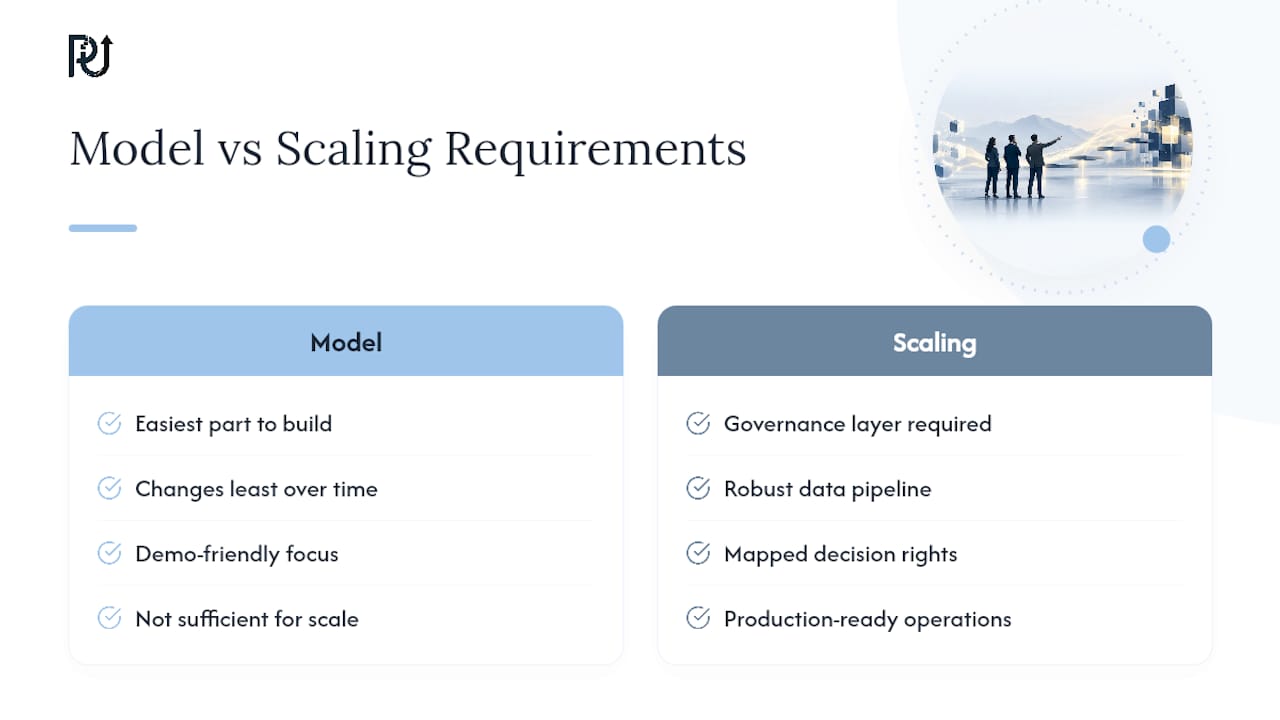
POW IT UP builds this way because the alternative doesn’t survive contact with real transaction volume. As a premier AI Integration & Automation Firm, the company functions as strategic technical architects, not script writers, designing digital workforces meant to run production traffic, not a controlled demo environment. That means automating high-volume transactional operations and hunting down the operational time leaks that quietly eat margin long before anyone notices them on a dashboard.
The signal to watch for when picking a partner isn’t how advanced their demo looks. It’s whether they can explain, in plain language, who approves an exception, how they validate agent output over time, and what happens when the data feeding the system breaks. If a vendor can’t answer that in the first meeting, they haven’t built anything that scales past a pilot.
— Syed Naveed Abbas
How DocuPOW and Custom AI Agents Fit Your Rollout
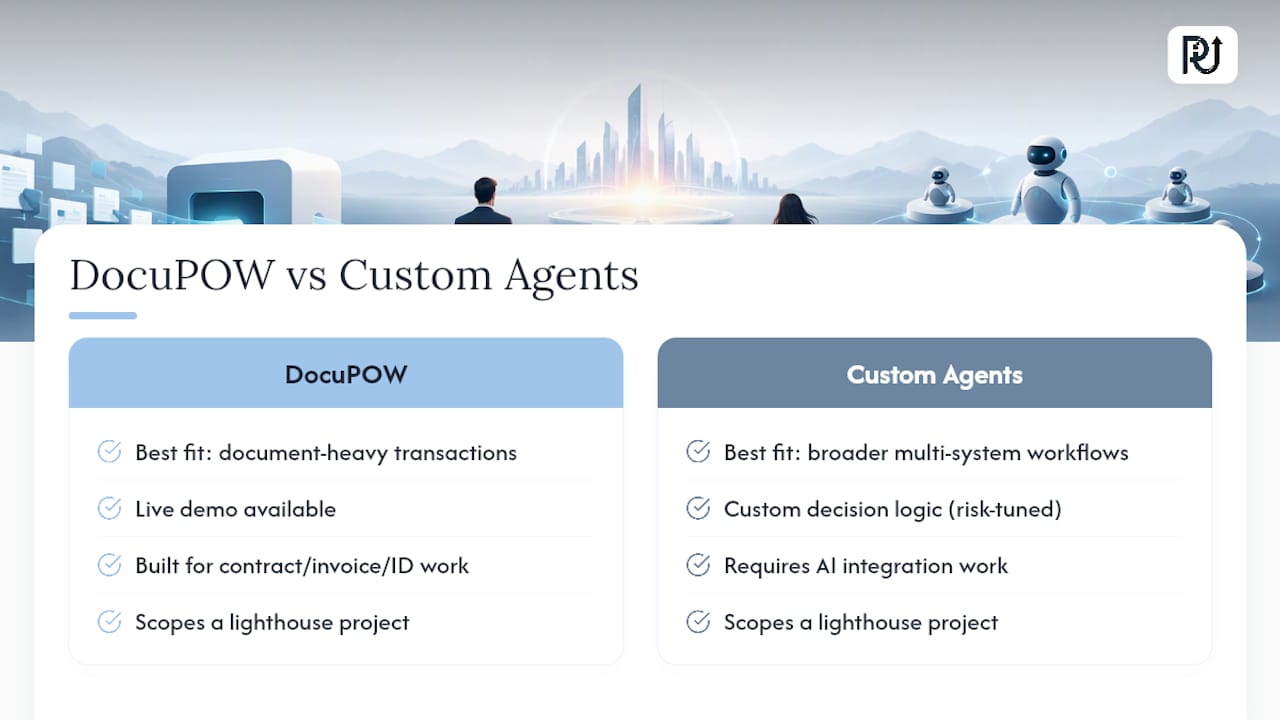
Here’s the practical split. If your bottleneck is document-heavy transactional work, reading contracts, validating invoices, checking IDs against records, DocuPOW is built for exactly that job and comes with a live demo so you can see it handle real documents before committing to anything. If your workflow is broader than document processing, spans multiple systems, or needs custom decision logic mapped to your own risk tolerance, that calls for custom AI agent development and AI integration work built around your specific transaction chain.
Either path starts the same way: a discovery session that maps your highest-volume workflow, scopes a lighthouse project with measurable KPIs from day one, and hands over a system your own team can maintain, not one that locks you into permanent vendor dependency. Request a scoped discovery call and see what a lighthouse project would look like for your operation before you commit to a full build.
Essential Reading and Standards for Governance and Design
Leaders building an intelligent scaling framework need more than vendor claims to anchor decisions. The NIST AI Risk Management Framework sets out inventorying practices, documentation standards, and monitoring requirements that hold up regardless of which agentic platform you choose. McKinsey’s work on the agentic organization lays out the operating model shift toward agent factories and mesh architecture, while its decision-rights research gives the clearest public framing of when autonomy is appropriate. MIT Sloan’s work on task chaining and workflow redesign rounds out the picture on where the real throughput gains come from. Leadership teams building an AI council should also look at how partners like Latitude Park frame strategic alignment between AI initiatives and business objectives, since governance structure often fails not from bad policy but from unclear ownership.
Sources
- When can AI make good decisions? The rise of AI corporate citizens
- Artificial Intelligence Risk Management Framework: Generative Artificial Intelligence profile (NIST)
- How AI is reshaping workflows and redefining jobs (MIT Sloan)
FAQ
What Is an Intelligent Scaling Framework?
It’s the combination of governance, architecture, and measurement practices that lets autonomous AI agents handle high-volume transactional work reliably. It covers people, data, technology, and KPIs together, not just the AI models themselves.
How Many Agents Can a Small Team Manage?
McKinsey’s research found agent factories commonly run with a small number of human supervisors per many AI agents. The ratio depends on how much monitoring and escalation logic is built into the architecture itself.
How Do You Decide Which Tasks Agents Handle Alone?
Score each decision point on risk and complexity. Low-risk, routine tasks like status checks or document verification suit full autonomy, while high-judgment or exception cases should stay in a copilot model with human review.
Does POW IT UP Offer a Ready-Made Solution or Custom Builds?
Both. DocuPOW handles document-centric transaction automation out of the box with a live demo available, while custom AI agent development covers workflows that need bespoke logic across multiple systems. Pricing for custom engagements is scoped per project and available on request.
What’s the Biggest Mistake Companies Make When Scaling AI Agents?
Skipping the data and governance work to jump straight to building agents. MIT Sloan research found that most implementation effort belongs in data engineering and workflow integration, not model selection, and teams that skip that step usually rebuild everything within a year.