
Scalable AI infrastructure, in practice, means the orchestration layer, data foundation, and governance controls that let autonomous agents handle rising transaction volume without hiring more people to babysit them. Three things determine whether that scales or collapses: a unified data foundation agents can trust, orchestration that’s auditable end to end, and governance built in from day one, not bolted on after an incident. Some firms build this kind of application layer directly, and their document-intelligence products can be working examples of the pattern rather than just slides about it.
TL;DR:
- Building a scalable AI infrastructure relies on a unified data foundation, end-to-end auditable orchestration, and built-in governance, not just increased models or compute power.
- The recommended orchestration pattern depends on failure response needs: event-driven for quick error detection or supervisor/coordinator for traceability, with tenant-aware memory essential for high-volume systems.
- Governance controls such as detailed audit trails, role-based access, circuit breakers, and distributed tracing are mandatory to meet compliance and prevent project stalls; trust gaps are the primary obstacle for 70% of organizations.
- Moving from pilot to full deployment requires initial read-only validation, incremental write access, and thorough testing, with most failures happening during these transitional stages.
- Cost control depends on measuring end-to-end resolution costs, monitoring data drift, and matching compute resources precisely to task complexity, with autoscaling policies triggered by queue depth and latency.
Table of Contents
- What Makes AI Infrastructure Actually Scalable?
- What Governance Controls Do Compliance Teams Require?
- How Do You Move an Agent Pilot to Production?
- What Should You Measure to Control AI Costs at Scale?
- How Should You Allocate Compute and Autoscaling Policies?
- What Security Practices Protect Data in Scalable AI Systems?
- How Do You Design Data Pipelines for Scalable AI Applications?
- How Do You Integrate Agents With Legacy Enterprise Systems?
- How Do You Monitor AI Systems for Performance and Data Drift?
- POW IT UP’s Approach to Building Scalable AI Infrastructure
- Ready to Build Your Scalable Agent Workforce?
- Sources
- FAQ
What Makes AI Infrastructure Actually Scalable?
Scalable AI infrastructure isn’t a bigger model or more compute. It’s the plumbing around the model: the pipes that route work, the memory that keeps context, and the guardrails that stop a bad decision from cascading. Get that plumbing wrong and adding agents just multiplies your failure modes.
Four orchestration patterns cover most production cases, and all trades control for flexibility differently. A supervisor/coordinator pattern puts one agent in charge of delegating tasks to specialist sub-agents, which is easiest to audit but creates a bottleneck at scale. Hierarchical orchestration nests supervisors inside supervisors, useful when workflows split into genuinely independent sub-processes. Event-driven orchestration reacts to triggers rather than a fixed sequence, which fits variable transaction volume better than anything rigid. Blackboard or shared-memory patterns let multiple agents read and write to common state, powerful for collaborative reasoning but harder to debug when something goes wrong.
Whatever pattern you pick, agents need a shared context layer: tenant-aware memory that keeps one client’s data from leaking into another’s session, persistent state so a workflow survives a restart, and retrieval fast enough that an agent isn’t waiting seconds for context it needs in milliseconds. AWS’s prescriptive guidance for agentic systems recommends event-driven orchestration paired with tenant-aware state stores, using services like Amazon EventBridge to route triggers and DynamoDB to hold state, precisely because this combination scales without turning into a tangle of point-to-point integrations.
Orchestration itself has to handle task decomposition, deterministic control flow where it matters, idempotency so a retried action doesn’t double a payment, and checkpoints so a failed run resumes instead of restarting from zero. On the deployment side, the baseline now is containers and Kubernetes, with blue-green or canary releases and real CI/CD pipelines for agent behavior, not just application code.
- Supervisor/coordinator: best for auditability, weakest at high concurrency
- Event-driven: best for variable, high-volume transaction flows
- Shared-memory: best for collaborative reasoning, hardest to debug
- Containerized deployment on Kubernetes: the baseline for portability and resilience
Pro Tip: Pick your orchestration pattern based on your failure mode, not your org chart. If a bad decision needs to be caught in seconds, event-driven wins. If a bad decision needs to be traceable to one accountable step, supervisor/coordinator wins.
What Governance Controls Do Compliance Teams Require?
Governance is the difference between a demo and something legal will actually let near customer data pass. Skip it and you don’t get a faster launch, you get a slower one, because compliance stalls the project until someone builds the controls anyway.
Four things need to exist before an agent touches production data:
- Audit trails that log intent, not just output — the model’s reasoning context, every tool call it made, and the final action, tied together with a correlation ID so a single transaction can be reconstructed end to end, weeks later, for an auditor.
- Role-based access control scoped per agent — each agent gets its own identity and the narrowest permission set it needs, not a shared service account with broad access.
- Circuit breakers and budget thresholds — automated halts when a dependency fails, a cost ceiling is crossed, or an agent enters a loop, plus discovery/dry-run modes that let an agent propose actions before it’s trusted to execute them.
- Distributed tracing feeding real dashboards — OpenTelemetry-style traces that turn every run into data for continuous evaluation, not just a log file nobody reads until something breaks.
NIST’s Cybersecurity Framework 2.0 treats auditable decision paths and RBAC as baseline requirements for enterprise AI systems, not optional hardening. That framing matters because 70% of organizations struggling to scale agentic AI cite trust and governance gaps as the primary obstacle, according to Forbes Business Council research, which also found Gartner projects that a significant share of agentic AI projects will be canceled in the coming years without these fixes in place.
How Do You Move an Agent Pilot to Production?
Most agent programs die between pilot and platform, not at launch. The sequence that survives is pilot, stabilize, standardize, then scale, and skipping a stage is the most common way teams end up rebuilding from scratch six months in.
The pilot phase should run agents in a read-only discovery mode first: let them plan and propose actions while a human validates every tool call before anything executes for real. That single step catches most design flaws before they touch a live system. Once an agent proves reliable in discovery, write access gets granted incrementally, staging stays strictly separate from production, and every agent ships with a kill switch a human can hit without waiting for an engineer.
Stabilizing means treating agent behavior like code: version your prompts, run golden-workflow tests against known-good outcomes, and run adversarial tests designed to break the agent on purpose. Failed runs need to be replayable, so a bad output can be reproduced and fixed rather than shrugged off as a fluke.
- Discovery: read-only, human validates every proposed action
- Pilot: limited write access, staging environment, kill switch live
- Standardize: golden-workflow and adversarial tests in CI/CD
- Scale: on-call ownership assigned, cost and quality reviewed on a fixed cycle
Standardizing turns a working pilot into a repeatable platform pattern other teams can reuse, and scaling means someone owns the agent’s on-call rotation and revisits cost and quality on a recurring cycle, not just at launch. Research on agentic rollouts backs this sequencing directly: most organizations are still piloting or expanding departmentally, and the recommended path is incremental deployment as a bridge to full process redesign, not a single big-bang launch.
Pro Tip: Treat the discovery phase as non-negotiable even when leadership wants to move faster. A week of read-only validation is cheaper than the week you’ll spend explaining an autonomous write error to a customer.
What Should You Measure to Control AI Costs at Scale?
The metric that matters most is cost-per-resolution: what it costs, end to end, to close one transaction or ticket through automation, including every escalation back to a human. If that number doesn’t beat the fully-loaded cost of a human doing the same task, scaling the agent just scales the loss.
Three supporting metrics round out the picture: autonomy rate (the share of cases an agent closes without human intervention), decision quality score (how often the agent’s output holds up on review), and token efficiency ratio (useful output per unit of model spend). Watch all three together, because a high autonomy rate paired with low decision quality just means more mistakes going unreviewed.
- Cascading API calls — one agent decision triggering three downstream calls nobody budgeted for.
- Context-window inflation — feeding an agent more history than a task needs, which quietly multiplies token cost.
- Orchestration overhead — the coordination layer itself consuming more compute than the task it’s coordinating.
- Integration maintenance — every connector added is another thing that breaks when an upstream system changes its API.
Right-sizing models to the task, semantic caching for repeated queries, routing simple requests to cheaper models, and prompt compression are the practical levers that keep these costs in check. As a budgeting heuristic, expect every dollar of inference spend to require another one to two dollars in platform, staffing, and monitoring costs. Any total-cost-of-ownership estimate that leaves those out isn’t a real estimate.
How Should You Allocate Compute and Autoscaling Policies?
Resource management for agentic workflows isn’t about buying more capacity. It’s about matching the right compute tier to each task and letting autoscaling handle the swings, rather than provisioning for peak load year-round.
Not every agent task needs the same horsepower. A document classification step and a multi-step reasoning task have wildly different compute profiles, and routing both through the same allocation wastes money on the simple case and starves the complex one. Tiered allocation, where lightweight tasks route to smaller, faster resources and complex reasoning gets the heavier tier, keeps spend proportional to actual need.
Autoscaling policies need triggers tied to queue depth and latency, not just raw CPU or memory, since agentic workloads spike in bursts tied to transaction volume rather than steady traffic. A document-processing pipeline that gets flooded at month-end needs to scale out fast and back down just as fast, or the idle capacity between spikes eats the savings autoscaling was supposed to deliver.
Kubernetes handles most of this natively through horizontal pod autoscaling, and it’s the deployment baseline production-grade agentic systems are built on for exactly this reason: portability across environments, resilience when a node fails, and autoscaling that responds to real signals instead of static thresholds. Build in headroom for retry storms too. An agent that hits a failing dependency and retries aggressively can spike resource use in a way a normal application never would, and your autoscaling policy needs a ceiling that catches that before it becomes a bill.
What Security Practices Protect Data in Scalable AI Systems?
Security in agentic systems has a wrinkle most application security playbooks miss: the agent itself is a new attack surface, not just the data it touches. An agent with broad tool access is effectively a service account with judgment, and judgment can be manipulated.
Data privacy starts with strict tenant isolation. Multi-tenant agent systems need their memory and context stores partitioned so thoroughly that one client’s documents can never surface in another client’s session, even through an indirect retrieval path. This is where the RBAC and per-agent identity model covered earlier does double duty: the same scoping that limits what an agent can do also limits what data it can see.
Secure model deployment means treating prompts and tool definitions as attack surface. Prompt injection, where malicious content embedded in a document or email tries to hijack an agent’s instructions, is a real risk for any system that processes external input, which describes most document-intelligence and workflow-automation deployments. Sanitizing inputs before they reach the model, and constraining what tools an agent can call regardless of what it’s told, closes most of that gap.
Encryption in transit and at rest is table stakes, but the more common failure is logging too much. Audit trails that capture full document content in plaintext logs create a second, less-guarded copy of sensitive data. Log the metadata and decision path; don’t duplicate the sensitive payload unless a specific compliance requirement demands it.
How Do You Design Data Pipelines for Scalable AI Applications?
A scalable agent is only as good as the data feeding it, and most scaling failures trace back to a fractured data foundation rather than a weak model. Forbes Business Council research found 72% of organizations struggling to scale agentic AI point to a lack of a unified data foundation as the root cause, ahead of governance and integration issues.
Ingestion needs to handle both structured feeds and unstructured input, documents, emails, scanned forms, at whatever volume the business actually generates, not the volume it generated during the pilot. Preprocessing is where most of the real engineering work happens: normalizing formats, extracting structured fields from unstructured text, and flagging low-confidence extractions for human review rather than letting them flow downstream silently.

A feature store or equivalent shared reference layer keeps agents working from the same source of truth instead of each pulling its own inconsistent snapshot of customer or transaction data. Without it, two agents can make contradictory decisions from the same underlying event, and nobody notices until a customer complains.
The pipeline also needs a clear boundary between raw and validated data. An agent acting on unvalidated extraction results is a liability. DocuPOW’s approach to document reading and validation reflects this directly: extraction paired with a validation layer before the data reaches a downstream decision, rather than trusting raw model output as ground truth.
How Do You Integrate Agents With Legacy Enterprise Systems?
Legacy integration is where scalable AI infrastructure projects quietly stall. The orchestration layer might be elegant, but if it can’t talk to the 15-year-old ERP system that actually holds the customer records, none of it matters.
Building a custom integration for every legacy system a business runs on is slow. Practitioner guidance on production agent deployment puts the timeline at two to four weeks per custom integration when built from scratch, and that cost compounds fast across a business running a dozen disconnected systems. Pre-built connectors and integration platforms cut that timeline substantially, which is why the build-versus-buy decision on integration tooling deserves as much scrutiny as the agent architecture itself.
The Model Context Protocol has become a practical answer to part of this problem. MCP standardizes how an agent discovers and calls external tools and data sources, which means a new legacy system integration doesn’t require rewriting the agent’s core logic, just adding a new MCP-compatible connector. That separation between agent reasoning and tool access is one of the clearer architectural wins to come out of recent agentic system design.
Integration cost and complexity is not a minor factor here. It’s the third-most-cited reason agentic projects stall, at 67% according to the same Forbes Business Council findings, which puts it right behind data foundation and governance issues. A manufacturing deployment using deterministic agentic scheduling shows the pattern in practice: orchestration wrapped tightly around existing production systems rather than replacing them outright, which is usually the more realistic path for any business with real infrastructure already in place.
How Do You Monitor AI Systems for Performance and Data Drift?
Monitoring an agentic system is different from monitoring a normal application because the thing you’re watching for isn’t just uptime, it’s whether the agent’s judgment is still good. A system can be perfectly available and still be quietly making worse decisions than it did last month.
Data drift is the core risk here. If the documents, transaction patterns, or customer inputs an agent sees start shifting away from what it was validated against, decision quality degrades gradually, often invisibly, until someone notices a spike in escalations or complaints. Tracking distribution shifts in input data, not just output accuracy, catches this earlier.

Traces and decision logs aren’t just for audits. One practical insight from enterprise-scale agent deployments is that observability data should be built into orchestration from the start, because those same traces double as regression tests for every future change to the system. That reframes monitoring from a compliance cost into a feedback loop that actually makes the system better over time.
Alerting thresholds need to be tied to the KPIs already covered: a drop in decision quality score, a spike in autonomy rate paired with a spike in escalations (a contradiction worth investigating immediately), or a jump in cost-per-resolution that signals a cascading API problem rather than a genuine volume increase. Dashboards built around correlation IDs let a team trace a quality drop back to a specific model version, prompt change, or upstream data shift within minutes instead of days.
POW IT UP’s Approach to Building Scalable AI Infrastructure
Most of what breaks agentic projects isn’t the model, it’s the absence of a data foundation and governance built in from day one. That’s the gap POW IT UP’s AI Agents Development work is built to close: custom, context-aware agents engineered with audit trails and RBAC from the start, not retrofitted after a compliance review flags them.
A typical engagement runs discovery in read-only mode first, moves into a scoped pilot, then scales with AgentOps and governance already baked into the platform, not layered on top of it later. DocuPOW is the clearest proof point: a production document-intelligence system built on exactly this discipline.
— Syed Naveed Abbas
Ready to Build Your Scalable Agent Workforce?
An alternative to hiring your way through rising transaction volume is to use custom-built agents engineered with audit trails, RBAC, and rollout discipline, from teams that create governance-first products instead of only recommending ideas to clients.
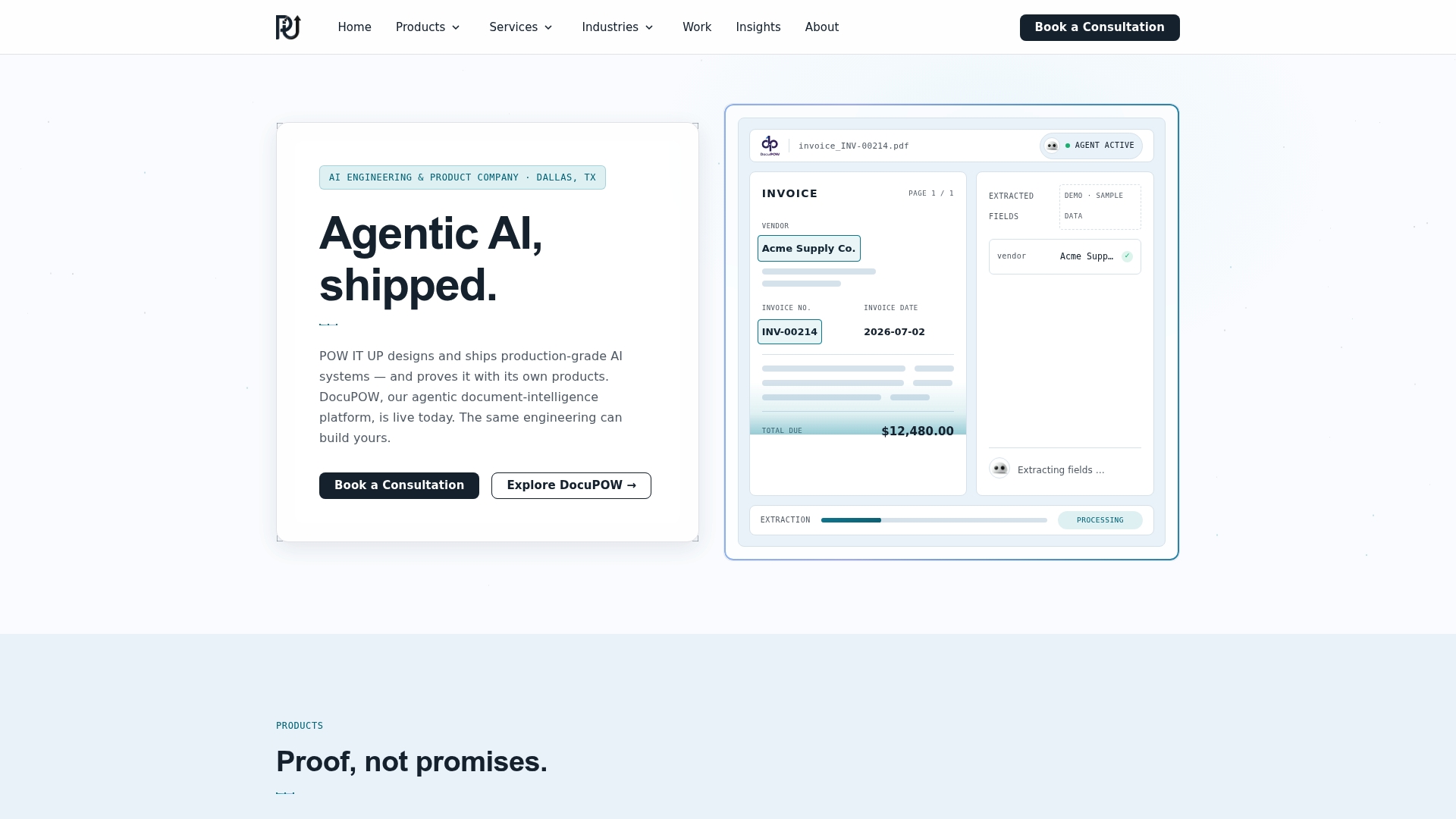
An initial engagement typically starts with a discovery phase focused on your highest-volume, most repetitive workflow, whether that’s document validation, transaction processing, or client health monitoring, and maps where an agent can safely take over versus where a human stays in the loop. From there, AI Integration work connects agents to the enterprise systems you already run on, and AI Automation covers the ongoing orchestration and monitoring once agents go live. If document processing is your bottleneck, DocuPOW is worth a live look on its own. Request a demo to see how a discovery-phase pilot would map onto your actual workflow.
Sources
- Why 40% Of Agentic AI Projects Will Fail (Forbes Business Council)
- Operationalizing agentic AI — AWS prescriptive guidance (PDF)
- Engineering
FAQ
What Is Scalable AI Infrastructure?
Scalable AI infrastructure is the orchestration, data, and governance layer that lets autonomous agents handle growing transaction volume without proportional headcount increases. It covers agent design patterns, shared data foundations, audit trails, and deployment tooling like Kubernetes rather than the underlying model itself.
How Long Does It Take to Scale From Pilot to Platform?
There’s no fixed timeline, but the sequence matters more than speed: discovery, pilot, standardize, then scale. Rushing past the discovery or stabilization stage is the most common reason agent programs stall or get rebuilt, according to research on enterprise agent rollouts.
What Does DocuPOW Do?
DocuPOW is POW IT UP’s document-intelligence product for reading and validating high-volume documents. It pairs automated extraction with a validation layer so downstream agents and workflows act on verified data rather than raw model output.
Why Do Most Agentic AI Projects Fail to Scale?
The leading causes are architectural and organizational, not technical: 72% of struggling organizations point to a lack of a unified data foundation, 70% cite governance gaps, and 67% cite integration cost. Gartner projects roughly 40% of agentic AI projects will be canceled by the end of 2027 without fixes to these issues.
What Is the Model Context Protocol?
The Model Context Protocol (MCP) is a standard that lets AI agents discover and call external tools and data sources without custom integration code for each one. It separates an agent’s reasoning logic from the specifics of each connected system, which speeds up legacy system integration significantly.