
AI-first means AI operates as a core capability embedded in how work gets designed, not a tool bolted onto existing processes. The single most important move for leaders right now: pick one to three high-impact, outcome-driven workflows and redesign them from scratch around what AI can do, rather than automating the steps you already have. Everything else, from data governance to organizational structure to build-versus-buy decisions, follows from that first redesign.
TL;DR:
- Most AI investments have failed to deliver transformational results because organizations automate existing workflows instead of redesigning them around AI capabilities.
- Building trust in data, creating flexible agentic workflows, and establishing an adaptable technology stack are essential for scaling AI pilots into production.
- Successful AI-first transformation requires cross-functional teams focused on outcomes, clear governance with designated accountability, and parallel reskilling efforts.
- Prioritization of AI use cases should be based on impact, feasibility, and risk, with a focus on tasks that can be automated with minimal regulatory or reputational exposure.
- Leaders must own the outcome-driven redesign and avoid delegating organizational restructuring, as waiting for the perfect moment delays key competitive advantages.
Table of Contents
- What Does AI-First Mean, and How Is It Different From Automation?
- What Should Leaders Invest In: Data, Agentic Workflows, and Infrastructure?
- How Should You Organize Teams and Governance for AI-First Operations?
- How Do You Decide Which AI Use Cases to Pursue First?
- Should You Build, Buy, or Partner for AI Integration?
- What Metrics Prove an AI-First Strategy Is Working?
- What Are the Biggest Risks in AI-First Transformation?
- How POW IT UP Approaches AI-First Transformation
- Why Leaders Can’t Afford to Wait on This
- Ready to Move From Pilot to Production?
- Sources
- FAQ
What Does AI-First Mean, and How Is It Different From Automation?
Automation speeds up an existing process. AI-first business strategy starts by throwing that process out and asking what outcome you actually need, then letting AI determine how to get there. That distinction sounds academic until you look at the numbers: organizations poured more than $250 billion into AI globally in 2025, yet only about a quarter report transformative impact. Most of that spending automated old workflows instead of rebuilding them.
Two principles separate real AI-first companies from automation projects:
- Zero-based, outcome-first design. Define the result you need, then let the process adapt as AI capability improves, an approach Roland Berger argues can unlock tenfold efficiency gains in reimagined workflows.
- Human-AI teaming, where judgment-heavy decisions stay human and repeatable execution shifts to AI agents.
Structural redesign, not tool selection, is what unlocks the value.
What Should Leaders Invest In: Data, Agentic Workflows, and Infrastructure?
Three technical foundations determine whether a pilot ever reaches production. Skip any one of them and you get a demo that never scales.
- Data you can trust. Clean, accessible, well-governed data is the prerequisite HBS Online lists first for a reason: agents built on bad data make bad decisions faster than humans did.
- Agentic workflows as the execution layer. These are the intelligence engines that actually do the work, drawing structured decisions from your data rather than surfacing another dashboard for a human to interpret.
- An adaptive technology stack. Infrastructure that can swap models and integrate new capabilities without a rebuild, following the production-readiness practices AWS outlines for enterprise AI deployment.
Pro Tip: Before funding a new AI pilot, audit whether your data even supports the outcome you want. Most stalled projects fail on data access, not model quality.
How Should You Organize Teams and Governance for AI-First Operations?
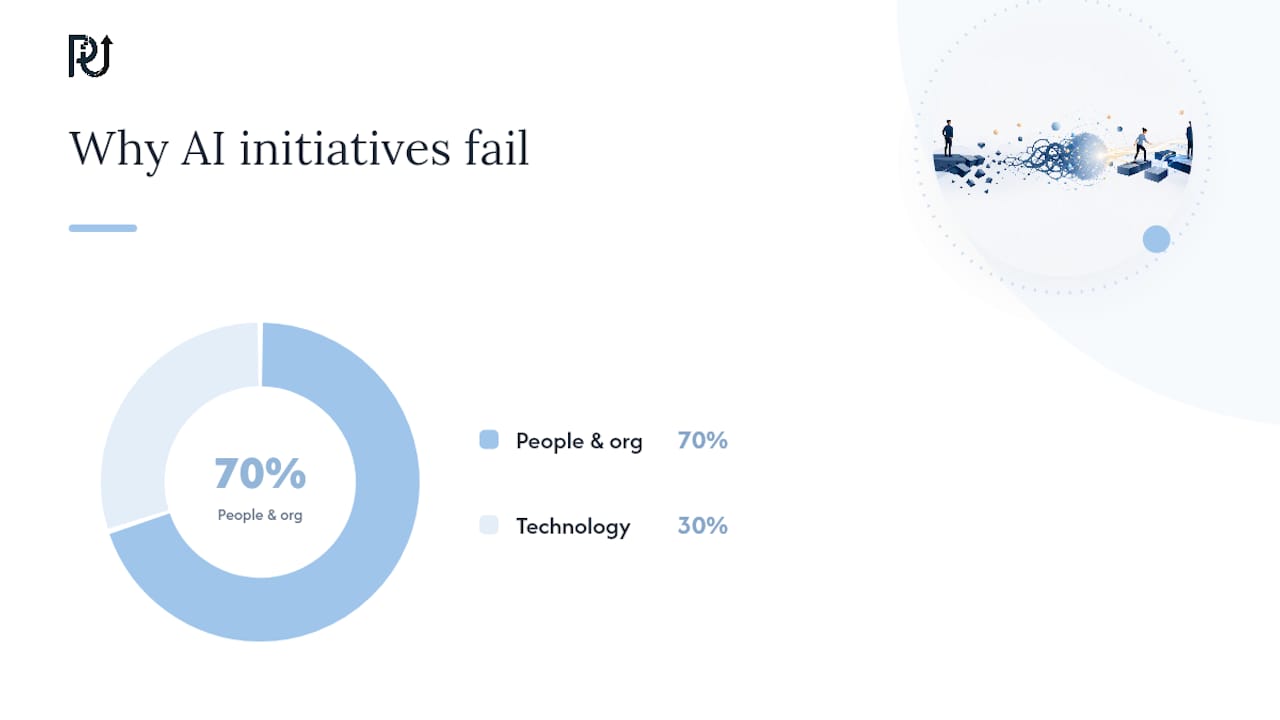
AI-first transformation is roughly 30% technology and 70% people and organizational redesign, which is why most failed initiatives are structural failures wearing a technical costume.
Build cross-functional teams organized around value streams, not departments. A claims-processing team should include claims staff, data engineers, and an AI specialist working the same outcome, not three separate departments handing off a ticket.
Governance needs named owners:
- A Chief AI Officer or equivalent accountable for the AI portfolio and its risk profile.
- An AI transformation office coordinating pilots so they don’t duplicate effort across business units.
- A center of excellence that sets standards for model evaluation, data access, and ethics oversight.
Reskilling has to run parallel to all of it. Set an AI fluency target for every function touching a redesigned workflow, and treat resistance to change as a governance problem, not a training gap you can patch later.
How Do You Decide Which AI Use Cases to Pursue First?
BCG frames the prioritization question with brutal simplicity: can AI do this as well or better, and should AI do it? The second question matters more than most leaders assume. Plenty of tasks AI can technically perform still carry judgment, brand risk, or regulatory exposure that argues for keeping a human in the loop.
- List candidate workflows tied to a measurable business outcome, not a department wish list.
- Score each on impact. Revenue effect, cost reduction, or customer experience lift.
- Score feasibility. Data readiness, task structure, and how well-defined the decision logic is.
- Score risk. Regulatory exposure, reputational stakes, and how reversible a mistake would be.
- Sequence by combined score, starting with high impact, high feasibility, low risk.
Document processing, transaction reconciliation, and portfolio monitoring routinely score well on all three axes. Judgment calls involving client relationships or novel legal questions usually don’t, at least not yet.
Should You Build, Buy, or Partner for AI Integration?
Three factors decide this: whether the workflow touches proprietary data or IP you need to protect, how fast you need results, and how much ongoing control you want over the system.
Building in-house makes sense when the workflow is a genuine differentiator. Buying makes sense for commodity functions where a vendor has already solved the problem cheaper than you can. Most companies land on a hybrid: pilot with an integration partner to prove value fast, then bring core capabilities in-house as internal expertise matures.
Whichever path you choose, hold vendors and partners to the same checklist:
- Clear data ownership and access controls
- Documented integration points with existing systems
- Explicit SLAs on uptime and support
- Security and compliance certifications relevant to your industry
Pro Tip: Ask any AI vendor exactly how their engine handles a model swap. Vendor lock-in shows up fastest when you try to upgrade, not when you sign the contract. Infrastructure resources like Opsphere’s engine compatibility guidance are worth reviewing before you commit to a single-model architecture.
What Metrics Prove an AI-First Strategy Is Working?
Track outcomes across seven categories, not just accuracy scores:
- Adoption rate. The percentage of eligible users or workflows actually running through the new system.
- Model-task fit. Whether the AI’s error rate on this specific task is acceptable, not whether it’s impressive in general.
- Cycle time. How much faster the outcome now happens end to end.
- Cost per transaction. The real driver of scalable margin.
- Error and exception rate. How often a human still has to intervene.
- Customer experience impact. Satisfaction or retention shifts tied directly to the redesigned workflow.
- Revenue or top-line effect. The hardest to measure and the one that ultimately justifies the investment.
HBS Online recommends targeting roughly 75 to 80% adoption for initial use cases before declaring a pilot successful.
Scaling from pilot to enterprise means turning one-off builds into reusable platform components, handing governance from the pilot team to the center of excellence, and tracking ROI against the baseline you measured before redesign, not against vague expectations.
What Are the Biggest Risks in AI-First Transformation?
The most common failure is the pilot trap: dozens of proof-of-concepts running in parallel, none reaching production because nobody built the operational muscle to deploy at scale. IBM’s implementation guidance points to the fix directly: assemble cross-functional teams and establish continuous improvement processes before you scale, not after.
Bias, privacy exposure, and regulatory risk are the other recurring traps, especially in workflows touching customer data or financial decisions.
Practical mitigations:
- Stand up a production-focused team before your first pilot leaves the lab.
- Write clear, shared data definitions so different teams aren’t measuring the same outcome differently.
- Keep a human-in-the-loop checkpoint on any decision with legal or reputational weight.
How POW IT UP Approaches AI-First Transformation
An AI integration and business automation firm designs and deploys autonomous, context-aware agents rather than scripting one-off integrations. Products for document reading and validation and for monitoring portfolio health and client analytics are built to hunt down operational time leaks that keep transformation projects stuck in pilot mode.
That work is grounded in principles this guide covers directly:
- Outcome-first redesign over automating legacy steps
- Production-ready agentic workflows, not proof-of-concept demos
- Governance and data controls built in from the first pilot
Business leaders evaluating an AI integration strategy benefit from working with partners experienced in solving the production-readiness problems many in-house teams encounter.
Why Leaders Can’t Afford to Wait on This
It’s a leadership problem: too many executives approved pilots and delegated the hard organizational redesign to someone else’s roadmap. Pick your one to three workflows, redesign them around outcomes, and own the governance decisions yourself. Waiting for a “safer” moment just hands the advantage to whoever moves first.
— Syed Naveed Abbas
Ready to Move From Pilot to Production?
Redesigning a workflow around AI is straightforward to describe and genuinely hard to execute without a team that has done the production-readiness work before. Custom agents, data pipelines, and integration layers can turn a prioritized use case into a system running in production, handling document intelligence, transaction processing, and portfolio monitoring while aiming to scale efficiently.
If you’ve already identified a candidate workflow from the prioritization framework above, the next step is a conversation, not another internal committee. Visit the AI integration services page to see how such engagements can be scoped, or request demos of relevant automation tools to see agentic automation running against a real workflow before you commit budget.
Sources
FAQ
What Is an AI-First Strategy?
An AI-first business strategy embeds AI as a core operating capability that shapes how work is designed, rather than layering automation on top of existing processes. Leaders define the outcome first and let AI determine the execution path.
Which Jobs Are Most Likely to Survive AI?
Roles centered on judgment under uncertainty, high-stakes relationship management, and novel problem-solving tend to remain human-led longest, since these carry regulatory, reputational, or ethical weight that argues for keeping a person accountable. Specific job survival lists vary too much by industry to state as a fixed rule.
What Is the 30% Rule in AI Transformation?
Industry analysis from BCG frames AI-first transformation as roughly 30% technology and 70% people and organizational redesign, meaning most of the hard work is structural, not technical.
What Adoption Rate Should a New AI Pilot Target?
HBS Online recommends targeting 75 to 80% adoption on an initial use case before scaling it further. Adoption is a better early success signal than raw model accuracy.
Does POW IT UP Help With AI-First Transformation Strategy?
Yes. POW IT UP designs and deploys custom AI agents and automation systems, including DocuPOW and AuraPOW, built specifically to move workflows from pilot to production without added headcount.