

Adopt AI as a growth engine, not a cost-cutting tool. Pick one revenue-focused use case, run a two-week discovery sprint, name an executive sponsor, and push your first production workflow live inside 90 days. Revenue-driven AI initiatives typically show measurable payback in 18 to 36 months, though a well-scoped pilot can produce visible wins in 30 to 90 days.
Three moves matter more than any framework:
-
Choose one high-impact revenue use case (not five).
-
Run a focused two-week discovery to map your actual workflow, not your assumed one.
-
Assign a single executive sponsor who owns the outcome, not just the budget.
Pro Tip: Resist the urge to pilot in a low-stakes corner of the business “just to test the technology.” Pilots that don’t touch revenue rarely earn the internal attention needed to scale past the demo stage.
Key Takeaways
Growth-oriented AI adoption succeeds when leaders start with one revenue use case, run real discovery, and measure outcome metrics, not just usage.
| Point | Details |
|---|---|
| Lead with revenue, not efficiency | Frame the first use case around pipeline or conversion impact, not cost reduction. |
| Discovery comes before building | Spend two weeks auditing the real workflow before writing a single line of agent logic. |
| Match the technology to the need | Choose copilots for speed, custom agents for control, based on your data readiness. |
| Govern lightly but explicitly | Name an executive sponsor, day-to-day owner, and function champions before deployment. |
| Track adoption and outcomes separately | Weekly usage checks plus quarterly ROI reviews keep the program honest. |
| Bring in an implementation partner | POW IT UP designs and deploys the custom agent workflows behind a growth-first rollout. |
Table of Contents
-
Where AI Adoption for Growth-Oriented Companies Stands Today
-
Which Growth-Focused AI Use Cases Should Companies Prioritize?
-
What Are the Real Risks in AI Adoption, and How Do You Manage Them?
-
What Does AI Adoption Actually Cost, Including the Hidden Parts?
-
Why Data Strategy Determines Whether Growth Use Cases Succeed
Where AI Adoption for Growth-Oriented Companies Stands Today
Adoption is uneven, and that unevenness is the story. Large enterprises have moved first and moved fastest, while mid-market and smaller firms are still deciding where to start. MIT Sloan’s research on the who, what, and where of AI adoption in America finds usage concentrated among large companies and clustered in specific sectors like manufacturing and healthcare, with much thinner penetration elsewhere. The OECD’s cross-country review of AI adoption in firms confirms the same pattern globally and flags firm-level barriers, including skills gaps and data infrastructure, as the main reasons adoption stalls below the enterprise tier.
That concentration isn’t just a curiosity. It means the tooling, playbooks, and talent pool are maturing fastest around large-firm problems, so mid-market leaders often have to adapt rather than copy.
Two adoption patterns show up repeatedly across the research:
-
Efficiency-first firms report faster time-to-value but plateau quickly once the obvious automation is done.
-
Growth-first firms report slower initial wins but compounding revenue signals as agents touch more of the customer journey.
Statista’s industry and function breakdown shows adoption still skews toward back-office functions like IT and finance, leaving sales, marketing, and product development comparatively underdeveloped. That gap is exactly where growth-oriented companies have room to move first.
Which Growth-Focused AI Use Cases Should Companies Prioritize?
Not every use case pulls its weight equally. Rank these by revenue proximity and data readiness, not by novelty.
-
Autonomous account research and outbound. Agents that research prospects, draft personalized outreach, and route qualified leads to reps can compress a research task from hours to minutes. Minimum readiness: a clean CRM and a defined ideal customer profile. Early KPI: reply rate and meetings booked.
-
Personalized marketing at scale. AI-generated segmentation and messaging variants let a five-person marketing team run campaigns that used to require twenty. Readiness: consolidated customer data and consistent brand guidelines. Early KPI: conversion lift per segment.
-
AI-powered product features. Embedding recommendation or assistant features directly into your product turns AI into a retention and upsell lever, not just an internal tool. Readiness: product usage data and engineering capacity. Early KPI: feature adoption and expansion revenue.
-
Automated lead qualification and scoring. Agents that score inbound leads against historical close data free reps to focus on the deals most likely to close. Readiness: a few years of closed-won/closed-lost data. Early KPI: sales cycle length.
-
Dynamic pricing and recommendation engines. These require the most mature data infrastructure but produce direct, attributable revenue impact once tuned.
Pro Tip: Sequence by data richness, not ambition. Start with whichever function already has the cleanest historical data (usually sales or marketing) and let that early win fund the next, harder use case.
Bessemer’s Ascend case study shows what this looks like in practice: a COO built a growth engine from scratch by sequencing ICP research, messaging, and AI-operated outbound channels, lifting ARR significantly in several months without hiring a dedicated growth team.
What Does a 90-Day AI Rollout Actually Look Like?
Most AI initiatives fail before they launch, not after, because leaders skip the unglamorous discovery phase. Treetop’s 90-day rollout playbook identifies skipped discovery as the single most common failure cause, and the sequence below builds discovery in from day one.
-
Weeks 1 to 2, discovery. Document your operational ICP, audit the actual workflow (not the org chart version of it), and rank use cases by revenue proximity and data readiness.
-
Weeks 3 to 6, build. Design the agent workflows, assemble the knowledge base the agent will pull from, and build the integration hooks into your CRM or document systems.
-
Weeks 7 to 9, deploy. Train a small cohort of users, name function-level champions, and put a governance document in place before wider rollout.
-
Weeks 10 to 12 and beyond, optimize. Stand up usage dashboards, iterate on prompts and workflows, and retire anything that isn’t getting adopted.
Two failure patterns show up again and again:
-
Treating AI as a procurement decision (buy the tool, hope adoption follows) instead of a workflow redesign.
-
Automating a broken process, which just makes the broken process faster.
Google Cloud’s research on building an effective AI strategy found that 78% of organizations with a documented AI strategy report faster ROI on generative AI investments than those without one, which is a strong argument for writing the roadmap down before week one starts. POW IT UP’s own AI transformation strategies guide walks through a similar sequencing model for enterprise teams building this out internally.
Which Technology Model Fits Your Growth Use Case?
The right technology choice depends on how much control you need versus how fast you need to move, and Microsoft’s AI strategy framework is a useful starting decision tree.
-
Copilots (built into tools like Microsoft 365 or Salesforce) get you moving fastest with minimal setup, but you’re limited to what the vendor exposes.
-
Low-code agent platforms offer a middle ground: more customization than a copilot, less engineering overhead than a custom build.
-
Managed platform-as-a-service options suit teams that need domain-specific logic but don’t want to own infrastructure.
-
Custom-built agents give full control over logic, data handling, and integration depth, which matters most when the workflow is core to your competitive advantage.
Every model still needs the same underlying plumbing: clean CRM data, accessible document stores, and stable APIs. Security and cost review belong in the vendor decision from day one, not bolted on after a breach or a surprise invoice.
How Do You Govern AI Adoption Without Slowing It Down?
Ownership has to be explicit, or adoption drifts. Assign an executive sponsor who owns the growth outcome, a day-to-day operator who manages the workflows, and function-level champions who field questions from their teams.
-
Train by role, not by department blast email, and refresh training every quarter as workflows change.
-
Give champions early access and a direct line to the technical owner so small issues don’t calcify into “AI doesn’t work here.”
-
Set a lightweight governance policy covering output verification standards, an escalation path for errors, and clear usage boundaries.
Pro Tip: Write your governance document before deployment, not after the first mistake. A one-page policy beats a fifty-page one nobody reads.
How Do You Measure Whether AI Is Actually Driving Growth?
Two metric families matter here, and conflating them is a common reporting mistake. Adoption metrics tell you whether people are using the system: active users, workflow retention, and feature usage by function. Outcome metrics tell you whether it’s working: pipeline influenced, conversion rate lift, time-to-proposal, and incremental revenue attributable to the workflow.
-
Run weekly operational checks on adoption metrics to catch drop-off early.
-
Run a quarterly ROI review tied to outcome metrics, presented to the executive sponsor directly.
-
Set an early-win target of measurable pipeline or conversion movement within the first 90 days, even if full ROI takes longer.
HBR’s argument that companies should use AI to grow, not just cut costs hinges on this exact measurement gap: firms that only track efficiency metrics never build the case for expanding AI into revenue functions, because they’re not measuring revenue in the first place.
Who Is Actually Building These Systems?
POW IT UP operates as a strategic AI architecture firm, not a script-writing shop. The company designs and deploys autonomous, context-aware agents that handle high-volume transactional work, and its productized tools reflect that focus:
-
DocuPOW handles document reading and validation for teams drowning in manual paperwork review.
-
AuraPOW monitors portfolio health and client analytics for firms that need ongoing visibility, not a one-time dashboard.
-
Custom engagements cover bespoke digital workforce builds, cloud analytics, and maintainable automation systems designed to scale without adding headcount.
This article’s editorial perspective comes from Syed Naveed Abbas, whose view on growth-first adoption closes out the piece below.
What Are the Real Risks in AI Adoption, and How Do You Manage Them?
The biggest risk isn’t the technology failing. It’s the technology working on bad data or unclear authority and nobody catching it in time. Agents making autonomous decisions, whether qualifying a lead or approving a transaction, need explicit boundaries on what they can act on versus what they must escalate to a person.
Bias and data drift are the quieter risks. A lead-scoring model trained on last year’s closed deals can quietly encode outdated assumptions about who your best customers are, especially if your market shifted. Review model outputs against fresh outcomes on a set cadence, not just at launch.
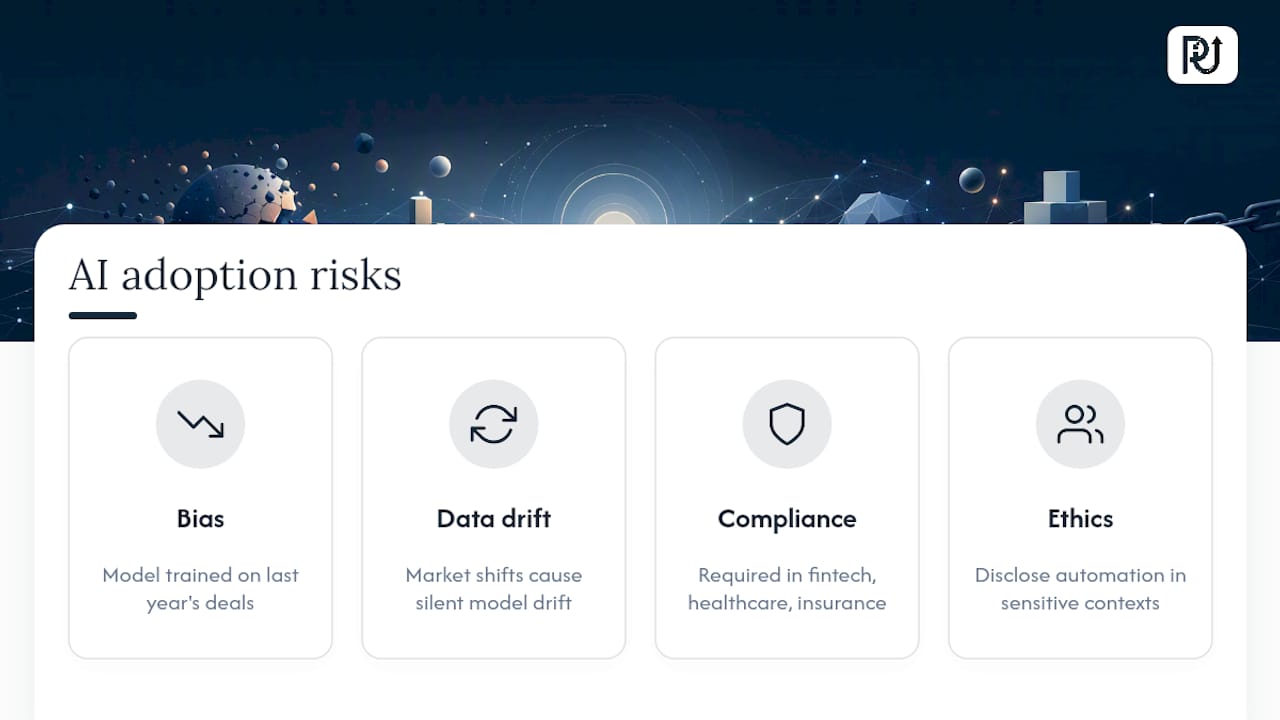
Compliance exposure grows with autonomy. A workflow that touches customer financial data, health information, or contractual terms needs a documented review trail, and in regulated industries like fintech, healthcare, or insurance, that trail is often a legal requirement, not a nice-to-have. Firms like Beyond Horizons Legal work specifically on governance and compliance advisory for AI projects, and bringing in that kind of review early is cheaper than retrofitting it after an incident.
Ethical considerations extend beyond compliance checkboxes. Customers increasingly notice when they’re interacting with an agent instead of a person, and undisclosed automation in sensitive contexts (credit decisions, healthcare triage, hiring) erodes trust faster than it builds efficiency. Build disclosure into the workflow design, not as an afterthought once legal asks about it.
Is Your Organization Actually Ready for AI Adoption?
Technology readiness gets all the attention. Cultural readiness decides whether the technology sticks. A team that’s spent years distrusting “the new system that never works” will route around an AI agent the same way they routed around the last three tools that overpromised.
Run an honest readiness check before committing budget. Ask whether frontline teams have been burned by past technology rollouts that were announced with fanfare and abandoned within a year. Ask whether managers reward speed and volume in ways that would make an AI-assisted shortcut look suspicious rather than smart. Ask whether your data owners will actually grant an agent access to the systems it needs, or whether turf and access politics will quietly stall the integration for months.
The strongest signal of organizational readiness isn’t enthusiasm from leadership. It’s whether a mid-level manager can name one specific task on their team that’s slow enough, repetitive enough, and well-documented enough to hand to an agent. If nobody in the room can answer that question specifically, you’re not ready to build yet, you’re ready to run discovery.

Smaller, growth-stage companies sometimes have an advantage here that enterprises don’t: fewer entrenched systems to fight, and often a founder or executive close enough to daily operations to spot the workflow worth automating first.
What Does AI Adoption Actually Cost, Including the Hidden Parts?
The sticker price of a platform license or a development engagement is the easy part to budget. The expensive surprises show up later.
Data cleanup is the most underestimated line item. If your CRM has years of duplicate records, inconsistent field naming, or missing values, an agent built on top of that mess will produce unreliable output, and the cleanup work needed to fix it often costs more than the AI build itself.
Integration work is the second hidden cost. Connecting an agent to your existing CRM, document stores, and internal APIs typically takes longer than the agent’s core logic, especially in older systems that were never designed with API access in mind.
Ongoing maintenance is the cost most budgets forget entirely. Prompts drift, business rules change, and workflows that worked perfectly at launch degrade quietly as your product, pricing, or customer base shifts. A living runbook for prompt and workflow versioning keeps that degradation from becoming invisible until a customer complains.
Training time is a real cost too, not a footnote. Budget actual hours for role-based training and champion enablement, not just a one-time kickoff webinar. A team that gets thirty minutes of training on a tool that changes how they work will underuse it for months.
Why Data Strategy Determines Whether Growth Use Cases Succeed
Every growth use case in this article assumes one thing: usable data. That assumption is where most projects quietly fall apart.
Clean, structured, accessible data isn’t a nice-to-have for revenue-focused AI, it’s the actual prerequisite. A lead-scoring agent trained on a CRM with inconsistent stage definitions will produce scores nobody trusts. A personalization engine fed fragmented customer records across three disconnected systems will personalize badly, which is worse than not personalizing at all.
Start with an honest data audit before choosing a use case, not after. Map what data you actually have, where it lives, how current it is, and who owns updating it. Prioritize use cases where your data is already strongest, even if a different use case sounds more exciting on paper.
Integration matters as much as quality. An agent that can’t reach your CRM, your document store, or your billing system in real time will always be working from a stale snapshot, and stale data in a fast-moving sales or marketing context produces decisions that were right last week and wrong today.
A Growth-First Perspective on AI Adoption
Most companies treat AI governance as a brake on speed. It is the opposite: a clear governance line is what lets you move into revenue-facing workflows with confidence instead of caution. Start small, prove it on one use case like the Ascend team did before scaling their growth engine, and let the win argue for the next investment.
— Syed Naveed Abbas
From Roadmap to Rollout: Building With POW IT UP
A 90-day playbook only works if someone builds it correctly the first time. POW IT UP is the team that turns the roadmap in this article into a live production system, not another slide deck that stalls after the kickoff call. Instead of assembling a patchwork of copilots and low-code tools yourself, you get architects who design the agent workflows, wire the integrations into your CRM and document systems, and stay accountable for the outcome, not just the handoff.
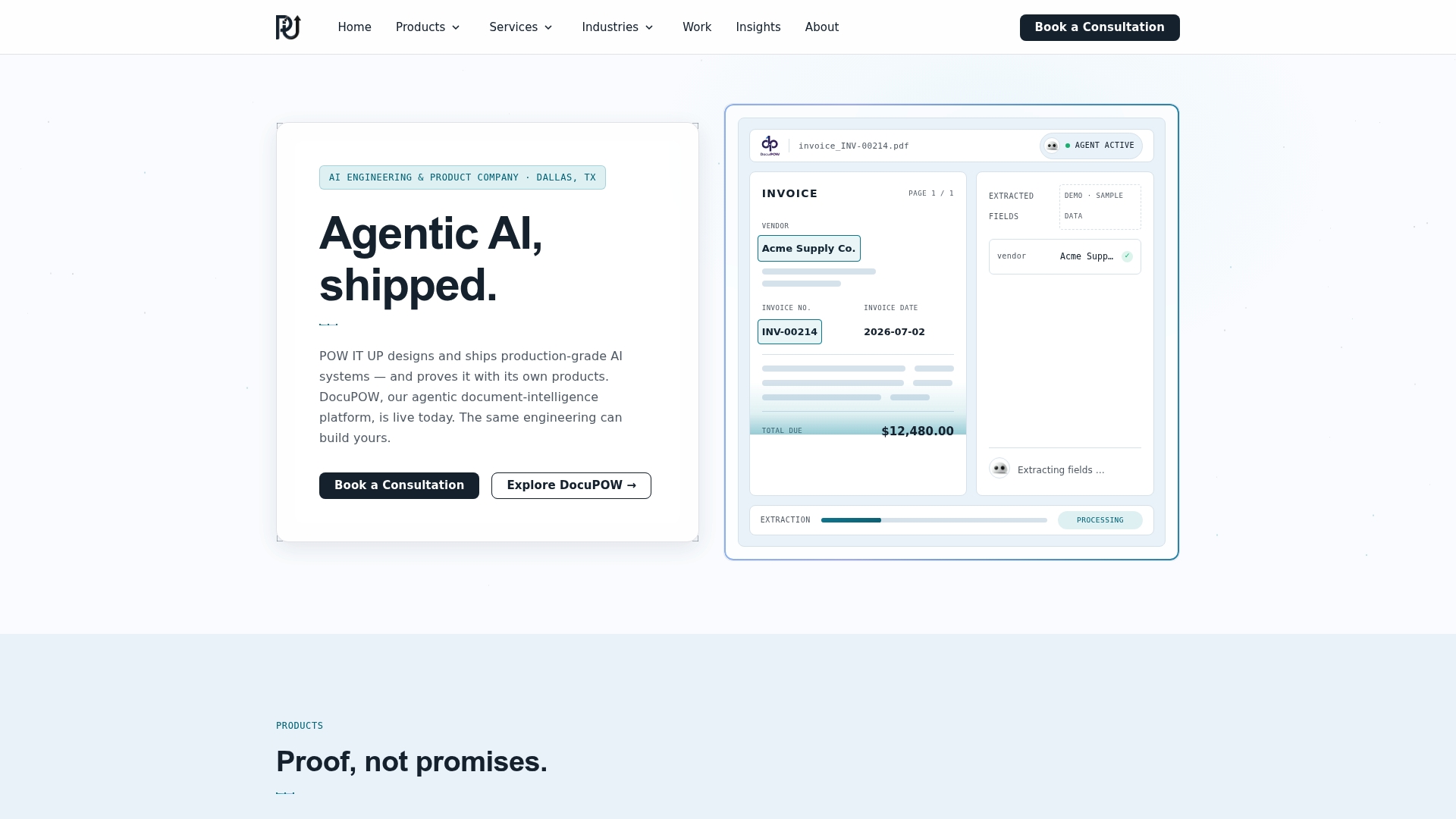
That distinction matters most in the build phase, where most in-house attempts lose months to integration work nobody budgeted for. POW IT UP’s AI integration service is built specifically for that gap: enterprise-grade connections between your existing systems and the autonomous agents doing the work. If you’re further along and evaluating custom agent development for a specific revenue workflow, the AI agent development team can scope that build directly. Book a consultation to map your first 90-day use case before your next budget cycle locks in.
Sources
-
Building a growth engine from zero: How one COO boosted ARR 38% without a growth team
-
Companies Are Using AI for Efficiency. They Should Use It to Grow.
FAQ
Which Companies Are Currently Adopting AI?
Adoption skews heavily toward large enterprises in manufacturing, healthcare, and finance, according to MIT Sloan’s research, while mid-market and smaller firms lag behind, especially outside back-office functions.
Which Jobs Are Least Likely to Survive AI Automation?
Roles built entirely around repetitive, rules-based tasks, such as basic data entry, manual document processing, and routine transaction matching, face the highest displacement risk since these are exactly the functions AI agents automate first.
What Is the 30% Rule in AI?
Definitions of this vary across sources, and the research behind this article doesn’t establish one canonical version, so treat any specific “30% rule” claim with caution unless a primary source defines it for your context.
Which Jobs Are Most Likely to Survive AI?
Roles centered on judgment, relationship management, and complex problem-solving tend to be more resilient, including strategic sales leadership, clinical decision-making, skilled trades, and roles like AI implementation architects who design and oversee the systems replacing routine work.
How Long Does It Take to See ROI From AI Adoption?
Revenue-focused AI use cases typically show measurable financial return in 18 to 36 months, though a well-scoped pilot can produce visible early wins, like pipeline or conversion movement, within 30 to 90 days.