

The fastest, most reliable path to scaling businesses with AI is not the biggest model or the longest tool list. It’s picking a focused portfolio of 5 to 7 high-impact, low-effort use cases tied to real business outcomes, then backing them with a production-grade platform and governance that doesn’t buckle under load. Google Cloud calls this shift moving from “random acts of experimentation” to a cultivated bouquet of prioritized use cases, and it’s the difference between a pilot that dies quietly and one that becomes infrastructure.
Here’s the 3 to 6 month sprint that gets you there:
- Month 1: Pick one pilot from your shortlist and lock down data access before writing a line of automation logic.
- Month 2: Stand up an observability baseline (accuracy, latency, drift) and name a product owner.
- Months 3 to 4: Run the pilot against pre-set success criteria with a small cross-functional team.
- Months 5 to 6: Hit your decision gate. Either scale the winner into production or kill it and reallocate.
Deployments built this way have produced a 14% lift in lead-to-opportunity conversion and a 14x increase in supply-chain vetting capacity after moving from pilot to production. That range gives you something concrete to benchmark against when your own numbers start coming in.
Key Takeaways
Scaling AI successfully depends on prioritizing a small portfolio of high-impact use cases, building production-grade infrastructure, and shifting human roles from doing tasks to training agents.
| Point | Details |
|---|---|
| Prioritize ruthlessly | Choose 5 to 7 use cases scored on impact, effort, data readiness, and KPI alignment. |
| Treat data as infrastructure | Fix fragmented data and build observability before scaling, not after a pilot fails. |
| Shift roles, not headcount | Move domain experts from executing tasks to training and supervising AI agents. |
| Gate every decision | Set numeric success criteria before each pilot, and enforce a real stop/scale decision. |
| Partner for production readiness | POW IT UP builds custom AI agents and MLOps discipline so pilots become reliable operating systems. |
Table of Contents
- Why Do Most AI Scaling Efforts Stall?
- What Is the Step-by-Step Roadmap for Scaling AI?
- Who Needs to Own What as AI Scales?
- What Technical Foundation Do You Actually Need?
- How Do You Measure Whether AI Is Actually Working?
- Which Use Cases Should You Start With?
- Ready to Move From Pilot to Production?
- Sources
- FAQ
Why Do Most AI Scaling Efforts Stall?
Most AI initiatives don’t fail because the model is bad. They fail because leadership treated a data and infrastructure problem like a plug-and-play software rollout. MIT Sloan’s research on scaling generative AI points to fear of missing out as the root cause behind a lot of failed pilots: teams launch fast, skip the data foundation, and then wonder why nothing reaches production.
The blockers tend to cluster into three groups.
- Operational: Fragmented data across systems, no MLOps discipline, and a pile of one-off scripts nobody wants to maintain.
- Organizational: FOMO-driven pilots with no clear owner, a missing product mindset, and a skills gap between people who can train an AI agent and people who can only operate one.
- Business: Use cases picked for novelty instead of ROI, no metrics defined before launch, and automation that never gets wired into actual workflows.
Pro Tip: Treat data-access friction as a ranking signal, not a roadblock. If a use case requires wrangling five disconnected systems to get clean data, that’s real information about implementation cost. Use it to rank your shortlist, not to talk yourself out of the whole effort.
What Is the Step-by-Step Roadmap for Scaling AI?
Scaling isn’t one leap from pilot to enterprise. It’s a sequence of gated decisions, each with its own metrics and its own point where you either double down or walk away.
- Prioritize by four factors. Score each candidate use case on impact, implementation effort, data readiness, and alignment with a core KPI. A use case that scores high on impact but low on data readiness should drop below one that scores moderately on both.
- Write a pilot hypothesis before you build anything. State what you expect the AI agent to do, what “success” looks like numerically, and what “fail” looks like. Skipping this step is the single most common reason pilots run for months with no clear verdict.
- Build the minimal viable integration. Resist the urge to connect every system on day one. Wire in only what’s needed to test the hypothesis.
- Set your first decision gate. At the end of the pilot, you need a number, not a vibe. Did lead qualification accuracy hit your target? Did document processing time drop by a measurable margin? If yes, move to productize. If not, iterate once, then stop.
- Productize the winner. This means moving from a script-and-prayer setup to something with monitoring, error handling, and a defined owner. This is also where technical debt either gets paid down or gets baked in permanently.
- Ramp infrastructure for scale. Add CI/CD for model updates, automated retraining triggers, and monitoring dashboards that flag drift before it becomes a customer-facing problem.
- Expand to the next use case in your portfolio. Repeat the cycle, but faster, because your platform and your team have already done this once.
Each of those gates needs both a hard number and a qualitative check. A pilot that hits its accuracy target but requires constant manual override isn’t ready to scale; the metric is lying to you if you don’t watch the operational reality behind it.
On resourcing, expect the pilot phase to run lean: one product owner, one or two engineers, and part-time domain expertise from whoever owns the workflow being automated. Productization typically needs to add MLOps capacity and a dedicated support rotation. Full scale is where budget shifts from “project cost” to “operating line item,” and that’s the point at which finance should start treating AI infrastructure the way it treats any other core system.
The arXiv paper on scaling AI from up to down and out makes a case worth internalizing here: deploying distributed, task-specific agents across your organization is often more practical than betting everything on one giant model. It also cuts your compute footprint, which shows up directly in your infrastructure budget once you’re running dozens of automations instead of one.
Who Needs to Own What as AI Scales?
Scaling AI restructures who does what inside your company, and getting the operating model wrong undoes even a well-run pilot.
Five roles matter most at this stage:
- Product owner: Owns the business outcome and the go/no-go decision at each gate.
- AI architect: Designs how agents connect to your existing systems and data. POW IT UP’s take on why service businesses need AI architects covers this shift in more depth.
- MLOps engineer: Keeps models running reliably, watches for drift, and manages deployment pipelines.
- Data steward: Makes sure the data feeding your agents stays clean and accessible as volume grows.
- Domain trainer: The person who used to do the task manually and now refines the agent’s logic instead.
That last role is the one leaders underestimate most. Google Cloud’s research on enterprise AI scaling notes that the highest-leverage move is shifting people from doers to trainers of AI agents, not replacing them. Someone who spent three years manually reviewing loan applications knows exactly where an agent will get it wrong, and that judgment is worth more sitting inside the training loop than outside it.
Pro Tip: Upskill your domain experts into trainers first. Hire for MLOps and AI architecture second. Domain knowledge is harder to buy than engineering talent, and it compounds faster once it’s embedded in your agents.

Governance can’t be an afterthought bolted on after scale hits. Build in a model risk assessment before any agent touches customer data, a change control process for updates, and clear escalation triggers when an agent’s confidence score drops below a set threshold.
What Technical Foundation Do You Actually Need?
You don’t need a research lab. You need a handful of unglamorous engineering practices that keep production systems from quietly breaking.
The minimum viable stack: a unified data layer so agents aren’t querying five inconsistent sources, a model registry so you know exactly what version is running where, and observability covering latency, accuracy drift, and data drift simultaneously. Skip any one of these and you’re flying blind the moment something goes wrong at 2 a.m.
MLOps practices worth insisting on:
- Automated retraining pipelines triggered by drift, not by calendar reminders.
- Blue/green or canary deployment so a bad model update affects 5% of traffic, not 100%.
- A rollback procedure that takes minutes, not a weekend.
On cost, recent scaling-law research shows that efficiency gains in hardware and systems architecture matter as much as raw model size for sustaining progress at reasonable cost. In practice, that means favoring model distillation, quantization, and lightweight task-specific agents over reflexively deploying the largest model available for every job. Set SLAs for business-critical agents just as you would for any core system: uptime targets, maximum acceptable drift before retraining, and a defined response time for anomalies.
How Do You Measure Whether AI Is Actually Working?
Track two tiers of metrics: business outcomes and technical health. Business metrics come first, always. Revenue lift, lead-to-opportunity conversion, cost-per-transaction, and hours saved per week are what justify continued investment. Technical signals like model uptime and prediction drift matter, but only as leading indicators of whether the business numbers will hold up next quarter.

Budget tends to fall into three buckets: a lean pilot budget covering one small team and minimal infrastructure, a larger productization budget once MLOps and monitoring get added, and a scale budget where AI infrastructure becomes a standing line item rather than a project cost. Set your reporting cadence to match your decision gates, typically monthly during pilot and quarterly once in production, so leadership isn’t surprised by either a win or a stall.
Realistic impact ranges exist to calibrate expectations, not guarantee them. The 14% conversion lift and 14x vetting capacity increase reported after production-grade agentic deployment gives you a plausible ceiling to test your own results against, not a promise.
Which Use Cases Should You Start With?
Start where data is clean, the task is repetitive, and integration doesn’t require touching ten systems at once.
- Lead qualification and sales triage: High data availability, clear success metric, fast feedback loop.
- Document intake and validation: Repetitive, rules-heavy, and a strong fit for automation with immediate time savings.
- Client onboarding automation: Well-defined process with a clear before-and-after in cycle time.
- Supply-chain vendor vetting: Where 14x capacity increases have been reported in production deployments.
- Marketing asset generation and localization: Fast to test, low risk if the pilot underperforms.
Pick the one where you already have clean data and a frustrated team. That combination predicts pilot success better than any impact projection on a slide.
What We See Working Across Client Engagements
Across engagements, the pattern holds: a tight portfolio beats a scattershot pilot list every time, and teams that shift from doing the work to training the agent hit throughput gains faster than teams that just add headcount. Productized automation compounds. The second use case is always cheaper to launch than the first.
Ready to Move From Pilot to Production?
Most companies get stuck between “we ran a pilot” and “this actually runs our business.” POW IT UP closes that gap directly: instead of a generic automation script that breaks the moment your data changes, we design context-aware AI agents built for your actual workflows, from document intake to portfolio monitoring, and we build the MLOps discipline underneath them so they don’t fall apart at scale.
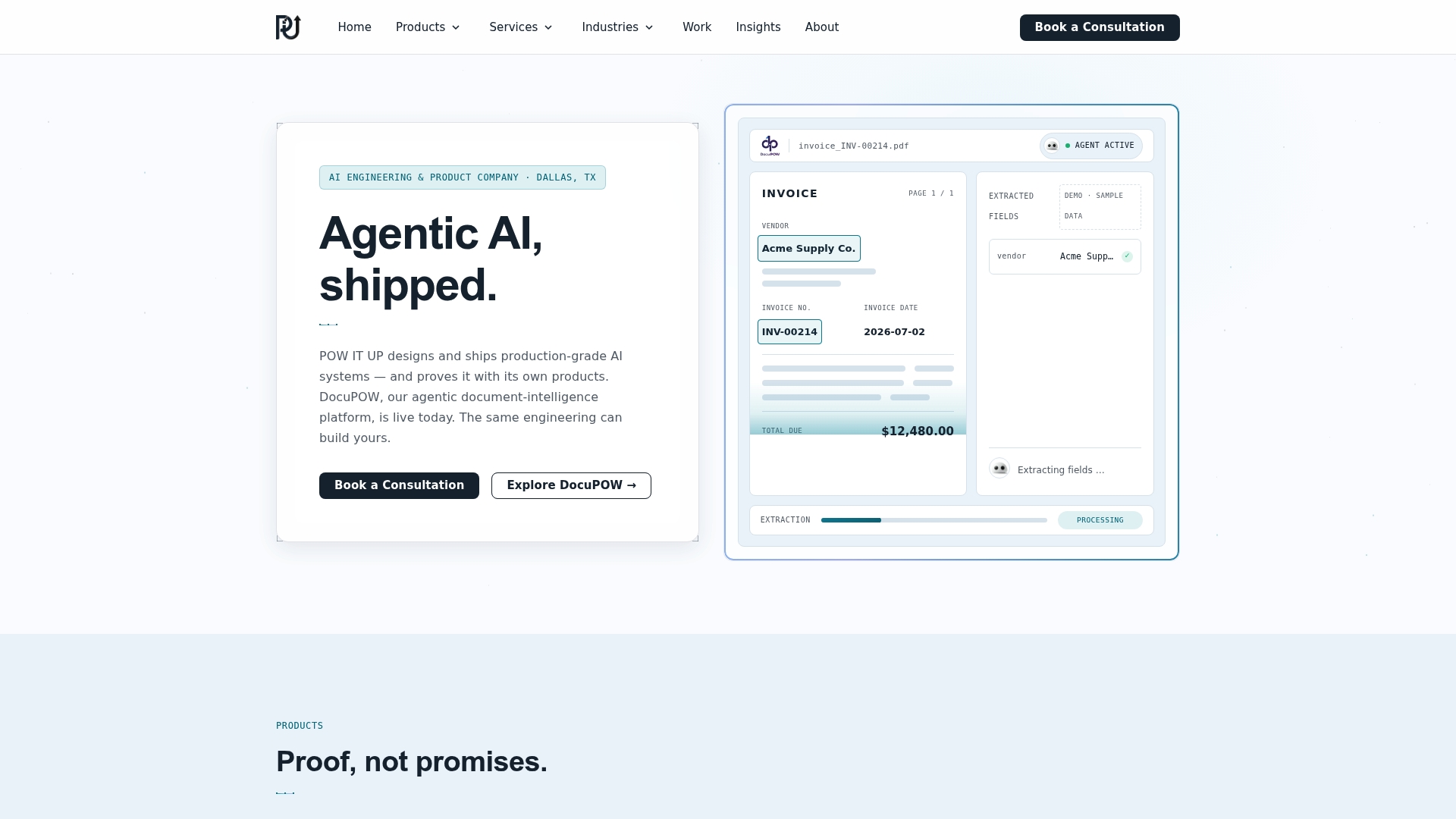
A first engagement typically starts with discovery: mapping your workflows, identifying your highest-probability use cases, and scoring them the way this playbook describes. From there, you get a prioritized shortlist, a pilot package with defined success criteria, and measurable KPIs baked in from day one, not bolted on after launch. Products like DocuPOW handle document reading and validation out of the box, while AuraPOW covers portfolio monitoring and client health analytics, giving you a productized starting point instead of a blank canvas. If you’re ready to see what a production-grade pilot looks like for your operation, request a consultation on AI integration and get a shortlist built around your actual data, not a generic template.
Sources
- Scaling AI from experimentation to enterprise reality | Google Cloud Blog
- Scaling AI to Deliver Tangible Business Outcomes | MIT Sloan
FAQ
What Is the 30% Rule in AI?
If you’ve seen the term used, it typically refers loosely to the idea of allocating around a third of project time to data preparation, though this varies widely by organization and use case.
How Can I Make $1,000 a Day Using AI?
There’s no reliable, verified method that guarantees a fixed daily income from AI tools. What does hold up is that businesses building AI-driven growth engines, like the case study showing 38% ARR growth in six months, can generate substantial revenue gains through sequenced automation rather than any single quick tactic.
What Is the 10/20/70 Rule for AI?
It’s a useful reminder that most AI scaling failures come from organizational gaps, not model quality.
What Does It Mean to Scale With AI?
Scaling businesses with AI means moving beyond isolated pilots to a portfolio of production-grade AI agents that handle real transactional volume, backed by data infrastructure, governance, and defined roles. It’s an operating-model shift, not just a technology purchase, and firms like POW IT UP specialize in building that infrastructure for enterprise and SMB operations alike.
How Do I Know When a Pilot Is Ready to Scale?
A pilot is ready when it hits its predefined numeric success criteria, such as accuracy or conversion targets, and requires minimal manual override to function reliably. If either condition isn’t met, iterate once before committing further budget.