

Future-proofing businesses means building the organizational capacity to absorb shocks, adapt faster than competitors, and sustain performance through conditions you cannot predict. That is enterprise resilience, and it is not a one-time project. Start this week with three priorities: assign a named owner to each resilience pillar (operations, people, technology), run a short dependency audit to find your single-source vulnerabilities, and pick one AI embed pilot with a measurable outcome. Then, over the next few months, work through this start list:
-
Days 1–30: Map your top five operational dependencies, document your current AI experiments versus embedded AI capabilities, and brief your executive team on the resilience lifecycle framework.
-
Days 31–60: Launch one AI pilot in a high-volume transactional process (document processing, claims, or order validation), assign scenario-planning owners, and run your first cross-functional risk workshop.
-
Days 61–90: Review pilot KPIs, update your risk register with new climate and geopolitical inputs, and schedule your first quarterly board-level resilience review.
Pro Tip: Don’t let the 90-day list become a parking lot. Assign each item a named owner and a due date before the week is out. A list without an owner is a wish.
Key Takeaways
Future-proofing businesses requires assigning named owners to resilience pillars, embedding AI into core processes beyond the pilot stage, and measuring progress with leading indicators reviewed regularly.
| Point | Details |
|---|---|
| Resilience is a lifecycle, not a project | Assign pillar owners and run a dependency audit this week to start the continuous cycle. |
| Embed AI, don’t just experiment | Move pilots to production within 90 days or redesign them; embedded AI compounds, experiments don’t. |
| Measure with leading indicators | Track dependency count, AI accuracy, and skill gap index monthly before problems escalate. |
| Both/and leadership is the discipline | Protect innovation budget as a fixed percentage of revenue even during cost-cutting cycles. |
| POW IT UP shortens time-to-production | Custom AI agents and modular automation systems move your resilience agenda from pilot to embedded capability. |
Table of Contents
-
What to do this month: your next steps and decision checklist
-
POW IT UP accelerates the technology side of your resilience agenda
What does future-proofing a business actually mean?
Future-proofing is often described as “preparing for change,” which is accurate but not sufficiently specific to act on. A sharper definition: it is the deliberate construction of adaptive business models and systems that maintain performance across a range of futures, not just the one you planned for. The industry term is enterprise resilience, and it spans dimensions including operational, financial, technological, people, and reputational. The NUS enterprise-resilience playbook frames this as a continuous lifecycle, not a periodic audit, requiring predictive analytics, scenario planning, and cross-functional ownership at every stage.
The urgency is real and recent. COVID-19 forced many companies to pivot their operating models rapidly. Supply chain shocks in 2021–2022 exposed how deeply single-source dependencies had been embedded in otherwise well-run organizations. Now AI is accelerating the pace of disruption further: AI and related tech sectors are among the fastest-growing in the economy, and the companies that treat AI as a platform capability rather than a side experiment are pulling ahead.
The risks of not acting are concrete:
-
Single-source dependencies in supply chains, technology vendors, or key personnel create catastrophic single points of failure.
-
Rigid operating models that cannot flex to new delivery channels or customer expectations lose market share to more adaptive competitors.
-
Siloed AI experiments that never embed into core processes produce cost without capability.
-
Reactive risk management that only activates after a crisis leaves organizations perpetually behind the curve.
-
Talent gaps in digital skills and change leadership slow every transformation initiative.
Long-term business sustainability requires treating these risks as operational inputs, not strategic footnotes.
The core pillars every future-proof organization builds
MIT CISR research identifies three leadership types and a modular architecture as the foundation of future-ready firms. Translated into an actionable framework, five pillars cover the full scope of what leaders need to build and maintain.
-
Leadership ambidexterity: The ability to run efficient core operations while simultaneously investing in new capabilities. Owner: CEO/COO. First deliverable: a written policy that explicitly protects innovation budget from being raided during cost-cutting cycles.
-
Continuous learning and people resilience: Embedding skill development into the rhythm of work, not just annual training events. Owner: CHRO. First deliverable: a role-rotation pilot for three high-potential managers within 60 days.
-
Technology transformation and modularity: Adopting modular, reusable system components (what MIT CISR calls “Lego” architectures) so that new capabilities can be added without rebuilding the entire stack. Owner: CTO/CIO. First deliverable: an audit of current systems to identify which are modular and which are monolithic.
-
Operational resilience: Mapping dependencies, stress-testing processes, and maintaining continuity plans that are actually tested, not just documented. Owner: COO. First deliverable: a single-source dependency map for your top three revenue-generating processes.
-
Ecosystem and partnerships: Building relationships with suppliers, regulators, research institutions, and even competitors that extend your sensing and response capacity beyond your own walls. Owner: Chief Strategy Officer or equivalent. First deliverable: a stakeholder map identifying three partnerships that could accelerate your resilience agenda.
HBR’s coverage of future-proofing makes the case that the most common failure mode is treating efficiency and innovation as a trade-off. The firms that sustain performance through uncertainty pursue both simultaneously. WBCSD’s transformation blueprint adds a governance layer: aligning purpose, management systems, and performance measurement so that sustainability and resilience are not separate programs but integrated into how the business is run.
Pro Tip: When your leadership team debates whether to cut innovation spending to protect margins, that is the exact moment the “both/and” discipline matters most. Build a standing rule: innovation investment is a fixed percentage of revenue, not a discretionary line item.
How to build your 30/90/365-day resilience roadmap
The table below maps the highest-leverage activities at each stage, with effort level and suggested owners. The goal is not to do everything at once but to sequence actions so that early investments unlock later ones.
| Timeframe | Activity | Effort | Owner |
|---|---|---|---|
| 30 days | Dependency audit: map top 5 operational single-source risks | Low | COO |
| 30 days | Assign resilience pillar owners and brief executive team | Low | CEO |
| 30 days | Identify one AI embed pilot with a measurable KPI | Low | CTO/CIO |
| 90 days | Launch AI pilot; document baseline and target metrics | Medium | CTO + Ops |
| 90 days | Run first cross-functional scenario-planning workshop | Medium | CSO/Risk Lead |
| 90 days | Publish updated risk register with climate and geopolitical inputs | Medium | Risk/Compliance |
| 90 days | Begin role-rotation pilot for 3 high-potential managers | Medium | CHRO |
| 365 days | Embed AI pilot into core process; retire manual workaround | High | CTO/COO |
| 365 days | Migrate at least one monolithic system to modular architecture | High | CTO |
| 365 days | Conduct annual resilience war-game with board participation | Medium | CEO/Board |
| 365 days | Publish first transparent resilience performance report | Medium | CFO/CSO |
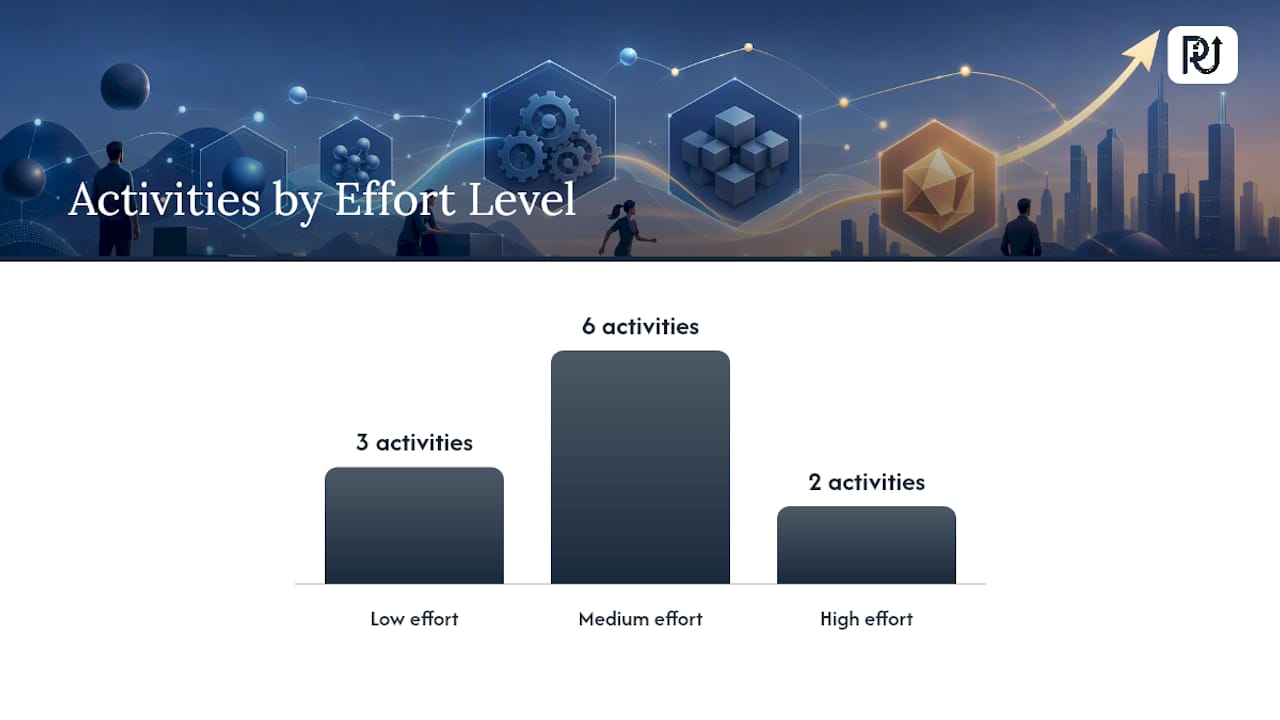
StartUs Insights identifies 12 data-driven strategies that leading companies are deploying, including agentic AI, digital twins, modular operating models, and platform ecosystems. The roadmap above is sequenced to build the organizational readiness those strategies require before you invest in them at scale.
Implementation checklist
Copy this into your project plan and assign owners before your next leadership meeting:
-
Name a resilience lead for each of the five pillars (leadership, learning, technology, operations, ecosystem).
-
Complete a dependency audit for your top three revenue processes.
-
Select one AI embed pilot: define the process, the baseline metric, and the target improvement.
-
Schedule a cross-functional scenario-planning workshop within 60 days.
-
Update your risk register to include AI disruption, climate risk, and geopolitical supply chain exposure.
-
Establish a quarterly board-level resilience review cadence.
-
Audit current systems for modularity; flag monolithic architectures for phased migration.
-
Align innovation budget protection into the annual planning cycle.
-
Brief your CHRO on the continuous learning agenda and agree on a role-rotation pilot.
-
Set a date for your first transparent resilience performance report.
Business in the Community’s seven-step toolkit adds a practical layer for non-technical resilience: embedding social and environmental risks into strategy, upskilling people for the transition economy, and co-creating plans with community stakeholders. These are not soft extras. For companies with significant physical operations or regulated supply chains, they are operational imperatives.
Cost vs. effort guidance: The 30-day items are almost entirely organizational (meetings, assignments, documentation) and cost little beyond leadership time. The 90-day items require modest project investment, primarily in facilitation and tooling. The 365-day items, particularly system migrations and AI embedding, carry real capital and change-management costs. Sequence them in that order and you will have the organizational readiness to execute the expensive items well.
How AI becomes a force multiplier, not just an experiment
The distinction between experimenting with AI and embedding AI is the single most important technology judgment a leadership team makes right now. Experiments produce learning. Embedded AI produces capability that compounds. MIT CISR’s research describes a four-stage adoption trajectory: experiment, pilot, ways of working, and embedded AI. Most organizations are stuck between stages one and two. The ones pulling ahead have crossed into stage four, where AI is woven into core processes and modular enough to be updated without rebuilding the surrounding system.
Starter projects with measurable outcomes:
-
Document intelligence: Automate the reading, validation, and routing of high-volume documents (contracts, invoices, insurance claims). KPI: processing time per document, error rate, and cost per transaction. For a sector-specific example of how this works in a regulated environment, see AI integration in core banking systems.
-
Transaction processing automation: Deploy AI agents to handle order validation, reconciliation, or claims adjudication at volume. KPI: throughput per FTE, exception rate, and cycle time.
-
CRM augmentation: Use AI to flag at-risk accounts, surface next-best actions, and automate follow-up sequences. KPI: pipeline velocity, churn rate, and rep time on high-value activities.
AI pilot governance checklist
Before you launch any pilot, confirm these guardrails are in place:
-
Data hygiene: Is the training and input data clean, labeled, and representative of production conditions?
-
Monitoring: Is there a dashboard tracking model accuracy, drift, and exception rates from day one?
-
Rollback plan: Can you revert to the manual process within 24 hours if the model underperforms?
-
Compliance review: Has legal/compliance signed off on data usage, privacy, and any sector-specific regulations?
-
Human-in-the-loop: For high-stakes decisions, is there a defined escalation path to a human reviewer?
Pro Tip: Scope your first AI pilot to a process that is high-volume, rule-bound, and currently handled manually. That combination gives you the fastest measurable ROI and the lowest risk of a compliance problem. Avoid starting with judgment-intensive or customer-facing processes until you have a track record.
How to measure resilience: KPIs, dashboards, and governance
You cannot manage what you do not measure, and resilience is no exception. The NUS enterprise-resilience playbook recommends moving from periodic risk reviews to continuous monitoring, with predictive indicators that give you early warning before a risk becomes a crisis.
Dashboard and governance cadence:
-
Weekly (operational): COO and CTO review AI pilot metrics, dependency flags, and any active incident signals. This is a 30-minute standing meeting, not a full review.
-
Monthly (executive): CEO, CFO, COO, and CHRO review the full KPI dashboard, update the risk register, and make resource allocation decisions on active resilience initiatives.
-
Quarterly (board): Present resilience performance against targets, review scenario plan updates, and approve any major architectural or investment decisions.
WBCSD’s performance measurement guidance recommends aligning these KPIs to your purpose and governance systems so that resilience performance is reported with the same rigor as financial performance. That alignment is what converts resilience from a risk function into a board-level strategic priority.
How to make your organization genuinely adaptive
Adaptive business models do not emerge from strategy decks. They come from organizations where learning is embedded in daily work, incentives reward experimentation, and structure allows teams to move without waiting for central approval.
Embedding continuous learning:
-
Introduce role rotations for high-potential managers across functions every 12–18 months. Cross-functional experience is the fastest way to build the organizational empathy that adaptive decision-making requires.
-
Replace annual training events with microtraining modules (15–30 minutes) tied to specific skill gaps identified in your quarterly skill gap index.
-
Pair each major initiative with a structured debrief (what worked, what did not, what we would do differently) that feeds into a shared knowledge base.
Incentive and hiring adjustments:
-
Add an “adaptation metric” to senior leader performance reviews: did they identify and act on a new risk or opportunity before it became urgent?
-
Hire for learning velocity, not just domain expertise. A candidate who has successfully navigated two major transitions in their career is often more valuable than a deep specialist who has not.
-
Protect psychological safety explicitly. Teams that fear being penalized for failed experiments stop experimenting. Make it a stated norm that well-designed experiments that fail are celebrated, not punished.
Training checklist for adaptive capability:
-
Scenario planning and pre-mortem facilitation (for strategy and risk teams)
-
AI literacy and prompt engineering basics (for all managers)
-
Agile project management fundamentals (for cross-functional team leads)
-
Data interpretation and dashboard reading (for all department heads)
-
Change leadership and stakeholder communication (for senior managers)
Org structure for agility: The most adaptive organizations use modular team structures, where small, cross-functional pods own specific outcomes and have the authority and budget to act. This mirrors the modular architecture principle in technology: reusable, reconfigurable, and fast to deploy. HBR’s both/and leadership framework applies here too. Efficiency and agility are not opposites. The best-run modular teams are both highly productive and highly adaptable.
Pro Tip: If your org chart has more than four layers between a frontline decision and executive approval, you have a structural resilience problem. Map the decision paths for your three most time-sensitive operational responses and redesign any that require more than two approvals.

Common traps that derail future-proofing efforts
Most future-proofing initiatives fail not because the strategy was wrong but because of predictable execution failures. Recognizing these red flags early lets you correct course before the investment is wasted.
-
Red flag: AI projects that never leave the pilot stage. Corrective action: Set a hard gate at 90 days. If a pilot cannot demonstrate a measurable improvement in its target KPI, either redesign it or kill it. Perpetual pilots are a budget drain and a morale problem.
-
Red flag: Resilience pillars with no named owner. Corrective action: Assign owners in your next leadership meeting. A pillar owned by “the team” is owned by no one. Name a person, give them a budget line, and put their name on the quarterly review.
-
Red flag: Overcentralized decision-making during a crisis. Corrective action: Pre-authorize decision rights for operational leaders before a crisis hits. Document who can approve what up to what threshold without escalation. Proton’s C-suite resilience guide recommends war-gaming these scenarios so that decision rights are tested, not just documented.
-
Red flag: Data governance treated as an IT problem. Corrective action: Appoint a business-side data steward for each major data domain. AI pilots fail most often because of data quality problems that no one in the business owned.
-
Red flag: Future-proofing as a separate program, not integrated into operations. Corrective action: Merge resilience KPIs into your existing management reporting. If resilience metrics live in a separate deck that only appears at the annual strategy review, they will never drive daily decisions.
-
Red flag: Innovation budget raided during downturns. Corrective action: Codify innovation spend as a fixed percentage of revenue in your financial planning policy. This is the single most common way organizations accidentally defund their own future-proofing.
When resources are constrained: Prioritize the dependency audit and AI pilot selection first. Both are low-cost, high-signal activities that give you the information you need to make every other investment decision more accurately.
What to do this month: your next steps and decision checklist
The goal for the next 30 days is not to complete the full resilience agenda. It is to get the right owners in place, the right information on the table, and one concrete pilot underway.
Prioritized action list for this month:
-
Assign named owners to all five resilience pillars and schedule a 60-minute kickoff with each.
-
Complete a dependency audit for your top three revenue processes and document the single-source risks.
-
Select and scope one AI embed pilot: define the process, baseline metric, target KPI, and governance guardrails.
-
Schedule your first cross-functional scenario-planning workshop within 45 days.
-
Brief your board on the resilience agenda and agree on a quarterly review cadence.
Decision checklist: pilot-ready, scale-ready, or defer?
Use this to quickly assess any initiative before committing resources:
-
Is the process high-volume and rule-bound? If yes, it is likely pilot-ready for AI automation.
-
Do we have clean, representative data for this process? If no, defer until data governance is addressed.
-
Has a previous pilot demonstrated measurable improvement? If yes, it is likely scale-ready.
-
Is there a named owner with budget authority? If no, defer until ownership is assigned.
-
Does the initiative align to a named resilience pillar? If no, question whether it belongs on the priority list at all.
Cascading priorities to functional owners: Once the executive team has agreed on the top three initiatives, each functional owner should translate them into 30-day deliverables for their teams. Use the KPI table from the measuring-resilience section as the shared scorecard. Review progress monthly at the executive level and quarterly at the board.
The part most leaders get wrong about enterprise resilience
Most organizations approach future-proofing the way they approach insurance: they buy it once, file it away, and hope they never need it. That is exactly backwards. The organizations that sustain performance through genuine disruption, not just favorable conditions, treat resilience as an operating state. They run efficiency and innovation simultaneously, not in alternating cycles. They embed AI into processes rather than running it as a perpetual experiment. They assign owners to risks before the risks materialize.
The hardest part is not the strategy. It is the discipline to keep investing in adaptive capability when the business is performing well and the pressure to cut “non-essential” programs is highest. Every leader I have observed who built a genuinely resilient organization made one consistent choice: they protected the learning and innovation agenda even when it was uncomfortable to do so.
If there is one thing to act on immediately, it is this: run a 30-minute dependency audit this week. Map your top five single-source risks across operations, technology, and people. That exercise alone will surface the two or three vulnerabilities that deserve your attention before anything else.
POW IT UP accelerates the technology side of your resilience agenda
The hardest part of embedding AI into core processes is not identifying the right use cases. It is the engineering work: building systems that are modular, maintainable, and production-ready rather than fragile prototypes that break under real operational load.
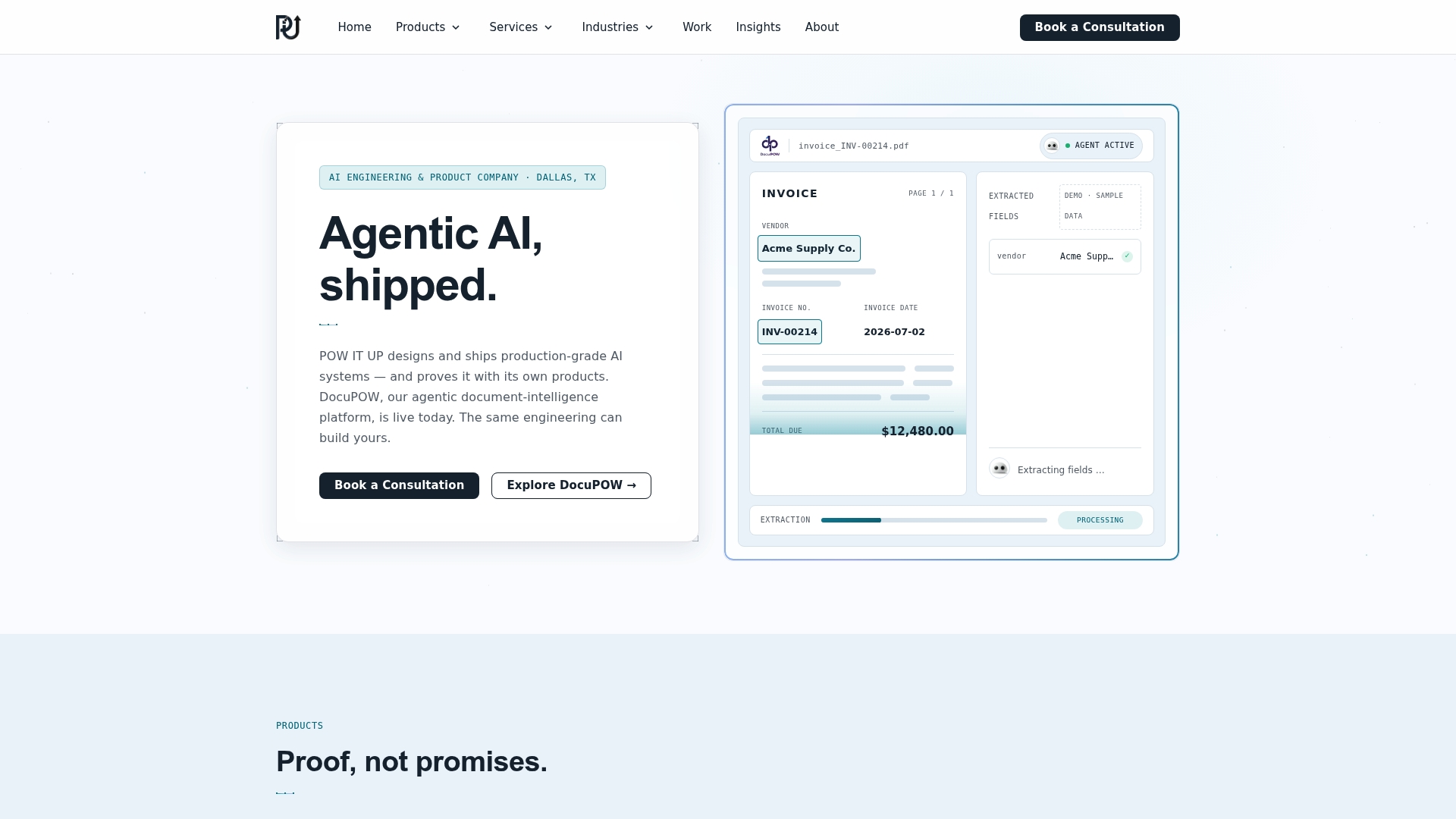
POW IT UP designs and deploys custom AI agents and automation systems built for exactly that transition. Rather than handing you a generic integration script, POW IT UP’s team functions as strategic technical architects: they map your highest-volume transactional processes, identify the “time leaks” costing you throughput, and build autonomous, context-aware systems that scale without a corresponding headcount increase. Products like DocuPOW handle document reading and validation at volume; AuraPOW monitors portfolio and client health in real time. Both are built on modular architectures that can be extended as your needs evolve.
When evaluating an AI integration partner, ask: Do they build for production or for demos? Do they provide governance documentation, monitoring dashboards, and rollback plans? Do they transfer knowledge to your team or create dependency? POW IT UP’s engagement model is built around maintainable systems and knowledge transfer, not lock-in.
Ready to move your AI agenda from experiment to embedded capability? Explore POW IT UP’s AI integration services or review the full AI integration service offering to book a discovery conversation.
Sources
-
How to lead future-ready organizations in times of uncertainty | MIT Sloan
-
CGS_ORMC_Enterprise-Resilience_A-Playbook-for-Organisations_2025.pdf
-
Future Proofing Business in 2026: 12 Strategies | StartUs Insights
-
Seven Steps for Futureproofing Business – Business in the Community
FAQ
What does it mean for a business to be future-proof?
A future-proof business has built the adaptive capacity to sustain performance through unpredictable disruptions, whether economic, technological, or environmental. It is characterized by modular systems, cross-functional resilience ownership, embedded AI capabilities, and a continuous learning culture rather than periodic crisis responses.
Which types of businesses are most resilient to future disruption?
Businesses with diversified revenue streams, modular technology architectures, and strong continuous-learning cultures tend to be most resilient. Industries with recurring demand and digital delivery models, such as healthcare technology, financial services, and logistics automation, show strong structural durability, though resilience ultimately depends on organizational practices more than sector alone.
What industries are considered future-proof?
No industry is immune, but sectors tied to essential services, digital infrastructure, and AI-driven productivity, including healthcare, cybersecurity, energy transition, and enterprise software, carry structural tailwinds. AI and related tech sectors are among the fastest-growing in the economy, making AI capability a cross-industry advantage rather than a sector-specific one.
How do you start future-proofing a business with limited resources?
Start with the two lowest-cost, highest-signal activities: a dependency audit (map your top five single-source operational risks) and the selection of one AI embed pilot in a high-volume, rule-bound process. Both require leadership time, not capital, and the information they produce guides every subsequent investment decision.
How does AI fit into a future-proofing strategy?
AI accelerates future-proofing when it is embedded into core processes rather than run as isolated experiments. The practical starting points are document intelligence, transaction processing automation, and CRM augmentation, each with measurable KPIs. POW IT UP’s AI integration services are designed specifically to move organizations from the pilot stage to production-ready embedded capability.