

Operational excellence is an organization-wide discipline that consistently delivers customer value by aligning strategy, processes, people, and technology. It is not a project with a finish line. It is a permanent operating mode where every team member understands how value flows to the customer and acts to protect or improve that flow every day. The frameworks most leaders associate with it, including the Shingo Institute’s cultural model, Juran’s quality trilogy, Lean, Six Sigma, and PDCA/Kaizen, are tools in service of that discipline, not the discipline itself.
If you are a leader starting today, four actions matter most:
- Diagnose your current state: map at least one critical value stream and establish a baseline for cycle time, defect rate, and cost-to-serve.
- Appoint a sponsor at the executive level who owns the OpEx program and has authority over resources and priorities.
- Select one pilot in a high-volume, data-rich process where improvement is measurable within 90 days.
- Define your measurement system before the pilot launches, not after. Agree on the two or three metrics that will determine whether you scale.
Start there. Everything else in this guide builds on those four moves.
Key Takeaways
Operational excellence is a permanent management discipline, not a project: it requires leadership commitment, baseline measurement, and a governance system that sustains gains after every pilot closes.
| Point | Details |
|---|---|
| Define OpEx as a system | OpEx is an ongoing discipline aligned to customer value, not a one-time improvement project. |
| Sequence before selecting tools | Map your value stream and establish a baseline before choosing any methodology or technology. |
| Use a two-track improvement model | Combine daily Kaizen with structured DMAIC/PDCA projects to sustain momentum and tackle complex problems. |
| Measure end-to-end, not local | Track value-stream metrics (cycle time, first-pass yield, cost-to-serve) rather than departmental scorecards. |
| POW IT UP for AI-enabled pilots | POW IT UP builds custom AI agents and automation systems tied to defined operational outcomes, starting with a scoping session. |
Table of Contents
- What are the core principles of operational excellence?
- Which frameworks and methodologies should you use?
- How do you implement operational excellence step by step?
- What tools and technology accelerate operational excellence?
- How do you measure operational excellence success?
- How does operational excellence look across different industries?
- What pitfalls cause operational excellence programs to fail?
- How do AI and automation fit into an operational excellence program?
- The mindshift most leaders miss
- POW IT UP accelerates your OpEx program with AI
- Sources
- FAQ
What are the core principles of operational excellence?
Operational excellence rests on five interlocking components. Weaken any one of them and the system degrades.
- Customer focus. Quality is defined by the customer, not by internal standards. Every process decision should trace back to a customer outcome: faster delivery, fewer errors, lower cost, or higher reliability. If a process step cannot be connected to a customer benefit, it is a candidate for elimination.
- Continuous improvement (CQI) and the PDCA loop. Continuous quality improvement is a disciplined, ongoing effort that uses the Plan-Do-Check-Act cycle to raise performance incrementally over time. Lean improves flow; Six Sigma reduces variation. Both are engines for CQI, and both require a functioning measurement system to work.
- Standardization and process discipline. Improvement only sticks when the new method becomes the standard method. Without documented standard work, gains erode within weeks as teams revert to familiar habits.
- Employee engagement and empowerment. The Shingo Model makes this explicit: respect every individual and lead with humility. Frontline workers hold the most detailed knowledge of where processes break down. An OpEx program that bypasses them is working with incomplete information.
- Data-driven decision making and strategic alignment. Decisions made on gut feel or anecdote are hard to defend and harder to replicate. OpEx programs that sustain gains track leading indicators, not just lagging results, and they connect operational metrics directly to strategic objectives.
Pro Tip: Map each of these five components to a specific, observable behavior in your organization. “We are customer-focused” is not a behavior. “Every process change is evaluated against its impact on customer lead time” is.
Which frameworks and methodologies should you use?
The honest answer: the right framework is the one your organization will actually use consistently. Research from MoreSteam makes this point plainly: the most important factor is committing to a structured approach, not debating which single method is theoretically superior.
That said, different frameworks address different problems. Here is a practical map.
Lean strips waste from processes by focusing on value flow. It originated in Toyota’s production system and has since spread to healthcare, financial services, and logistics. Use Lean when your primary problem is speed, excess inventory, or unnecessary handoffs. Its tools, including value stream mapping, pull systems, and visual management, are designed to make waste visible.
Six Sigma targets variation and defects using a statistical toolkit. The DMAIC cycle (Define, Measure, Analyze, Improve, Control) gives teams a structured problem-solving sequence. Use Six Sigma when your primary problem is inconsistency: a process that sometimes works well and sometimes fails, with no clear pattern.
Lean Six Sigma combines both. Most mature OpEx programs use this hybrid because flow problems and variation problems rarely appear in isolation.
The Shingo Model operates at the cultural level. Its ten guiding principles, from “seek perfection” to “think systemically” to “create value for the customer,” are designed to build the behavioral foundation that makes tools like Lean and Six Sigma stick. Use Shingo when your tools are working but the culture is not sustaining the gains.
Juran’s Quality Trilogy frames quality management as three interlocked processes: quality planning, quality control, and quality improvement. Joseph Juran’s contribution was insisting that quality is a management responsibility, not a quality-department problem. His framework is particularly useful for leaders designing governance structures and accountability models.
PDCA and Kaizen work at the daily improvement level. Kaizen events (short, focused improvement sprints) combined with the PDCA cycle give frontline teams a repeatable method for small-scale problem solving. They are the operational heartbeat of any sustained OpEx program.
5S (Sort, Set in order, Shine, Standardize, Sustain) is a workplace organization method that creates the visual discipline necessary for other improvements to hold. It is often the right starting point for manufacturing and operations environments where physical disorder masks process problems.
Value Stream Mapping (VSM) is a diagnostic tool, not a methodology. It maps the current state of a process from customer request to delivery, quantifying wait times, handoffs, and defects at each step. Run a VSM before choosing any other tool. It tells you where the problem actually is.
A practical decision sequence:
- Run a VSM to identify your biggest waste or variation source.
- If the problem is flow or speed, start with Lean tools.
- If the problem is defects or inconsistency, use Six Sigma’s DMAIC.
- If the culture is not sustaining gains, layer in Shingo principles.
- Use PDCA/Kaizen as the daily cadence regardless of which framework you chose.
How do you implement operational excellence step by step?
Implementation fails most often not because the methodology was wrong but because the sequence was wrong. Leaders launch tools before they have a baseline, or they run pilots without governance, or they declare success after one project and move on. The roadmap below is sequenced to avoid those traps.
Phase 1: Leadership commitment (months 0–3)
- Appoint an executive sponsor with real authority, not just a title.
- Define the OpEx program’s scope: which value streams, which business units, which outcomes.
- Establish an OpEx owner (often a VP or Director of Continuous Improvement) and cross-functional improvement teams.
- Set a governance cadence: monthly steering reviews, weekly team check-ins, and a defined escalation path.
Phase 2: Diagnosis (months 1–3, overlapping)
Run value stream mapping on your highest-volume or highest-cost process. Establish baselines for cycle time, first-pass yield, defect rate, and cost-to-serve. Conduct root-cause analysis on your top three defect or delay categories. Without this baseline, you cannot measure improvement, and you cannot make the case for continued investment.
Integrated management systems reduce overlap and create a single framework for direction-setting, risk management, change control, and continuous improvement. If your organization already has an IMS, map your OpEx program into it rather than building a parallel structure.
Phase 3: Pilot selection and execution (months 3–6)
Pick pilots that are high-impact and low-friction: processes with good data, willing process owners, and outcomes measurable within 90 days. Run each pilot using DMAIC or PDCA. Define your control plan before you close the project. A pilot without a control plan is a one-time fix, not an improvement.
Phase 4: Scale and governance (months 6–18+)
Codify what worked as standard work. Integrate it into your management system. Expand to adjacent value streams using the same diagnostic and pilot sequence. Hold quarterly audits to verify that standard work is being followed and that metrics are holding.
Milestone check: By month 12, you should have at least two completed pilots with documented results, a functioning governance cadence, and a pipeline of three to five next-priority projects. If you do not, the bottleneck is almost always leadership attention, not methodology.
A two-track model works well for sustaining momentum.
Small daily improvements handled by frontline Kaizen, combined with larger structured projects (DMAIC/PDCA) for complex problems. The daily track keeps energy alive between projects; the project track tackles issues too large for a daily standup.
What tools and technology accelerate operational excellence?
Technology does not create operational excellence. Disciplined processes do. But the right tools make disciplined processes faster to build, easier to monitor, and harder to break.
Process mining platforms (such as Celonis or UiPath Process Mining) reconstruct actual process flows from event log data. They reveal where processes deviate from the designed path, where bottlenecks form, and how often exceptions occur. For leaders who suspect their processes are not working as documented, process mining is the fastest way to get evidence.

Workflow orchestration and BPM platforms enforce process logic across systems and teams. They replace email-based handoffs with structured, trackable workflows and provide the audit trail that governance requires.
Robotic process automation (RPA) handles high-volume, rule-based tasks: data entry, document routing, status updates, reconciliations. RPA improves repeatability, surfaces exceptions, and generates the data that continuous improvement programs need. It is most effective when deployed on a process that has already been standardized. Automating a broken process just produces broken results faster.
AI and machine learning add forecasting, anomaly detection, and pattern recognition to the OpEx toolkit. Demand forecasting, lead-time prediction, and quality anomaly detection are common early use cases. AI acts as an accelerant for OpEx but requires preparedness: start with outcomes, prepare data for probabilistic decision-making, clarify processes, build iterative infrastructure, enable adoption through training, and establish governance.
Quality management systems (QMS) provide the document control, audit management, and nonconformance tracking that regulated industries require. They are also useful outside regulated industries as a way to enforce standard work and capture improvement history.
Analytics platforms and dashboards close the feedback loop. Without visible metrics, teams cannot self-correct.
Pro Tip: Before evaluating any tool, answer three questions: Is our process documented and stable enough to automate? Do we have the data the tool needs? Who owns the output and acts on it? A “no” to any of these means the tool will underperform, regardless of how good it is.
Vendor selection criteria worth applying:
- Data readiness: does the tool work with your existing data structures, or does it require a major data project first?
- Explainability: can the tool’s outputs be understood and challenged by the people who use them?
- Integration: does it connect to your existing systems without a custom build for every handoff?
- Governance: does it produce an audit trail and support access controls?
- ROI horizon: how long before the tool pays back its implementation cost? Anything beyond 18 months needs a strong strategic justification.
How do you measure operational excellence success?
Measurement is where most OpEx programs reveal whether they are serious or performative. A program that tracks only financial results is measuring outcomes, not the process behaviors that produce them. A balanced metrics set covers four dimensions: speed, quality, cost, and customer experience.
| Metric | What it measures | Calculation hint | Illustrative target |
|---|---|---|---|
| Cycle time | End-to-end time from request to delivery | Timestamp at process start and end | Aim to reduce significantly in pilot process |
| First-pass yield (FPY) | Percentage of units completed correctly without rework | Units passing first time / total units started | Target high yield in stable processes |
| Overall Equipment Effectiveness (OEE) | Manufacturing asset productivity (availability × performance × quality) | Standard OEE formula | Aim for high performance levels indicative of best practices |
| Cost-to-serve | Total cost to deliver one unit of output to a customer | Total process cost / units delivered | Trend downward quarter over quarter |
| Lead time | Time from order receipt to customer delivery | Order date to ship/delivery date | Align to customer expectation |
| Net Promoter Score (NPS) | Customer loyalty and satisfaction | Standard NPS survey | Track trend, not just absolute score |
A few principles for dashboard design:
- Limit your operational dashboard to eight to ten metrics. More than that and nothing gets acted on.
- Separate leading indicators (cycle time, FPY, defect rate) from lagging indicators (revenue, NPS). Lead with the leading ones in your weekly reviews.
- Set a review cadence that matches the pace of the process. A daily production process needs daily metrics; a monthly billing cycle needs weekly at minimum.
- Assign an owner to every metric. A metric without an owner is decoration.
How does operational excellence look across different industries?
OpEx principles are universal. The tools and metrics that surface them vary by sector.
Manufacturing is where most OpEx frameworks originated. The primary metrics are OEE, cycle time, and defect rate. Lean and Six Sigma are the dominant methodologies. A typical improvement sequence starts with a VSM of the production line, identifies the constraint (often a bottleneck machine or a changeover process), and runs a focused Kaizen event to reduce changeover time or eliminate a defect source. Organizations that sustain OpEx in manufacturing report measurable gains in on-time delivery and defect reduction when continuous improvement is maintained over multiple years.
Healthcare applies OpEx to patient throughput, wait time reduction, and medication error rates. The primary tools are Lean (for flow) and PDCA (for daily problem solving). A common pilot is reducing emergency department wait times by mapping the patient journey from triage to discharge and eliminating unnecessary handoffs. The cultural challenge in healthcare is significant: clinical staff often resist process standardization, making the Shingo Model’s emphasis on respect and engagement particularly relevant.

Financial services uses OpEx to reduce processing errors, cut cycle times in loan origination or claims handling, and automate reconciliation. Back-office automation is a natural entry point: document validation, data extraction, and status updates are high-volume, rule-based tasks that RPA handles well. Finance leaders tracking OpEx typically focus on error rate, processing time per transaction, and cost-per-transaction.
Professional services and operations apply OpEx to service-level consistency, on-time delivery of deliverables, and utilization rates. The challenge here is that processes are often undocumented and vary by individual. The first OpEx move in a services firm is usually standardization: documenting how work actually gets done, then improving from that baseline.
| Industry | Primary OpEx metrics | Common first tools |
|---|---|---|
| Manufacturing | OEE, cycle time, defect rate | VSM, Kaizen, Six Sigma DMAIC |
| Healthcare | Wait time, throughput, error rate | Lean, PDCA, 5S |
| Financial services | Error rate, processing time, cost-per-transaction | RPA, process mining, Six Sigma |
| Professional services | On-time delivery, utilization, rework rate | Standardization, VSM, Lean |
What pitfalls cause operational excellence programs to fail?
Most OpEx programs do not fail because the methodology was wrong. They fail because of predictable organizational behaviors that leaders can anticipate and prevent.
- No sustained leadership. The executive sponsor attends the kickoff, then disappears. Without visible, consistent leadership attention, improvement teams lose authority and momentum within months. Fix: build OpEx into the executive’s standing agenda, not just the launch event.
- Treating OpEx as a one-off project. A single Kaizen event or a Six Sigma Black Belt project is not an OpEx program. It is a project. The difference is governance, cadence, and permanence. Fix: define OpEx as a management system, not a project portfolio.
- Missing baseline data. Teams launch pilots without knowing the current state. They cannot measure improvement because they never measured the starting point. Fix: make baseline measurement a gate condition for any pilot approval.
- Launching tools before process clarity. Automating an undocumented or unstable process produces faster chaos. Fix: document and stabilize the process before selecting any technology.
- Poor adoption and governance. Standard work is documented but not followed. Control plans exist on paper but are not audited. Fix: build short governance loops (weekly team reviews, monthly steering reviews) and make adherence to standard work a visible management expectation.
Early warning signals to watch for: pilot results that cannot be replicated in adjacent processes; metrics that improve during a project and then drift back within 60 days; frontline teams that describe OpEx as “something the consultants do”; and a growing gap between the number of projects launched and the number with documented, sustained results.
How do AI and automation fit into an operational excellence program?
The sequencing question matters more than the technology question. Leaders who start by asking “which AI tool should we buy?” almost always end up with a pilot that cannot scale. Leaders who start by asking “what operational outcome do we need, and what process and data changes would produce it?” end up with something deployable.
A formal framework that links AI use cases to workflows, data foundations, governance, and change execution significantly improves the chance of moving from pilot to production. Without that linkage, AI initiatives stall at the proof-of-concept stage because no one owns the operational integration.
Here is a practical playbook for sequencing AI into an OpEx program:
- Define the outcome first. Start with the financial or operational result you need: reduce lead-time variance by 30%, cut document processing errors to below 2%, improve first-contact resolution to above 85%. The outcome defines the use case; the use case defines the data requirements.
- Audit your data readiness. Probabilistic AI models need labeled, contextualized data. Before selecting a model, answer: Do we have historical records for this process? Are exceptions captured, or only successful cases? Can we reconstruct labels retroactively? AI readiness requires preparing data for probabilistic decision-making and clarifying process inputs before building infrastructure.
- Design a low-risk, high-impact pilot. Pick a process with good data, a willing process owner, and a measurable outcome within 90 days. Document the control plan before the pilot starts.
- Measure explainability and adoption, not just accuracy. A model that is 94% accurate but that no one trusts or uses is worthless. Build in adoption metrics from day one: how many users are acting on the model’s output? How often are they overriding it, and why?
- Establish governance before scaling. Define who reviews model performance, how often, and what triggers a retrain or rollback. Governance is not a bureaucratic add-on. It is what keeps the model trustworthy as the process evolves.
Pilot acceptance criteria worth defining before you start:
- Outcome metric hits the defined threshold (e.g., error rate below 2%) within the pilot window.
- Adoption rate among intended users exceeds a defined floor (typically 70–80% active use within 60 days).
- Process owner signs off on the control plan and owns ongoing monitoring.
- Governance review is scheduled and staffed before the pilot closes.
AI-powered business operations that follow this sequence consistently outperform those that start with tool selection. The reason is simple: when the outcome is defined first, every subsequent decision (data prep, model choice, integration design, training plan) has a clear criterion for success.
For service firms standardizing with AI, the most common high-impact pilots involve document validation, forecasting, and task routing: processes that are high-volume, rule-intensive, and currently dependent on manual review.
The mindshift most leaders miss
The most common mistake in OpEx programs is not a methodology error. It is a measurement error. Leaders optimize for local efficiency, and they reward it.
The single mindshift that changes this: measure and optimize for end-to-end value flow, not local performance. This means your primary operational metric is always the time and quality of the full customer journey, from request to delivery, not the performance of any individual step or department.
This shift has a practical implication for how leaders spend their time. Instead of reviewing departmental scorecards in isolation, the most effective OpEx leaders spend the majority of their review time on cross-functional value stream metrics. They ask: where is the handoff breaking down? Where is inventory (physical or digital) piling up between steps? Which team is waiting on another team, and why?
The reward system has to follow. If you recognize and promote people for local efficiency while the end-to-end metric is deteriorating, you will get exactly the behavior you are rewarding. Aligning incentives to value-stream outcomes is not a soft cultural exercise. It is the structural change that makes everything else in an OpEx program work.
POW IT UP accelerates your OpEx program with AI
Most OpEx programs reach a ceiling when manual process improvement runs out of runway. The next gains come from AI and automation, but only when they are deployed on processes that are already understood and measured.
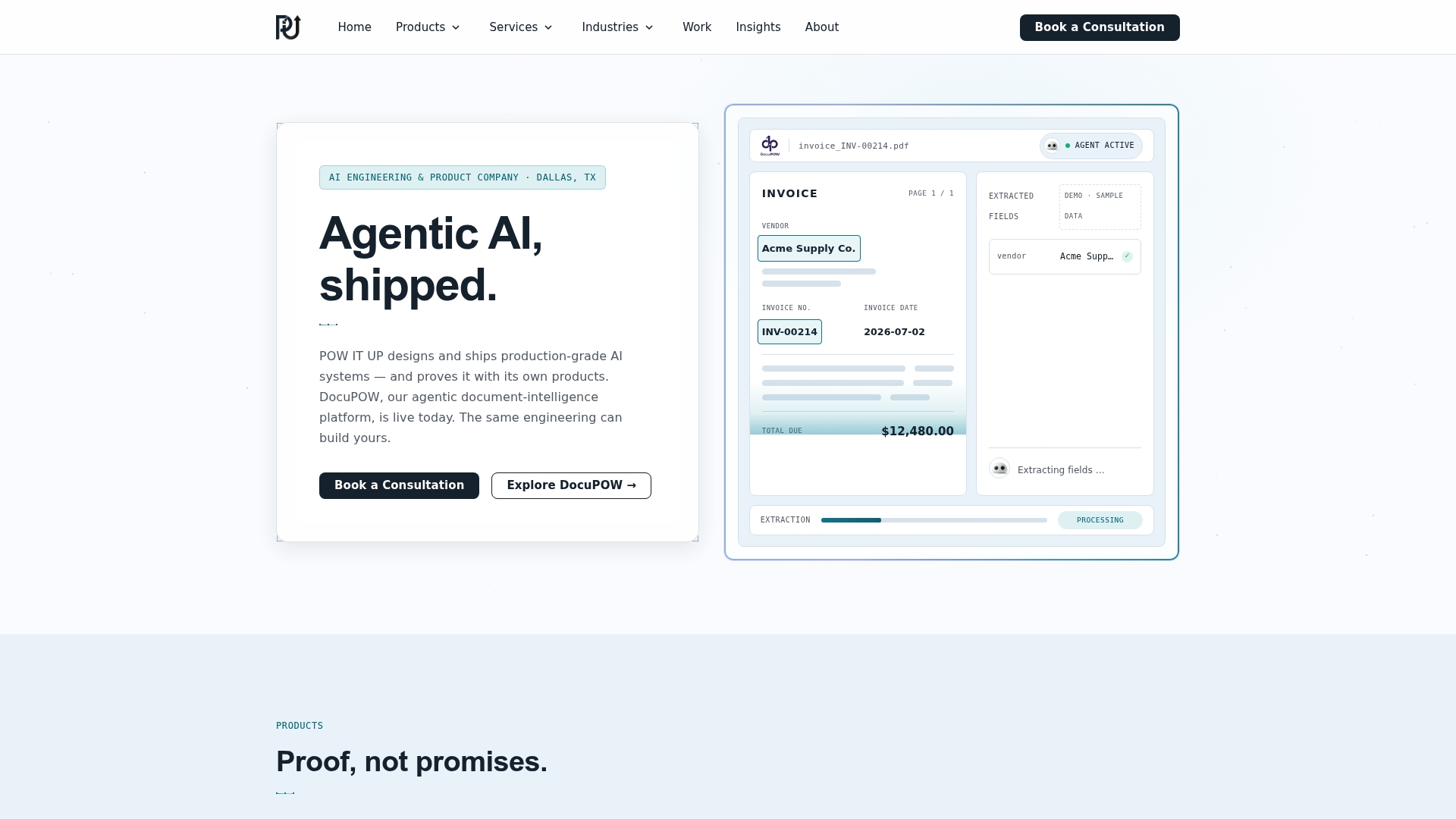
POW IT UP designs and deploys custom AI agents and automation systems built specifically around your operational outcomes, not generic use cases. For leaders who have completed a baseline diagnosis and are ready to pilot, POW IT UP’s typical entry points are document validation (cutting processing errors and review time), lead-time forecasting (reducing variance in delivery and production schedules), and task automation for high-volume transactional work. Each engagement starts with an outcome-first scoping session: you define the operational result you need, and POW IT UP maps the data, process, and integration requirements to get there. To scope a pilot or request a first call, visit POW IT UP’s AI integration services.
Sources
- Operational excellence
- Shingo
- Aisel
- Continuous Quality Improvement: What It Is and How to Apply It
- 10 Common Continuous Improvement Strategies | MoreSteam
FAQ
What are the four pillars of operational excellence?
Definitions vary across frameworks, but a widely used version groups OpEx into four pillars: strategy and leadership alignment, process discipline and standardization, continuous improvement culture, and performance measurement. These map directly to the components described in the Shingo Model and Juran’s quality trilogy.
What are the five basic elements of operational excellence?
The five most commonly cited elements are customer focus, continuous improvement, standardization, employee engagement, and data-driven decision making. These are the components listed in the operational excellence definition and form the foundation of most enterprise OpEx programs.
What are some real examples of operational excellence?
Manufacturing organizations use Lean and OEE tracking to reduce changeover time and defect rates. Healthcare systems apply PDCA to cut emergency department wait times. Financial services firms deploy RPA and process mining to reduce loan processing errors and cycle time. In each case, the common thread is a baseline measurement, a structured improvement method, and a governance system that sustains the gain.
How does operational excellence differ from operational efficiency?
Operational efficiency focuses on doing existing tasks with less waste or cost. Operational excellence is broader: it aligns every process to customer value, builds a culture of continuous improvement, and sustains gains through governance and standard work. Efficiency is a component of excellence, not a synonym for it.
How long does it take to implement operational excellence?
Early pilots can show measurable results within 90 days. A functioning governance system with multiple completed pilots typically takes 12–18 months to establish. Sustaining OpEx as a permanent management discipline is a multi-year commitment, with the cultural shift often taking longer than the process improvements themselves.