

An AI-driven growth strategy turns your existing customer and product data into an automated, measurable acquisition and expansion engine. The fastest way to start: audit your data sources, pick one high-value pilot, and set a single KPI before you touch any tooling.
McKinsey research confirms that capturing AI’s strategic value requires rewiring plans, budgets, and roles, not just deploying software. JPMorgan Chase Institute data shows entry costs for AI services have dropped to a low range for small businesses, meaning the barrier is now execution, not cost. POW IT UP builds the orchestration layer that converts those tools into a compounding growth engine.
Your 7–30 day checklist:
- Audit every customer data source you own (CRM, billing, support tickets, web analytics) and confirm attribution is clean.
- Identify one use case where a wrong or slow decision costs you money today (lead routing, invoice processing, churn prediction).
- Define one primary KPI, a baseline, and a target before any vendor conversation.
Table of Contents
- What are AI-driven growth strategies and why do they work now?
- What core components must be in place before you scale?
- How do you build and scale an AI growth initiative in six steps?
- Which use cases deliver the highest ROI across your organization?
- How do you measure impact and prove ROI on AI investments?
- How do you choose between platforms, automation suites, and custom integrations?
- What governance and compliance controls do U.S. businesses need?
- How do you manage data quality and governance specifically for AI projects?
- How do you break down silos to make AI initiatives work cross-functionally?
- What are the most common pitfalls in deploying AI growth strategies?
- How do you keep AI models effective over time with continuous learning?
- Case studies: AI-driven growth in practice across industries
- Key Takeaways
- POW IT UP builds the AI growth infrastructure your team needs
- Useful sources
- FAQ
What are AI-driven growth strategies and why do they work now?
The term “AI-driven growth strategy” describes a deliberate plan to use machine learning models, automation, and AI agents to accelerate revenue, reduce cost-to-serve, and personalize customer experiences at a scale no human team can match manually. The standard industry framing is “AI-enabled growth,” and the two terms are interchangeable in practice.
Five value levers explain most of the measurable impact:
- Process automation: Repetitive, high-volume tasks (invoice matching, document validation, lead routing) run without human intervention, cutting cycle time and error rates. IEEE research documents measurable efficiency gains and cost reductions from AI-driven process automation.
- Operational efficiency: — Fewer manual handoffs mean faster fulfillment, lower headcount pressure, and more consistent output.
Quick wins typically live in lead routing, content personalization, and invoice or document automation. Long-horizon bets, like building a new AI-native product line, require more governance and a longer payback window.
JPMorgan Chase Institute data shows AI service costs fell from a higher amount per month in 2019 to a lower range per month by 2025, while adoption shifted from sporadic experimentation to consistent, multi-service portfolios. The cost curve is no longer the obstacle. Execution depth is.
Common outcomes leaders should plan to measure: revenue uplift from AI-assisted pipeline, customer acquisition cost (CAC) reduction, speed-to-lead improvement, error rate reduction in automated processes, and retention lift from personalized engagement.
What core components must be in place before you scale?
No AI initiative compounds without five non-optional building blocks. Missing even one creates a ceiling.
- Data and instrumentation: Clean, labeled, attributed data is the foundation. “Good enough” for a pilot means you can answer: who are your best customers, where did they come from, and what did they do before they converted? Without that, every model trains on noise.
- Models and inference: You need a model appropriate to the use case, whether that is a pre-built API (OpenAI, Anthropic), a fine-tuned open-source model, or a custom-trained classifier. The selection criterion is fit to your data and latency requirements, not brand recognition.
- Orchestration and integrations: This is where most firms stall. Individual tools produce individual outputs. An orchestration layer, connecting your CRM, acquisition channels, finance systems, and communication tools, is what converts isolated predictions into automated actions. Practitioner analysis shows that organizations connecting fewer, better tools with an orchestration layer consistently outperform teams running many disconnected ones.
- People and operating model: Someone must own the data, someone must own the model, and someone must own the business outcome. Without clear ownership, pilots die in committee.
- Governance and measurement: Defined KPIs, experiment designs, and model monitoring prevent drift and protect against compliance exposure.
The dependency order matters: fix data and attribution first, then build models and orchestration, then scale. Skipping attribution before paid channels means you will optimize toward the wrong signals and inflate CAC.
How do you build and scale an AI growth initiative in six steps?
A documented case from Bessemer Venture Partners shows a COO who built a full AI-operated acquisition stack and achieved a significant ARR lift in six months with no dedicated growth hires. The sequencing he used maps closely to this roadmap.
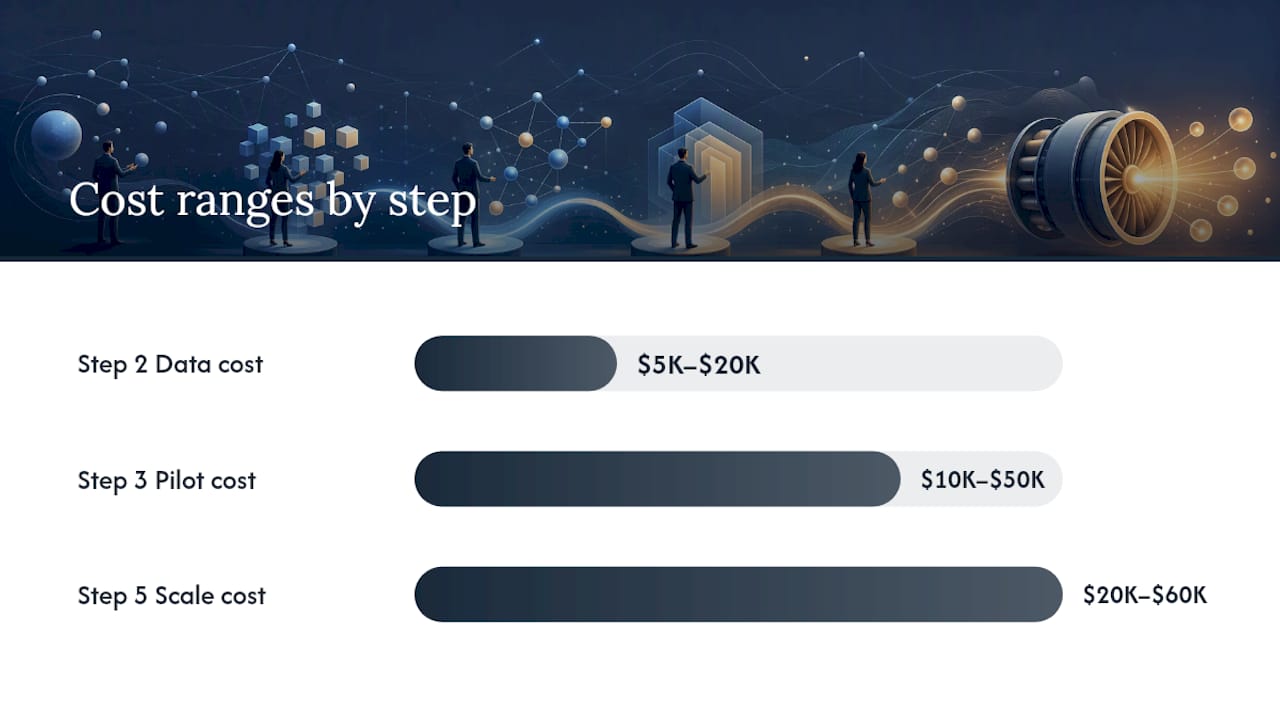
| Step | What you do | Timeline | Roles needed | Cost shape |
|---|---|---|---|---|
| 1. Prioritize and align | Define ICP, pick one use case, set KPI and baseline | Weeks 1–2 | CEO/GM, Head of Data | Internal hours only |
| 2. Data and instrumentation | Audit sources, fix attribution, build a minimum viable dataset | Weeks 4–8 | Data engineer, analyst | $5K–$20K or internal |
| 3. Pilot build | Build or configure the model/agent for the chosen use case | Weeks 4–10 | ML engineer or integration partner | $10K–$50K |
| 4. Experiment and measure | Run A/B or holdout test, measure against KPI, document results | Weeks 6–8 | Analyst, product owner | Minimal incremental |
| 5. Scale and automate | Expand to additional segments or channels, automate handoffs | Months 3–5 | Engineering, ops, sales | $20K–$60K |
| — | Monitor model performance, retrain on new data, iterate | Ongoing | ML ops, data steward | Ongoing SLA cost |
Sequencing rules leaders must enforce:
- ICP and attribution must be confirmed before any paid channel optimization or full automation.
- A pilot must produce a statistically meaningful result (or a clear failure signal) before budget moves to scale.
- Governance controls (data access, audit trail, bias check) must be approved before the model touches customer-facing decisions.
- Retraining cadence must be defined before handover to operations.
Which use cases deliver the highest ROI across your organization?
The best pilot candidates combine high transaction volume, clear success metrics, and low regulatory complexity. Here are eight use cases mapped across functions:
- Marketing: Content personalization. AI matches landing page copy, email subject lines, and ad creative to individual behavior signals. Applied AI marketing programs show measurable lift in engagement and conversion when personalization is applied with a structured pilot design.
- Finance: AP and expense automation. AI matches invoices to purchase orders, flags exceptions, and routes approvals. SAP Concur data documents speed and efficiency gains in AP automation, with one example recovering investment within seven months.
The highest-ROI pilots share one trait: they automate a decision that was already being made manually, repeatedly, at volume. The AI does not change the decision logic. It runs it faster, at scale, without fatigue.
Cross-functional coordination note: every use case above requires a data owner, a business process owner, and a legal or compliance sign-off before go-live. Build that triangle into your pilot governance from day one.
How do you measure impact and prove ROI on AI investments?
Measurement discipline separates pilots that scale from pilots that stall. Define your KPIs before the pilot launches, not after.
| KPI | Baseline example | Target | Measurement cadence |
|---|---|---|---|
| Marketing-sourced pipeline % | — | 50% | Monthly |
| CAC by acquisition cohort | — | — | Quarterly |
| CAC payback period | 7 months | 10 months | Quarterly |
| Lead response time | 4 hours | — | Weekly |
| Invoice processing cycle time | 5 days | 1 day | Weekly |
| Churn rate (AI-monitored accounts) | — | 5% annually | Monthly |
Experiment design for pilots:
- Use a holdout group (10–20% of the audience receives no AI intervention) to isolate the model’s contribution from market trends.
- Run for a minimum of four weeks before drawing conclusions; six to eight weeks is better for conversion-heavy use cases.
- Measure the primary KPI and one secondary metric (e.g., revenue per lead alongside conversion rate) to catch unintended tradeoffs.
- Document the baseline in writing before launch. Post-hoc baseline adjustments are the most common way pilots get declared successful when they are not.
IEEE research on AI-driven business processes supports efficiency and error-reduction claims, but the specific magnitude varies by process type and implementation quality. Avoid citing vendor-supplied ROI figures as your own baseline; build your measurement from your actual data.
Measurement checklist before greenlighting scale:
- Primary KPI shows statistically meaningful improvement over holdout.
- No unintended negative effect on a secondary metric.
- Data pipeline is stable and reproducible.
- Model performance metrics (precision, recall, or equivalent) are documented and within acceptable range.
How do you choose between platforms, automation suites, and custom integrations?
Tool categories differ in what they give you and what they cost you in flexibility:
- SaaS ML platforms (pre-built APIs, model-as-a-service) are fast to deploy and low-cost to start. They work well for standard use cases like sentiment analysis or document classification. The tradeoff is limited customization and data portability risk.
- Activity automation suites handle workflow triggers and conditional logic across apps. Good for connecting existing tools without writing code. They hit a ceiling when the logic becomes complex or the data volume grows.
- Agentic orchestration layers coordinate multiple AI models and tools to complete multi-step tasks autonomously. This is where the AI growth stack approach argues the real edge lives: integration and monthly improvement loops, not tool count.
- Custom integrations are built to your data model, your compliance requirements, and your specific process logic. Higher upfront cost, but no ceiling on complexity and no vendor lock-in on your data.
Vendor evaluation checklist:
- Can you export your data in a standard format at any time?
- What are the SLAs for uptime and model response time?
- How does the vendor explain model decisions (explainability)?
- What are the integration limits (API rate caps, connector availability)?
- How is pricing structured as volume scales?
Vendor red flags: black-box claims with no explainability, vague data lineage documentation, promises of full autonomy without human-in-the-loop controls, and pricing that balloons at production volume.
Pro Tip: When your use case involves regulated data, complex multi-system handoffs, or end-to-end process ownership (not just a single workflow), a custom integration partner like POW IT UP will reach production faster than assembling a stack of SaaS tools that were never designed to talk to each other. Explore automation tool categories to map your options before your first vendor call.
What governance and compliance controls do U.S. businesses need?
McKinsey’s analysis is direct: AI requires organizational rewiring of plans, budgets, and roles. Governance is not a legal formality. It is what keeps a pilot from becoming a liability.
Governance roles every AI initiative needs:
- Executive sponsor: Owns the business outcome and budget. Makes the call to scale or stop.
- Data steward: Owns data quality, access controls, and lineage documentation.
- ML engineer or integration architect: Owns model performance, retraining schedules, and integration stability.
- Legal/compliance owner: Reviews data use agreements, privacy notices, and vendor contracts before any model touches customer data.
U.S. compliance checklist:
- Confirm data residency requirements for any regulated data (HIPAA for health, GLBA for financial, CCPA/state privacy laws for consumer data).
- Update privacy notices to disclose AI-assisted processing where required.
- Review vendor data processing agreements for sub-processor clauses and data retention terms.
- Maintain an audit trail for any AI-assisted decision that affects a customer (credit, pricing, eligibility).
- Document bias testing results before deploying any model that scores or ranks people.
Academic research across 125 high-tech firms links AI adoption to improved innovation and decision-making, but also confirms that cultural change and upskilling are prerequisites for sustained results. Kellogg’s executive education program emphasizes cross-functional team design and leadership roles as the primary levers for embedding AI into operations.
Change management matters as much as the technology. Employees who understand why a model is making a recommendation adopt it. Employees who feel replaced by it resist it. Brief your teams on what the model does, what it does not do, and where human judgment still applies.
This article provides general information, not legal or compliance advice. Confirm your specific obligations with a qualified attorney or compliance professional.
How do you manage data quality and governance specifically for AI projects?
AI models are only as reliable as the data they train on. Garbage in, garbage out is not a cliché; it is the most common reason pilots fail to generalize beyond the test set.
Three data quality problems kill AI projects before they scale. First, inconsistent labeling: if your CRM marks “closed-won” differently across sales reps, a churn model trained on that data will learn the labeling inconsistency, not the actual churn signal. Second, missing data at inference time: a model trained on complete records will degrade badly when production data arrives with missing fields. Build imputation logic or flag missing-data cases explicitly. Third, data drift: the distribution of your input data changes over time (new customer segments, market shifts, product changes), and a model trained six months ago may no longer reflect current reality.
Practical governance controls for AI data:
- Assign a named data steward to every dataset used in a model.
- Version your training datasets the same way you version code.
- Set a documented threshold for model performance degradation that triggers a retraining review.
- Audit data access logs quarterly to confirm only authorized systems and users are reading model inputs.
How do you break down silos to make AI initiatives work cross-functionally?
The single most common reason AI pilots produce results in a demo but die in production: the data owner, the process owner, and the budget owner are in different departments with different incentives.
Fix the incentive problem first. If marketing owns the AI budget but sales owns the pipeline KPI, neither team has full accountability for the outcome. Assign a shared OKR that both teams are measured against before the pilot launches.
Structural moves that work:
- Appoint a cross-functional AI steering group — with one representative from data, product, operations, legal, and the business unit running the pilot. Meet weekly during the pilot, monthly during scale.
The Kellogg executive education framework identifies cross-functional team design as one of the primary levers for embedding AI into operations. That matches what practitioners see: the technology is rarely the constraint. The org chart usually is.
What are the most common pitfalls in deploying AI growth strategies?
Most failures are predictable. Here are the ones that appear most often, and what to do instead.
Starting with the tool, not the problem. Leaders buy a platform because a competitor uses it, then search for a use case to justify the purchase. The result is a solution looking for a problem. Start with the business question: where is a wrong or slow decision costing you money today?
Skipping attribution. If you cannot measure where a customer came from and what drove their conversion, you cannot tell whether the AI is helping or hurting. Fix attribution before you run any model on acquisition data.
Treating a pilot as a proof of concept rather than a production rehearsal. A pilot that runs on clean, curated data in a controlled environment will not automatically generalize to messy production data. Design your pilot to use real production data from day one, even if the volume is small.
Underestimating change management. Research across high-tech firms consistently shows that cultural resistance and lack of upskilling are larger barriers to AI adoption than technical complexity. Budget time and money for training, not just engineering.
No retraining plan. A model deployed and forgotten will drift. Customer behavior changes, product lines change, market conditions change. Without a defined retraining cadence, your AI will quietly degrade while your team assumes it is still working.
How do you keep AI models effective over time with continuous learning?
A deployed model is not a finished product. It is a system that requires ongoing maintenance, the same way a production database or a sales process does.
Model performance degrades for two reasons: data drift (the input distribution shifts) and concept drift (the relationship between inputs and the target variable changes). Both are inevitable. The question is whether you catch them early or after they have damaged a business process.
A practical retraining governance process:
- Set performance thresholds at deployment — Define the minimum acceptable precision, recall, or business-metric performance. When the model falls below that threshold, a retraining review is triggered automatically.
Case studies: AI-driven growth in practice across industries
Fintech (ARR growth): The Bessemer Venture Partners case study documents a COO who built a complete AI-operated acquisition stack using Claude Code, covering ICP definition, brand positioning, and execution automation. The result: a 38% ARR increase in six months with no dedicated growth hires. The key lever was orchestration: AI managed the handoffs between research, content, outreach, and attribution that would otherwise require a full team.
Finance operations (AP automation): SAP Concur’s documented cases show AP and expense automation delivering measurable speed improvements, with one example recovering the full investment within seven months. The use case is straightforward: AI matches invoices to purchase orders, flags exceptions, and routes approvals without human review of routine transactions.
Document-intensive operations (DocuPOW): A financial services team processing high volumes of loan and compliance documents replaced a manual review queue with POW IT UP’s DocuPOW agent. Cycle time dropped from days to hours, and the team’s capacity to handle volume increased without adding headcount. The automation ROI examples on POW IT UP’s site document comparable outcomes across service business contexts.
High-tech enterprise (innovation and decision-making): ScienceDirect research across 125 high-tech firms found that AI adoption improved innovation output and decision precision, but only in firms that paired the technology with governance structures and upskilling programs. Firms that deployed AI without those supports saw smaller and less durable gains.
Key Takeaways
AI-driven growth strategies compound only when data quality, orchestration, and governance are built in sequence, not bolted on after the fact.
| Point | Details |
|---|---|
| Start with attribution | Fix data sources and attribution before any model or channel optimization, or you will optimize toward the wrong signals. |
| Sequence the roadmap | Data first, then models and orchestration, then scale. Skipping steps creates ceilings that are expensive to remove later. |
| Measure with holdouts | Use a holdout group and a pre-defined baseline for every pilot; post-hoc baseline adjustments are how failed pilots get declared successful. |
| Retrain on a schedule | Set performance thresholds at deployment and retrain quarterly (or on trigger) to prevent silent model drift from degrading results. |
| POW IT UP for complex builds | When use cases span multiple systems, regulated data, or require autonomous agents like DocuPOW or AuraPOW, a custom integration partner reaches production faster than assembling disconnected SaaS tools. |
The gap between AI strategy and AI results
Most leaders I work with are not short on AI ambition. They are short on sequencing discipline. The organizations that compound results are the ones that resist the urge to deploy ten tools at once and instead build one clean orchestration layer, prove it against a real KPI, and then expand. The 38% ARR case from Bessemer is instructive not because the technology was exotic, but because the COO treated attribution and ICP definition as prerequisites, not afterthoughts.
The other thing practitioners consistently underestimate: the org chart problem. A model can be technically sound and still fail because the data owner and the process owner report to different executives with different incentives. Governance is not bureaucracy. It is the mechanism that keeps a working pilot from dying in a handoff.
My preference, and POW IT UP’s default approach, is to start with data and attribution before touching channels or automation. It adds two to four weeks at the front. It saves months of rework at the back.
POW IT UP builds the AI growth infrastructure your team needs
Leaders who have read this far know what needs to happen. The harder question is who builds it. POW IT UP designs and deploys custom AI agents, integration layers, and automation systems for enterprise and SMB operations across the United States. That includes DocuPOW for document intelligence, AuraPOW for portfolio and client health monitoring, and bespoke orchestration that connects your CRM, finance systems, and acquisition channels into a single automated growth engine.
The difference between a POW IT UP engagement and a platform subscription: you get a system built to your data model, your compliance requirements, and your specific process logic, with a defined SLA and a retraining plan included. No ceiling on complexity, no vendor lock-in on your data.
If you are ready to move from pilot to production, book a discovery call with POW IT UP or explore our AI integration services to see what a custom engagement looks like for your industry.
Useful sources
- Understanding the use of AI among small businesses
- How AI is transforming strategy development
- Building a growth engine from zero: How one COO boosted ARR 38% using Claude Code — Bessemer Venture Partners
- The AI Growth Stack: What Actually Works in 2026 — Bob Clary
- Grow with AI: Your AI-driven Growth Marketing strategy
FAQ
What is an AI growth strategy?
An AI growth strategy is a plan to use machine learning, automation, and AI agents to accelerate revenue, reduce customer acquisition cost, and personalize customer experiences at scale. It connects data, models, and process automation into a measurable, repeatable growth engine.
What does the 38% ARR result from the Bessemer case study tell us?
A COO built a full AI-operated acquisition stack using Claude Code and achieved a substantial ARR increase in six months with no dedicated growth hires, per Bessemer Venture Partners. The result came from sequencing ICP definition and attribution before automation, not from deploying more tools.
What are the core pillars of AI-driven development for business?
The five non-optional components are: clean data and instrumentation, appropriate models and inference, an orchestration layer connecting systems, a defined operating model with clear ownership, and governance with measurement. Missing any one of them creates a ceiling on what the initiative can achieve.
How much does it cost to start an AI pilot?
JPMorgan Chase Institute data shows AI service entry costs at roughly $20–30/month for small businesses in 2025. A structured pilot with data work, model configuration, and integration typically runs $10K–$50K depending on complexity, with internal hours adding to that figure.
When should a business hire a custom AI integration partner?
Custom integration makes sense when a use case spans multiple systems, involves regulated data, requires autonomous agents, or needs end-to-end process ownership rather than a single workflow trigger. POW IT UP specializes in exactly these scenarios, building systems that scale without adding headcount.