

TL;DR:
- Next-generation business systems are layered architectures that extend existing core systems with AI agents, domain-specific models, and a data fabric.
- They focus on high-volume, structured workflows like document intake and claims processing to deliver rapid return on investment.
Next-generation business systems are AI-first, composable platforms that combine multi-agent orchestration, domain-specific language models, and a data fabric to automate and scale core operations without replacing your existing infrastructure. Gartner identifies multi-agent systems and domain-specific models as the defining enterprise automation trends for 2026. The practical starting point: run a focused pilot on a single high-volume workflow, such as document intake under HIPAA or financial transaction processing under GLBA, and build the business case before scaling. POW IT UP designs and deploys exactly these systems for U.S. enterprises and SMBs.

Table of Contents
- What are next-generation business systems, really?
- Which use cases deliver the fastest ROI?
- How do you build a pilot-to-scale roadmap?
- What security and compliance issues should you plan for?
- How do you measure success and govern the system over time?
- POW IT UP builds the systems this guide describes
- Key Takeaways
- The part most guides skip
- Useful sources
- FAQ
What are next-generation business systems, really?
The term gets used loosely, so a precise definition matters. These are not monolithic ERP replacements. They are layered architectures where AI agents, orchestration hubs, and a shared data fabric sit on top of your existing core systems, extending them rather than ripping them out.
The core components every leader should understand:
- Multi-agent orchestration: Autonomous AI agents handle discrete tasks (extraction, validation, routing, escalation) and coordinate with each other through an orchestration layer.
- Domain-specific language models: Smaller, fine-tuned models trained on industry data (medical records, financial filings, logistics manifests) outperform general-purpose models on accuracy and compliance-sensitive tasks.
- Data fabric / event-driven integration: A loosely coupled integration layer that connects legacy ERPs, databases, and SaaS tools through event streams, enabling real-time data flow without brittle point-to-point connections.
- Engagement (low-code) layer: The interface between end users and the orchestration hub, allowing business teams to configure workflows without touching core systems.
- API gateway: Manages authentication, rate limiting, and versioning for all service-to-service calls.
- Observability and monitoring: Tracks model accuracy, data lineage, drift, and SLA compliance across every agent and pipeline.
According to CACI’s practitioner guidance, the right integration strategy uses an engagement layer and orchestration hub to preserve the ERP core while delivering modern capabilities through the “strangler pattern”: new functionality is built in the orchestration layer and legacy capabilities are migrated progressively, cutting disruption and upgrade risk significantly.
Pro Tip: Design for observability from day one. Model versioning, data lineage tracking, drift detection, and retraining pipelines are far cheaper to build into the initial MLOps scope than to retrofit at scale.
Gartner 2026 trend: AI has moved from experimental pilots to core architecture for CIOs. Multi-agent systems and domain-specific models are now foundational, not optional.
Which use cases deliver the fastest ROI?
Not all automation targets are equal. The highest-value use cases share a common trait: high transaction volume, structured data inputs, and clear error costs.
- Document intake and validation (DocuPOW): Automated reading, classification, and validation of contracts, invoices, claims, and compliance documents. Reduces manual review time and exception rates in healthcare (HIPAA-sensitive PHI handling) and financial services (GLBA-regulated records).
- Portfolio monitoring and client health analytics (AuraPOW): Continuous monitoring of client portfolios with anomaly detection and risk flagging, replacing manual spreadsheet reviews in fintech and wealth management.
- Service desk automation: Ticket classification, routing, and first-response resolution using conversational agents, cutting mean time to resolution for IT and customer operations teams.
- Accounts payable and receivable: Three-way match automation, exception handling, and payment scheduling reduce processing costs per invoice and free finance staff for higher-value work.
- Claims processing: Insurance and healthcare claims benefit from automated intake, eligibility checks, and adjudication routing, where accuracy directly affects regulatory exposure.
- Inventory and logistics orchestration: Demand-signal ingestion, reorder triggers, and carrier coordination reduce stockouts and manual dispatch decisions in manufacturing and e-commerce.
The World Economic Forum’s 2026 emerging technologies list underscores how quickly AI and automation are reshaping cross-sector operations, reinforcing the urgency for leaders to move beyond pilots in at least one of these categories. For a practical breakdown of automation tools by service type, POW IT UP’s resource library covers the current landscape in detail.
How do you build a pilot-to-scale roadmap?
A four-phase model keeps scope controlled and ROI visible at every checkpoint.
| Phase | Timeline | Key Deliverables | Team | Success Criteria |
|---|---|---|---|---|
| Assess | 2–4 weeks | Process map, data audit, compliance gating | Business analyst, architect, compliance lead | Pilot scope agreed, data gaps identified |
| Pilot | 3–6 months | Working agent pipeline, integration to one core system, baseline metrics | 2–3 engineers, MLOps, business owner | Target KPIs met in controlled environment |
| Harden / Govern | 3 months | Security review, model versioning, SLA documentation, rollback plan | Engineering, compliance, IT ops | Passes security audit, governance model approved |
| Scale | 6 months | Multi-process rollout, change management, managed operations | Full cross-functional team, managed services | Adoption targets met, cost-per-transaction declining |
Phase checklist before moving from pilot to harden:
- Scope is locked to a single process with measurable inputs and outputs.
- Data readiness confirmed: clean, labeled training data available.
- Compliance gating complete: HIPAA, GLBA, or CCPA/CPRA review signed off.
- Model selected and baseline accuracy benchmarked.
- Monitoring and alerting configured from day one.
- Rollback plan documented and tested.
On contracting: fixed-price pilots work well when scope is tight and the vendor has a repeatable playbook. Subscription products like DocuPOW are the right call when the use case is document-heavy and you want faster time-to-value without a full custom build. Custom agent engineering makes sense for proprietary workflows where off-the-shelf tools cannot reach the required accuracy or integration depth. For enterprise automation guidance, POW IT UP’s 2026 leader’s guide covers staffing models and budget structures in detail.
What security and compliance issues should you plan for?
U.S. regulatory requirements are not a post-launch concern. They shape architecture decisions from the first design session.
Compliance checklist:
- HIPAA: Any system processing protected health information (PHI) requires Business Associate Agreements with vendors, encryption at rest and in transit, access logging, and minimum-necessary data access controls.
- GLBA: Financial institutions must implement a written information security program covering AI-processed customer financial data, with vendor oversight requirements that extend to integration partners.
- CCPA/CPRA: California consumer data rights apply to any system that processes personal data of California residents, including automated profiling and AI-driven decision-making. Data subject request workflows must be built into the architecture.
- Data residency: For sensitive workloads, confirm that cloud providers keep data within U.S. jurisdiction. Third-party model APIs that route data through non-U.S. infrastructure can create compliance exposure.
- Model governance: Training data must be auditable. Document data provenance, consent basis, and any third-party data used in fine-tuning.
Security best practices include data minimization (process only what the agent needs), role-based access controls at the agent and orchestration layer, confidential computing for sensitive inference workloads, and regular penetration testing of API gateways.
Pro Tip: Gate every phase transition on a compliance sign-off, not just a technical milestone. A model that works perfectly but processes PHI without a BAA in place is a liability, not an asset.
How do you measure success and govern the system over time?
Governance without measurement is just paperwork. Start with a short KPI list and assign clear ownership before the pilot goes live.
Core KPIs to track:
- Throughput (transactions or documents processed per hour)
- Exception and error rate (percentage requiring human review)
- Time to resolution (end-to-end process cycle time)
- Cost per transaction (fully loaded, including cloud and engineering)
- Model accuracy (precision, recall, or AUROC depending on task type)
- Business adoption rate (active users and usage frequency)
| Role | Responsibilities | Decision Gate |
|---|---|---|
| Data owner | Data quality, access controls, lineage | Approves data for training and production |
| ML engineer | Model development, retraining, versioning | Signs off on model releases |
| MLOps | Pipeline reliability, drift monitoring, incident response | Triggers retraining or rollback |
| Compliance owner | Regulatory gating, audit readiness | Approves phase transitions |
| Business owner | KPI accountability, adoption, change management | Approves go-live and scale decisions |
For change management: persona-based training (what the agent does for this role, not a general AI overview) drives adoption faster than broad rollouts. The engagement layer is your friend here. When end users interact with a familiar interface that happens to be powered by agents behind the scenes, resistance drops sharply.
POW IT UP builds the systems this guide describes
POW IT UP’s engagement model follows the same assess-to-scale arc outlined above: a discovery session scopes the highest-value process, a fixed-scope pilot proves the business case, and a build-and-operate phase delivers a production system with ongoing MLOps support.
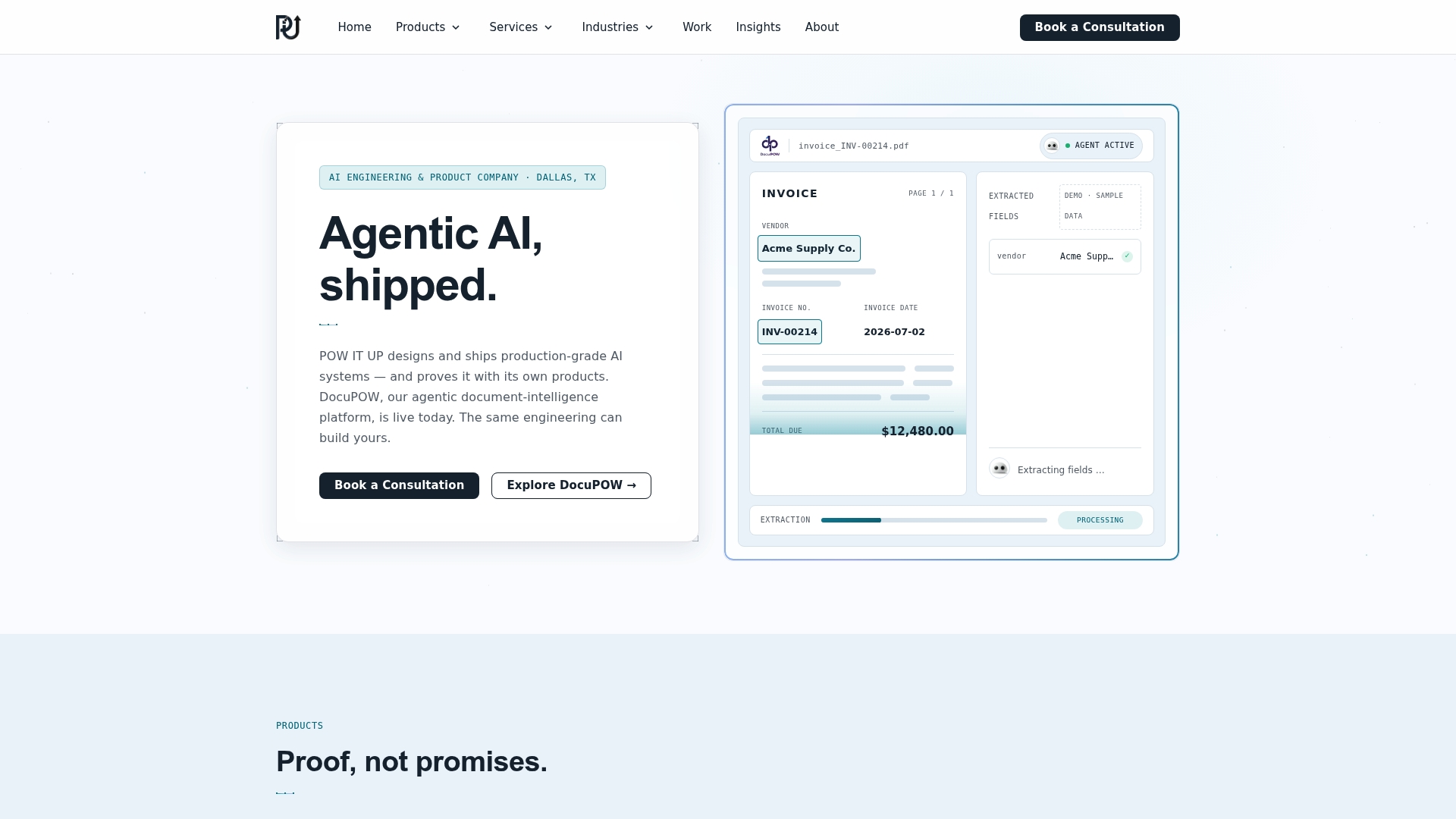
The productized offerings cover two of the highest-ROI use cases immediately. DocuPOW handles document intelligence and validation, reading, classifying, and validating contracts, invoices, and compliance documents with agent-level accuracy. AuraPOW delivers portfolio monitoring and client health analytics for fintech and wealth management teams. Beyond these, POW IT UP engineers custom AI agents for proprietary workflows where off-the-shelf tools fall short, including orchestration design, API gateway configuration, and full MLOps setup.
For leaders ready to scope a pilot, the AI integration services page outlines engagement options and typical timelines. If automation is the priority, the intelligent automation services page covers the full scope of what a first engagement delivers.
Key Takeaways
Next-generation business systems require a layered architecture, a compliance-first mindset, and a governed pilot before any attempt to scale.
| Point | Details |
|---|---|
| Definition and architecture | AI-first, composable systems use multi-agent orchestration and a data fabric layered over existing cores, not replacing them. |
| Highest-ROI use cases | Document intake, portfolio monitoring, AP/AR, and claims processing deliver the fastest measurable returns. |
| Pilot timeline | A structured pilot runs for a moderate duration; plan several weeks for assessment and a few months to harden before scaling. |
| Compliance is architecture | HIPAA, GLBA, and CCPA/CPRA requirements must gate every phase transition, not just the final launch. |
| POW IT UP engagement | POW IT UP’s DocuPOW, AuraPOW, and custom agent engineering cover the full pilot-to-scale path for U.S. enterprises and SMBs. |
The part most guides skip
The single biggest failure mode in enterprise AI adoption is not a technology problem. It is a scoping problem dressed up as a technology problem.
Leaders arrive at a first engagement with a list of fifteen processes they want automated. The instinct is understandable. But a pilot that tries to prove value across five workflows simultaneously proves nothing clearly and costs twice as much to govern. The organizations that move fastest pick one process, instrument it completely, and let the numbers make the case for the next one.
The second pitfall is treating compliance as a legal department concern rather than an architecture constraint. HIPAA and GLBA requirements affect which cloud regions you can use, how training data must be handled, and what your vendor contracts must contain. Discovering this after a model is in production is expensive. Discovering it before the pilot scope is finalized costs almost nothing.
Common pitfalls to avoid:
- Over-scoping the pilot (more than one core process)
- Skipping a data readiness audit before model selection
- Underinvesting in governance roles (particularly the compliance owner and MLOps function)
- Treating observability as optional until something breaks
- Delaying U.S. compliance gating until post-launch
The leaders who get this right share one habit: they assign a named compliance owner and a named business owner before the first line of code is written. Accountability at the start prevents expensive rework at the end.
Useful sources
Authoritative references for further research and procurement decisions:
- Gartner Top Strategic Technology Trends 2026: The primary authority on multi-agent systems and domain-specific models as 2026 enterprise priorities. Request the full eBook for CIO briefing material.
- CACI Next-Gen ERP Modernization Playbook: Practitioner guidance on the engagement layer, strangler pattern, and legacy integration strategy.
- World Economic Forum: Top 10 Emerging Technologies 2026: Cross-sector technology horizon for strategic planning.
- POW IT UP: Smart Business Systems: Integration patterns, database architecture, and analytics as foundational elements of next-gen systems.
- POW IT UP: AI Integration Services: Service overview and pilot engagement options for U.S. enterprises and SMBs.
- AI business tools roundup (ChatzyBot): Independent perspective on the current AI tools market for decision-makers.
FAQ
What are next-generation business systems?
They are AI-first, composable platforms that layer multi-agent orchestration, domain-specific language models, and a data fabric over existing core systems to automate and scale operations without replacing legacy infrastructure.
How long does a typical pilot take?
A focused pilot targeting a single high-volume process runs 3–6 months, preceded by a 2–4 week assessment phase to confirm data readiness and compliance gating.
Which U.S. regulations affect AI system architecture?
HIPAA governs PHI handling in healthcare workflows, GLBA covers financial data safeguards, and CCPA/CPRA applies to any system processing California consumer data, including automated AI-driven decisions.
What does POW IT UP offer for getting started?
POW IT UP provides a discovery-to-pilot engagement model, productized tools (DocuPOW for document intelligence, AuraPOW for portfolio analytics), and custom AI agent engineering for proprietary workflows.
What is the strangler pattern in legacy integration?
It is a migration approach where new functionality is built in an orchestration layer while legacy capabilities are progressively moved out, reducing disruption and allowing incremental modernization without a full system replacement.