

What is business optimization, and why does it matter now?
Business optimization is the continuous process of aligning an organization’s operations, workflows, and strategy with its long-term goals to increase efficiency, reduce costs, and improve overall performance. It is not a one-time project. It is a discipline that repeats, refines, and compounds over time.
The stakes in 2026 are higher than they have ever been. AI is reshaping what is possible in operations, competition is accelerating, and the gap between companies that run on disciplined systems and those that run on instinct is widening fast. Organizations that treat optimization as an ongoing practice consistently outperform those that treat it as a quarterly initiative.
Here is what business optimization actually involves:
- Measuring productivity, efficiency, and performance against defined benchmarks
- Identifying where processes break down, slow down, or cost more than they should
- Introducing new methods, tools, or workflows to close those gaps
- Measuring again to confirm the change worked
- Repeating the cycle so gains hold and compound
Core benefits include lower operational costs, higher output from the same team, better product and service quality, and faster decision-making. Six Sigma’s DMAIC framework, Lean management, and Kaizen are the most established methodologies for structuring this work. Each gives teams a repeatable way to find problems and fix them without guessing.
Table of Contents
- How core frameworks guide business optimization projects
- What types and techniques of optimization should you use?
- How does business process optimization differ from improvement and automation?
- How AI and automation are reshaping optimization in 2026
- Real-world use cases that show what optimization actually delivers
- Why change management determines whether optimization sticks
- Which tools support business optimization work?
- How to calculate ROI on optimization efforts
- POWITUP builds the AI infrastructure that makes optimization permanent
- FAQ
- Key Takeaways
How core frameworks guide business optimization projects
The most proven structure for process improvement is Six Sigma’s DMAIC cycle: Define, Measure, Analyze, Improve, Control. Successful optimization projects typically run through DMAIC at least twice, with quarterly reviews in the first year to lock in gains. That repetition is not redundancy. It is how you catch the drift that happens when teams revert to old habits after the initial rollout.
Here is how to apply it in practice:
- Define the process you are targeting and the specific problem it has. Write a clear problem statement with a measurable outcome attached.
- Measure current performance. Collect data on cycle times, error rates, cost per transaction, and any other metric tied to the problem.
- Analyze the data to find root causes. Do not fix symptoms. Find what is actually driving the inefficiency.
- Improve by redesigning the process, removing waste, and testing the new version with a small group before rolling it out widely.
- Control by setting up monitoring, assigning a process owner, and documenting the new standard so it does not quietly revert.
Beyond DMAIC, Lean targets waste: unnecessary steps, waiting, rework, and handoffs that add no value. Kaizen favors small, continuous improvements made by the people doing the work rather than top-down redesigns. Many organizations blend all three, using Lean to strip out waste, Six Sigma to reduce variation, and Kaizen to keep the improvement culture alive between major projects.
Pro Tip: Assign one named owner to every optimized process. Without a clear owner, accountability evaporates within weeks of launch, and the process drifts back to its old shape.

What types and techniques of optimization should you use?
The right technique depends on the problem. Applying the wrong method to a process is one of the most common reasons optimization projects stall.
Major types of business optimization include:
- Change management optimization: Restructuring how decisions get made and how people adapt to new workflows
- Supply chain optimization: Reducing lead times, cutting inventory costs, and improving supplier coordination
- Pricing optimization: Using data to set prices that maximize margin without sacrificing volume
- Risk management optimization: Identifying operational vulnerabilities before they become failures
- Search engine optimization: Aligning digital content and structure with how customers actually search
Key techniques that cut across all of these types:
- Process mapping: Drawing the actual current-state workflow, step by step, before redesigning anything
- Process mining: Using event log data to reveal how work actually flows through systems, uncovering bottlenecks that stakeholder interviews miss
- Data analytics: Tracking performance metrics to identify trends and inform decisions with evidence rather than intuition
- Automation initiation: Introducing software to handle repetitive, rules-based steps after the process has been cleaned up
- Performance metric tracking: Monitoring KPIs continuously so you catch degradation early
In 2026, AI-driven analytics tools have made process mining significantly more accessible. Teams that previously needed a data engineering team to analyze event logs can now surface bottleneck patterns through platforms that interpret the data automatically. That shift means smaller organizations can now run the kind of operational diagnostics that were once reserved for enterprise teams.
How does business process optimization differ from improvement and automation?

These three terms get used interchangeably, and that confusion leads to wasted effort.
Business process optimization is the structured effort to redesign an entire workflow for efficiency, cost-effectiveness, and quality. It looks at the full chain from start to finish and asks what should be improved, what should be automated, and what should be eliminated entirely.
Process improvement is narrower. It means making incremental fixes to specific tasks within an existing process. It does not question the overall design.
Business process reengineering goes further than optimization. It discards the existing process and rebuilds it from scratch, typically when the current workflow is too broken to fix incrementally.
Automation is a tool, not a discipline. It executes steps faster and more consistently, but it does not fix a flawed process. Automating a broken process scales the inefficiency rather than eliminating it.
| Discipline | Scope | Approach | Best used when |
|---|---|---|---|
| Process improvement | Single task or step | Incremental fix | One step is underperforming |
| Process optimization | End-to-end workflow | Redesign for efficiency | The whole chain has friction |
| Process reengineering | Full process | Rebuild from zero | The current design is fundamentally broken |
| Automation | Specific steps | Technology execution | The process is clean and repeatable |
KPIs that matter most for process optimization:
- Cycle time: How long does the full process take from start to finish?
- First-pass yield: What percentage of work completes correctly the first time, without rework?
- Exception rate: How often does the process break down and require manual intervention?
- Cost per transaction: What does it actually cost to complete one unit of work?
A common pitfall is optimizing in silos. A team fixes its own piece of the process without coordinating with upstream or downstream teams, and the bottleneck simply moves rather than disappears. Cross-team visibility is not optional.
How AI and automation are reshaping optimization in 2026
AI has moved from a supporting tool to a central driver of operational efficiency. Companies deploying AI strategically report significant operational cost reductions and multiple-fold returns on investment within the first year. Those numbers reflect what happens when AI is applied to the right problems: repetitive, high-volume, rules-based tasks with predictable inputs.
What AI does well in an optimization context:
- Automates data entry, document processing, and routine approvals at scale
- Runs predictive analytics to flag supply chain disruptions before they happen
- Personalizes customer interactions based on behavioral data without manual segmentation
- Speeds up decision-making by surfacing the right information at the right moment
What still requires human judgment:
- Processes with frequent exceptions or ambiguous inputs
- Decisions that carry significant legal, ethical, or relationship risk
- Creative problem-solving and strategic direction
Pro Tip: Before selecting an AI tool, map the process it will touch and confirm it meets three criteria: it is rules-based, it runs at high volume, and its inputs are predictable. If it fails any of those tests, redesign the process first.
The most reliable implementation path is a pilot rollout: test the new AI-assisted process with a small group for 30–60 days, measure the results against your baseline KPIs, fix what the pilot reveals, then scale. Big-bang implementations consistently underperform because they skip the feedback loop that catches failure points early.
Statistic: Companies that deploy AI strategically in optimized workflows report 30–50% reductions in operational costs and 2–5x ROI within the first year.
Real-world use cases that show what optimization actually delivers
Optimization without a concrete outcome is just process theater. Here is what it looks like when it works:
- AI-driven personalization in e-commerce: Retailers using AI recommendation engines report measurable increases in average order value by surfacing relevant products at the right moment in the purchase flow.
- Automated customer support triage: Companies routing support tickets through AI classification systems cut first-response times significantly, freeing human agents for complex cases that actually need them.
- Supply chain reoptimization: Manufacturers that mapped their procurement workflows and eliminated redundant approval steps reduced purchase order cycle times and lowered inventory carrying costs.
- Client onboarding automation: Service businesses that automated client onboarding reduced manual data entry, shortened time-to-active, and improved early client satisfaction scores.
- Law firm revenue optimization: Professional service firms that restructured billing workflows and matter intake processes saw measurable gains in revenue per attorney without adding headcount.
Statistic: AI-driven optimization initiatives targeting high-volume, rules-based processes deliver 2–5x ROI within the first year for companies that deploy strategically.
The pattern across every successful case is the same: start with one high-impact process, measure the baseline, implement the change, measure again, then expand. Prioritizing by impact versus effort keeps resources focused on what actually moves the business. Mid-market teams that pick one high-value process per quarter make more progress than those that attempt enterprise-wide transformation all at once.
Why change management determines whether optimization sticks
You can design a perfect process and still watch it fail. The reason is almost always people, not the process design itself. Change management quality is one of the strongest predictors of whether optimization gains hold over time.
The mechanics of good change management during an optimization initiative:
- Explain the why before the what. People resist changes they do not understand. If the team knows the process is changing because it costs the company three hours per transaction and the target is 45 minutes, they have context. Without that context, the change feels arbitrary.
- Involve the people doing the work. The employees running a process daily know where it actually breaks. Excluding them from redesign produces solutions that look good on paper and fail in practice.
- Train before you launch. Deploying a new workflow without adequate training creates a period of confusion that generates exactly the kind of errors optimization was supposed to eliminate.
- Assign clear ownership. Every optimized process needs one named owner responsible for monitoring performance and escalating when something drifts.
- Communicate results. When the new process delivers measurable improvements, share those numbers with the team. It reinforces that the disruption was worth it and builds appetite for the next initiative.
The organizations that sustain optimization gains treat it as a cultural discipline, not a project. Regular review cycles, visible KPI dashboards, and a standing mandate to surface inefficiencies keep the improvement engine running between major redesigns.
Which tools support business optimization work?
The right tool depends on where you are in the optimization cycle. No single platform covers everything.
Process mapping and analysis:
- Lucidchart and Miro for visual process mapping and collaborative workflow documentation
- Celonis and UiPath Process Mining for event log analysis that reveals actual workflow patterns beyond what stakeholders describe
Project and workflow management:
- Asana, Monday.com, and ClickUp for tracking optimization initiatives, assigning ownership, and monitoring progress against KPIs
Automation execution:
- Zapier and Make for connecting applications and automating rules-based handoffs without custom development
- UiPath and Automation Anywhere for robotic process automation on high-volume transactional tasks
- POWITUP’s custom AI agents for autonomous, context-aware automation of complex, multi-step workflows
Analytics and performance monitoring:
- Tableau, Power BI, and Google Looker for building KPI dashboards that surface performance trends in real time
CRM and customer process optimization:
- Salesforce and HubSpot for managing customer-facing workflows, tracking pipeline efficiency, and measuring service delivery performance
The types of automation tools available in 2026 span a wide range of complexity and cost. Entry-level workflow connectors work well for simple, linear handoffs. Enterprise platforms handle multi-system, exception-heavy processes. The gap between them is significant, and choosing the wrong tier wastes both budget and implementation time.
How to calculate ROI on optimization efforts
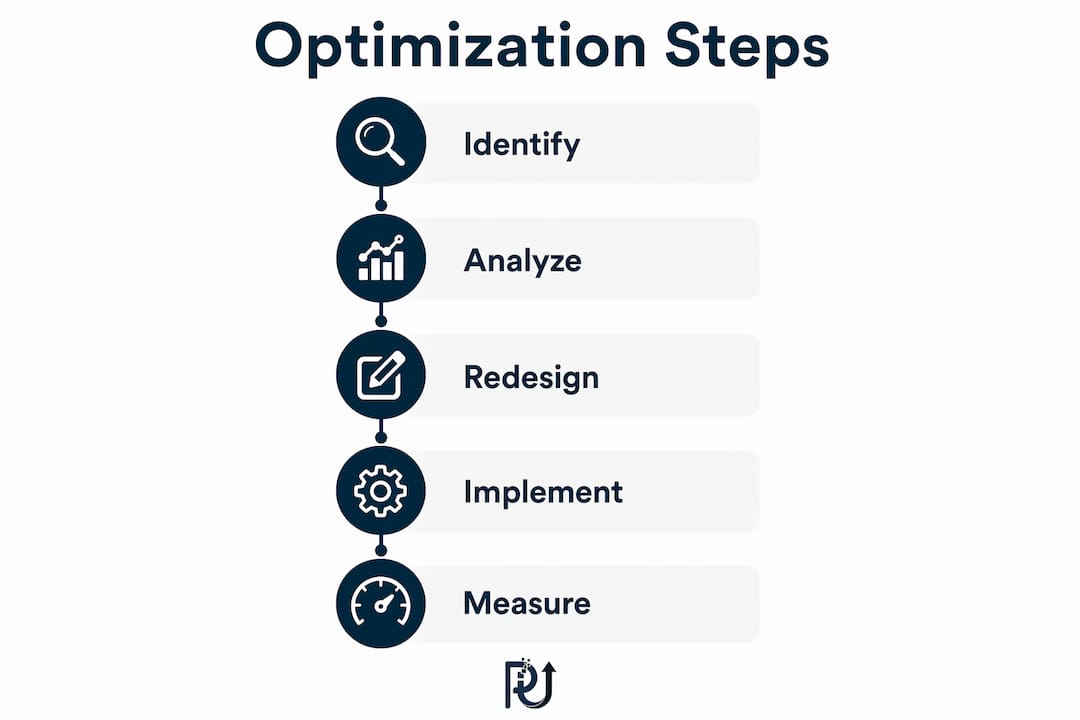
ROI on optimization is measurable, but only if you set a baseline before you start. Without a before-state, you cannot prove the after-state is better.
The basic ROI formula for an optimization initiative:
ROI = (Value of gains – Cost of initiative) / Cost of initiative × 100
Value of gains includes: labor hours saved multiplied by fully loaded cost per hour, error-related rework costs eliminated, revenue recovered from faster cycle times, and customer retention improvements tied to better service delivery.
Cost of initiative includes: staff time spent on redesign and implementation, software or tooling costs, training costs, and any consulting or external support.
A practical example: a billing process that takes nine days and costs $180 per transaction gets redesigned to take two days at $60 per transaction. If the company runs 500 transactions per month, the monthly savings are $60,000. If the initiative cost $90,000 to implement, the ROI is 67% in the first month, with every subsequent month adding pure gain.
Three things that inflate ROI calculations and should be avoided:
- Counting projected savings before they are confirmed by measurement
- Ignoring the fully loaded cost of employee time spent on implementation
- Attributing revenue gains to optimization when other variables changed simultaneously
Automation ROI examples in service businesses consistently show that the highest returns come from processes with high transaction volume, significant manual touch time, and measurable error rates. Those three factors together create the largest numerator in the ROI equation.
POWITUP builds the AI infrastructure that makes optimization permanent
Most optimization projects stall at the same point: the process is redesigned, the KPIs are set, and then the team runs out of capacity to actually build and deploy the automation layer that makes the gains stick. That is the gap POWITUP fills.
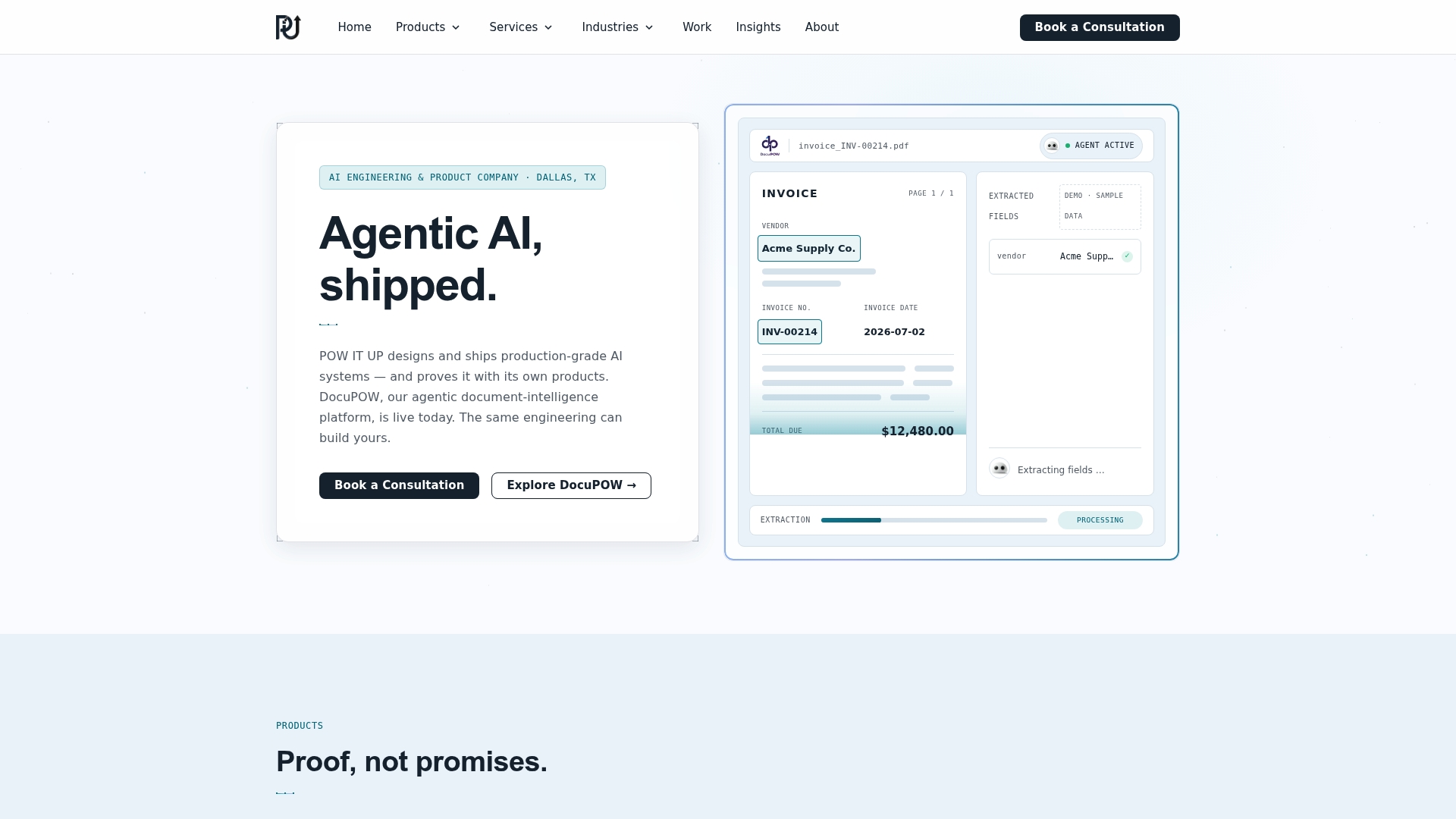
POWITUP designs, builds, and deploys custom AI agents and automation systems that execute the optimized workflows your team has identified. Rather than handing you a framework and leaving, POWITUP functions as a technical architect: mapping your highest-impact processes, building context-aware AI agents that handle high-volume transactional work, and eliminating the “time leaks” that drain capacity without appearing on any org chart. The result is a digital workforce that scales processing volume without a corresponding increase in headcount or management overhead.
For business leaders who have already done the process redesign work and need the execution layer, or for those who want a partner to handle both, POWITUP’s AI integration services are built for exactly that. Explore what a custom AI workforce could do for your operations at powitup.com.
FAQ
What is the meaning of business optimization?
Business optimization is the continuous process of improving an organization’s operations, workflows, and strategies to increase efficiency, reduce costs, and align performance with long-term goals. It applies across functions including supply chain, customer service, finance, and human resources.
How do I optimize my business?
Start by identifying your highest-impact, most friction-heavy processes, map how they actually work today, set measurable KPIs, redesign the workflow to remove waste and delays, then test with a small group before rolling out broadly. Treat it as a repeating cycle, not a one-time project.
What is the difference between process optimization and process improvement?
Process improvement makes incremental fixes to specific tasks within an existing workflow. Process optimization takes an end-to-end view, redesigning the full workflow to eliminate waste, reduce variation, and align the entire chain with business goals.
What are the 3 P’s of business success?
Definitions vary across frameworks, but a widely used version covers People, Processes, and Performance: the right team executing well-designed workflows, measured against outcomes that matter to the business.
How does POWITUP support business optimization?
POWITUP designs and deploys custom AI agents and automation systems that execute optimized workflows at scale, eliminating manual bottlenecks and allowing organizations to grow processing volume without adding headcount.
Key Takeaways
Business optimization delivers sustained gains only when it combines structured process redesign, continuous measurement, and automation applied to workflows that are already clean.
| Point | Details |
|---|---|
| Optimization is a cycle, not a project | Successful projects run DMAIC at least twice, with quarterly reviews in year one to lock in gains. |
| Fix the process before automating it | Automating a broken workflow scales inefficiency; redesign first, then apply automation to what remains. |
| AI delivers measurable returns | Strategic AI deployment in optimized workflows produces 30–50% operational cost reductions and 2–5x ROI within year one. |
| Change management predicts success | Employee involvement, clear ownership, and visible results are what separate lasting gains from temporary fixes. |
| POWITUP executes the automation layer | POWITUP builds custom AI agents that deploy optimized workflows at scale, turning process redesign into permanent operational capacity. |