
Future-ready growth means building a company that keeps performing today while it changes how it works, so the next shift in markets, technology or customer behavior becomes an opening instead of a threat. The best-documented strategies share a pattern: a clear purpose, disciplined operations, a steady rhythm of experiments, and digital capabilities that let volume grow faster than cost. This guide turns that research into a plan an operations-minded leader can start this quarter.
TL;DR
- Future-ready firms are rare: a study of 1,311 firms found only 22% qualify, and those that do report far stronger revenue growth and margins.
- The common thread across McKinsey, IMD, BCG and the World Economic Forum is running two horizons at once: efficiency in the core and deliberate exploration of new growth.
- Start with your operational time leaks. Map the repetitive, high-volume work, then automate the steps with the clearest rules and the highest volume first.
- AI agents and workflow automation add capacity without forcing you to hire at the same pace as volume. Pair them with transparent communication to your team.
- Measure with a short list of leading and lagging indicators, and review them on a fixed rhythm.
Table of Contents
- What future-ready growth actually means
- Six strategies the research keeps returning to
- Run two horizons at once
- Find your time leaks before you pick tools
- Where AI agents and automation fit
- Perspective
- Leadership, skills and culture
- A 90-day plan and how to measure it
- Managing risk while you scale
- Putting this to work with POW IT UP
- FAQ
- Sources
What future-ready growth actually means
The phrase gets used loosely, so it helps to pin it down. Researchers at MIT’s Center for Information Systems Research studied 1,311 global firms and defined a future-ready firm as one that has gone through the business transformation needed to use digital capabilities to innovate, engage and satisfy customers while reducing costs. Only 22% met that definition. Those firms reported estimated average revenue growth 17.3 percentage points above their industry average and a net margin 14 percentage points higher.
Those numbers come from a global sample, not only US companies, and they show correlation, not a guarantee. They are still a useful signal about where the gap opens: not in who has the most software, but in who has reorganized work around it.
Harvard Business Review frames the same idea as a measure of how well a company can adapt, how robust its internal capabilities are, and how capable it is of finding new sources of growth. In a crisis, it adds, that readiness doubles as resilience. Growth and resilience are one project, not two.
For a US owner or COO, that translates into three practical questions:
- Can we take on 30% more volume without a 30% rise in cost?
- Can we change an offer, a price or a process in weeks instead of quarters?
- Do we know which parts of the business are earning their keep, and which are only consuming attention?
If the honest answer to any of these is no, that is where your strategy starts.
Six strategies the research keeps returning to
No single framework wins. But when you read the major ones side by side, the same moves show up under different names.
The World Economic Forum lists six strategies for resilient businesses: reinvent from within, use megatrends for resilience, grow with green practices, embrace AI with a clear and transparent approach, foster innovation through collaboration, and align with your purpose.
McKinsey’s work on future-ready companies adds that they know who they are and what they stand for, operate with a fixation on speed and simplicity, and scale their ability to learn and innovate, whatever the origin of a good idea.
MIT Sloan Management Review describes dynamic strategy as four repeating activities: sensing new insights, organizing in response to threats or opportunities, capturing value by revising the business model, and renewing capabilities by monitoring results.
Boiled down for a growing company, that gives you six working moves:
| Move | What it looks like in a mid-sized US business |
|---|---|
| Clarify purpose and edge | One sentence on who you serve and why you win, used to say no to distractions |
| Simplify and speed up | Fewer approval layers, fewer hand-offs, shorter cycle times |
| Sense early | A standing review of customer, competitor and regulatory signals |
| Experiment in small bets | Funded pilots with a defined stop or scale decision |
| Build digital capacity | Automating high-volume work so growth does not need linear hiring |
| Develop people and culture | Training, clear ownership and open debate about trade-offs |
The fifth row is where most operational leaders can move fastest, and where we spend most of our time with clients.
Run two horizons at once
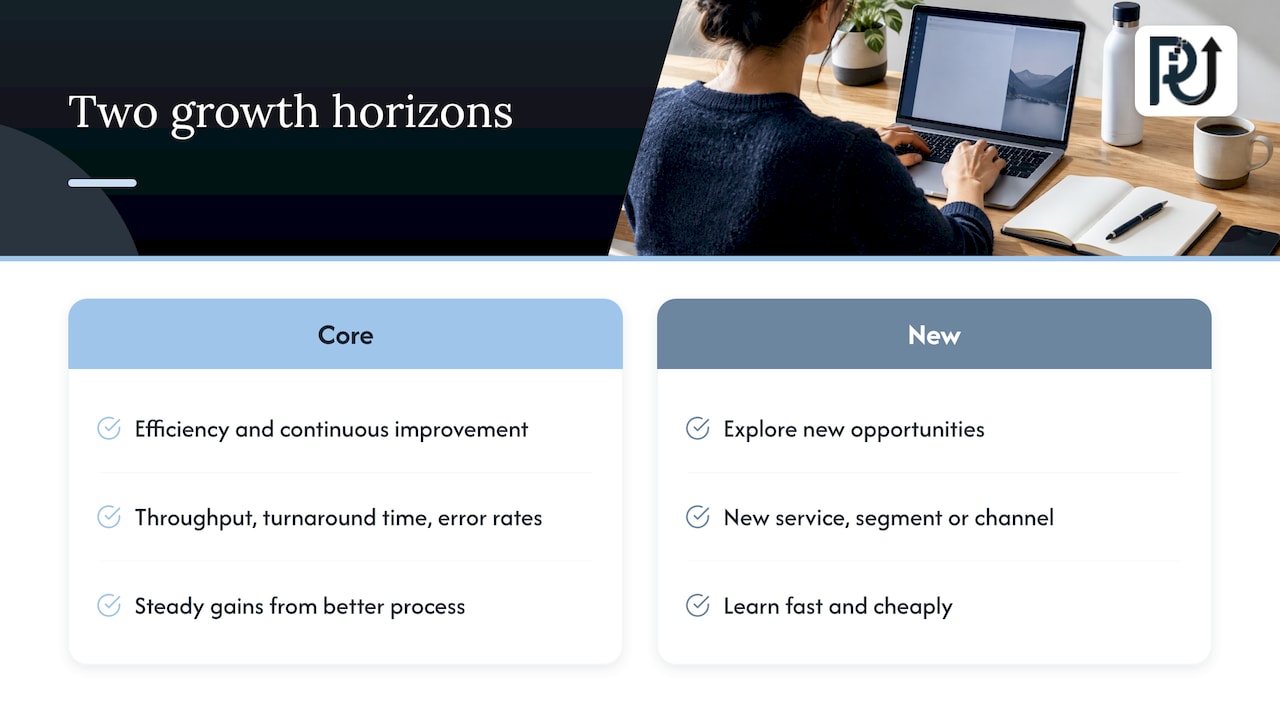
The most common failure is treating transformation as a replacement for running the business. IMD’s research says the most successful future-ready organizations operate on dual horizons: they keep performing while transforming, driving efficiency and continuous improvement in the core while exploring new opportunities with equal effort.
In practice, that means splitting your planning into two lists.
Horizon one: the core. Throughput, turnaround time, error rates, cost per transaction, customer retention. The goal is steady gains from better process, not heroic change.
Horizon two: the new. A new service line, a new customer segment, an AI-assisted product feature, a new channel. The goal is learning fast and cheaply.
The link between the two is capacity. Every hour you free in the core, through automation or better workflow, can be reassigned to the second horizon. That is why efficiency work is a growth strategy, not a cost-cutting side project.
A rhythm helps. Harvard Business Review’s guidance for volatile periods is to build a rhythm of awareness, experimentation and execution and to direct resources to three capabilities: prediction, adaptability and resilience. A quarterly cycle works for most small and mid-sized firms: sense in the first few weeks, pick two or three bets, execute, then review and reallocate.
Founders who want a structured way to test ideas before committing budget can also look at a step-by-step idea validation method that fits the experiment stage of this cycle.
Find your time leaks before you pick tools
The usual mistake in automation planning is starting with a tool. Start with a map of where time actually goes.
A time leak is work that is repetitive, rule-based, high in volume and low in judgment: re-keying data between systems, chasing missing documents, reconciling spreadsheets, routing requests, drafting standard replies. These tasks rarely appear on a strategy slide, yet they quietly cap how much volume a team can absorb.
A simple scoring method
List every recurring process in one department, then score each from 1 to 5 on four criteria:
- Volume: how many times per week or month does it run?
- Rule clarity: could you write the decision rules on one page?
- Data readiness: is the input digital, or does it arrive as scanned PDFs and emails?
- Cost of error: what happens when it goes wrong?
High volume and high rule clarity make the best first candidates. High cost of error does not rule a process out, but it means you design review checkpoints into the workflow from day one.
Mapping also pays off on its own. In a report on scaling with agentic AI, Forbes Tech Council notes that Microsoft teams mapped 27 discrete steps in a vendor-onboarding process before releasing a suite of third-party risk agents. The map came first, the agents second.
A word on budgeting. Spend varies enormously. Ramp’s 2026 Summer Business Spending Report, built on US firm data, found the median AI adopter on its platform spends $11.95 per employee per month, while the top 10% spend $650 and the top 1% more than $7,400. Tool subscriptions are the small part of the picture for most companies. The larger investment is the design work that makes a system fit your processes.
Where AI agents and automation fit
Traditional automation follows fixed scripts: if this field changes, do that. It works until the input varies. AI agents are context-aware, so they can read a document, decide what it is, check it against your rules and route it, escalating only the exceptions to a person.
That difference matters for the workloads US companies struggle with most:
- Document-heavy intake: loan files, insurance claims, patient paperwork, vendor onboarding, accounting source documents.
- Client monitoring: watching a portfolio or customer base for early signs of trouble.
- Transactional operations: order handling, task assignment, status updates, reconciliation.
On headcount, the honest picture is nuanced, and it favors growth. Ramp’s data on 21,559 US firms found that firms that heavily adopt AI grew headcount 10.2% over the following two years, with entry-level headcount up 12%. The data does not prove cause and effect, but it fits a pattern we see: capacity that automation releases gets reinvested in growth, so teams expand where judgment, relationships and selling matter, not where keystrokes pile up.
The goal, then, is not a smaller company. It is a company where volume can double without the back office doubling.
If you want to see how this plays out in detail, our guides on automation as a business process game changer and growing through technology walk through the operational side.
Perspective
Most growth plans fail in the gap between the strategy deck and the daily workflow. Leaders agree on a vision, then ask the same overloaded team to deliver it on top of their current jobs.
We build digital workforces to close that gap. Our approach is to design custom, context-aware AI agents around how your operation really runs, instead of forcing your process into a generic script. We start by hunting for the time leaks: the high-volume, transactional work that drains hours and caps what your team can take on.
We believe the right measure of an automation project is durable ownership. You should understand what was built, be able to maintain it, and hold the engineers accountable for how it behaves. That is why we favor transparent processes and documented engineering, and why we offer live demo products such as DocuPOW so you can see document reading and validation working before you commit to anything larger.
Our view is that future-ready growth is an operations discipline first. Companies that automate the repeatable can put their best people on the work that grows the business.
Syed Naveed Abbas
Leadership, skills and culture
Technology only compounds when people are ready to use it. McKinsey’s research says future-ready organizations create strong and distinct cultures that help them attract and keep the best people, and that they get clear on purpose and on how they create value.
IMD adds a leadership point worth acting on. Future-ready leaders build a shared long-term viewpoint that makes room for the trade-offs between performing and transforming, encourage healthy debate and build trust. Teams that disagree openly about priorities make better bets than teams that nod and drift.
Three habits to put in place:
- Name an owner for every automated process. Someone in the business, not only IT, is accountable for results and exceptions.
- Tell people early how AI is used. The World Economic Forum advises treating AI as a means, not an end goal, and says transparent communication about its role in decisions and its implications for the workforce can make it an empowering tool rather than a source of disruption.
- Teach exception handling. When agents do the routine work, your people spend more time on the cases that need judgment. Train for that explicitly.
Leaders of technology businesses can also borrow practices on how to experiment, learn and execute as a team rather than as isolated functions.
A 90-day plan and how to measure it
MIT Sloan’s researchers describe a five-step journey: motivate, commit, anticipate, build and accumulate, the last meaning you create, capture and track value from operations, customers and ecosystems. BCG similarly urges leaders to picture the company five or even ten years out as a North Star and then prepare a roadmap of practical steps.
Here is a 90-day version for a mid-sized firm.
- Days 1 to 15: set the North Star and baseline. Write your three-year picture in one page. Record today’s numbers: cost per transaction, turnaround time, error rate, revenue per employee.
- Days 16 to 35: map and score. Run the time-leak scoring on one or two departments. Pick the top three candidates.
- Days 36 to 60: pilot one process. Choose the one with the highest volume and clearest rules. Define the success threshold and the exception path before building.
- Days 61 to 80: run alongside people. Let the system and the team work in parallel, compare results, and fix edge cases.
- Days 81 to 90: decide and plan. Scale, adjust or stop. Choose the next two processes and fund the horizon-two bet your freed capacity supports.
What to track
Keep the dashboard short. Four lagging indicators and four leading ones are enough.
| Lagging (results) | Leading (early signals) |
|---|---|
| Revenue growth | Cycle time per process |
| Gross and net margin | Share of work handled without manual touch |
| Cost per transaction | Exception rate and time to resolve |
| Customer retention | Number of experiments launched and decided |
Review them monthly, and make a scale-or-stop decision on every experiment at the end of each quarter.
Managing risk while you scale
Speed without controls is not future-ready. Before any agent touches customer or financial data, settle five things:
- Data handling: which data the system can read, where it is stored, and who can see it.
- Human review: which decisions always get a person’s sign-off, especially in lending, claims and patient-related work.
- Reliability: how failures are detected, logged and escalated.
- Regulatory fit: which rules govern your industry. Fintech, healthcare and insurance each have their own, so involve your compliance lead or counsel at the design stage, not at launch.
- Transparency: a plain-language record of how the system is used and what it decides, shared with your team.
These controls are part of the build, not an add-on. For regulated work such as lending, our AI automation loan processing guide shows how review points fit into the workflow.
Putting this to work with POW IT UP
If your time-leak map shows document-heavy or transaction-heavy work, we can help you turn it into a working digital workforce. We design and build custom AI agents, integrate them with the systems you already run, and automate high-volume operations so your team can take on more volume. Our AI agents development service starts with your process, not a template, and our AI automation work is built to be maintainable and owned by you.
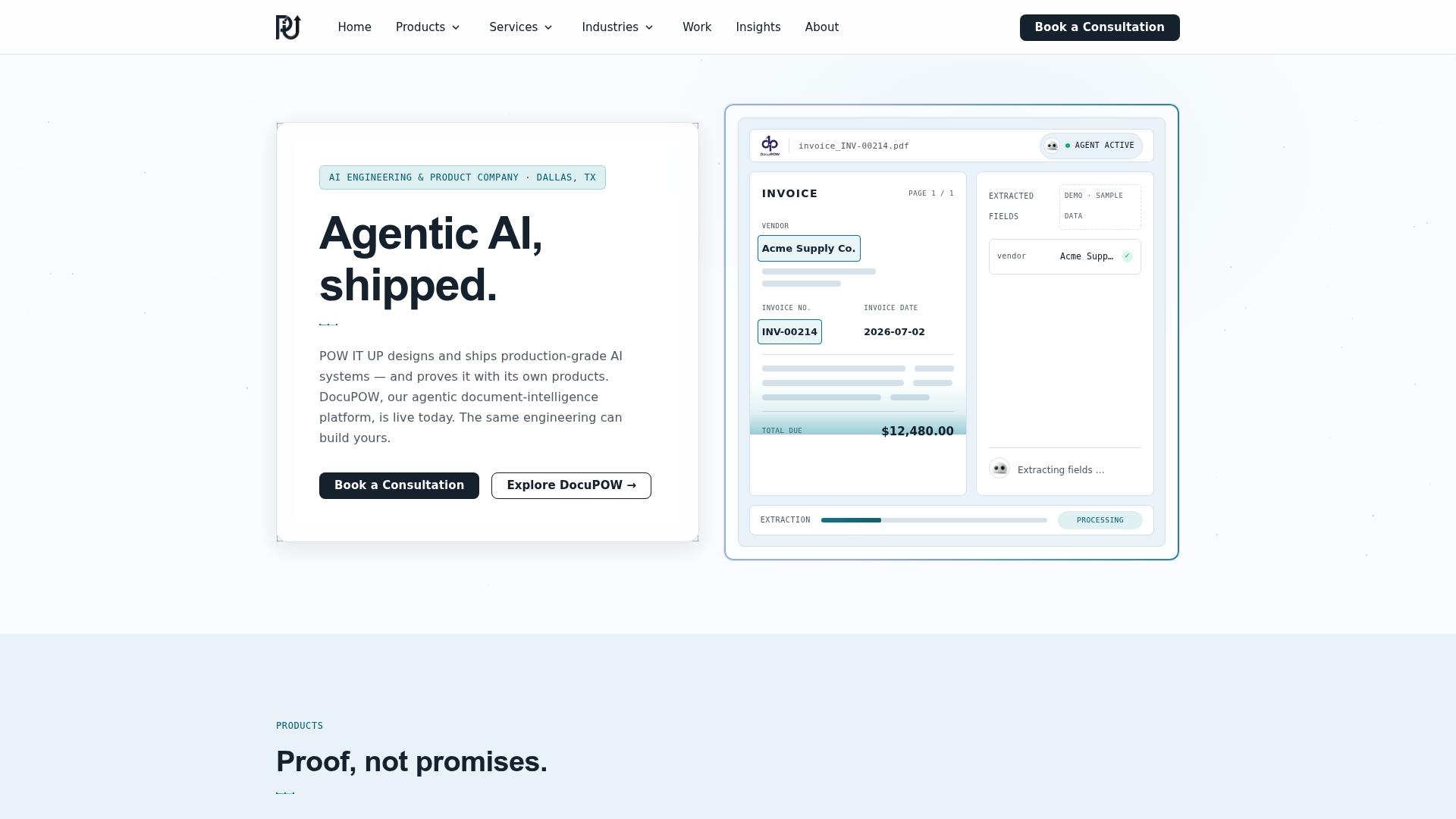
For document reading and validation, you can see DocuPOW in a live demo through the DocuPOW product page. To talk through where automation fits your growth plan, start at powitup.com.
FAQ
What is the difference between future-ready and future-proof?
Future-proof implies you can lock in protection against change, which no company can fully do. Future-ready means building the capacity to sense change and respond: adaptable processes, flexible capabilities and a culture that experiments. Our future-proofing playbook covers the practical steps.
How long does it take to see results from automation?
It depends on the process and your data. A focused pilot on one high-volume workflow can be designed, run alongside your team and evaluated within a quarter, as in the 90-day plan above. Broader programs build on those first results over several quarters.
Do I need a big budget to start?
No. Start with one process that has clear rules and high volume, and set a success threshold before you build. Spending ranges widely across US firms, so scope the pilot to a measurable outcome and expand only after it proves out.
Which processes should small businesses automate first?
Begin with repetitive, rule-based work that eats staff hours: document intake, data entry between systems, task routing and standard customer replies. Our guide to AI agents for small businesses goes deeper on where to begin.
How do I keep my team on board?
Tell them early how AI will be used, name an owner for each automated process, and train people for the exception-handling and relationship work that automation frees them to do.
Sources
- What it means to be a future-ready firm, MIT Sloan
- What Makes a Company Future Ready?, Harvard Business Review
- Resilience strategies businesses should adopt, World Economic Forum
- Nine keys to becoming a future ready company, McKinsey
- Plotting Strategy in a Dynamic World, MIT Sloan Management Review
- IMD Future Readiness Indicator: Being Future Ready
- How to Succeed in an Era of Volatility, Harvard Business Review
- Agentic AI Teams: How To Scale Without Hiring More People, Forbes Tech Council
- 2026 Summer Business Spending Report, Ramp
- For Business Leaders, the Future Is a State of Mind, BCG