
A scalable business system through AI is one where volume can double without headcount, errors or cycle times doubling with it. You get there by redesigning high-volume, rules-heavy work around AI agents and automation, keeping people in charge of exceptions and risk, and measuring results against a baseline. Buying more AI tools does not get you there. This guide covers which processes to start with, how to get from pilot to production, how agents and humans split the work, and what U.S. businesses should put in place for risk and compliance.
TL;DR
- Scaling with AI means moving AI out of isolated experiments and into the core processes that drive revenue and service delivery.
- Start with frequent, structured, low-risk work, and score each candidate on volume, clarity of output, cost of error, data readiness and measurability.
- Agents handle routine multi-step work inside defined limits. Humans own exceptions, approvals and accountability.
- Treat governance as continuous, not a one-time sign-off. The NIST AI Risk Management Framework is the U.S. reference point.
- Measure against a baseline before launch: hours, cycle time, cost per transaction and error rate.
Table of Contents
- What scaling a business with AI actually means
- Which processes to automate first
- From pilot to production: the steps that matter
- How agents, automation and people share the work
- Measuring whether it is working
- Risk, security and compliance for U.S. businesses
- Our perspective
- Where POW IT UP fits
- A practical 90-day plan
- FAQ
- Sources
What scaling a business with AI actually means
Most companies have run an AI pilot by now. A support team tries a chatbot, finance tests invoice extraction, and someone in sales uses a writing assistant. Scaling is what happens when those experiments stop being side projects. AWS describes AI scaling as increasing the use and scope of AI beyond isolated projects so that it is built into core services, products or business processes.
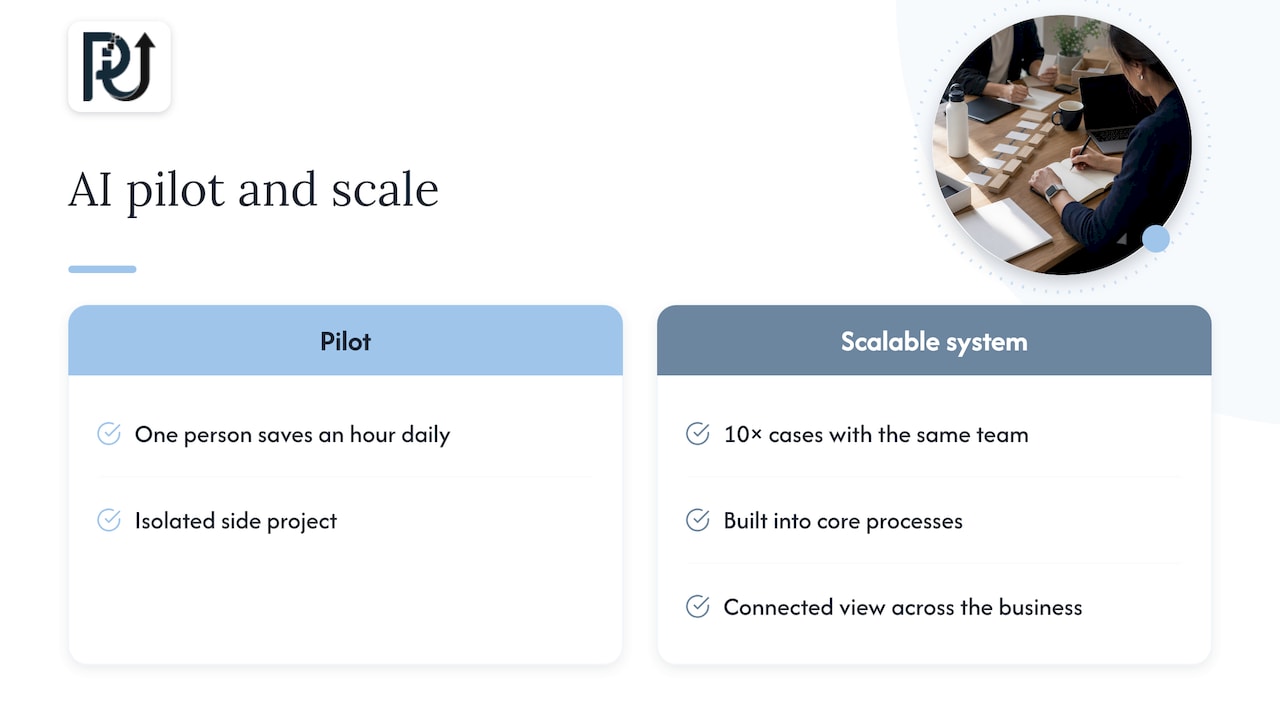
The difference shows up in the numbers you care about. A pilot saves one person an hour a day. A scalable system lets the business process ten times the documents, tickets or onboarding cases with the same team, because the work no longer passes through a person at every step.
There is also a strategic payoff. IBM notes that AI at enterprise scale moves tools out of silos, which gives a company a connected, data-driven view across the business rather than a pile of disconnected wins.
Why adding AI on top of old workflows plateaus
A 2026 paper in the Harvard Data Science Review, published by MIT Press, argues that layering AI onto workflows designed around people captures only marginal benefits. The larger gains come when the workflow itself is redesigned around autonomous, agent-centric steps. That matches what we see in practice: if a process still has six handoffs and three approvals designed for a human pace, an assistant at step four will not change the outcome.
This is why we frame scalability as an engineering problem, not a software purchase. Our approach to scaling AI operations past the pilot starts from the process, then decides where agents, rules and people belong.
Which processes to automate first
The fastest way to waste an AI budget is to start with the most exciting process instead of the most suitable one. Good first candidates are frequent, structured and low-risk. A Forbes Business Council piece from October 2025 lists examples such as CRM data entry, meeting scheduling, status notifications, SLA reminders, routine report assembly and lead routing.
At the function level, TechTarget’s 2026 roundup points to customer service, IT operations, process automation, supply chain and inventory management, and financial planning as areas with measurable business value. In IT, that includes service desk work, ticket summarization and routing, log analysis, anomaly detection, provisioning, patching and incident remediation.
A five-point scoring test
Navelo Software suggests scoring each candidate process on five criteria. We use the same logic in discovery, in our own words:
| Criterion | The question to ask | Strong signal |
|---|---|---|
| Volume | How often does this run each week? | Hundreds or thousands of runs |
| Clarity of correct output | Could two experienced staff agree on the right answer? | A clear, checkable result |
| Cost of error | What happens if the output is wrong? | Low cost, or easy to catch before it matters |
| Data readiness | Is the input data accessible and reasonably clean? | Digital, consistent, reachable by API |
| Measurability | Can you count time, cost or errors today? | A baseline already exists |
Score each process from 1 to 5 on each line and rank the totals. The top of the list is usually unglamorous: reading and validating documents, reconciling records, routing requests, preparing recurring reports. That is also where scale comes from, because those tasks grow in step with revenue.
Examples by industry
- Fintech and accounting: document intake, validation of statements and invoices, exception queues for review.
- Healthcare practices: intake forms, referral handling, scheduling reminders and billing documentation, under the privacy rules covered below.
- Logistics and e-commerce: order exceptions, quote and invoice processing, inventory alerts.
- Service businesses: lead routing, client onboarding, CRM updates. Our guide to AI integration in CRM for service businesses goes deeper on this one.
Document-heavy work deserves a special mention because nearly every industry has it. That is the problem our DocuPOW product is built for: reading and validating documents so that staff only see the cases that need judgment.
From pilot to production: the steps that matter
Pilots stall for predictable reasons: no owner, no clean data, no integration with the systems where work happens, and no agreed definition of success. Snowflake’s implementation guide lays out a useful sequence. Before a pilot, define the workflow, the users, the data you can access, the risks, the review process and the ROI target. Then assess value, data readiness, workflow fit, risk, integration complexity and the burden of reviewing outputs.
After launch, the same guide says to operationalize: monitoring, feedback loops, access reviews, updated evaluations, clear ownership, and lessons fed into the next use case. We would put it as a simple loop:
- Pick one process that scores well on the five criteria above.
- Write down the baseline: volume, hours, cost per transaction, error rate, turnaround time.
- Map the real workflow, including the workarounds nobody documented.
- Connect the systems. An agent that cannot read from and write to your CRM, ERP, core system or document store is a demo, not a system. See our overview of AI integration services for business leaders.
- Define the limits: what the agent may decide alone, what it must escalate, who reviews.
- Run in parallel, then cut over once results match or beat the baseline.
- Monitor and reuse. Build the next process on the same foundations.
The last step is where scalability compounds. IBM’s guidance on scaling AI in an organization stresses investing in people, processes and tools together, assembling cross-functional teams, and standardizing how AI is developed and deployed through MLOps. Standard patterns mean the fifth automation costs far less to build than the first.
Infrastructure planning
Scaling also has a cost side. AWS notes that AI scaling adds complexity and cost, and that governance, security and performance degradation are common challenges. Plan for platform overhead from the start rather than discovering it in month six. We cover this in scalable AI infrastructure for leaders, and the budgeting side in our AI automation cost and ROI breakdown.
How agents, automation and people share the work
A scalable system is not a swarm of autonomous agents with no supervision. It is a layered design. Microsoft’s business process transformation pattern describes it well: workflows handle deterministic, rule-based steps for predictable tasks. Agents orchestrate multi-step work across systems, make routine decisions within defined boundaries and escalate exceptions to humans. People set the autonomy limits, review exceptions, monitor KPIs and remain accountable for business results.
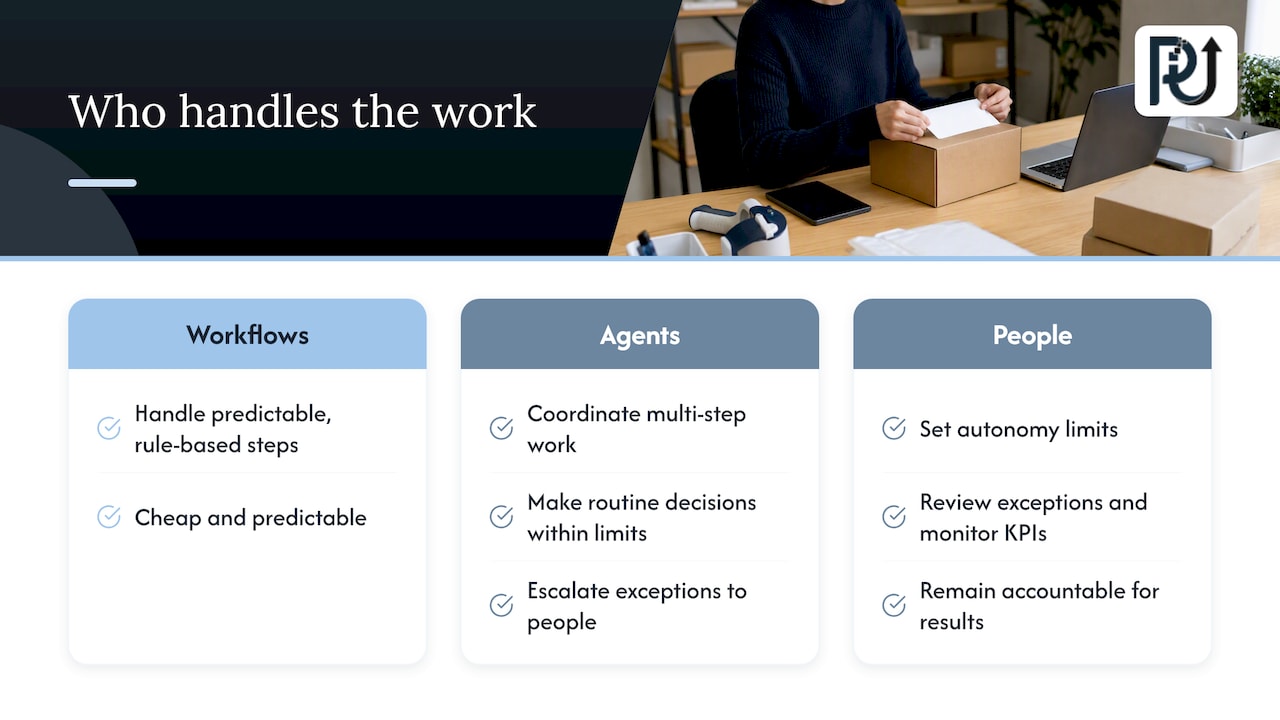
That split matters for two reasons. First, it keeps cost and speed where you want them: rules are cheap and predictable, agents are flexible, and people are expensive and best used where judgment counts. Second, it gives you a clear answer when something goes wrong, because every decision has an owner.
Start with decision support
The same Forbes Business Council author recommends using AI first for decision support: summarizing case histories, classifying requests, extracting data from documents, flagging KPI anomalies and drafting responses. Humans keep approvals, escalations and any action with financial, legal or customer-facing risk. As confidence grows and the data supports it, you widen the agent’s limits one step at a time.
A simple autonomy ladder
| Level | What the agent does | Who decides |
|---|---|---|
| 1. Assist | Drafts, summarizes, extracts | Person does the work, using the draft |
| 2. Recommend | Proposes an action with its reasoning | Person approves each action |
| 3. Act with review | Executes routine cases, queues exceptions | Person reviews exceptions and samples |
| 4. Act within limits | Executes inside defined boundaries, escalates outside them | Person monitors KPIs and audits |
Most processes should sit at level 3 for a while. Moving up is a decision you make with data, not a default.
Measuring whether it is working
If you cannot say what the process cost before automation, you cannot prove what it saves after. Capture four numbers per process before launch: volume per week, human hours per unit, cycle time and error rate. Then compare monthly.
Published results show what the upper end looks like. C.H. Robinson reports that it improved productivity by over 35% since the end of 2022 by deploying more than 30 AI agents across its quote-to-cash lifecycle. The same post reports Q2 2025 earnings per share of $1.29 and operating expenses down by more than $30 million year over year. In the HDSR case study of a global industrial firm, rebuilding audit workflows around autonomous agents cut audit report creation from 24 hours to 2 hours, about 92%, in the first six months.
These are results from large organizations with their own data and processes, not forecasts for yours. Use them to calibrate ambition and set your own targets from your own baseline. Track:
- Capacity: units processed per person per week.
- Speed: time from request to completion.
- Quality: error and rework rates, plus exception rate over time.
- Cost: fully loaded cost per transaction, including platform and review time.
- Growth: volume you can now take on without hiring.
Our piece on AI efficiency gains for leaders looks at how early gains tend to build toward agentic work.
Risk, security and compliance for U.S. businesses
Scale multiplies mistakes as well as output, so governance has to grow with the system. For U.S. organizations, the reference point is the NIST AI Risk Management Framework. It organizes the work into four functions, GOVERN, MAP, MEASURE and MANAGE, and names the traits to build toward: validity and reliability, safety, security and resilience, accountability and transparency, explainability and interpretability, privacy, and fairness with harmful bias managed.
Two points from NIST are worth building into your operating model. Governance is continuous and spans the whole lifecycle of a system; it is not a one-time approval. And documentation supports transparency, human review and accountability, so write down what each agent does, what data it touches and who owns it.
The U.S. Government Accountability Office, in a 2026 report on AI uses and risks, notes that human review can mitigate inaccurate outputs, privacy and security problems, and overreliance on AI. That is the practical case for the exception queues and approval points described above.
Controls to put in place before you scale
- Access: give each agent the minimum permissions it needs, and review them on a schedule.
- Data handling: decide what may leave your environment. In healthcare, involve your compliance officer early on any workflow touching patient information. In financial services, involve compliance and your regulators’ guidance for your charter.
- Evaluation: test agents on real examples, including edge cases, and re-test after every change to a model or prompt.
- Logging: keep an audit trail of inputs, outputs and decisions so any result can be explained.
- Ownership: name one accountable person per automated process.
Our perspective
Most of the AI projects we are asked to rescue did not fail on the model. They failed on the plumbing: the agent could not reach the right system, nobody owned the exceptions, and nobody had measured the starting point.
That is why we build digital workforces as engineered systems. We start by finding the time leaks in a process, then design agents that are context-aware rather than generic scripts, connect them to the systems where your work lives, and set clear limits on what they decide alone. Our goal is for you to own what we build and be able to maintain it, with transparent processes along the way.
We believe scale comes from volume that grows without a matching rise in headcount. A well-built agent layer takes on the repetitive transactional work, such as reading documents, validating records and routing cases, so your people spend their time on judgment, relationships and growth. DocuPOW is our live example of this approach for document intelligence, and you can see it working before you commit to anything.
Syed Naveed Abbas
Where POW IT UP fits
If you have a process that scores well on volume and measurability, we can help you design and build the system around it. We build custom AI agents, integrate them with your existing platforms, and automate the workflows around them, with cloud and data analytics to track results.
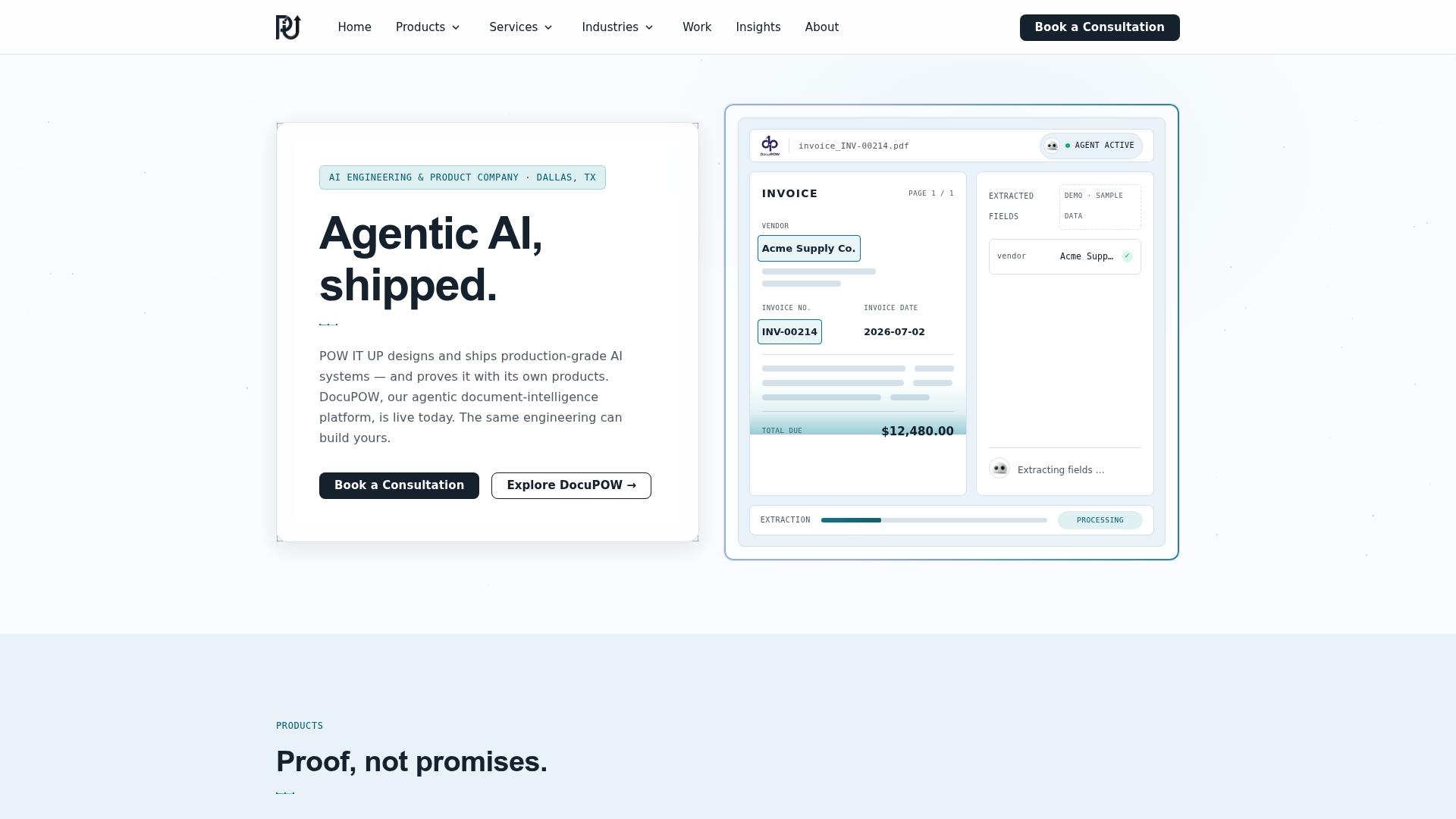
For document-heavy operations, DocuPOW reads and validates documents so your team handles only the exceptions. You can see how DocuPOW works and request a demo.
If you would rather scope a custom build, start with our AI automation services or AI agents development. Both begin with the same question: which process, at what volume, is holding your growth back?
A practical 90-day plan
You do not need a transformation program to begin. A focused first quarter looks like this:
- Weeks 1 to 3: list ten candidate processes, score them with the five criteria, and record baselines for the top three.
- Weeks 4 to 8: build and integrate the first automation at assist or recommend level. Run it alongside the current process.
- Weeks 9 to 12: move to act-with-review, compare against the baseline, and document the pattern so the second process reuses it.
By the end you should have one measured win, a repeatable build pattern, and a ranked backlog. That is the beginning of a scalable system rather than another pilot.
FAQ
What is the difference between AI automation and AI agents?
Automation follows fixed, rule-based steps and suits predictable tasks. Agents work across several steps and systems, make routine decisions inside defined limits, and escalate exceptions to people. Scalable systems usually combine both, with rules for the predictable parts and agents for the variable ones.
Can a small or mid-sized business build scalable systems with AI?
Yes. The approach is the same at any size: pick one high-volume, low-risk process, record a baseline, and automate it with clear review points. Smaller firms often move faster because they have fewer systems and fewer approval layers. Our page on custom AI agents for small businesses shows what that can look like.
How do I know if a process is ready to automate?
Score it on volume, clarity of the correct output, cost of error, data readiness and measurability. A process that runs often, has a checkable result, can tolerate review of mistakes, has digital inputs and already has a baseline is ready. If it fails on data readiness, fix the data first.
Do AI systems replace the people who run these processes?
The aim is to let volume grow without a matching rise in headcount, not to remove accountability. People set the limits, handle exceptions, approve higher-risk actions and own the results. Their time shifts from repetitive handling to work that needs judgment.
Which U.S. framework should guide AI governance?
The NIST AI Risk Management Framework is the main voluntary U.S. reference. It structures governance around its GOVERN, MAP, MEASURE and MANAGE functions. Add any sector rules that apply to you, such as those for healthcare or financial services, and confirm them with your compliance counsel.
Sources
- What is AI Scaling? (AWS)
- AI Pilots are Fun. AI at Scale is a Business. (IBM)
- How To Scale AI In Your Organization (IBM)
- The Agent-Centric Enterprise (Harvard Data Science Review, MIT Press)
- Streamlining Business Processes With Automation And AI (Forbes Business Council)
- 10 AI business use cases that produce measurable ROI (TechTarget)
- Which Business Processes to Automate With AI (Navelo Software)
- AI Transformation Implementation Guide (Snowflake)
- Core business process transformation pattern (Microsoft Learn)
- Lean AI and Relentless Improvement (C.H. Robinson)
- Artificial Intelligence Risk Management Framework (NIST)
- Artificial Intelligence: Uses and Risks (GAO-26-107828)