

Autonomous workflow systems are orchestration platforms where AI agents plan and execute multi-step business processes with limited human prompting at each step. They cut the handoffs that slow traditional automation and let throughput scale without a matching rise in headcount. None of that works without a staged pilot and governance built in from day one.
TL;DR:
- Autonomous workflow systems require careful staging, governance, and clear outcome definitions before scaling from pilot to production.
- Key capabilities include planning, tool use, state awareness, and escalation, which introduce complexity and risk not present in deterministic automation.
- Resilience, observability, and secure permission management are critical to prevent failures and maintain accountability during deployment.
- Success depends on measuring success rates, latency, costs, and exception rates, with escalation thresholds set prior to pilot phases.
- Gradual expansion following NIST’s risk framework and structured pilot testing reduces failure risks and ensures reliable scaling of AI-driven workflows.
Table of Contents
- What Makes a Workflow System Autonomous
- How Agentic Workflows Actually Run
- Designing an Architecture That Holds Up in Production
- Weighing the Benefits Against the Real Limitations
- A Pilot-to-Scale Roadmap Built on NIST’s Risk Framework
- How POW IT UP Approaches Production Autonomy
- What Leaders Should Prioritize This Year
- Getting From Pilot to Production With POW IT UP
- Sources
- FAQ
What Makes a Workflow System Autonomous
An autonomous workflow system combines one or more AI agents with an orchestration layer that sequences tasks, calls tools, and loops in people only when a rule or a confidence threshold demands it. The agents do not just follow a fixed script: they interpret a goal, choose among available actions, and adjust when conditions change. That is the dividing line between this category and traditional robotic process automation, which executes the same click path every time and breaks the moment a screen layout shifts.
Rule-based automation is deterministic. Give it the same input twice and it does the same thing twice, with no judgment applied. Autonomous workflow systems introduce planning and tool selection, which raises capability and raises risk at the same time: an agent that can choose its own path can also choose the wrong one.
A handful of traits separate a genuinely autonomous system from a scripted one:
- Planning: the agent breaks a goal into steps and adjusts the plan when a step fails or new information arrives.
- Tool use: it calls APIs, reads documents, or operates software interfaces to complete a task rather than waiting for a human to do it.
- State awareness: it tracks where a process stands across systems, not just within a single session.
- Escalation: it recognizes when a decision exceeds its confidence or authority and routes the case to a person.
Vendors describe these systems under different labels, including smart workflow systems and intelligent workflow automation, but the underlying architecture is the same: agents making bounded decisions inside an orchestrated, auditable process.
How Agentic Workflows Actually Run
Inside a production autonomous workflow, several agent roles typically divide the labor. An orchestrator agent owns the plan and decides what happens next. One or more specialist agents handle narrow tasks such as document extraction, data lookup, or drafting a response. A critic or guardrail agent checks outputs against business rules before anything ships, catching errors the specialist might miss.
The orchestration layer carries the operational weight. It sequences tasks in the right order, monitors whether each step actually completed, retries failed calls, and runs compensation logic when a downstream action needs to be reversed. This is closer to distributed systems engineering than it is to prompt writing.
Tool integration is where most of the real engineering happens:
- Define a data contract for every tool the agent can call, including expected inputs, outputs, and failure responses.
- Prefer API integrations over UI automation wherever an API exists, since UI automation breaks whenever a vendor changes a screen.
- Build document parsing as a discrete, testable step rather than folding it into the agent’s reasoning, so extraction errors are easy to isolate.
- Log every tool call with enough context to reconstruct what the agent saw and why it acted.
Observability is the hardest part to get right, and it is also where most failures hide. An agent can reason correctly about the information it has and still produce a bad outcome because it cannot see the downstream effects of its own action inside a large enterprise system. Research on this problem, including the World of Workflows benchmark, describes this as “dynamics blindness”: frontier language models tested against a simulated enterprise environment with thousands of interacting business rules struggled to anticipate cascading effects their actions triggered elsewhere in the system. The benchmark’s enterprise-style environment, built with more than 4,000 business rules across 55 workflows, was constructed specifically to expose this gap.
Exception handling has to assume agents will occasionally be wrong in ways that are not obvious from the output alone. Set confidence thresholds that trigger human review automatically. Require a second check before any irreversible action, such as a payment or a contract send. Keep a reversible compensation path for actions that do run, so a mistaken step can be undone without manual cleanup across five systems.

Pro Tip: Treat every agent action with a side effect outside its own system as reversible by design, even if reversing it is rare in practice.
Designing an Architecture That Holds Up in Production
A workable reference architecture for autonomous workflows has a short list of non-negotiable components: the agents themselves, an orchestration mesh that manages task routing and retries, a memory layer that persists context across steps and sessions, tool adapters that translate between agent output and system input, and an audit and logging layer that records every decision for later review. A policy module sits alongside all of this, enforcing what an agent is and is not allowed to do regardless of what it decides to attempt.
Three design principles keep this from collapsing under its own complexity. Composability means each agent and tool adapter does one job and can be swapped without rebuilding the whole system. Layered decoupling keeps the orchestration logic separate from the agent reasoning, so a model upgrade does not require rewriting the workflow. Governed autonomy means the system’s authority grows in steps, earned through demonstrated reliability, rather than granted all at once.
Resilience measures matter as much as the happy path:
- Modular agents that fail independently without taking the whole workflow down.
- Idempotency on every action, so a retried call does not duplicate a payment or a record.
- Checkpoints that let a long-running process resume from its last known good state instead of restarting from zero.
Security follows the same logic that governs any system with write access to production data: least privilege. An agent should hold only the permissions its specific task requires, scoped as narrowly as the underlying API allows, with fine-grained authorization checked on every call rather than once at login. A document-processing agent that can also issue refunds is a design error, not a feature.
Pro Tip: Give each agent its own service account and permission set instead of sharing credentials across agents, so an audit trail can tell you exactly which agent did what.
Weighing the Benefits Against the Real Limitations
The upside of autonomous workflows is concentrated in cycle time and scale. Multi-step processes that used to wait for a person at every handoff can run end to end, with people reviewing exceptions instead of routing every case. Parallel execution across many cases at once lets a team absorb volume growth without proportional hiring.
The limitations are not theoretical. Agents hallucinate, producing confident but incorrect outputs. Dynamics blindness means they can misjudge how an action ripples through connected systems, as the World of Workflows research documents. A locally reasonable decision can violate a downstream rule the agent never saw. And every one of these systems is only as reliable as the data feeding it: a workflow built on inconsistent source records will automate inconsistency at scale rather than fixing it.
Multi-tool, long-horizon tasks expose the largest reliability gaps. The AgencyBench evaluation, which tests agents against tasks requiring many sequential tool calls and persistent context, finds notable performance gaps between models once a workflow stretches beyond a handful of steps.
Four measurement axes matter more than any single accuracy number:
- Success or quality rate: the share of cases the agent completes correctly without rework.
- Latency: how long a full workflow takes from trigger to completion.
- Cost per transaction: the fully loaded cost of running the workflow, including model calls and infrastructure.
- Exception and override rates: how often a human has to step in, and how that rate trends over time.
The choice between heavy human-in-the-loop review and higher autonomy should follow those numbers, not an instinct about how impressive the model seems. A workflow with a low exception rate and low cost of error earns more autonomy over time. One with high stakes per transaction, such as a payment release or a regulatory filing, keeps a human checkpoint regardless of how well the agent scores in testing.
A Pilot-to-Scale Roadmap Built on NIST’s Risk Framework
Scaling autonomy safely is a sequence, not a launch event. A workable path looks like this:
- Define the outcome and the autonomy level. Decide exactly what the workflow should accomplish and how much decision authority the agent gets before a person reviews it.
- Map the actors, data, tools, and failure modes. List every system the workflow touches, every person who currently does the work, and every way the process can go wrong today.
- Build a constrained pilot. Run the workflow on a narrow slice of real cases, with a human reviewing every output before it takes effect.
- Measure against the pilot KPIs. Track quality rate, latency, cost per transaction, exception rate, and human override rate across a meaningful run of cases.
- Expand only when the numbers hold. Widen scope, raise autonomy, or add volume in stages, re-measuring at each step rather than jumping straight to full production.
The NIST AI Risk Management Framework gives this sequence a governance backbone built around four iterative functions rather than a one-time checklist. Govern sets the organizational policies, named owners, and escalation rules before any agent touches production data. Map identifies the context, the data sources, and the specific risks a given workflow carries. Measure applies quantitative and qualitative checks, which is where the pilot KPIs above plug in directly. Manage covers the ongoing response: adjusting controls, retraining, or pulling an agent back from a task it is not handling well.
Pilot KPIs need explicit stop and expand thresholds decided in advance, not debated after a bad week. A reasonable starting point: expand when the exception rate stays below an agreed ceiling for a sustained run of cases and the override rate is trending down; pause and investigate when either rate spikes or cost per transaction exceeds the manual baseline.
Production operation requires more than good pilot numbers. Each autonomous workflow needs a named human owner accountable for its performance, a documented incident response plan for when it misfires, and an audit trail detailed enough to reconstruct any decision after the fact. Testing, evaluation, verification, and validation, often shortened to TEVV, should run on a schedule, not just before launch, since model updates and upstream data changes can quietly degrade a workflow that was reliable six months earlier. McKinsey’s analysis of agentic AI adoption makes a related point worth building into the roadmap itself: treating an isolated use case as the unit of transformation tends to lose value at the handoffs between old and new process. Redesigning the full end-to-end process before assigning agents to it produces better results than bolting an agent onto a workflow that was already broken.
Pro Tip: Write your stop and expand thresholds down before the pilot starts. Deciding them after seeing the first week of results guarantees you will rationalize whatever number you got.
How POW IT UP Approaches Production Autonomy
Custom AI agents and automation systems are built for companies in fintech, healthcare, insurance, logistics, and similar transaction-heavy operations, where a workflow mistake has a direct cost attached. The practical starting point for any engagement is the same question the roadmap above asks first: what outcome, measured how, with what autonomy ceiling at launch.
From there, the engineering priorities track closely with what the research on enterprise agents recommends:
- Define success and exception rates before writing any agent logic, not after.
- Build integration architecture around documented data contracts for every tool and API the workflow touches.
- Assign a named owner for each deployed workflow, responsible for its monitoring and incident response.
- Run TEVV on a schedule rather than treating launch as the finish line.
DocuPOW applies this same discipline to document reading and validation, pairing automated extraction with the audit and exception-handling patterns described above rather than treating extraction as a black box.
What Leaders Should Prioritize This Year
Pick one end-to-end process, instrument it with real observability, and resist the urge to automate five workflows at once before any of them is proven. Assign a named owner for every agent in production, responsible for TEVV and for the exception queue, because “the model team” is not an incident response plan. Current adoption data backs a cautious posture: McKinsey-cited survey figures reported by Forbes show 23% of organizations scaling an agentic system somewhere in the business and 39% still experimenting, with no single business function past 10% in scaled use. Treat benchmark scores the same way: directional evidence of capability, never a substitute for testing against your own data and failure modes.
— Syed Naveed Abbas
Getting From Pilot to Production With POW IT UP
Most teams lose time not on the AI model but on the integration work: data contracts, legacy system quirks, and the judgment calls about where autonomy should stop. POW IT UP handles that layer directly, building custom AI agents scoped to one process at a time, with the connectors, logging, and exception rules built in rather than added later.
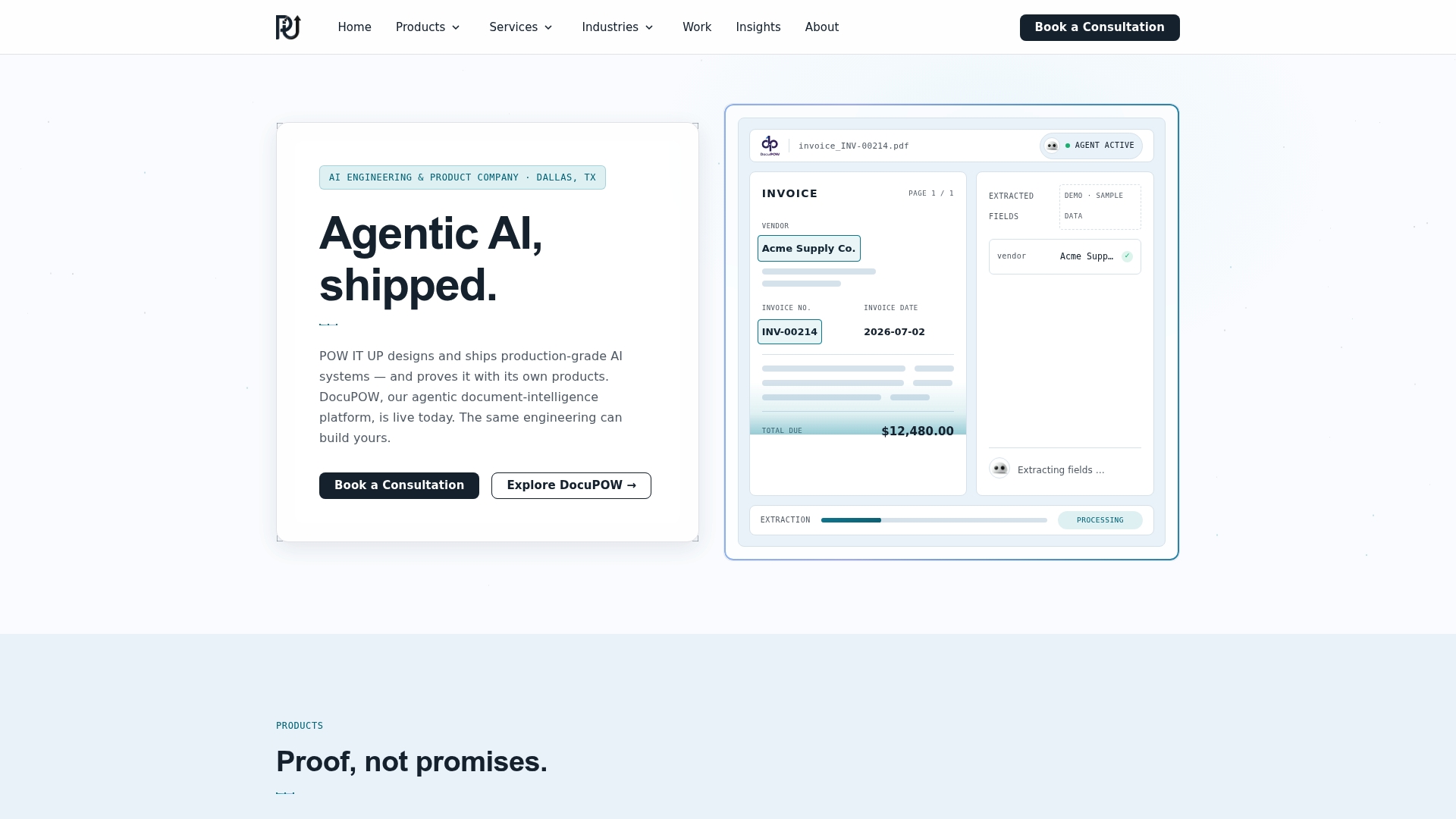
A first engagement typically starts with a discovery call to define the target process and the autonomy level, followed by a scoped pilot with agreed success metrics before anything touches full production volume. Teams dealing with high document volume often start with DocuPOW for extraction and validation, while broader process work runs through AI integration or AI automation engagements. If you have a process you suspect is ready for this, book a discovery call to scope a pilot.
Sources
- World of Workflows: A Benchmark for Bringing World Models to Enterprise Systems — arXiv (WoW)
- AI RMF core functions — NIST
- 10% Of Enterprise Functions Use AI Agents, McKinsey Finds — Forbes (citing McKinsey)
FAQ
What is an autonomous workflow?
An autonomous workflow is a multi-step business process in which an AI agent plans and executes the steps itself, calling tools and systems as needed, rather than following a fixed script written in advance. It typically includes escalation rules so a person reviews cases the agent is not confident handling.
What is the best automated workflow software?
There is no single best platform; the right choice depends on the process, the systems it touches, and how much autonomy the business is ready to grant. Evaluate any option against the same criteria covered above: quality rate, latency, cost per transaction, and exception and override rates measured in a real pilot rather than a vendor demo.
What are examples of autonomous systems?
In business operations, common examples include document intake and validation agents, customer service triage agents that route or resolve tickets, and finance agents that reconcile transactions and flag exceptions for review. Each pairs an AI agent with an orchestration layer and defined escalation rules rather than running unsupervised end to end.
Is ChatGPT autonomous?
ChatGPT on its own is a conversational model, not an autonomous workflow system: it responds to prompts but does not independently plan multi-step tasks, call external tools, or maintain state across a business process unless it is wired into an orchestration layer that does those things. Autonomy in the sense this article covers comes from that surrounding architecture, not from the underlying language model alone.