

Scalable operations are the systems and practices that let your organization handle rising demand without a proportional increase in cost or headcount. Three moves you can start this week: map your critical workflows end-to-end, pick the single highest-impact workflow to redesign first, and lock quality with documented SOPs and measurable KPIs before you touch any automation tool.
- Map critical workflows. Spend two hours with your operations lead drawing every step, handoff, and decision point in your top five revenue-generating or cost-driving processes.
- Pick one workflow to redesign. Score each workflow on impact (revenue risk, customer experience, cost) and ease of change. Start with the highest combined score, not the easiest one.
- Lock quality with SOPs and KPIs. Before piloting anything new, document the current process, define the acceptance criteria, and assign a single owner. That person signs off at every stage gate.
Assign ownership of the first pilot to whoever runs the process today, not to IT. The person closest to the work spots the failure modes fastest.
Key Takeaways
Scalable operations require process redesign before automation, adoption investment before tooling, and a governance spine before you scale.
| Point | Details |
|---|---|
| Redesign before you automate | Fix the root cause in the SOP first; automating a broken process amplifies the defect. |
| Adoption drives ROI | Bain found only 36% of frontline employees expected redesigns to succeed versus 88% of leaders; close that gap with manager enablement. |
| EBITDA impact is real | End-to-end workflow redesigns have produced EBITDA gains in a significant range; point-solution automation rarely moves the needle. |
| Governance prevents cost surprises | Token and agent costs may replace 20%–30% of headcount opex; model this before signing agent-based contracts. |
| POW IT UP connects the stack | POW IT UP builds and deploys custom AI agents and workflow orchestration so leaders can scale processing volume without proportional headcount growth. |
Table of Contents
- What does operational scalability really mean for leaders?
- The core building blocks every scalable operation needs
- How to scale a workflow: a step-by-step playbook
- Which tools and architectures actually enable scale?
- How to close the adoption gap before it kills your pilot
- Common mistakes leaders make when scaling operations
- What scalable operations look like across three sectors
- Ready-to-use SOP template, KPIs, and a pilot timeline
- Should you build internal capability or hire specialists?
- How POW IT UP helps you scale without adding headcount
- What the SERP gets wrong about scaling (and what actually matters)
- Sources
- FAQ
What does operational scalability really mean for leaders?
Operational scalability is an organization’s ability to grow its output and absorb demand spikes without sacrificing performance, quality, or efficiency. The standard indicators are consistent service quality under peak loads, throughput growth without proportional cost increases, and stable or improving customer satisfaction. Those three signals tell you whether your architecture is actually working or whether you are just adding people to keep up.
Most leaders misread the problem. They see a capacity crunch and hire. They see a slow process and buy software. Both moves can work, but neither addresses the underlying issue: the process itself is fragile, undocumented, and dependent on a handful of people who carry the logic in their heads. When demand doubles, that fragility doubles with it.
The contrast is sharp when you see it side by side. A professional services firm that routes every new client request through a senior partner for scoping is not scalable. Every new client adds hours to that partner’s calendar. Redesign the intake: a structured intake form feeds a workflow tool, a junior analyst runs the scoping template, and the partner reviews only the exceptions. Same quality output, a fraction of the senior time. That is the redesign logic that drives margin protection and customer experience stability simultaneously.
The margin protection argument is the one that gets executive attention fastest. However, the customer experience argument is the one that sustains the program. When a demand spike hits and your process holds, customers notice. When it breaks, they remember.
The core building blocks every scalable operation needs
Practical guides on operational scalability consistently point to the same foundation: the architecture must exist before automation or hiring can compound it. Six building blocks matter most.
- SOPs and playbooks. Every repeatable process needs a written procedure with a trigger, inputs, outputs, owner, SLA, and escalation path. The minimum acceptance criterion: a new hire can execute the process correctly on day two without asking anyone.
- Ownership and decision rights. Each process step has one named owner. Approvals are decentralized to the lowest competent level. If a $500 purchase requires VP sign-off, that is a governance problem, not a compliance feature.
- Standardized inputs and outputs. Variability in what enters a process creates variability in what exits it. Define the data fields, file formats, and handoff conditions before you automate anything.
- Integrations and APIs. Tools that cannot talk to each other create manual bridges. Every tool in your stack should expose an API and connect to your core systems without custom middleware you have to maintain.
- Observability and metrics. You cannot manage what you cannot see. Instrument every critical workflow with leading indicators (queue depth, time-in-step, error rate) and lagging indicators (throughput, cost per transaction, customer satisfaction score).
- Capacity-aware architecture. Cloud platforms and modular systems let you add capacity in minutes, not months. On-premise infrastructure with fixed capacity ceilings is a structural constraint on growth.
Pro Tip: Automate the process, not the workaround. If your team has built informal fixes around a broken step, automating that step will automate the broken behavior at scale. Fix the root cause in the SOP first, then automate.
How to scale a workflow: a step-by-step playbook
The Duquesne University SBDC frames the sequence clearly: assess, standardize, adopt cloud tools, automate, and measure. Here is how that plays out in practice for a leadership team running a real pilot.
-
Select the workflow. Score your top candidates on two axes: business impact (revenue at risk, cost, customer experience) and ease of change (process maturity, data quality, stakeholder alignment). Pick the workflow with the highest combined score. Involve the process owner, one frontline operator, and your finance lead in the scoring session.
-
Map it end-to-end. Document every step, decision point, and handoff. Assign a RACI (Responsible, Accountable, Consulted, Informed) to each step. The map will surface the bottlenecks and the informal workarounds you did not know existed.
-
Redesign before you automate. Remove redundant steps, consolidate handoffs, and standardize inputs. The redesigned process should be simpler than the current one. If it is more complex, you have not finished redesigning.
-
Design the pilot. Scope it to one team or one geography. Write explicit acceptance criteria (e.g., error rate below 2%, throughput up 20%, no increase in escalations). Define your measurement plan with both leading and lagging KPIs. Write rollback conditions before you start: if error rate exceeds 5% in week two, you pause and investigate.
-
Build the governance spine. Assign one executive sponsor, two process leads, a data steward, and a security owner. This small group meets weekly during the pilot. Their job is to read the KPIs, flag anomalies, and make go/no-go calls.
-
Roll by segment. After a successful pilot, expand by team, region, or customer segment, not all at once. Each expansion wave validates the process in a new context before you commit the full organization.
-
Establish a continuous improvement cadence. Monthly review of KPIs, quarterly SOP updates, and an annual architecture review. The process is never finished; it is always in the next iteration.
Which tools and architectures actually enable scale?
The tool categories that matter for operational scalability fall into five layers. The right choice in each layer depends on your current stack, your integration requirements, and how fast you need to move.
Cloud platforms are the infrastructure layer. AWS and Google Cloud both offer usage-based compute, managed databases, and serverless functions that let you scale processing capacity without provisioning servers. The decision between them usually comes down to your existing engineering relationships and which managed services fit your workload.
ERP and financial systems are the operational backbone. NetSuite handles multi-entity financials, inventory, and order management for mid-market companies scaling across business units. SAP Business One targets smaller enterprises that need manufacturing, procurement, and financials in one system. Both expose APIs that connect to workflow tools and automation layers.
Workflow and work-management platforms are where teams coordinate. Asana and Monday.com both handle task assignment, project tracking, and cross-functional visibility. The practical difference is that Asana’s rule engine is more mature for process automation, while Monday.com’s no-code board customization is faster for non-technical teams. Notion and Slite serve the knowledge layer: Notion as a flexible workspace for SOPs, wikis, and project docs; Slite as a more structured internal knowledge base with search and verification features.
Orchestration and agent stacks sit above the workflow layer. This is where AI agents, RPA tools, and integration platforms connect systems, execute multi-step processes, and surface decision-ready recommendations. According to Fairview’s operating intelligence research, next-generation operating intelligence should deliver ranked causes and viable responses so operators can act in meetings rather than spending days investigating anomalies.
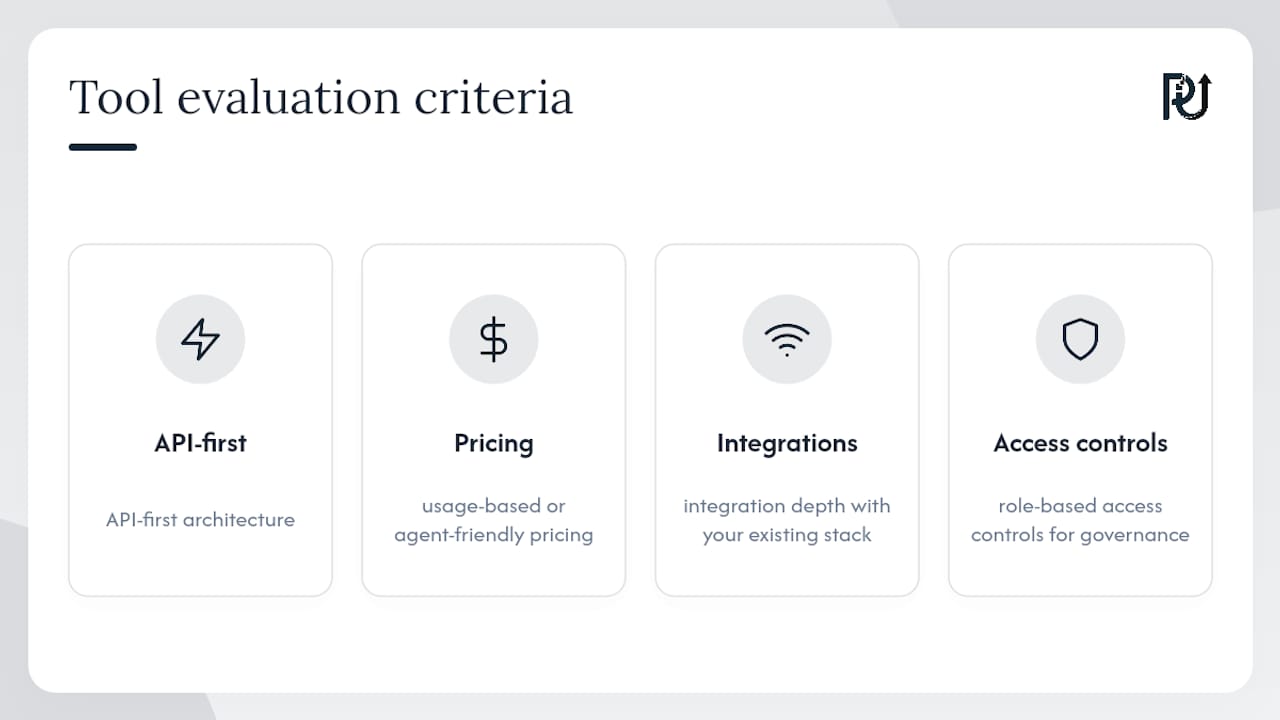
When evaluating any tool for scale, four criteria matter: API-first architecture, usage-based or agent-friendly pricing, integration depth with your existing stack, and role-based access controls for governance. A tool that scores well on all four will compound in value as your operation grows. One that fails on integrations will become a manual bridge you maintain forever.
For leaders who need custom AI agents, workflow orchestration, or document intelligence built on top of this stack, POW IT UP’s AI integration services are designed to connect these layers into a coherent, governed architecture.
How to close the adoption gap before it kills your pilot
The tooling is rarely what kills a scaling initiative. The adoption gap is. Bain’s research found that 88% of senior leaders expected a redesign to succeed, while only 36% of frontline employees agreed. That 52-point gap is where most programs stall.
The mechanism is straightforward. Leaders approve the initiative, attend the kickoff, and move on to the next priority. Middle managers, who are responsible for daily execution, receive a new tool and a training deck but no change to their performance metrics, no coaching on the new workflow, and no clear answer to “what happens to my team’s headcount?” Frontline employees follow the manager’s lead. If the manager is skeptical, the team is skeptical.
Bain’s prescription is to focus on the “200” rather than the “20.” The 20 are the senior leaders who already believe. The 200 are the middle managers who will determine whether the new process actually runs. Overinvest in enabling that group.
Six things to confirm before you launch a pilot:
- Communication: Every affected team knows what is changing, why, and what success looks like.
- Coaching: Middle managers have been trained on the new workflow, not just the new tool.
- Role clarity: Decision rights in the redesigned process are documented and communicated.
- Playbooks: SOPs are written, accessible, and reviewed by the people who will use them.
- Health checks: You have a weekly KPI review scheduled for the first 90 days.
- Reward signals: Performance metrics for managers and frontline staff reflect the new process, not the old one.
Track adoption with more than login counts. Measure whether decisions are actually moving to the new model: decision-rights adherence, time-to-decision, and rollback frequency. Override tracking is particularly useful because it tells you where the process is failing the user, not where the user is failing the process.
Common mistakes leaders make when scaling operations
Most scaling failures are predictable. They follow the same pattern: a leader sees a bottleneck, buys a tool, and discovers six months later that the bottleneck moved one step downstream.
- Automating a broken process. Automation amplifies whatever is already there. A process with a 15% error rate will produce errors 15% faster after automation. Fix the root cause first.
- Choosing tools before redesign. Tool selection should follow process design, not precede it. Buying a workflow platform before you have mapped the workflow means the tool will be configured around the current broken state.
- Under-resourcing governance. A pilot without a named data steward and a security owner is a compliance risk waiting to surface. Governance is not overhead; it is the mechanism that lets you scale without creating liability.
- Ignoring data quality. AI agents and automation tools are only as good as the data they process. Inconsistent field names, missing values, and duplicate records will degrade output quality at scale.
- Hidden token and agent costs. Bain’s analysis of the agent economy warns that token and agent costs could replace 20%–30% of current headcount opex in some scenarios. Finance teams that have not modeled this will face budget surprises in year two.
Red flags during a pilot: low manager engagement in weekly reviews, KPIs that are unstable week-over-week without explanation, and integrations that require manual intervention more than twice a week. Each of these signals a process design problem, not a technology problem.
On the procurement side, watch for agent-based pricing models that charge per transaction or per token without a cap. A workflow that processes 10,000 documents a month at a fixed cost is predictable. The same workflow priced per API call with no ceiling is a finance risk. Require usage caps or tiered pricing with alerts before you sign.
What scalable operations look like across three sectors
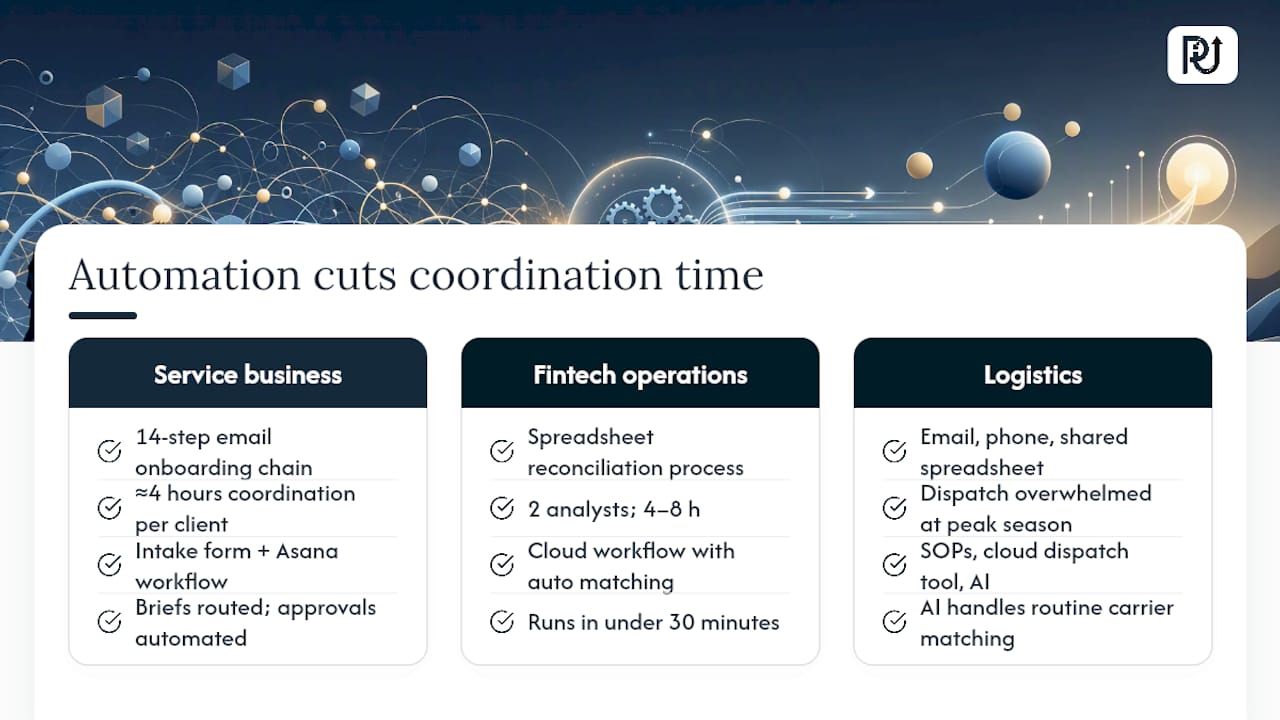
Service business. A mid-size marketing agency was onboarding new clients through a 14-step email chain that required the account director to manually collect briefs, approvals, and asset files. Every new client added roughly four hours of coordination time. The redesign replaced the email chain with a structured intake form connected to a project management workflow in Asana. Briefs routed automatically to the right team, approvals triggered by status changes, and asset delivery tracked in one place. The account director’s involvement dropped to exception handling. The agency reduced coordination overhead without adding headcount as client volume grew.
Fintech operations. A payments processor was running daily reconciliation through a spreadsheet-based process that required two analysts and took four hours. A demand spike during a product launch stretched that to eight hours and introduced errors. The redesign moved reconciliation to a cloud-based workflow with automated matching rules and exception flagging. The process now runs in under 30 minutes. The analysts shifted to reviewing flagged exceptions rather than processing every row. Quality improved because human attention concentrated on the cases that actually needed it.
Logistics. A regional freight broker was managing carrier assignments through a combination of email, phone calls, and a shared spreadsheet. During peak season, the coordination load overwhelmed the dispatch team and service quality dropped. SOPs were written for every carrier type, a cloud-based dispatch tool replaced the spreadsheet, and AI agents handled routine carrier matching based on load parameters. The dispatch team handled the same peak volume with the same headcount.
POW IT UP client case: Contact POW IT UP to discuss how these patterns apply to your operation. Client-specific metrics and outcomes are available on request.
Ready-to-use SOP template, KPIs, and a pilot timeline
SOP template fields
Every SOP your team writes should include these eight fields:
- Trigger: What event or condition starts this process?
- Inputs: What data, files, or decisions must be present before the process begins?
- Output: What does a successful completion look like, and who receives it?
- Owner: One named person responsible for execution and quality.
- SLA: How long should this process take from trigger to output?
- Escalation path: Who does the owner contact if the SLA is at risk?
- Exceptions: What conditions require a deviation from the standard steps?
- Change log: Date, author, and summary of every revision.
Use the service operations automation checklist to validate that each SOP is complete before a pilot begins.
KPIs by phase
Pilot phase (weeks 1–8): Adoption rate (% of transactions processed via new workflow), error rate, time-in-step for each stage, and rollback frequency.
Roll-by-segment phase (weeks 9–20): Throughput per FTE, cost per transaction, escalation rate, and decision-rights adherence.
Full scale (week 21+): Forecast confidence (variance between projected and actual throughput), customer satisfaction score, and total cost of operation versus prior baseline.
Impact ranges and timeline
| Phase | Duration | Expected outcome |
|---|---|---|
| Pilot (one workflow, one team) | Weeks 1–8 | Baseline KPIs established; error rate and SLA compliance validated |
| Roll-by-segment | Weeks 9–20 | Throughput growth without proportional headcount increase; cost per transaction trending down |
| Full scale | Week 21 onward | EBITDA uplift in the 10%–25% range reported by Bain for end-to-end redesigns; stable quality under peak load |
Match your operating review cadence to your AI signal frequency. Fairview’s research recommends weekly operating reviews to capture the value of AI-generated anomaly detection, rather than waiting for monthly reporting cycles.
Should you build internal capability or hire specialists?
Four decision criteria cut through most of the noise on this question.
Strategic core: If the capability you are building is a direct source of competitive differentiation, keep it internal. A logistics company whose routing algorithm is a competitive advantage should own that algorithm. A professional services firm whose core product is advice, not software, probably should not staff a full AI engineering team.
Repeatability: If the process you are automating is stable and well-understood, building internal capability makes sense over a 24-month horizon. If the process is still evolving, buying external expertise lets you iterate faster without locking in a team to a design that will change.
Speed to value: External specialists can deploy in weeks. Internal hiring, onboarding, and capability-building typically takes six to twelve months before a team is productive on a novel problem. If your competitive window is short, that timeline matters.
Total cost of ownership over 24 months: Model the full cost of both paths. Internal includes salary, benefits, tooling, training, and the opportunity cost of management attention. External includes fees, transition risk, and the cost of knowledge transfer at contract end. Bain’s opex research adds a new variable: agent and token costs that do not map to traditional headcount budgets. Build that line item into your model before you decide.
On contract terms, watch for three things when buying agent-based or API-first services: uncapped usage pricing, auto-renewal clauses with short cancellation windows, and data portability restrictions. All three create lock-in that is expensive to exit.
Hiring is the final asset deployment, not the first move. Build the process, validate the design, and then decide whether the ongoing operation belongs inside or outside the organization.
How POW IT UP helps you scale without adding headcount
The tools and playbook in this article require someone to connect them. That is where most operations programs stall: the strategy is clear, the tools are selected, and the integration work sits unfinished because no one on the internal team has the bandwidth or the architecture experience to wire it together.
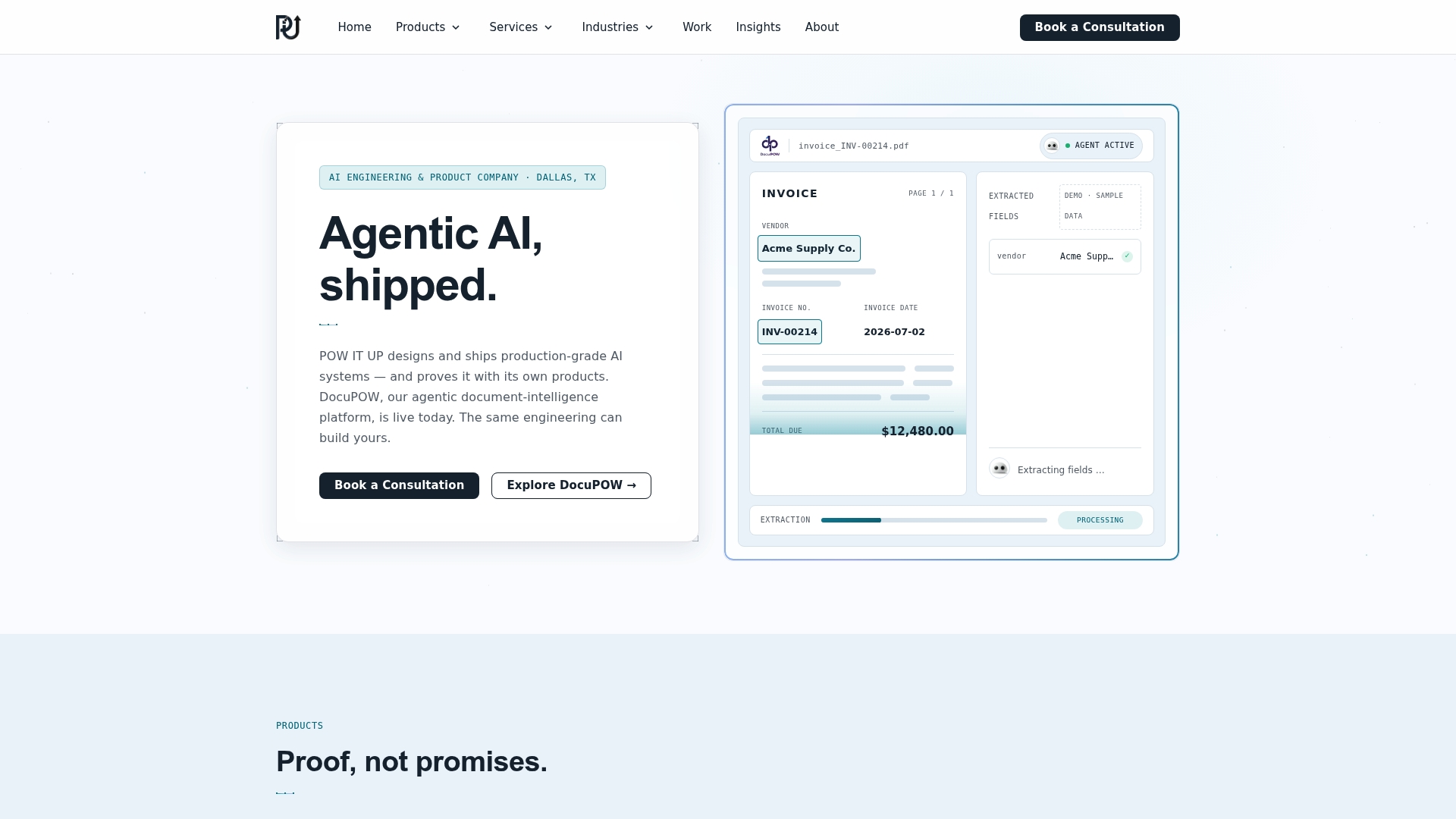
POW IT UP designs and deploys custom AI agents, workflow orchestration systems, and document intelligence pipelines that turn your SOPs into running, governed automation. The AI integration services cover the full stack: connecting your ERP, workflow tools, and cloud infrastructure into a single operating architecture with observability built in. DocuPOW handles document reading and validation at volume. AuraPOW monitors portfolio health and client analytics. Both are deployable on your existing stack without a multi-year implementation.
For leaders who want to move from pilot to full scale without building an internal engineering team, schedule a discovery call to discuss your first workflow and get a scoped engagement proposal.
What the SERP gets wrong about scaling (and what actually matters)
Most articles on operational scalability treat it as a technology problem. Buy the right ERP, deploy the right automation tool, and scale follows. That framing is wrong, and the Bain data makes it hard to argue otherwise. A 52-point gap between leadership confidence and frontline belief is not a tooling gap. It is a change management failure that happens before the first line of code runs.
The more interesting question is why leaders keep making the same mistake. Part of it is that technology decisions are visible and measurable in ways that culture and adoption are not. You can point to a contract signed, a platform deployed, a go-live date. You cannot easily point to the moment a middle manager stopped routing around the new process and started trusting it.
The leaders who get this right tend to share one habit: they treat the pilot as a learning exercise, not a proof of concept. They are not trying to prove the technology works. They are trying to understand where the process breaks under real conditions, with real people, at real volume. That orientation changes everything about how you design the pilot, what you measure, and how you respond when the KPIs move in the wrong direction.
One more thing worth saying plainly: the future of scalable business operations is not infinite headcount replacement. The most durable competitive advantage is a team that knows how to redesign processes, instrument them, and iterate. The agents and automation tools are multipliers. The human judgment about what to build and why is still the scarce resource.
Sources
Bain & Company: AI-Powered Operations — The primary source for the 10%–25% EBITDA finding and the 88%/36% adoption gap data. Essential reading for any leader planning an AI-powered redesign.
Bain & Company: The Future of Opex in the Agent Economy — Covers the shift in operating-expense mix toward token and agent costs. Read this before you model the 24-month cost of any agentic system.
Fairview: The Future of Operating Intelligence — Practical argument for decision-ready AI recommendations and weekly operating cadence. Useful for leaders designing their KPI review structure.
Duquesne University SBDC: Building Scalable Operations — Accessible, step-by-step operational checklist for moving from small-scale to scalable processes. Good for operations managers running their first pilot.
U.S. Small Business Administration (SBA) — The SBA and its national SBDC network offer no-cost advisory resources for U.S. businesses planning operational redesigns, including guidance on digital transformation programs.
Spendesk: Scalable Processes — Seven practical rules for operational scalability, with strong coverage of decentralization, cloud-first tooling, and knowledge base design.
Ocasta: What Is Operational Scalability? — Clean definitional reference and KPI framework for leaders who want a concise benchmark for what “scalable” actually means in practice.
- AI-Powered Operations: What Leaders Must Know | Bain & Company
- The Future of Operating Intelligence: AI and Human…
- Building scalable operations: Streamlining your Processes for Growth | Duquesne University SBDC
- Scalable processes: 7 golden rules for operational scalability | Spendesk
- What is Operational Scalability? Operations Explained | Ocasta
FAQ
What is a scalable operation?
A scalable operation is a system of processes, tools, and ownership structures that allows an organization to handle increasing demand without a proportional increase in cost or headcount. Key indicators include consistent quality under peak loads and throughput growth with stable or improving unit economics.
What does scaling operations mean in practice?
Scaling operations means redesigning workflows so they can process higher volumes through standardization, automation, and cloud infrastructure rather than by adding people to each step. The practical sequence is: map the workflow, redesign it, document it in SOPs, pilot the new design, and measure outcomes before expanding.
What is an example of a scalable solution?
A freight broker replacing a shared spreadsheet and phone-based dispatch process with a cloud workflow and AI-powered carrier matching is a scalable solution. The same team handles peak-season volume without additional hires because the routine matching is automated and human attention focuses on exceptions.
What is an example of a scalable business?
A SaaS company is the textbook example: the same software serves ten customers or ten thousand with minimal incremental cost per new customer. In service businesses, scalability requires deliberate process redesign. A professional services firm that replaces partner-dependent intake with a structured workflow and junior-analyst execution is building the same structural advantage.
How do I know if my operations are actually scalable?
Three signals: your quality metrics hold steady during demand spikes, your cost per transaction trends down as volume grows, and your team is handling more without working longer hours. If any of those three breaks under load, the process has a structural constraint worth finding before the next growth cycle.