

Business automation’s future is agentic: AI systems that plan, execute, and self-correct across entire workflows, not just individual tasks, with humans stepping back into judgment and oversight roles. MIT FutureTech research shows AI already performs a minimally sufficient job on a range of text-based tasks, with that figure projected to improve significantly by 2030. Many leaders in that same research expect a substantial share of their processes to be agent-centric within the decade.
That timeline is close enough to change budgets this year, not five years from now. The immediate move isn’t a company-wide AI rollout. It’s a 30-day triage:
- Run a disruption audit. Map which revenue-generating tasks are most exposed to automation and how fast the cost curve is falling on each.
- Inventory your data assets. Agentic systems only work as well as the process context and structured data feeding them.
- Pick one production deployment. Choose a single workflow, ship it into live use, and measure it. Skip the sandbox pilot that never leaves the lab.
Everything below unpacks why this timeline holds, what changes for your workforce, and how to sequence the work so it survives contact with a real budget cycle.
Key Takeaways
The future of business automation belongs to companies that redesign workflows around autonomous agents and unified data, not the ones that simply add AI tools to existing processes.
| Point | Details |
|---|---|
| Act within 30 days | Run a disruption audit, inventory your data assets, and ship one production automation. |
| Redesign, don’t bolt on | Structural ROI comes from rebuilding workflows around AI, not adding tools to old processes. |
| Govern from day one | Build traceability and human-in-the-loop gating before scaling past your first agent. |
| Reskill toward oversight | Turn subject-matter experts into intelligence managers who govern AI judgment, not manual work. |
| Partner for production | POW IT UP builds custom agents and tools like DocuPOW and AuraPOW to move deployments past the pilot stage. |
Table of Contents
- What Are the Key Trends Shaping Business Automation’s Future?
- Does Redesigning Workflows Beat Adding Automation Tools?
- How Will Automation Change Jobs and Skills by 2030?
- What Technology and Data Foundations Does Agentic Automation Require?
- Why Does Governance Determine Whether Automation Scales?
- How Do Leaders Move From Pilots to Production?
- Where Is Automation Already Delivering Structural Change?
- What Should Leaders Expect by 2026, 2028, and 2030?
- Sources
- FAQ
What Are the Key Trends Shaping Business Automation’s Future?
Five shifts are converging at once, and most companies are only tracking one or two of them.
Agentic AI is the biggest departure from what came before. Instead of a chatbot that answers a question or a script that moves a file, an autonomous agent plans a sequence of steps, executes them, checks its own output, and escalates only when it hits a genuine exception. Gartner’s 2026 strategic technology trends puts agentic systems at the top of the list, alongside composable applications and platform observability.
Generative AI is becoming ambient rather than a separate tool employees open on purpose. It’s getting embedded into the applications people already use for drafting, summarizing, and triaging, which is part of why adoption curves look steeper than earlier automation waves.
Low-code and no-code platforms are compressing the distance between “we should automate this” and “this is live.” Composable, modular automation components let a business analyst assemble a workflow that once required a development sprint.
Hyperautomation, process mining, and orchestration tie the other trends together. Process mining tools reveal exactly where work actually flows (as opposed to where the org chart says it should), and orchestration layers coordinate multiple agents and systems so nothing falls into a gap between two tools.
AI-human orchestration is the trend most leaders underrate. The World Economic Forum’s analysis points to a new role emerging inside AI-native companies: the “intelligence manager,” a subject-matter expert who doesn’t do the transactional work anymore but instead encodes their judgment into the systems that do.
- Agentic AI executing multi-step workflows end to end
- Generative AI embedded across daily tasks rather than isolated tools
- Composable, low-code platforms shortening deployment cycles
- Hyperautomation and process mining exposing where work actually happens
- Subject-matter experts shifting into AI governance roles
Pro Tip: Before adding a new automation tool, run a process-mining pass on the workflow first. Half the “automation projects” companies plan turn out to be fixing a broken process, not automating a good one.
Does Redesigning Workflows Beat Adding Automation Tools?
Yes, and the gap between the two approaches is where most of the ROI hides. Bolting an AI tool onto an existing workflow produces a task-level productivity bump. Redesigning the workflow around what AI and agents can now do produces something structurally different: new economics for the whole function, not a faster version of the old one.
The World Economic Forum notes that generative AI produces noticeable task-level productivity gains in various cases. That’s real, but it’s also a ceiling if the workflow around the tool never changes. Structural gains only show up when a company redesigns the process so expert judgment gets captured once and reused indefinitely, instead of re-created by a human every single time a similar case comes through.
The metric that separates the two: task-level gains show up as “faster individual work.” Structural gains show up as falling cost-per-transaction and rising revenue-per-employee across an entire function, because the process itself needed fewer human touchpoints, not just faster ones.
Track these metrics if you want to know which category your automation investment falls into:
- Cycle time from request to completed transaction, end to end
- Cost per transaction, tracked before and after redesign, not just after tool adoption
- Signal-to-action lag, or how long it takes a flagged exception to reach a human decision-maker
- Revenue per employee in the automated function specifically, isolated from company-wide averages
How Will Automation Change Jobs and Skills by 2030?
Transactional, rules-based, and high-volume documentation work is the first category headed for near-complete automation. Judgment calls, client relationships, exception handling, and anything requiring accountability for a decision are staying human-led, at least through the end of the decade.
The MIT FutureTech research frames this as a rising tide rather than a crashing wave: capability improves gradually across many tasks, which gives organizations time to adapt if they start now instead of waiting for a forcing event.
2026 to 2030, roughly, looks like this: early movers spend 2026 and 2027 building the intelligence-manager role and moving pilots into production. By 2028, agent-run processes stop being a novelty in the functions that adopted early.
A reskilling checklist worth working through this quarter:
- Identify which job descriptions are 70% transactional; those roles need redesign, not elimination
- Select your best subject-matter experts to become intelligence managers, not your most junior staff
- Build a feedback loop where the AI’s exceptions actually train the humans reviewing them
- Rewrite performance metrics so managing agents counts as real, measurable work
What Technology and Data Foundations Does Agentic Automation Require?
Autonomous agents fail quietly and often when the underlying data and platform architecture aren’t ready for them. SAP’s framing of the Autonomous Enterprise is blunt about the prerequisite: unified process context, unified data, and governance built in from the start, not layered on after the fact.

Unified data semantics matter more than any single tool choice. If your finance system calls a customer one thing and your CRM calls the same customer something else, an agent tasked with resolving a discrepancy across both systems will either fail or, worse, resolve it wrong with total confidence.
Platform requirements for reliable agentic automation include an orchestration layer that coordinates multiple agents without collision, an agent runtime that can execute and roll back actions safely, observability tooling that shows what an agent did and why, and model-agnostic design so you’re not locked into a single AI provider’s roadmap.
Legacy integration is where most projects stall. API-first approaches, where legacy systems expose clean interfaces rather than requiring screen-scraping or brittle point-to-point connections, hold up far better as the number of connected systems grows. A practical AI-first business playbook makes a related point worth stealing directly: document your top recurring workflows as literal step-by-step standard operating procedures before you automate them. You can’t hand an agent a process nobody has ever written down.
- Unify data definitions across systems before connecting agents to them
- Build an orchestration layer before scaling past two or three agents
- Choose model-agnostic platforms to avoid vendor lock-in
- Prioritize API-first integrations over screen-scraping legacy systems
- Document workflows as SOPs before automating them, not after
Pro Tip: Treat your first agent deployment like plumbing, not a demo. Build the observability and logging layer before the “impressive” part, because you’ll need to explain exactly what the agent did the first time it does something wrong.
Why Does Governance Determine Whether Automation Scales?
Governance is the difference between an automation program that reaches production and one that stalls in permanent pilot mode. Gartner projects that a significant share of agentic AI projects will be canceled by the end of 2027 without strong governance.

A workable governance checklist covers four areas: clear policies on what an agent is authorized to do without human sign-off, full traceability of every action an agent takes, defined exception-handling paths for anything outside the agent’s authority, and human-in-the-loop gating on any action with financial, legal, or safety consequences.
Security and compliance deserve the same scrutiny you’d apply to a new employee with system access, because that’s functionally what an autonomous agent is. What data can it read? What can it write or change? What happens if it’s compromised or simply wrong?
Here’s the part leaders often get backward: governance built in from day one accelerates deployment, it doesn’t slow it down. A team that has already answered “what happens when this breaks” moves faster into production, because nobody has to stop mid-rollout to invent an incident response plan.
How Do Leaders Move From Pilots to Production?
Most companies have an automation pilot running somewhere. Few have moved one into full production, and the gap between the two is almost always sequencing, not technology. A five-step playbook that holds up across industries:
- Run a formal AI disruption audit. Map revenue-generating activities against how automatable each one is and how quickly the cost of automating it is falling, an approach Arete’s research recommends specifically to identify near-term exposure before committing budget.
- Secure your core data assets. Fix the unified-data problem before it becomes an agent’s problem.
- Build one production automation, end to end. Not a proof of concept. A live workflow handling real transactions with real accountability attached.
- Establish governance alongside deployment, not after an incident forces it.
- Measure, then iterate. Use the cycle-time and cost-per-transaction metrics from earlier to decide what gets automated next.
A regional lending firm working with POW IT UP’s AI integration team followed roughly this sequence: document intake and validation went first because it was high-volume, low-judgment, and fully measurable, freeing loan officers from manual data entry so they could spend that time on borrower relationships instead.
Pro Tip: Sequence internal-facing automation before anything customer-facing. Arete’s research on future-proofing found that leading with internal operations avoids the customer-satisfaction dip that comes from shipping an unpolished agent directly to clients.
Where Is Automation Already Delivering Structural Change?
The most convincing use cases share one trait: they didn’t just speed up an existing process, they eliminated steps entirely.
In fintech, document-heavy underwriting and compliance checks that once took days now run through automated validation and flagging, with measured ROI documented across several fintech deployments. In healthcare operations, automating intake documentation and insurance verification has freed clinical staff from hours of paperwork per week, time redirected to actual patient care. In supply chain and logistics, SAP’s Autonomous Suite framing shows assistants coordinating multiple agents across procurement, inventory, and fulfillment as a single connected process rather than three disconnected systems handed off manually.
Use cases ready for near-term production deployment right now include:
- Document intake, extraction, and validation across finance and insurance
- Client health and portfolio monitoring with automated risk flagging
- Recurring compliance reporting and audit trail generation
- Customer service triage that routes only genuine exceptions to humans
What Should Leaders Expect by 2026, 2028, and 2030?
By 2026: early adopters move their first agentic workflows into production; most companies are still running pilots or haven’t started.
By 2028: agent-run processes stop being a novelty inside the functions that started early, and the productivity gap between AI-native and pilot-stuck companies becomes visible in the numbers.
By 2030: roughly three-quarters of surveyed leaders expect about half their processes to be agent-centric, with task-level AI success rates on text-based work reaching 88% to 97%.
Each window maps to a readiness activity: 2026 is for the disruption audit and data cleanup, 2027 to 2028 is for scaling your first production wins, and the run-up to 2030 is when governance maturity determines who’s still standing after the consolidation Gartner’s cancellation forecast implies.
The Blind Spot Most Leaders Never Correct
Most leaders treat automation as a pilot problem: pick a use case, run a proof of concept, see if it works. That instinct is backward. Pilots almost always work. The actual failure point is refusing to commit a workflow to full production because it feels safer to keep testing. Waiting for certainty is itself the risk, since the cost curve on automation keeps falling whether you act or not.
How POW IT UP Builds Your Path From Pilot to Production
You don’t need another vendor selling a chatbot demo. You need a partner that builds the actual infrastructure behind an agent, the part that decides whether it survives contact with your real data and real exceptions. POW IT UP designs and deploys custom digital workforces, autonomous agents built around your specific processes rather than generic templates.
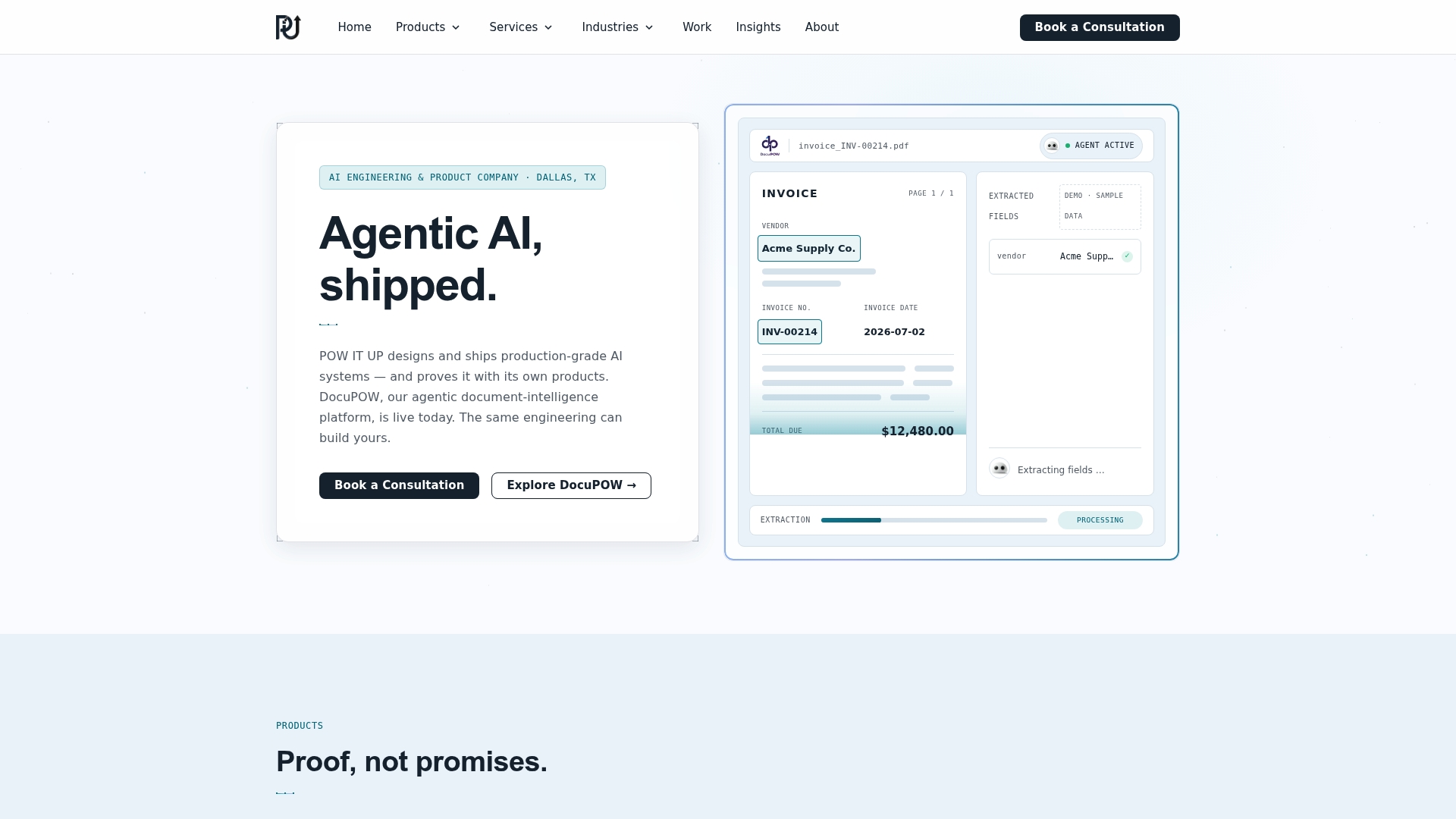
That includes productized tools like DocuPOW for document reading and validation, and AuraPOW for portfolio monitoring and client health analytics, alongside bespoke agent development for workflows unique to your business. If you’re still deciding where to start, POW IT UP’s AI integration services begin with exactly the disruption audit described earlier in this article, mapping which of your workflows are ready for production automation now. Request a consultation and get a concrete sequencing plan instead of another pilot that never ships.
Sources
- How will AI automation hit — like a crashing wave or a rising tide? | MIT Sloan
- Will the next decade of business quickly become AI-native? | World Economic Forum
- What is an Autonomous Enterprise? | SAP
FAQ
What jobs will disappear because of AI automation by 2030?
High-volume, rules-based, transactional roles, like manual document entry, basic data validation, and routine compliance checks, face the steepest declines. Jobs requiring judgment, accountability, or client relationships are far more likely to persist through 2030.
Is automation replacing AI, or is AI driving the next wave of automation?
AI is driving the next wave. Agentic AI now plans and executes multi-step workflows autonomously, which is a structurally different capability than the rule-based automation scripts of the last decade.
Which jobs are most likely to survive automation?
Roles centered on judgment calls, exception handling, and relationship management tend to survive, and many are evolving into “intelligence manager” positions where the person governs AI output rather than performing the transactional task themselves.
Is a career in AI automation a good bet in 2026?
Yes, particularly for professionals willing to shift from doing transactional work to overseeing and training the AI systems that now do it. Demand for people who can bridge domain expertise and AI governance is rising as more companies move from pilots to production.
How does POW IT UP help companies move from automation pilots to production?
POW IT UP builds custom AI agents, document intelligence tools like DocuPOW, and monitoring tools like AuraPOW, engineered around a specific company’s data and workflows rather than generic templates, which is the piece most pilots lack when they try to scale.