

Strategic AI integration means aligning AI investments to end-to-end business processes rather than isolated tasks, so the technology changes how work actually gets done. The immediate priority for any executive team is simple: assign a named owner and pick one lighthouse domain, a high-volume, well-understood process, to prove the model before spreading further.
TL;DR:
- Most AI investments have yet to demonstrate significant financial returns, as autonomous AI deployment remains very limited across core business functions.
- Failure patterns often include isolated use cases, lack of governance, and rebuilding from scratch each time, preventing scalable enterprise AI.
- Prioritization should focus on initiatives with high value potential and quick time-to-value, assessed through consistent scoring of multiple decision domains.
- AI should be governed with operational risk-based guardrails, ensuring scalability without slowing progress, and maintained with proper provenance and audit trails.
- Moving from pilot to production is most effective when pilot projects target high-volume, well-understood processes and leverage reusable infrastructure.
Table of Contents
- Why Strategic AI Integration Matters Now
- A Decision Framework for Prioritizing AI Investments
- Who Should Own AI Inside the Organization?
- Building the Technology and Data Foundation
- How Do You Govern AI Without Slowing It Down?
- Moving From Pilot to Production
- What Metrics Actually Prove AI Is Working?
- How POW IT UP Operationalizes Strategic AI Integration
- What CEOs Should Actually Prioritize Right Now
- Ready to Move From Pilot to Production?
- Sources
- FAQ
Why Strategic AI Integration Matters Now
Private investment and adoption of generative AI both surged through 2024 and 2025, but most companies report only modest near-term financial impact from their early deployments, according to Stanford’s AI Index Report. That gap between spending and payoff is the whole story right now.
Organizational adoption of general AI tools has climbed sharply, yet deployment of autonomous AI agents across core business functions is still rare, per the AI Index Report’s economy chapter.
By the numbers: Enterprise AI adoption is rising fast, but agentic deployment, systems that act autonomously across a workflow, remains a small fraction of that activity. Most organizations are still stuck at the “assistant” stage, not the “agent” stage.
Pilots stall for predictable reasons. Watch for these three failure patterns:
- Isolated use cases. Teams automate one step of a process instead of reengineering the whole chain, so gains never compound.
- Missing governance. No one owns risk decisions, so legal and compliance eventually freeze the project.
- No reusable infrastructure. Every pilot gets built from scratch, which means nothing gets faster or cheaper the second time.
Many AI initiatives never reach enterprise scale because they optimize a single step instead of transforming the full value chain, a pattern McKinsey has documented repeatedly in its work on agentic AI.
A Decision Framework for Prioritizing AI Investments
Most leadership teams don’t have a capital allocation problem with AI. They have a triage problem. PwC’s answer is a portfolio approach it calls Lead, Lag, Exit: fund the initiatives with real differentiation potential (Lead), keep pace on commodity capabilities everyone will eventually need (Lag), and kill projects that are burning budget without a credible path to value (Exit).
Applying that framework requires scoring every initiative, current or proposed, against a consistent set of decision domains:
- Value potential. What is the realistic size of the financial or strategic upside?
- Time to value. How many months until the project produces a measurable result?
- Data readiness. Does the required data exist, and is it clean enough to use?
- Risk profile. What happens if the system fails, hallucinates, or gets it wrong in front of a customer?
- Scalability. Can this pattern extend to other business units without a full rebuild?
- Strategic importance. Does this touch a process that differentiates the company, or a back-office commodity?
- Operational dependency. How many other systems or teams does this initiative rely on to function?
Score every current and proposed AI initiative against these seven domains, then plot the results on a simple two-axis grid: value potential against time-to-value. What lands in the top right becomes your Lead bucket and your near-term roadmap. Everything else either gets a Lag holding pattern or an Exit conversation.
Pro Tip: Run this scoring exercise with finance and operations in the room, not just IT. A project that looks brilliant on technical merit often collapses once someone asks who owns the process it touches.
Who Should Own AI Inside the Organization?
AI belongs on the organizational architecture agenda, not buried inside a single IT initiative. Treating it as a plumbing upgrade instead of a structural decision is the fastest way to guarantee it never scales.

COOs who lead AI integration by aligning operating structure, data governance, and change management generate more operational impact than technology-led efforts running in parallel with no operating owner, according to McKinsey’s research on gen-AI operations. The CIO still matters, but as the architecture and risk partner, not the sole sponsor.
On structure, most enterprises land on one of two models, or a hybrid:
- Center of excellence (COE): a central team builds standards, tooling, and shared infrastructure that business units draw on.
- Federated model: business units run their own initiatives against central guardrails, with a COE providing oversight and reusable components.
- Transformation squads: cross-functional teams (ops, data, engineering, a business champion) embedded in the priority domain from the Lead bucket.
Staffing usually mixes embedded external specialists for velocity with in-house hires for long-term ownership, so capability doesn’t walk out the door when the contract ends, following best practices on AI in ecommerce use cases and hiring models.
Building the Technology and Data Foundation
Architecture decisions made in month one determine whether an AI program compounds or collapses under its own weight by month twelve. The current shift toward agentic systems, AI that plans and executes multi-step work rather than answering single prompts, raises the stakes on three principles:
- Governed autonomy. Agents get defined boundaries and escalation paths, not open-ended discretion.
- Interoperability. Agents and systems need to exchange context through shared standards, not custom point-to-point connections.
- Composability. New capabilities should assemble from existing components instead of requiring a rebuild each time.
On data, the highest-leverage move is treating information as a product: structured pipelines with clear ownership, rather than a one-off export built for a single pilot.
Implementation sequencing also matters more than most technology roadmaps admit. API-mediated inference, calling an existing model through an API, is the fastest way to reach production. Async precomputation and embedded models take longer to build but cut latency and cost once volume climbs, according to a practical guide for product teams on AI implementation.
Deployment of fully autonomous AI agents across core business functions remains uncommon even as general AI adoption rises, per Stanford’s AI Index economy chapter, which is exactly why architecture choices made early carry outsized weight later.
How Do You Govern AI Without Slowing It Down?
Governance built as operational guardrails, sized to actual risk, enables scale instead of blocking it. Governance built as a blanket approval process just trains employees to route around it.
The NIST AI Risk Management Framework gives a practical starting sequence:
- Inventory every AI system in use, including shadow tools employees adopted on their own.
- Tier each system by risk, based on what happens if it fails, not on how impressive the technology sounds.
- Set acceptable-use policies with human-in-the-loop checkpoints on anything customer-facing or financially material.
- Run red-teaming and validation before high-risk systems go live, and repeat it after major changes.
- Assess supplier and third-party model risk with the same rigor applied to internal builds.
Pro Tip: Keep a provenance and audit trail on every model version and prompt change. When something goes wrong six months from now, “we don’t know which version produced that output” is not an acceptable answer to a regulator or a board.
Moving From Pilot to Production
Lighthouse projects work when they hit a specific, high-volume, well-understood process where success is easy to measure and failure is contained. A single department’s invoice processing beats a company-wide “AI transformation” pilot every time, because the blast radius of a mistake is small and the win is countable.
The infrastructure built for that first project should never be single-use. Reusable assets typically include:
- An evaluation harness to test outputs before and after any model or prompt change.
- Feedback capture loops so frontline users can flag errors in real time.
- Prompt and model versioning to prevent silent regressions.
- Cost controls that cap spend per request before it scales into a surprise line item.
Building an evaluation harness and versioning discipline from the first pilot is what separates programs that compress delivery time on project two from those that rebuild everything from scratch, per that same implementation guide. API-mediated pilots often reach production in a matter of weeks; embedded or async architectures typically run longer but pay that time back in lower cost per transaction at scale.
What Metrics Actually Prove AI Is Working?
Boards don’t need a dashboard of vanity metrics. They need three tight categories, each answering a different question about whether the investment is paying off.
- Outcome KPIs: cost savings, revenue lift, process cycle time, and error reduction, the numbers that justify the spend.
- Operational KPIs: cost per request, latency, system reliability, and agent success rate, the numbers that catch problems before finance does.
- Adoption and change KPIs: active users, percentage of the process now automated, and retention of human oversight on flagged decisions.
Track cost per request as closely as revenue lift. Agentic systems that look cheap in a pilot can quietly become expensive once request volume scales, and that shift often shows up in the invoice before it shows up in a dashboard.
How POW IT UP Operationalizes Strategic AI Integration
Some firms work as strategic technical architects, not vendors of generic scripts, designing autonomous, context-aware agents that handle high-volume transactional work. DocuPOW, its document intelligence product, shows that approach in production: reading and validating documents at scale instead of routing them to a human queue.
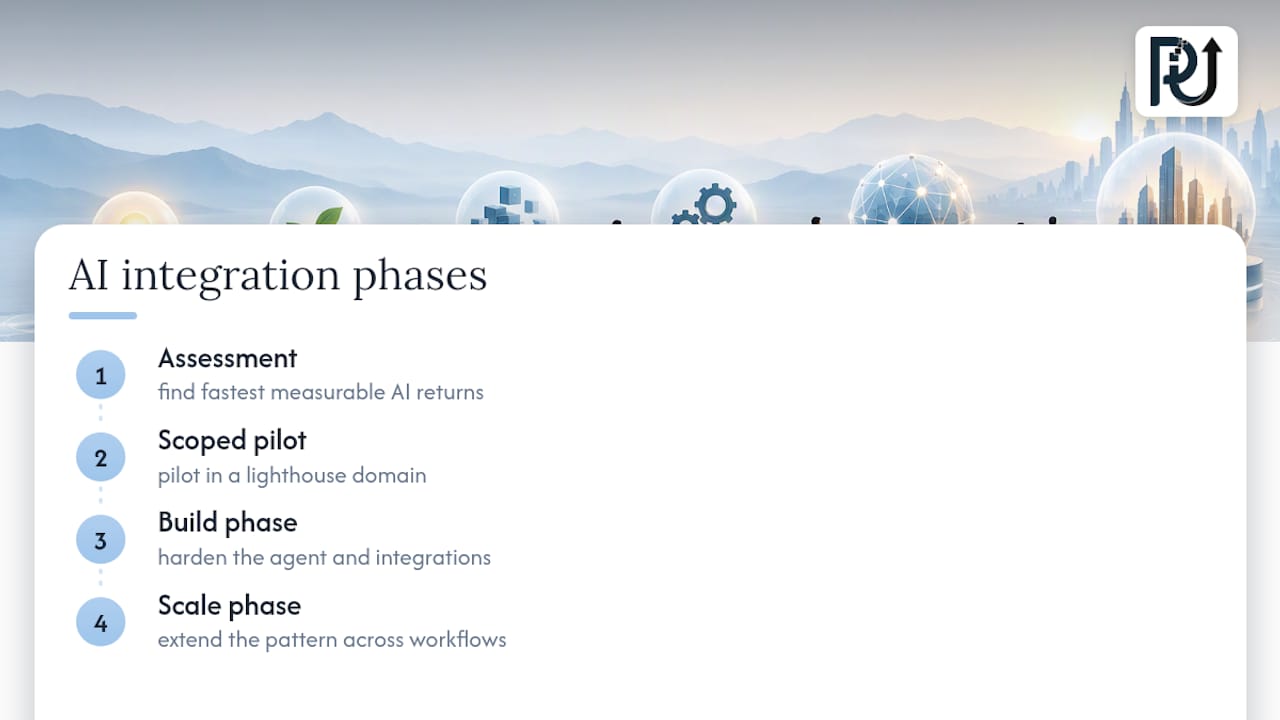
Engagements typically move through four phases: an assessment of where AI investment produces the fastest measurable return, a scoped pilot in a lighthouse domain, a build phase that hardens the agent and its integrations, and a scale phase that extends the pattern across additional workflows. That sequencing mirrors the AI agents development work POW IT UP runs for enterprise and SMB clients pursuing the same pilot-to-production path this article outlines.
What CEOs Should Actually Prioritize Right Now
The real opportunity sits in agentic automation of transactional operations and in treating data as a product, not in another chatbot pilot. The real risk is agent sprawl: dozens of ungoverned tools quietly generating cost and liability nobody tracks. If you take one thing from this: put a named executive owner on AI before you approve another budget line for it.
— Syed Naveed Abbas
Ready to Move From Pilot to Production?
POW IT UP is the alternative to another stalled pilot: instead of a proof-of-concept that dies in a slide deck, you get a working agent handling real transaction volume within weeks, built on infrastructure that gets reused for the next process, not thrown away.
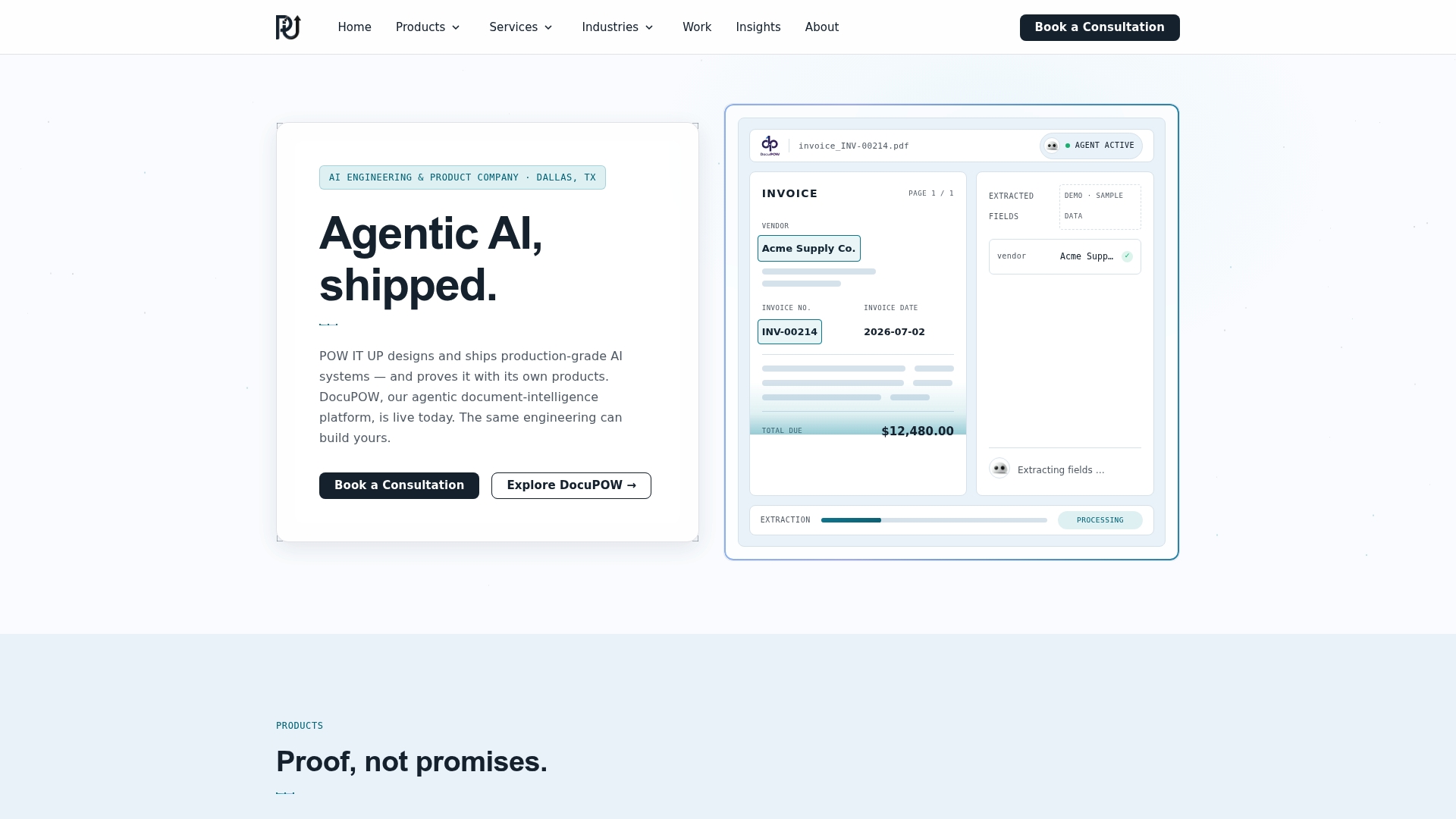
If you’re evaluating a partner for strategic AI integration, ask three questions in the demo: How does the agent handle an edge case it has never seen? What does the evaluation harness look like once the model changes? And who owns the data pipeline after the contract ends? POW IT UP’s AI integration services are built around answering all three before a single agent goes live, drawing on the same document intelligence work behind DocuPOW and the AI agents development practice supporting it. Request a live demo to see how a lighthouse project in your operation could look in production, not just in a slide.
Sources
- PwC — Lead–Lag–Exit framework for AI investments
- NIST AI Risk Management Framework (AI RMF) — Generative AI Profile
FAQ
What Is the 30% Rule for AI?
There’s no single, universally recognized “30% rule” in AI strategy literature. If you’ve heard the term, it likely refers informally to the share of processes or tasks within a workflow that AI can currently handle end-to-end, a figure that varies widely by industry and process type rather than a fixed standard.
Which Jobs Are Least Likely to Be Replaced by AI?
Roles built around complex human judgment, physical dexterity in unpredictable environments, and relationship-driven trust, such as skilled tradespeople, therapists, and senior negotiators, tend to be the most resistant to automation. AI is displacing tasks within jobs far faster than it’s eliminating entire roles, which is why strategic AI integration focuses on redesigning workflows rather than simply cutting headcount.
What Is the 10/20/70 Rule for AI?
This isn’t an established or sourced framework, and definitions circulating online vary considerably. Rather than repeat an unverified ratio, focus on the decision domains covered above, value potential, data readiness, and risk, to prioritize AI investment in a way that’s actually defensible to a board.
Which AI Tool Is Best for Strategic Thinking?
No single tool “wins” at strategic thinking, because the value comes from the framework applied around the tool, not the model itself. A structured approach like Lead, Lag, Exit paired with a governed agentic architecture, the kind POW IT UP builds through its AI integration engagements, matters more than which large language model sits underneath it.
How Long Does Strategic AI Integration Typically Take?
A well-scoped lighthouse project using API-mediated inference can reach production in weeks, while embedded or async architectures designed for scale usually take longer to build but cost less to run once volume grows. Timelines depend heavily on data readiness and how many existing systems the initiative needs to connect to.