

Automation Architecture, in the agentic sense, is the engineered design of composable AI agents, governed orchestration, and AgentOps discipline that automates transactional workflows end to end. The recommended approach is to build for composability and governed autonomy from the first sprint, not bolt governance on after a pilot succeeds. Leading AI integration firms treat this as the standard, not an upgrade path.
TL;DR:
- Building for composability and governance from the first sprint is essential, as most pilots fail due to skipping core layers like orchestration and security.
- Autonomous agents should evaluate context, call tools within authorized scopes, and escalate only when necessary, shifting away from scripted step sequences.
- Rules for multi-agent workflows vary from sequential pipelines to collaboration loops like swarm patterns, with human-in-the-loop checkpoints placed only at high-risk points.
- Agent identities require strict zero-trust controls, audit trails, and runtime policy checks to prevent policy violations and support incident tracing.
- Operationalizing agents demands dedicated AgentOps teams responsible for lifecycle management, end-to-end observability, and reliable execution environments.
Table of Contents
- What Does Automation Architecture Cover?
- What Are the Core Layers of an Automation Architecture?
- Which Multi-Agent Design Pattern Fits Your Workflow?
- What Governance and Security Controls Does Agentic Automation Require?
- How Do You Operationalize Agents in Production?
- What ROI Should You Expect From Agentic Automation?
- How Do You Launch a 90-Day Automation Architecture Pilot?
- Why Engineering Discipline Beats Flashy Demos
- Ready to Build Your Automation Architecture?
- Sources
- FAQ
What Does Automation Architecture Cover?
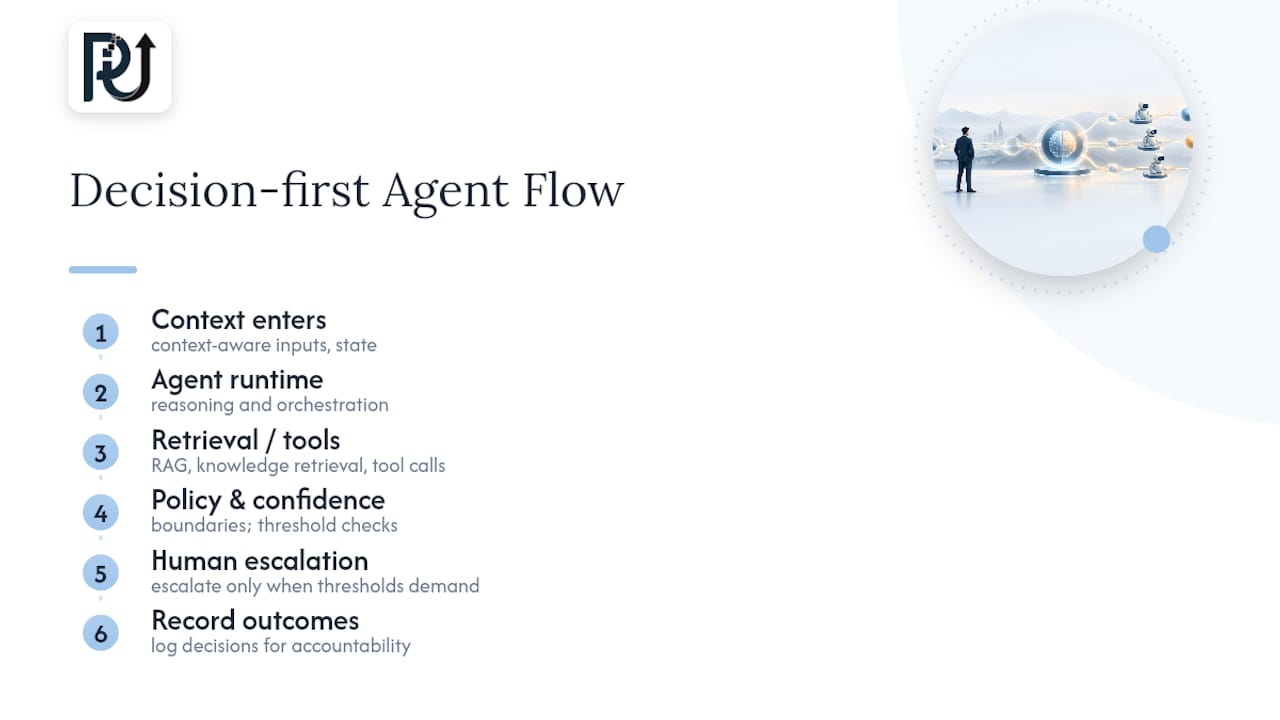
Automation Architecture, in this context, means the design of autonomous, context-aware agents that reason over context, retrieve knowledge, call tools, and hand off work through orchestrated pipelines. It covers agent runtimes, retrieval-augmented generation (RAG), orchestration logic, and the workflow redesign needed to enable agents to actually own a process instead of just assisting a human through it.
It does not mean software test automation frameworks or industrial PLC control systems. Those are execution-first disciplines: a script runs a fixed sequence, and success means matching a predefined outcome. Agentic Automation Architecture is decision-first. The agent evaluates context, chooses among paths, and only escalates when policy or confidence thresholds demand it. That distinction changes everything about how you design the system. You are not scripting steps. You are architecting judgment, boundaries, and accountability around a system that makes calls on its own.
What Are the Core Layers of an Automation Architecture?
Every production-grade agentic system rests on a handful of layers, and skipping one is usually where pilots stall out before reaching production.
- Agents layer: runtime environments with distinct identities, short-term working memory, and long-term memory stores, isolated per session so one client’s data never bleeds into another’s.
- Orchestration layer: a coordinator or arbiter agent, an agent registry for discovery, and an API gateway that routes requests and enforces call limits.
- Tools layer: a secure invocation gateway with role-based access control (RBAC), so an agent can call a billing system or CRM only within its authorized scope.
- Model access layer: a curated list of approved models with cost and latency controls, preventing runaway spend on expensive calls for simple tasks.
- Knowledge layer: vector stores and tenancy-aware retrieval so RAG pulls the right document set for the right client, never a shared pool.
- Infrastructure layer: versioned container images, CI/CD pipelines, durable storage, and hosting patterns built for horizontal scale.
Microsoft’s own reference architecture for multi-agent workflow automation illustrates this pattern concretely: a Container Apps API orchestrator, Cosmos DB for persistence, and GitHub-driven CI/CD tying the whole pipeline together. That is the shape a serious build takes, whether you run it on Azure, AWS, or elsewhere.
Which Multi-Agent Design Pattern Fits Your Workflow?
A single agent handles the job when the task has one clear owner and a narrow tool set, like answering a defined category of support tickets. Once a workflow needs specialized reasoning at different stages, split it into multiple agents.
- Sequential: agents pass work down a pipeline, each handling one stage, ideal for structured processes like invoice intake, validation, then posting.
- Parallel: several agents work the same input simultaneously, useful for gathering data from multiple systems before a decision.
- Coordinator: one agent delegates subtasks to specialists and assembles the result, common in customer service triage.
- Hierarchical: layered coordinators manage sub-coordinators, suited to complex operations like claims processing across departments.
- Swarm: agents collaborate and critique each other’s output in a loop, useful for drafting and refining complex documents.
- Human-in-the-loop (HITL): a checkpoint pauses execution for approval, placed only at genuine risk points, like a payment above a threshold.
Google Cloud’s guidance on agent design patterns maps these directly to workflow shapes, and getting the mapping wrong is a common cause of stalled pilots. An arbiter agent should own delegation and exit conditions, deciding when a task is genuinely done rather than looping indefinitely.
Pro Tip: Place HITL checkpoints only where a wrong decision is expensive or irreversible. Every unnecessary checkpoint reintroduces the manual delay you built the system to remove.
What Governance and Security Controls Does Agentic Automation Require?
Agent identities need the same zero-trust treatment you’d give a human employee, arguably more, since agents act faster and at higher volume.
- Bind every agent identity to a specific tenant and grant the minimum permissions its task requires, nothing broader.
- Deploy guardrail or critic agents that review high-stakes outputs before they execute, catching policy violations before they reach a customer or a ledger.
- Route every tool call through a discovery gateway with RBAC and fine-grained authorization, so a document-processing agent cannot suddenly touch payroll data.
- Log every decision, tool call, and escalation to an audit trail that supports hallucination monitoring and incident tracing after the fact.
Google Cloud’s identity and governance guidance frames this as evaluation-driven governance: build policy checks into the runtime itself rather than reviewing behavior after damage is done. AWS’s own governance guidance for agentic AI makes the same case for observability spanning metrics, audit logs, and tracing as a baseline requirement, not an optional add on.
How Do You Operationalize Agents in Production?
Running agentic systems reliably takes a dedicated AgentOps function, not a side responsibility bolted onto your existing DevOps team, a principle emphasized in AI Consulting & Transformation as a Service for successful AI transformation projects.
- AgentOps owns the full lifecycle of each agent: versioning, retraining triggers, and retirement when a workflow changes.
- Durable execution engines like Temporal let a workflow pause during a human approval step and resume exactly where it left off, without burning compute or losing state.
- CI/CD pipelines should version prompts, policies, container images, and model choices together, so a rollback restores the entire configuration, not just the code.
- Observability needs end-to-end tracing, cost attribution per agent call, and quality metrics tracked over time, not just uptime.
Durable execution exists precisely to solve the “time leak” problem: a workflow that waits hours or days for a human signature shouldn’t tie up compute or lose its place. Temporal’s integration with agent runtimes persists state through that wait and resumes precisely where the process paused.
AWS’s prescriptive guidance on operationalizing agentic AI frames AgentOps as one of five core principles for scaling agentic systems responsibly, alongside composability and governed autonomy.
What ROI Should You Expect From Agentic Automation?
The numbers here are worth taking seriously before you scope a pilot. McKinsey’s research on the “agentic organization” found that a supervised agent factory, where two to five human supervisors oversee 50 to 100 specialized agents, can cut time and effort by up to roughly 50% on high-volume operational tasks. That ratio is the practical target for a mature deployment, not a first pilot.
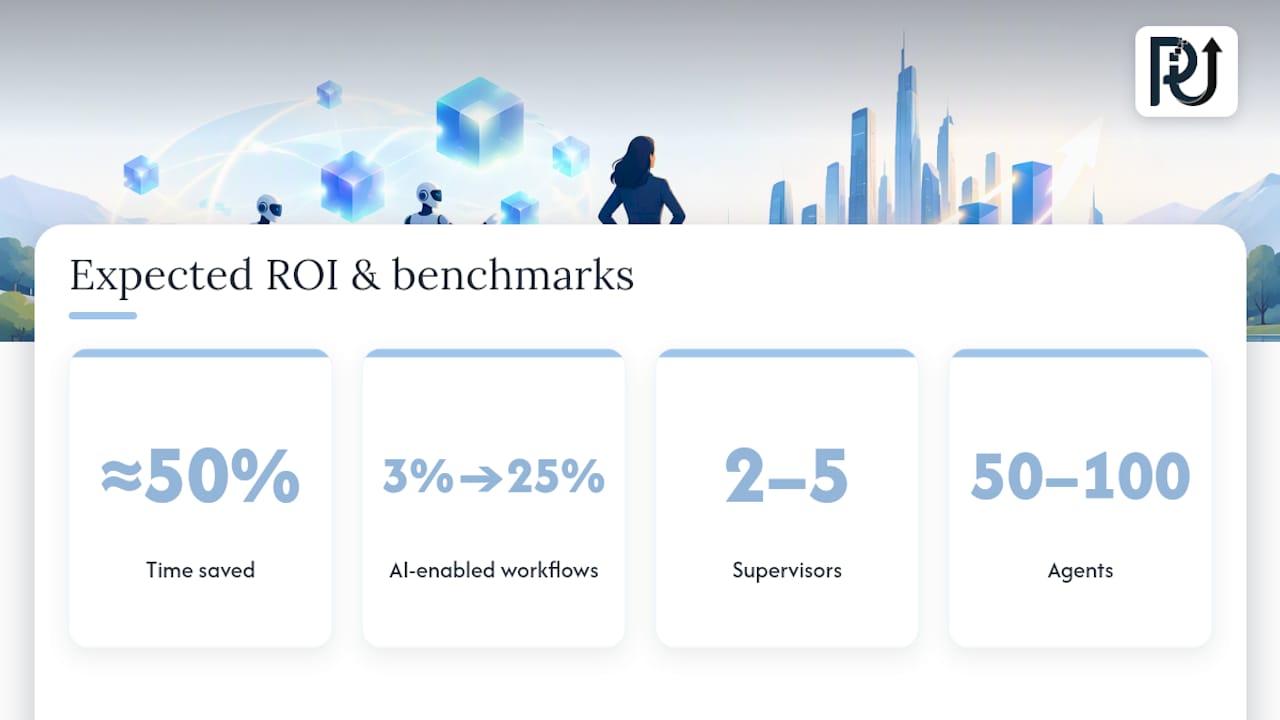
IBM’s 2025 research adds urgency: AI-enabled workflows are projected to jump from 3% of workflows to 25% by the end of 2025, and workflow redesign, not simple task automation, correlates most strongly with financial impact. Track time saved, decision accuracy, cost per transaction, and adoption rate as your core KPIs. Target processes with high volume and clear rules first, like invoice matching or claims triage, and reserve full workflow redesign for processes where patching the old system has already hit diminishing returns.
How Do You Launch a 90-Day Automation Architecture Pilot?
- Define scope tightly: pick one workflow, set success metrics up front, and confirm data access and integration points before writing any agent logic.
- Choose a modular, vendor-neutral pattern: favor composability and open protocols like MCP and A2A over a single vendor’s proprietary stack, so you’re not locked in later.
- Staff for AgentOps from day one: observability, durable execution, and security gates need owners before launch, not after an incident.
- Watch for red flags in any proposal: no identity controls per agent, no tracing or audit logs, and no named owner for the agent’s lifecycle are all signs the architecture won’t survive contact with production volume.
Why Engineering Discipline Beats Flashy Demos
Most vendors show you a demo agent answering questions cleanly and call it done. The harder, less visible work is what makes an agent survive contact with real transaction volume: identity scoping, durable execution, audit trails that hold up under a compliance review. The firm was built around that harder work, positioning itself as an AI integration and automation provider that treats agent systems as production infrastructure, not a chatbot wrapper. A live product like DocuPOW exists precisely to prove that document-intelligence automation can run reliably at volume, not just in a sales deck.
Durable engineering matters more than clever prompting. A system your team can maintain, audit, and hand off ownership of will outlast one built for a demo day.
— Syed Naveed Abbas
Ready to Build Your Automation Architecture?
Most automation vendors sell you a workflow tool and leave the architecture decisions to you. Some vendors design the system itself—including agents, orchestration, governance, and AgentOps—as a single accountable engagement, so you’re not left assembling parts from a demo.
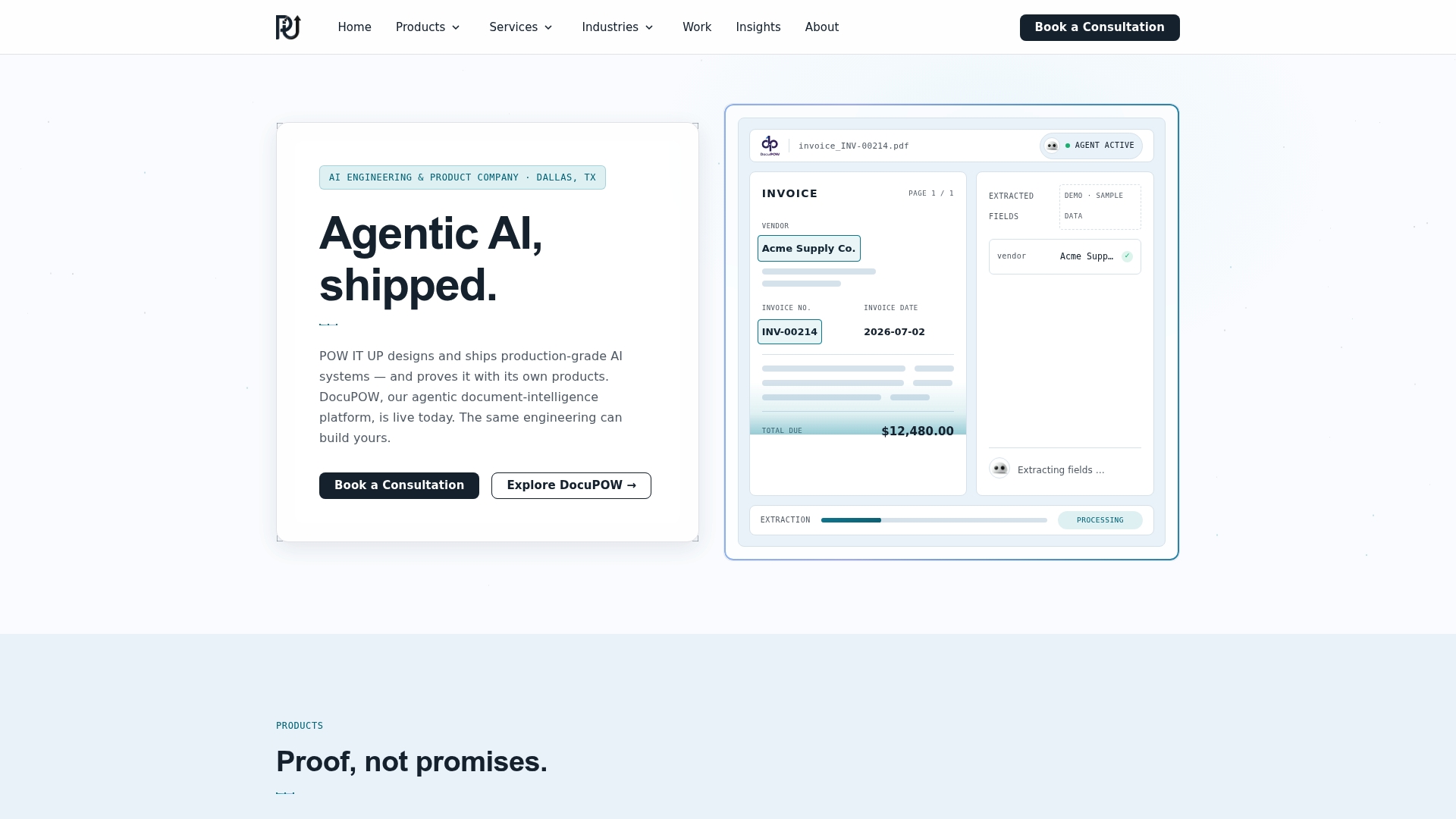
POW IT UP’s AI Agents Development service builds the custom, context-aware agents this article describes, while AI Integration connects them into your existing systems without a rebuild from scratch. For document-heavy operations, DocuPOW is a live product handling document reading and validation today, not a concept on a roadmap. If your operation runs high-volume transactional work that still depends on manual review, request a demo and see what a governed agent system looks like on your own data before committing to a build.
Sources
- The agentic organization (McKinsey, 2025)
- Multiple-agent workflow automation (Microsoft Learn)
- Orchestrating agents with Temporal (APN blog)
FAQ
What Is Automation Architecture in Agentic AI?
Automation Architecture is the engineered design of autonomous agents, orchestration, and governance controls that let AI systems run transactional workflows without constant human execution. It spans agent identity, tool access, knowledge retrieval, and lifecycle operations, and it’s distinct from scripted or industrial automation.
How Many Agents Can a Small Team Supervise?
McKinsey’s research on agent factories found that two to five human supervisors can manage 50 to 100 specialized agents in a mature deployment. That ratio applies once governance and observability are already in place, not during an early pilot.
What’s the Difference Between Sequential and Swarm Agent Patterns?
Sequential agents pass work down a fixed pipeline, each owning one stage, which suits structured processes like invoice validation. Swarm patterns let multiple agents collaborate and critique each other’s output in a loop, better suited to drafting or refining complex documents.
How Much Does POW IT UP’s Automation Service Cost?
Pricing for POW IT UP’s AI Agents Development, AI Integration, and AI Automation services is not published and depends on project scope. Current pricing details are available directly on the POW IT UP website.