
Operational Productivity Systems are AI-powered digital workforces, autonomous agents, orchestration layers, and document intelligence, engineered to scale transactional throughput without adding headcount. Deloitte frames this as a shift from task automation to autonomous reasoning, and a recent production study of document pipelines found a 97.0% full-pipeline automation rate across 955 real invoices. POW IT UP’s own case studies show what that shift looks like when it’s engineered correctly instead of bolted on.
TL;DR:
- Automation rates for document processing systems can reach over 97 percent, with most organizations seeing pilot results within 4 to 8 weeks.
- Processes involving high volume, frequent handoffs, and predictable exceptions, such as invoice and claims processing, yield the best return on agentic AI.
- Successful deployments depend on phased assessment, targeted pilots, and layered integration into existing systems, not immediate full-scale scaling.
- Clear decision rights based on transaction value, reversibility, and data sensitivity are critical to maintaining trust and effective oversight.
- Most project failures stem from insufficient process engineering and governance, rather than model quality, highlighting the importance of thorough process redesign.
Table of Contents
- What Makes Up an Operational Productivity System?
- Which Processes Get the Best Return From Agentic AI?
- How Do You Roll Out an Operational Productivity System?
- How Much Autonomy Should an Agent Actually Have?
- What KPIs Actually Prove an Operational Productivity System Is Working?
- Why Most Agentic AI Projects Underdeliver
- Build Your Digital Workforce With POW IT UP
- Sources
- FAQ
What Makes Up an Operational Productivity System?
An agentic system is built from distinct working parts, not a single “AI layer” dropped on top of existing software. Each piece does a specific job, and skipping one is usually why pilots stall; practical infrastructure compatibility and engine choices are crucial, as detailed in Bring Your Own AI (LLM) — Infrastructure Operations | Opsphere.
- Agents: task-specific AI workers that plan, reason, and act, rather than follow a fixed script.
- Orchestration: the logic that sequences agents, hands off work between them, and manages retries.
- Connectors: integrations into ERPs, CRMs, email, and line-of-business systems where the real data lives.
- Document pipeline: extraction, classification, and validation for invoices, claims, contracts, and forms.
- Human-in-the-loop (HITL) gates: checkpoints where a person approves, corrects, or overrides an agent’s decision.
- Observability: logging and monitoring that show what an agent did and why, after the fact.
The difference from robotic process automation (RPA) comes down to autonomy. RPA follows rigid, rule-based steps and breaks the moment a screen layout or data format changes. Agentic AI plans around ambiguity, calls tools when needed, and retains context across a transaction. That said, RPA still wins for high-volume, perfectly structured tasks where variability is near zero. Agentic approaches earn their cost when exceptions, judgment calls, or unstructured documents enter the picture.
Which Processes Get the Best Return From Agentic AI?
Not every workflow deserves an agent. The best candidates share three traits: high volume, repeated handoffs between systems or people, and predictable categories of exception. Map the transaction’s full event trail before committing engineering time to it.
Strong candidates include:
- Invoice processing and three-way matching
- Insurance claims intake and triage
- Account reconciliations across ledgers and banks
- Recurring billing and subscription transaction processing
- First-line triage routing for support or operations queues
Production benchmark: The MADP multi-agent document study reported 98.5% document-level accuracy in ablation testing and modeled a roughly 70% FTE reduction for a scenario processing 100,000 invoices a year, using specialized agents paired with selective human validation.
Treat those figures as illustrative of what a well-tuned pipeline can achieve, not a guaranteed outcome for any given company. Actual results depend heavily on document quality, exception rates, and how clean the source data is going in. Most organizations see a working pilot within 4 to 8 weeks, with production-grade scale-up following over the next 2 to 4 months as edge cases get resolved and confidence thresholds get tuned.
How Do You Roll Out an Operational Productivity System?
Deloitte’s phased adoption guidance sets the pattern that works best in practice: assess, pilot, layer, then scale. Skipping straight to “scale” is the single most common reason agentic projects underdeliver.
- Assess readiness. Map the process end-to-end, audit data quality at each handoff, and document current architecture before writing a line of agent logic.
- Design a narrow pilot. Pick one transaction type, define hard KPIs up front, set HITL rules, and write acceptance criteria before the pilot starts, not after.
- Layer agents into existing platforms. Rather than ripping out systems, insert agents into specific sub-processes and assign clear ownership for monitoring and drift mitigation.
- Scale with governance. Stand up a governance body, set SLAs, build continuous improvement loops, and invest in workforce upskilling as volume grows.
Pro Tip: *Run your pilot on a process you already understand cold. The point isn’t proving the AI works in theory.
Both McKinsey and Deloitte converge on the same warning: the model is rarely the bottleneck. McKinsey’s research finds workflow redesign has the strongest relationship with EBIT impact from generative AI, ahead of model selection or prompt engineering. POW IT UP’s AI automation work leans on this insight directly: redesign the process first, automate second.
How Much Autonomy Should an Agent Actually Have?
Not every agent decision deserves the same level of trust. An autonomy matrix ties decision rights to specific transaction attributes, giving you a defensible answer to “should the agent just do this, or should a person sign off?” MIT CISR’s research on decision rights frames this as the core design question in agentic deployments, not an afterthought.
Build the matrix around:
- Transaction value: higher dollar amounts get tighter oversight, regardless of confidence score.
- Reversibility: irreversible actions (wire transfers, contract execution) need human sign-off; reversible ones don’t.
- Data sensitivity: PII, financial, or health data raises the review bar automatically.
- Confidence thresholds: below a set score, the agent routes to a human instead of guessing.
Selective human review, rather than checking everything, is what makes this sustainable. The MADP study’s approach of capturing reviewer corrections and feeding them back into prompt fine tuning lets the system improve without retraining a model from scratch, which matters when a new vendor format or document variant shows up.
Pro Tip: Log every agent decision with enough context to reconstruct it later. When something goes wrong, “the agent flagged low confidence and a human approved anyway” is a very different incident than “nobody knows what happened.”
Round this out with real operational controls: canary rollouts for new agent logic, defined identity and permission scopes so an agent can’t touch more than it needs to, and a documented incident response plan. The U.S. Department of Labor’s guidance is explicit that organizations shouldn’t lean on automated systems alone for decisions with real employment or financial consequences, and NIST’s AI Risk Management Framework gives a structured way to build that oversight in from day one rather than retrofitting it after an incident.
What KPIs Actually Prove an Operational Productivity System Is Working?
Track outcomes, not activity. A dashboard full of “agent runs completed” tells you nothing about whether the business is actually better off.
- Throughput: transactions processed per hour or day, compared to the pre-automation baseline.
- Automation rate: the percentage of cases resolved end-to-end without human touch.
- Accuracy: error rate on completed transactions, measured against the manual process it replaced.
- Time-to-exception-resolution: how fast flagged cases get resolved once a human is looped in.
- FTE impact: hours reallocated away from manual processing, not headcount eliminated outright.
- Compute and operating cost: the ongoing bill for running agents at volume, not just the build cost.
Deloitte notes that agentic systems introduce genuine new costs, ongoing compute and maintenance among them, that need to be weighed against labor savings rather than assumed away.
Ownership matters as much as the KPIs themselves. Someone needs explicit responsibility for drift monitoring, rule updates, and reporting cadence, or the system quietly degrades as supplier formats, edge cases, and business rules shift underneath it. POW IT UP’s services overview covers the analytics and cost-modeling work that typically anchors this ownership model.
Why Most Agentic AI Projects Underdeliver
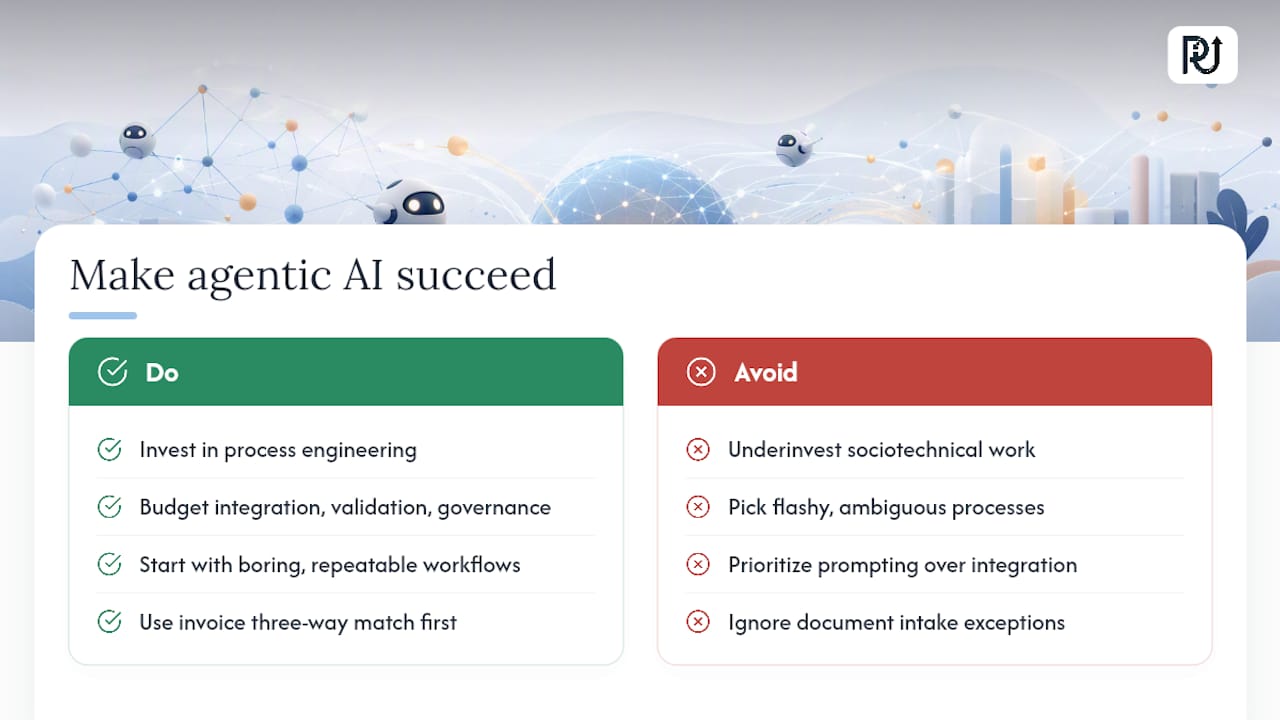
Most failures don’t come from weak models. They come from underinvesting in process engineering, integration work, and governance, the unglamorous parts nobody wants to budget for. MIT Sloan’s research on clinical AI deployments found that more than 80% of project effort went into sociotechnical work, integration, validation, governance, not model prompting. That ratio holds up in enterprise transactional systems too.
The pattern I see repeatedly: teams pick a flashy, ambiguous process for their first agent instead of a boring one with repeated handoffs and predictable exceptions. Start boring. A three-way invoice match with known exception types will teach you more about your data quality and integration gaps than a complex judgment-heavy workflow ever will, and it gets you to a defensible KPI faster. Tools like DocuPOW exist precisely because document intake is where most of these predictable, high-volume exceptions live.
— Syed Naveed Abbas
Build Your Digital Workforce With POW IT UP
Scaling agents instead of people can be an alternative way to absorb transaction growth, reducing the marginal cost of processing additional invoices or claims.
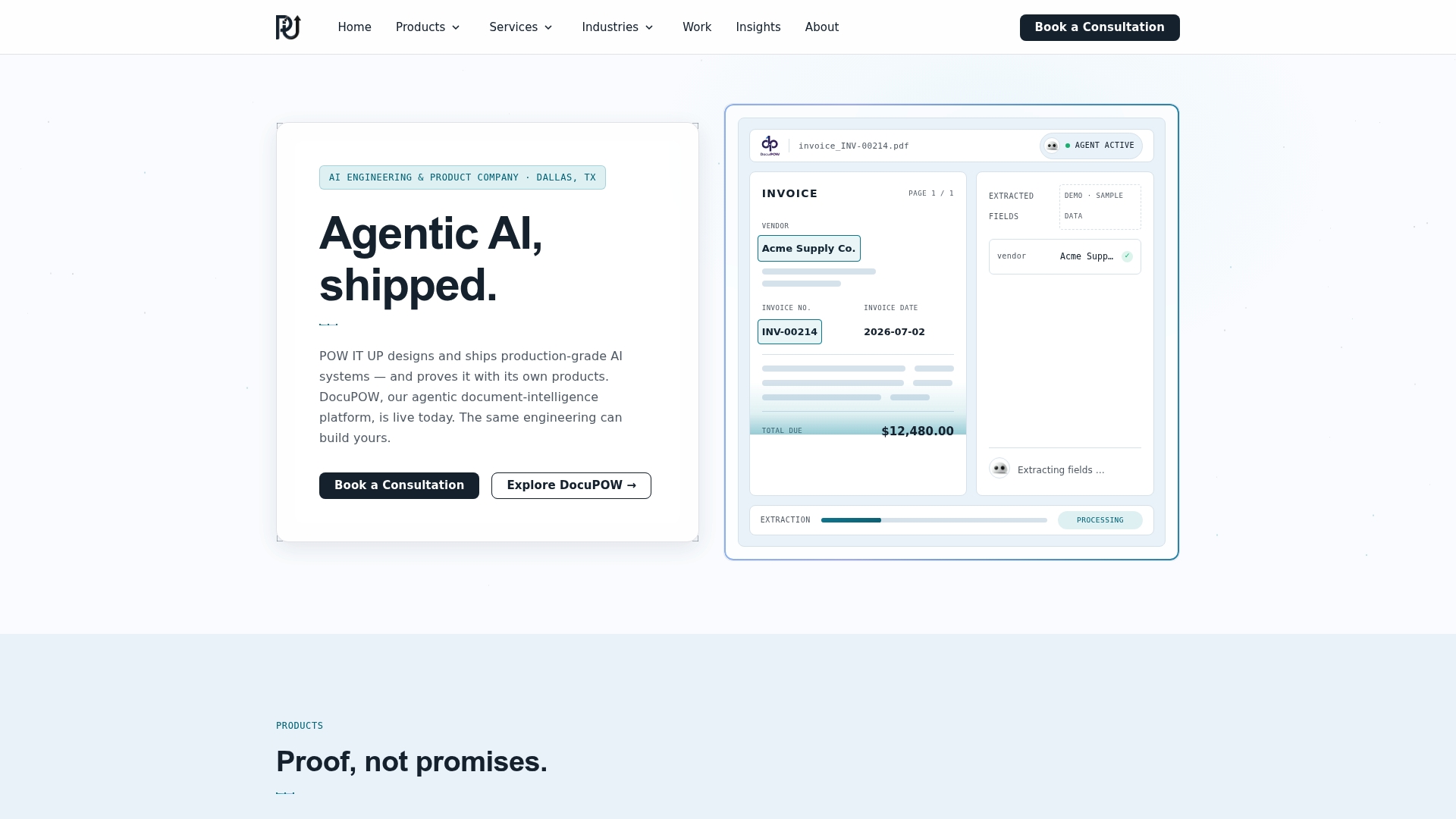
Our engagement flow follows the same phased logic covered above: a readiness assessment maps your process and data quality, a scoped pilot proves value on one transaction type, and production rollout comes with governance and monitoring built in from the start. Core offerings include AI Agents Development for custom autonomous workers, AI Integration to connect agents to your existing systems, AI Automation for end-to-end workflow builds, and DocuPOW, our live document intelligence product, for teams that want a working demo before committing to a custom build. Case studies with real KPIs are available on request. If a transaction chain in your operation has predictable exceptions and repeated handoffs, that’s the one worth piloting first. Reach out to scope a readiness assessment or request a DocuPOW demo.
Sources
- Agentic AI enterprise adoption guide (Deloitte)
- NIST AI RMF (Generative AI profile) – NIST
- MADP multi-agent document processing study (arXiv)
- U.S. Department of Labor AI principles and best practices (DOL)
- MIT Sloan clinical-deployment field guide (implementation effort distribution)
FAQ
What Is an Operational Productivity System?
It’s an AI-powered digital workforce, autonomous agents plus orchestration plus document intelligence, built to handle high-volume transactional work end-to-end. Deloitte describes this as a shift from scripted automation toward systems that plan and reason through autonomous decision-making.
How Is Agentic AI Different From RPA?
RPA follows fixed rules and breaks when a screen or data format changes; agentic AI plans, uses tools, and adapts to variation within a transaction. RPA still fits narrow, perfectly structured, high-volume tasks better in many cases.
How Long Does a Pilot Take Before Showing Results?
Most pilots reach a working state in 4 to 8 weeks, with production scale-up following over the next 2 to 4 months as exceptions get tuned out. Timelines shift based on data quality and how many systems the agent needs to touch.
What Does POW IT UP Charge for AI Agent Development?
Pricing for AI Agents Development and DocuPOW isn’t published; current rates are available directly on the POW IT UP site or through a scoped consultation.
Do These Systems Require Constant Human Oversight?
They require selective oversight at defined checkpoints, not constant supervision. An autonomy matrix routes low-confidence or high-value decisions to a person while letting routine cases pass through automatically, which the Department of Labor’s guidance treats as a baseline safeguard rather than optional.