
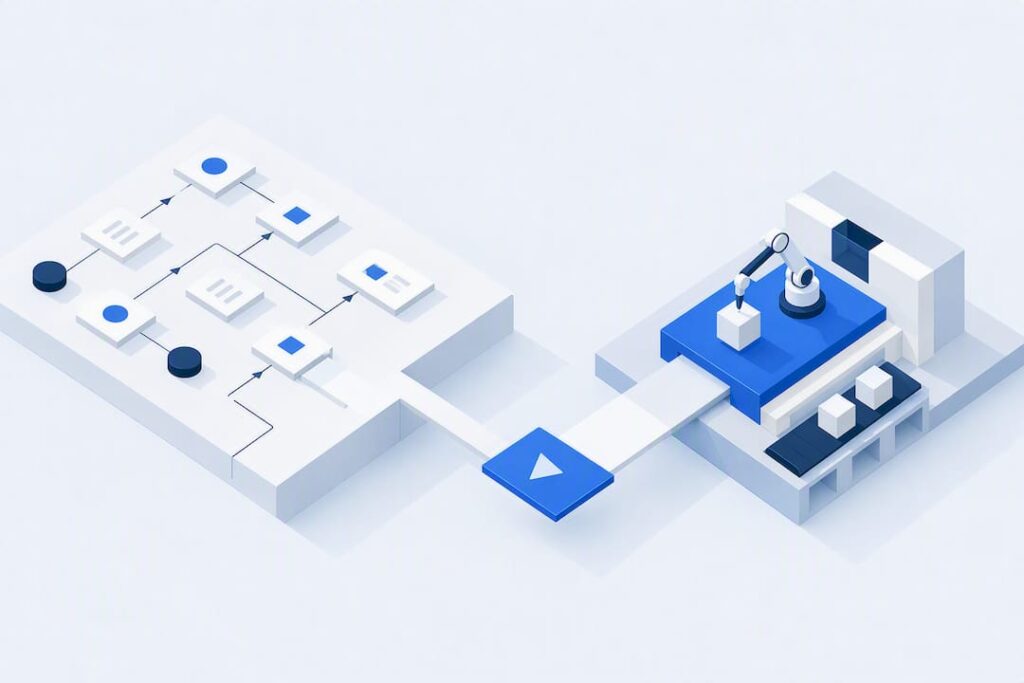
Enterprise workflow optimization delivers measurable cuts in cycle time, error rate, and cost per transaction by redesigning how work moves across systems and teams, then automating the highest-volume steps with AI. The single most important first move: map one high-volume process end to end, find where it actually breaks, and run a small automation pilot before touching anything else at scale.
TL;DR:
- Automating high-volume, complex processes requires a deep understanding of actual workflows, not just documented procedures, often involving multiple systems and manual workarounds.
- The most effective methodology depends on the bottleneck type: Lean targets waste, Six Sigma addresses variation, TOC focuses on system constraints, and all are best supported by automation tiers like RPA, intelligent automation, and AI agents.
- Deep integration, AI governance, legacy data compatibility, and security are critical criteria when selecting automation platforms to ensure scalability and compliance.
- Moving from pilot to enterprise-scale automation demands careful planning, process mapping, baseline measurement, and building repeatable infrastructure before expanding to new processes.
- Establishing a central governance team or Center of Excellence is essential for scaling automation efficiently, reducing maintenance costs, and maintaining control over process quality and compliance.
Table of Contents
- What Is Enterprise Workflow Optimization and Why Does It Matter?
- Lean, Six Sigma, PDCA, or TOC: Which Method Fits Your Bottleneck?
- What Should an Enterprise Automation Platform Actually Provide?
- How Do You Move From Pilot to Enterprise-Wide Scale?
- How Do You Measure Success and Govern It at Scale?
- What Actually Happens When You Automate a High-Volume Process
- Process Maturity First, or AI Agents First?
- Ready to Pilot Your First Automation?
- Sources
- FAQ
What Is Enterprise Workflow Optimization and Why Does It Matter?
At the enterprise level, workflow optimization means something different than it does at a 20-person startup. You’re not fixing one team’s process. You’re untangling handoffs across finance, IT, legal, and customer service, often spanning five or six systems that were never designed to talk to each other. A single loan approval, insurance claim, or purchase order might touch an ERP, a CRM, a document management system, and three different approval queues before it’s done.
That complexity is exactly why the payoff is bigger at scale. Fix a bottleneck in a process that runs 50,000 times a month, and the savings compound in a way a small-team fix never will. Business process improvement works by analyzing processes to find inefficiencies and then applying structured methods like Lean and Six Sigma to close the gaps. That definition holds true here, just at a bigger, messier scale.
The outcomes leaders should expect fall into a few clear buckets:
- Efficiency gains: fewer manual touchpoints, shorter cycle times, less rework
- Cost reduction: lower cost per transaction as headcount stops scaling linearly with volume
- Scalability: the ability to absorb a 3x increase in transaction volume without a 3x increase in staff
- Customer and employee experience: faster resolution times for customers, less repetitive drudgery for employees
- Error reduction and compliance: fewer manual entry mistakes and cleaner audit trails
Documented benefits of business process improvement include exactly this mix: increased efficiency, cost savings, improved scalability, and reduced errors, all of which compound when applied across a large organization rather than a single department.
The harder question is which lever to pull. Business process improvement (BPI) works well when the process is fundamentally sound but inefficient. Business process reengineering (BPR) makes sense when the process itself is broken beyond incremental fixes and needs a ground-up redesign. Automation-first approaches fit when the bottleneck is repetitive, rules-based work that humans are doing simply because no one built a better system yet. Most enterprises need all three, applied to different processes at different times, not one approach applied everywhere.
Lean, Six Sigma, PDCA, or TOC: Which Method Fits Your Bottleneck?
Pick the wrong methodology and you’ll spend six months mapping a process that needed a two-week fix. Pick the right one and you’ll know within weeks whether you’re on the right track. The decision usually comes down to whether your problem is about waste, variation, or capacity.
Incremental improvement versus radical reengineering is the first fork in the road. Continuous improvement methods assume the process is basically right and needs tuning. Reengineering assumes the process is wrong at the root and needs to be torn up. Most enterprise operations leaders default to incremental methods because reengineering carries real disruption risk. That instinct is usually correct, but it’s worth checking that assumption at least once a year against processes that have accumulated so many patches they no longer resemble their original design.
Here’s how the four core methodologies stack up against each other:
- Lean targets waste. It uses value stream mapping to strip out steps that don’t add value to the customer or the business. Choose Lean when a process has obvious dead time, duplicate approvals, or handoffs nobody can explain the reason for.
- Six Sigma (DMAIC) targets variation and defects. Its five phases, Define, Measure, Analyze, Improve, Control, work best when the process runs consistently but produces inconsistent quality or error rates. Choose Six Sigma when your problem is “sometimes this works fine, sometimes it doesn’t” rather than “this is slow.”
- PDCA (Plan, Do, Check, Act) is a four-step iterative loop built for continuous testing. Structured BPI methods like Kaizen, Lean, PDCA, and Six Sigma are frequently combined rather than used in isolation, and PDCA is often the wrapper that ties smaller Kaizen-style fixes together over time.
- Theory of Constraints (TOC) targets the system bottleneck specifically. Instead of optimizing every step evenly, TOC says: find the one constraint limiting total throughput, fix that, then find the next one. Choose TOC when you suspect that fixing everything is wasted effort because one stage is choking the whole pipeline.
Where these methods hit their limit is volume. Lean can eliminate a redundant approval step, but it can’t process 10,000 invoices overnight. That’s where automation enters, and it comes in three tiers of sophistication. Robotic process automation (RPA) handles rule-based, repetitive tasks, think data entry between two systems with no exceptions. Intelligent automation adds document understanding and decision logic on top of RPA, so it can handle some variability. AI agents go further still: they can reason across multiple systems, handle exceptions that would have required a human, and make judgment calls within defined guardrails.
Applied by function, this looks different everywhere. Finance teams use intelligent automation for invoice matching and AI agents for anomaly detection in expense reports. HR uses RPA for onboarding paperwork and AI agents for resume screening with human sign-off. Customer service leans on AI agents for tier-one ticket resolution, escalating only genuine edge cases. Manufacturing uses TOC to find the constraint machine, then automation to keep it fed continuously.
Pro Tip: Don’t run a methodology diagnostic before you’ve talked to the people doing the work. Ask them where they waste time waiting, not where the process documentation says the bottleneck is. Those two answers are rarely the same, and frontline input uncovers the fixable bottleneck faster than any flowchart.
What Should an Enterprise Automation Platform Actually Provide?
Most procurement teams evaluating automation platforms get distracted by demo polish and miss the capabilities that determine whether the system survives contact with a real enterprise IT environment — check out practical tips from the procurement contract workflow that moves faster to guide your evaluation. The checklist that matters has four categories: integration depth, AI governance, data architecture, and security.
Integration depth comes first because nothing else matters if the platform can’t talk to your existing stack. Enterprise automation platforms need deep integration, AI-agent orchestration, audit trails, and governance to deliver real cycle time reductions at scale, not just impressive pilot demos that fall apart against production data. Look for:
- Open APIs rather than proprietary connectors that lock you into one vendor’s ecosystem
- Pre-built connectors for common ERP and CRM systems, plus a documented path for legacy or homegrown systems
- Support for both batch processing and real-time event triggers
- The ability to orchestrate work across multiple systems in a single workflow, not just automate within one
AI agent governance is where most platforms show their age, because agentic AI is new enough that governance tooling hasn’t caught up everywhere. Before deploying agents into production, confirm the platform offers model version management so you know exactly which version of an agent made which decision, rollback capability if a new model version underperforms, and explainability features that let a human trace why an agent took a specific action. Without these three, you’re deploying a black box into a regulated process, and that’s a liability question waiting to surface during an audit.
Data patterns for legacy integration deserve specific attention because most enterprises still run critical processes on systems built before 2010. A platform that only integrates cleanly with modern SaaS tools will leave your oldest, often highest-volume processes untouched. Preferring open APIs and standards over locked-in stacks gives you the flexibility to orchestrate across that mixed environment instead of ripping and replacing systems that still work fine.

Security and compliance expectations at enterprise scale include multi-tenant governance controls, recognized security certifications like SOC 2, granular permission structures, and audit trails detailed enough to satisfy a regulator asking “who approved this transaction and why.” A platform that treats audit logging as an afterthought will cost you far more in remediation than it ever saved in automation.
The teams that get this right treat the checklist as non-negotiable before signing anything, not as a nice-to-have they’ll revisit later. Tools built for AI integration into enterprise systems tend to separate themselves from generic automation software exactly on these four points.
How Do You Move From Pilot to Enterprise-Wide Scale?
The gap between a successful pilot and enterprise-wide rollout is where most automation initiatives quietly die. The process below is the sequence that actually works, in order, without skipping steps.
- Identify candidate processes with a value times complexity score. Rank every process you’re considering on two axes: how much value fixing it would generate (transaction volume, cost per error, customer impact) and how complex it would be to fix (number of systems touched, regulatory sensitivity, exception rate). The sweet spot is high value, moderate complexity. High-value, high-complexity processes are tempting but dangerous as a first project.
- Map the process as it actually runs, not as documented. Sit with the people doing the work. Documentation is almost always stale, and the real process has three workarounds nobody wrote down.
- Quantify the opportunity with real numbers. Measure current cycle time, error rate, and cost per transaction before you touch anything. Without a baseline, you can’t prove improvement later, and skeptical stakeholders will assume you’re guessing.
- Design the pilot with hard success criteria up front. Define the target cycle time reduction, the rollback trigger if error rates spike, and exactly what data you’ll collect during the pilot window. A pilot without a predefined kill switch tends to limp along indefinitely instead of failing fast or succeeding clearly.
- Run the pilot on a contained slice of volume. Don’t automate 100% of a process on day one. Automate a defined subset, watch it closely, and compare results against the baseline you captured in step three.
- Build the scale mechanics before you need them. This means templates for onboarding the next process, versioning standards so agent updates don’t break production silently, and runbooks that let someone other than the original builder operate the system.
Pro Tip: The most common scaling failure isn’t a bad pilot. It’s a successful pilot that nobody built repeatable infrastructure around, so every new process automation starts from zero instead of from a template. Comparing manual versus automated workflow costs before and after each pilot gives you the hard numbers that make the case for scaling investment obvious to finance.
How Do You Measure Success and Govern It at Scale?
Three KPIs matter more than any dashboard vanity metric: cycle time, error rate, and cost per transaction. Cycle time tells you how long a process takes from trigger to completion. Error rate tells you how much rework or correction the process generates downstream. Cost per transaction ties both back to a number finance actually cares about. Track these three consistently across every automated process, and you’ll have a defensible story for every dollar invested.
Real-time monitoring beats monthly reporting for a simple reason: AI-driven analytics and live dashboards let leaders catch and fix bottlenecks immediately instead of discovering a problem 30 days after it started costing money. Build dashboards that flag anomalies as they happen, not retrospectives that explain what already went wrong.
Governance is where scale either holds together or falls apart. A Center of Excellence should own:
- Standardizing implementation patterns so every new automation doesn’t reinvent its own architecture
- Maintaining a RACI model that spells out who approves, builds, monitors, and audits each automated process
- Running audit and compliance checks on a fixed schedule, not only when a regulator asks
- Retiring or upgrading agent models on a defined lifecycle rather than letting them run unmonitored indefinitely
The data backs this structure: organizations running a Center of Excellence achieve 60% faster time-to-value and 40% lower per-automation maintenance costs compared to teams scaling automation ad hoc, department by department.
The most common governance failure is letting individual departments build automations independently with no central review. It looks efficient for the first six months and then collapses under duplicate tooling, inconsistent audit trails, and nobody able to answer who’s responsible when an agent makes a mistake. The fix is establishing the CoE before the second department starts automating, not after the third one has already gone rogue.
What Actually Happens When You Automate a High-Volume Process
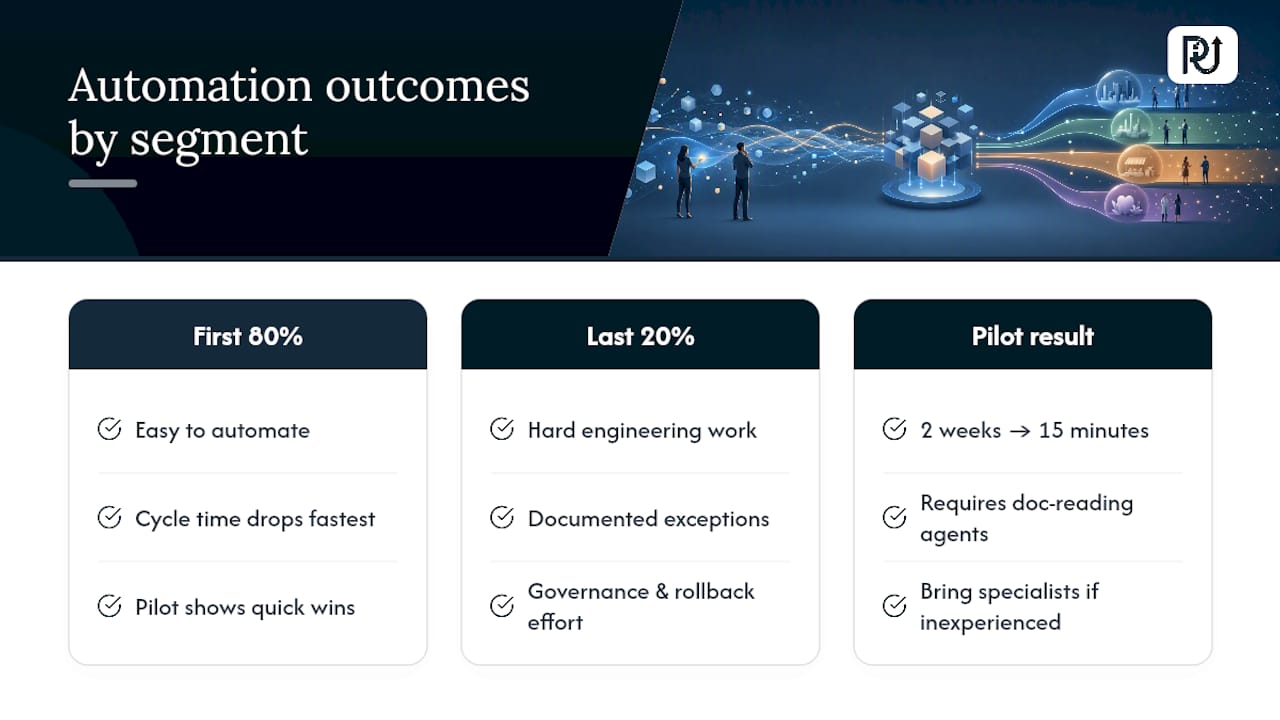
Enterprises that pair method discipline with a well-run pilot tend to see similar patterns: cycle time drops fastest in the first automated segment, then the real work becomes documenting the exceptions the pilot surfaced. One illustrative case from IBM’s own automation work took a title insurance processing workflow from a two-week turnaround down to 15 minutes, an order-of-magnitude shift that’s only possible once the manual review steps get replaced by document-reading agents rather than faster humans.
The tactical lesson that generalizes: the first 80% of a process is usually easy to automate, and the last 20% is where all the actual engineering work lives. Teams that budget time and staff for that final stretch scale successfully. Teams that assume the pilot’s easy win will extrapolate cleanly usually stall out.
Deciding whether to build this capability internally or bring in a specialist comes down to one honest question: does your team have people who’ve built and shipped AI agents into regulated, high-volume production environments before? If the answer is no, the learning curve on governance and rollback design alone often costs more in delay than hiring AI integration expertise for the first one or two pilots.
Process Maturity First, or AI Agents First?
Enterprises with chaotic, undocumented processes should mature the process before automating it. Bolting AI agents onto a broken workflow just automates the chaos faster. Enterprises with stable, well-mapped processes should move straight to automation pilots. Either path needs human-in-the-loop review, full audit trails, and a rollback plan before touching production volume. Align spending to near-term cycle time wins first. Long-term agentic capability follows once the fundamentals hold.
— Syed Naveed Abbas
Ready to Pilot Your First Automation?
Most enterprises don’t need another audit or a six-month strategy deck. They need one process mapped, one pilot built, and proof it works before scaling further. Our team designs and deploys custom AI agents that handle document reading, transaction processing, and workflow orchestration for high-volume processes, aiming to integrate with your existing tech stack.
If your team has a candidate process already identified, high volume, well understood, painfully manual, that’s the right place to start. We work with operations leaders in various industries to scope a pilot around that process, build the automation, and measure the cycle time and cost-per-transaction results against your baseline. Book an AI integration assessment to find out what a pilot would look like for your highest-volume workflow, and what it would take to scale it once it proves out.
Sources
- What is Business Process Improvement (BPI)? | Definition from TechTarget
- Enterprise AI Workflow Automation | NiCE
- Business Automation Workflow | IBM
FAQ
What Is an Enterprise Workflow System?
An enterprise workflow system is software that orchestrates tasks, approvals, and data handoffs across multiple business systems like ERP, CRM, and document management platforms, rather than automating just one department’s process in isolation.
What Is Workflow Optimization?
Workflow optimization is the practice of analyzing how work actually moves through a process, removing unnecessary steps, and applying methods like Lean or automation to reduce cycle time, cost per transaction, and error rates.
Which BPM Tool Is the Best?
There’s no single best business process management tool for every enterprise. The right platform depends on your integration needs, but any strong candidate should offer deep API integration, AI-agent orchestration, model governance, and full audit trails, capabilities enterprise automation platforms need to scale safely.
How Do You Optimize Workflow Performance?
Start by mapping a high-volume process as it actually runs, measure its current cycle time and error rate, then run a small automation pilot with clear success criteria before scaling. Combining a structured method like Lean or Six Sigma with automation typically outperforms either approach alone.
Do I Need a Center of Excellence to Scale Automation?
Not for a single pilot, but yes before scaling past two or three automated processes. Organizations running a CoE see 60% faster time-to-value and 40% lower maintenance costs than teams that scale automation department by department without central governance.