
An intelligent operations strategy is a decision-centric plan for using AI, automation, and real-time data to run enterprise workflows with less manual handoff and fewer stalled decisions. Frameworks like OPTIMA© and firms like POW IT UP build these systems around one goal: scaling transaction volume and processing speed without scaling headcount at the same rate.
TL;DR:
- Most successful intelligent operations programs require a complete stack including data, AI agents, automation, and observability, rather than just one tool.
- Focusing on high-volume workflows like onboarding and billing yields the biggest gains in efficiency and processing speed.
- Building a clear authority matrix and funding ongoing management are critical steps often overlooked, causing delays and degraded performance.
- Integrating AI with legacy systems through APIs and middleware prevents data drift and ensures decision consistency across multiple platforms.
- Effective risk management demands explainability, human override authority, and granular audit trails for all autonomous decisions.
Table of Contents
- What Does Intelligent Operations Actually Cover?
- Why Does Intelligent Operations Strategy Matter for the Bottom Line?
- How Does the OPTIMA© Framework Structure an Intelligent Operations Program?
- How Do You Move from Strategy to Execution?
- Which KPIs Prove an Intelligent Operations Program Is Working?
- What Pitfalls Stall Intelligent Operations Programs?
- Integrating Intelligent Operations with Legacy Systems
- Culture and Talent: The Human Side of Intelligent Operations
- Security and Risk Management for Intelligent Operations
- Where IoT and Edge Computing Fit Into Intelligent Operations
- What Does an Intelligent Operations Program Look Like in Practice?
- How POW IT UP Builds Your Intelligent Operations Program
- Sources
- FAQ
What Does Intelligent Operations Actually Cover?
Intelligent operations is not one tool. It is four layers working together, and most transformation programs fail because they build one layer and skip the rest.
- Data foundations: clean, connected, real-time data feeds that decisions can actually rely on.
- Intelligence and agents: AI models and autonomous agents that read context and recommend or execute actions.
- Automation and orchestration: the workflow engines that route work between systems, agents, and people.
- Observability: the monitoring layer that shows what happened, why, and whether it worked.
You see this stack most clearly in AIOps, where machine learning flags anomalies in IT infrastructure before an outage cascades. It shows up in back-office document processing, where an agent reads an invoice, validates it against a purchase order, and routes exceptions to a human. It shows up in supply chain forecasting and scheduling, where AI and machine learning already handle predictive maintenance and demand forecasting at scale. Each use case maps to a specific pain: high mean time to resolution, repetitive manual handoffs, or forecasts that lag reality by weeks.
Why Does Intelligent Operations Strategy Matter for the Bottom Line?
The business case comes down to three shifts: faster decisions, more output per employee, and fewer breakdowns. Leaders who treat intelligent operations as an IT project instead of a margin lever miss the point entirely.
By the numbers: A 2025 survey found 78% of participating businesses now use AI for at least one work-related task specifically to improve operational efficiency. That is not experimentation anymore. That is baseline behavior.
The mechanism behind the payoff is straightforward. IBM’s operational efficiency guidance ties efficiency gains, including reductions achieved through automation and process mapping, directly to improved net operating income. When a workflow that used to take a team three days now clears in three hours, the savings don’t just sit in labor cost. They compound into faster customer response, fewer error corrections, and capacity to take on volume that would have previously required new hires. That is the real shift: operations that scale on software instead of on headcount.
How Does the OPTIMA© Framework Structure an Intelligent Operations Program?
Most transformation efforts stall because they bolt automation onto a process nobody redesigned. OPTIMA© addresses this by treating decision design as the core mechanism that converts digital capability into operational value, not an afterthought bolted on once the software ships. The framework organizes a program around six elements:
- Objectives: what outcome the operation actually needs to produce, stated in business terms.
- People: who owns which decision, and where human judgment stays in the loop.
- Technology: the agents, platforms, and integrations that execute the work.
- Information: the data and telemetry feeding every decision point.
- Metrics: the leading and lagging indicators that prove the system works.
- Adaptability: how the operation adjusts when volume, rules, or risk change.
In practice, “People” shows up as a documented authority matrix. “Information” shows up as a telemetry plan built before the agent ever goes live, not retrofitted after launch. OPTIMA© also stresses a principle that gets skipped constantly: stabilize the process first, then automate it. Automating a broken handoff just makes the breakage faster.
Pro Tip: Before you approve any pilot budget, write down who has the authority to override the AI’s decision and under what conditions. If nobody can answer that in one sentence, the program isn’t ready for automation yet.
How Do You Move from Strategy to Execution?
Strategy documents don’t fail. Execution sequencing does. Here’s the order that actually holds up under real operating pressure:
- Run the diagnostic first. Identify the highest-frequency, highest-labor workflows, things like client onboarding, billing, and internal reporting, since enterprise guidance consistently shows the biggest wins come from targeting these processes first, with focused redesigns often cutting processing time by a significant percentage.
- Build the data strategy before the pilot. Operations need different telemetry than the project phase produced, so design the data handoff intentionally rather than inheriting whatever the build team happened to log.
- Assign decision rights and set a governance cadence. Decide who reviews exceptions weekly, who owns model performance monthly, and who can pause an agent immediately.
- Choose architecture for hybrid reality, not a greenfield fantasy. Most enterprises are integrating agents into systems that already exist, not replacing them wholesale.
- Shift the funding model. Scaling agentic AI requires moving away from one-time project budgets toward operating funding that covers ongoing management, monitoring, and oversight.
- Manage the change, not just the technology. Train the people whose jobs shift from doing the task to supervising the system that does it.
Pro Tip: Fund the pilot like you’d fund the scaled version, just smaller. If your budget assumes the project ends at go-live, you’ve already built a program that can’t sustain itself past quarter two.
Skipping step one is the most common mistake. Teams pilot the interesting workflow instead of the expensive one, then wonder why the business case never lands.
Which KPIs Prove an Intelligent Operations Program Is Working?
Pick too many metrics and nobody watches any of them. Management guidance generally recommends a small set, four to six high-impact metrics tracked weekly, rather than a dashboard nobody has time to read.
- Mean time to resolution (MTTR): how fast an issue gets fixed, not just detected.
- Decision latency: the gap between data arriving and a decision getting made.
- Throughput per FTE: volume processed per employee, tracked over time, not just at launch.
- Percent autonomous remediation: how much work the system resolves without human escalation.
Treat the first two as leading indicators and the last two as lagging proof of scale. Report MTTR and decision latency weekly to operating teams; report throughput and autonomous remediation monthly to leadership, since those numbers move slower and need more context to interpret correctly.
What Pitfalls Stall Intelligent Operations Programs?
Three failure modes show up again and again, and none of them are technology problems.
- Weak decision ownership. Nobody actually has authority to say yes or no when the agent flags an exception, so exceptions pile up unresolved.
- Underfunding past the pilot. The build gets budget; the ongoing monitoring and model tuning does not, and performance quietly degrades.
- Tech-only pilots. A team automates a task without redesigning the workflow around it, so the automation just speeds up a broken process.
The fix pattern is consistent: build an authority matrix before launch, fund operations, not just projects, and keep a human oversight checkpoint on every agent that makes a customer-facing or financial decision. A company that skips the authority matrix typically sees exceptions queue up for days. One that builds it usually clears the same queue same-day, because someone was always designated to decide.
Integrating Intelligent Operations with Legacy Systems
Most enterprises aren’t replacing their core systems. They’re wrapping intelligence around what already exists, and that reality shapes almost every architecture decision in an intelligent operations program.
The practical path runs through integration layers rather than rip-and-replace migrations. Middleware, APIs, and robotic process automation connect agents to mainframes, legacy ERPs, and homegrown databases that were never designed to talk to modern AI tooling. A document intelligence agent, for instance, can read an invoice and validate it against a decades-old accounting system without that system ever knowing an AI touched the transaction. The integration happens at the data and workflow layer, not inside the legacy application itself.
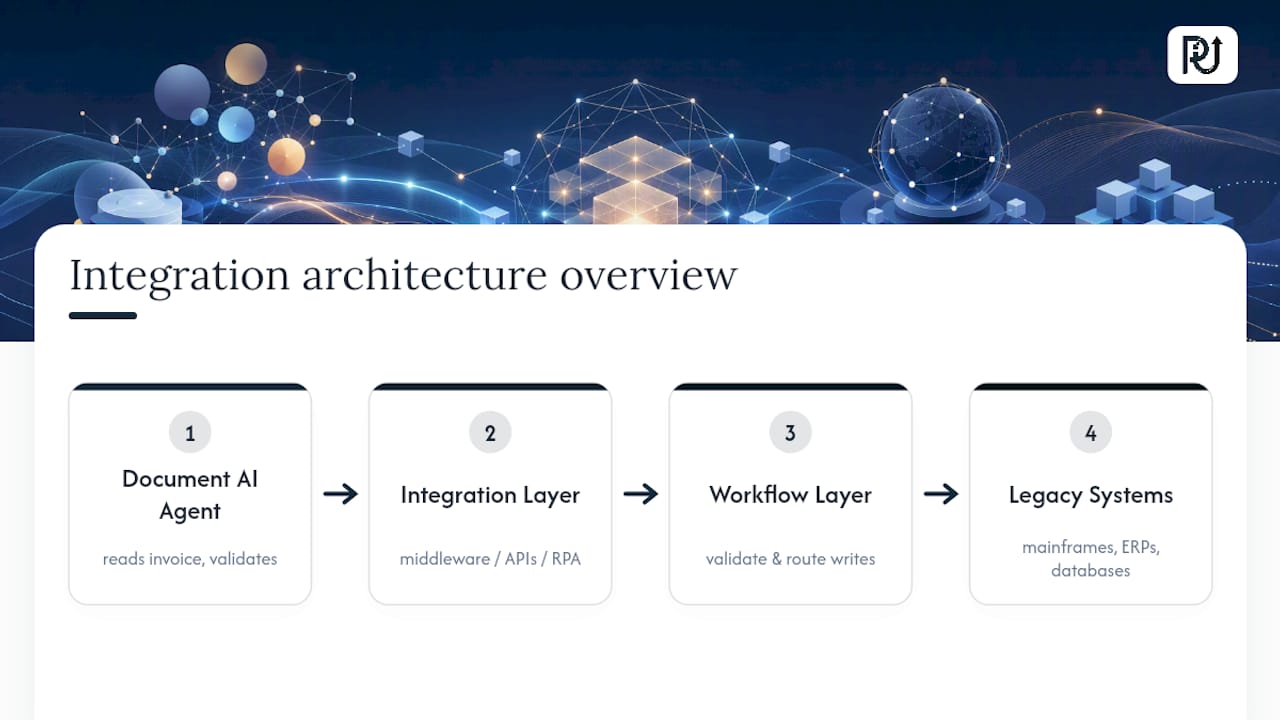
Hybrid environments introduce their own governance question: where does the system of record live once an agent starts making decisions that update multiple systems at once? Programs that skip this question end up with data drift, where the legacy system and the new automation layer disagree about the current state of a record. The fix is defining one authoritative source per data type before agents go live, then routing every write-back through that source, not around it.
Sequencing matters more than sophistication here. Start integration with the highest-friction handoff points, the ones where a human currently copies data between two systems by hand, because those are also the points where legacy fragility does the most damage. Save the deeper, riskier core-system integrations for after the operating model has proven itself on lower-stakes workflows.
Culture and Talent: The Human Side of Intelligent Operations
Technology adoption rarely fails on the technology. It fails because the people running the workflow never bought in, or because nobody retrained them for the job that actually exists after automation lands.
Intelligent operations changes what “doing the work” means. An employee who used to process transactions manually now supervises an agent that processes them, reviews exceptions, and tunes the rules when the agent gets something wrong repeatedly. That is a different skill set: less data entry, more judgment and pattern recognition. Programs that don’t invest in this transition see high resistance and quiet workarounds, employees who route work around the new system because nobody explained why it changed or trained them to operate inside it.
Culture also determines whether decision rights actually hold up in practice. A documented authority matrix means nothing if the person with authority feels pressured to rubber-stamp whatever the AI recommends, or if middle management punishes anyone who overrides an automated decision. Leaders need to explicitly reward good override judgment, not just efficiency metrics, or the human oversight layer becomes theater.
Talent strategy has to shift too. Hiring for intelligent operations increasingly means hiring people comfortable auditing a model’s output, not just executing a checklist. Some of that comes from reskilling current staff; some comes from bringing in people who’ve done this work elsewhere. Either way, the organizations that treat this as a training-budget line item, not a one-time announcement, are the ones whose pilots actually survive contact with year two.
Security and Risk Management for Intelligent Operations
Autonomous agents making decisions across connected systems create a different risk profile than traditional software, and treating it like a standard IT security problem understates the exposure.
The core risk isn’t just unauthorized access anymore. It’s an agent making an incorrect but authorized decision at scale, propagating an error across thousands of transactions before anyone notices. That is why Deloitte’s guidance on scaling agentic AI centers so heavily on governance and ongoing oversight rather than treating deployment as a one-time security review. A partner analysis on agentic AI and compliance makes a similar point: risk and decision-making authority need to be reviewed continuously, not signed off once at launch.
Practical risk management for intelligent operations rests on a few non-negotiables. Every agent needs explainability, meaning a human can trace why it made a specific call, not just that it made one. Every high-stakes decision path needs a human checkpoint, sized to the actual risk, financial approvals get tighter oversight than routine document sorting. And every system needs an audit trail granular enough to reconstruct a decision months later if a regulator, auditor, or customer disputes it.
Data exposure is the other half of the equation. Agents that pull from multiple legacy systems often have broader data access than any single human role ever had, which means access governance has to be rebuilt around the agent’s actual footprint, not the org chart’s assumptions about who needs to see what. Skipping this step is how a single compromised agent credential turns into a multi-system breach instead of a contained one.
Where IoT and Edge Computing Fit Into Intelligent Operations
Intelligent operations doesn’t stop at the data center. In manufacturing, logistics, and field service, the sensors and edge devices generating raw data are becoming as important as the AI models interpreting it.
IoT sensors feed the real-time telemetry that predictive maintenance models depend on, catching equipment failures before they cause downtime rather than after. Edge computing matters here because latency has real cost: a factory floor sensor that has to send data to a distant cloud server before triggering a shutdown can lose the seconds that separate a near-miss from a costly failure. Processing decisions at the edge, closer to where the data originates, keeps time-sensitive automation fast enough to matter.

This connects directly back to the observability layer of an intelligent operations stack. Edge devices and IoT sensors are, functionally, an expanded set of eyes on the operation, feeding the same monitoring and decision systems that already watch software workflows. A supply chain program using AI for demand forecasting gets meaningfully more accurate when it’s also ingesting real-time IoT data from warehouses and transport fleets, not just historical sales figures.
The strategic implication for leaders building an intelligent operations program: don’t treat IoT and edge computing as a separate initiative running on its own roadmap. Fold them into the same data foundation and governance model covering your AI agents and automation layer. Splitting them creates two disconnected monitoring systems that don’t talk to each other, which recreates the exact silo problem intelligent operations is supposed to eliminate.
What Does an Intelligent Operations Program Look Like in Practice?
Client engagements often start with a diagnostic: mapping which workflows burn the most hours and where decisions stall waiting on a person who’s buried in queue. From there, the work is decision logic first, agent design second, engineering digital workforces that execute high-volume transactional work without needing a person to touch every case.
The typical output isn’t a flashy dashboard. It’s eliminated time leaks and processing volume that scales without a matching headcount increase, exactly the outcome OPTIMA© identifies as the marker of a mature intelligent operations program.
Before greenlighting any vendor or internal pilot, leaders should ask three questions: What’s the exact scope of decisions this system can make without escalation? What SLA governs response time when it fails? Who holds override authority, and how is that documented? If those answers aren’t clear before the contract is signed, they won’t materialize after.
— Syed Naveed Abbas
How POW IT UP Builds Your Intelligent Operations Program
This approach replaces the guesswork of a DIY automation build with engineered digital workforces designed around actual decision points, not a generic workflow template. Where most teams spend months wiring together point solutions that break under real volume, POW IT UP designs the decision logic first, then builds AI agents and integrations that hold up at scale.
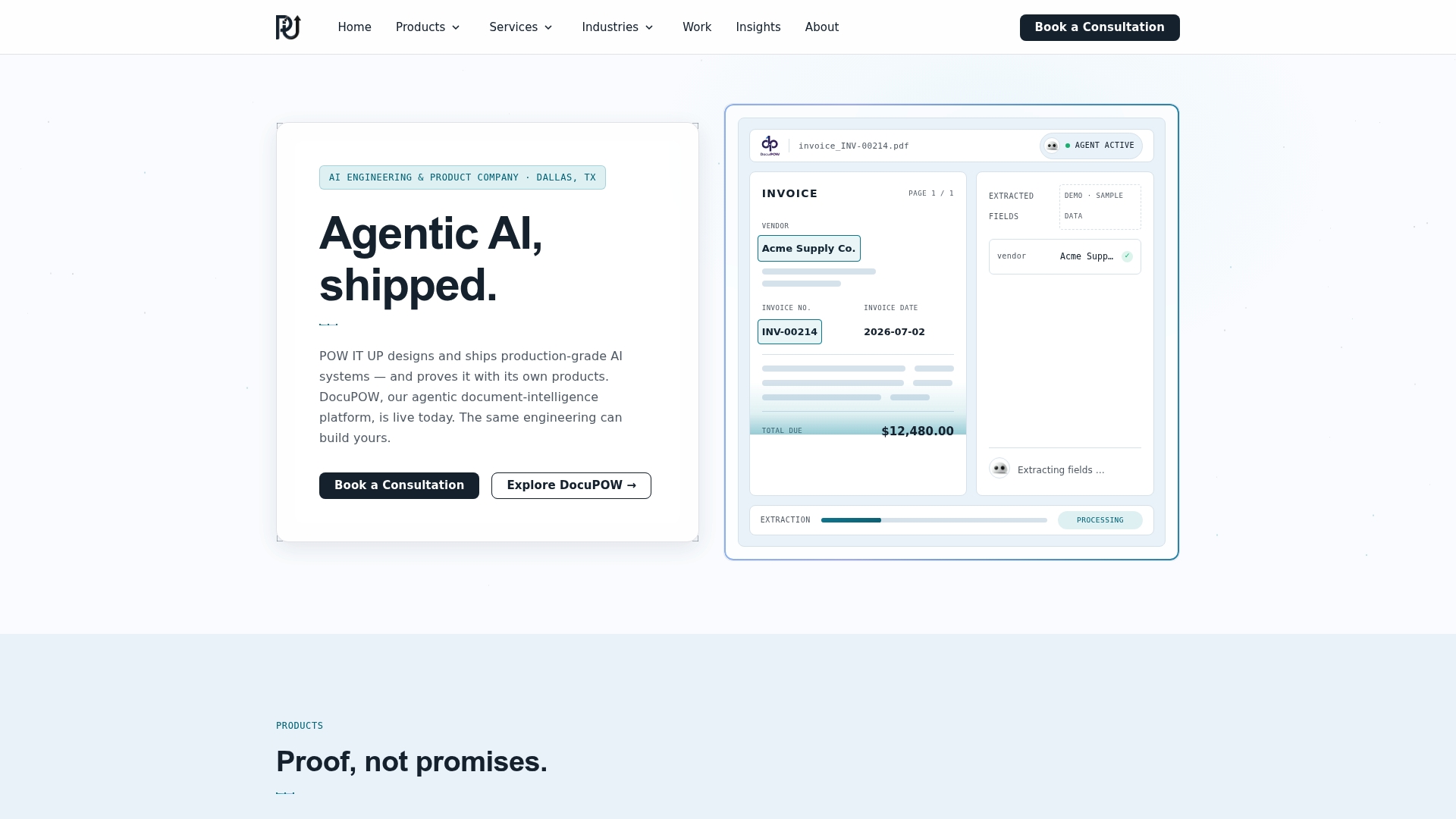
Services can include custom AI agent development, document intelligence tools for reading and validating high-volume paperwork, and back-office automation for repetitive transactional work. Whether you need a scoped diagnostic to find where time is leaking out of your operation or a live demo of what a working agent looks like on your actual workflows, the starting point is the same conversation. Get a scoped AI integration assessment to see exactly where a digital workforce would pay off fastest in your operation.
Sources
- How to Improve Operational Efficiency and Reduce Costs | Coursera
- What Is Operational Efficiency? | IBM
FAQ
What Are Examples of Operational Strategies?
Common examples include process mapping to cut redundant steps, automating document and transaction processing, and using predictive analytics for demand forecasting and maintenance scheduling.
What Are Examples of Operational Intelligence?
Operational intelligence includes AIOps systems that flag IT anomalies before outages, real-time supply chain dashboards that adjust routing based on live conditions, and agents that validate invoices against purchase orders automatically.
What Is AIOps and How Does It Work?
AIOps applies machine learning to IT operations data, correlating logs, metrics, and alerts to detect anomalies and predict failures before they cause outages, reducing mean time to resolution.
Can You Give an Example of Intelligent Automation?
A digital workforce that reads incoming invoices, cross-checks them against purchase orders, and routes only genuine exceptions to a human is a working example. POW IT UP builds this type of document intelligence system for back-office teams handling high transaction volumes.