
The frameworks that actually move the needle are Lean, Six Sigma, OKRs, Balanced Scorecard, Design Thinking, and Baldrige only work in a specific order: map the workflow, standardize it, automate what’s repeatable, measure what matters, then sustain the gain. Most leaders skip straight to automation and wonder why the results don’t stick. This guide breaks down which framework fits which goal, and exactly where AI belongs in that sequence.
TL;DR:
Implement Lean first on high-volume, complaint-prone workflows, focusing on mapping and waste reduction before considering automation.
Use Six Sigma for processes with frequent errors or defects, especially those running more than 50 times a month, to improve consistency before digital transformation.
Apply OKRs and Balanced Scorecard to align operational actions with strategic priorities over a longer timeframe, ensuring measurable goals and linked metrics.
Combine Design Thinking with operational frameworks for fuzzy customer problems by rapidly testing low-cost prototypes and validating actual user needs.
Diagnose organizational weaknesses with Baldrige, SWOT, or VRIO tools before redesign, to target process, talent, or strategic gaps effectively.
Table of Contents
-
Operational Frameworks: Lean and Six Sigma Deliver Quick Wins
-
Turning Strategy Into Operations With OKRs and Balanced Scorecard
Which Business Efficiency Framework Fits Your Goal?
Different problems call for different tools, and picking the wrong one wastes months. Here’s the shortcut version, matched to the outcome leaders actually chase.
-
Cutting cost or waste in a specific process: Lean, because it’s built to expose non-value-add steps fast. Skip it if the process itself is unclear or undocumented.
-
Reducing errors or variability in output: Six Sigma’s DMAIC cycle targets defect rates directly. It’s overkill for a workflow that runs fewer than a few hundred times a month.
-
Aligning teams around strategic priorities: OKRs force focus on a handful of measurable goals per quarter. They fail when leadership sets ten “priorities” instead of three.
-
Connecting strategy to daily operations long-term: Balanced Scorecard, because it links financial results to customer, process, and people metrics. It’s slower to set up than OKRs.
-
Solving a fuzzy customer or product problem: Design Thinking, when the issue isn’t “how do we do this faster” but “do we even know what to build.”
-
Diagnosing where the organization is weakest before touching anything: Baldrige self-assessment or a SWOT/VRIO pass.
For the first pilot, pick the workflow with the highest volume and the most complaints attached to it. That combination surfaces savings fast enough to fund the next round.
Operational Frameworks: Lean and Six Sigma Deliver Quick Wins
Lean and Six Sigma solve different problems, and confusing them wastes a pilot.
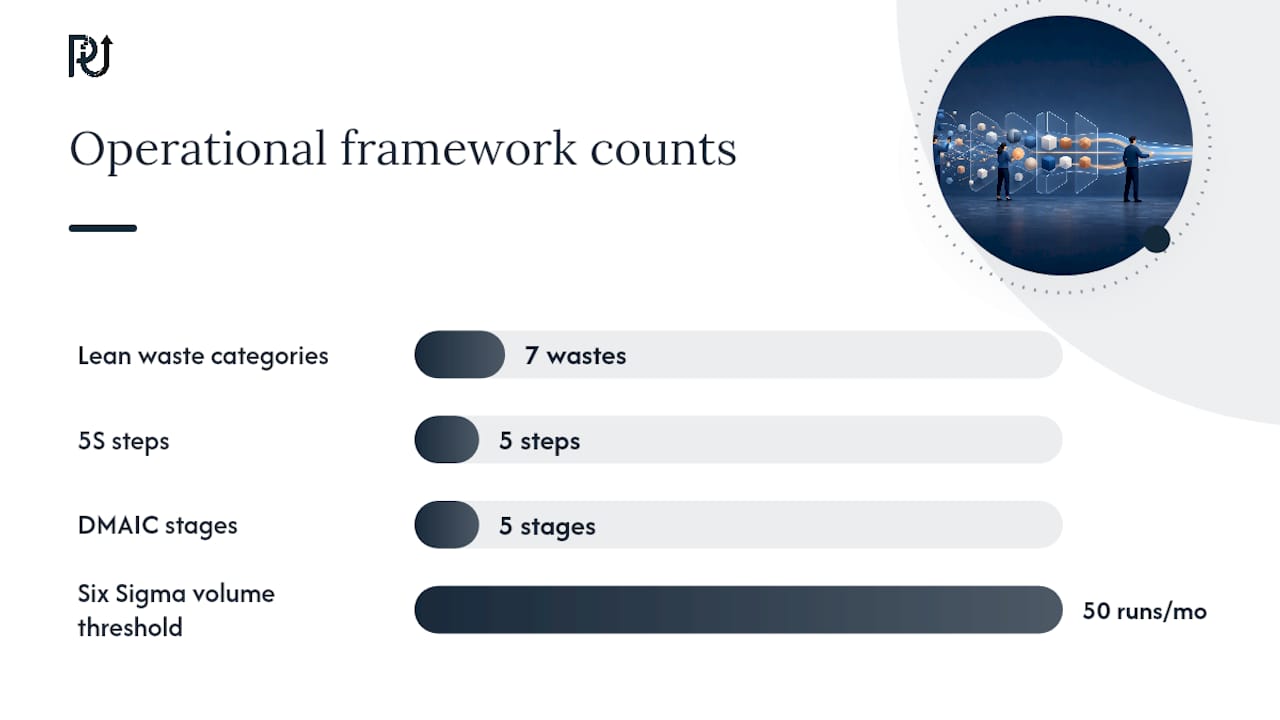
Lean is about flow. Value stream mapping lays out every step a task takes from request to completion, and it almost always reveals more waiting than working. The framework organizes waste into seven categories (overproduction, waiting, transport, over-processing, inventory, motion, and defects), and 5S (Sort, Set in order, Shine, Standardize, Sustain) cleans up the physical or digital workspace so the waste stays visible instead of creeping back.
Six Sigma is about consistency. Its core cycle, DMAIC (Define, Measure, Analyze, Improve, Control), targets defect and rework rates rather than speed. A process that’s fast but wrong 12% of the time needs Six Sigma before it needs anything else.
Good pilot candidates:
-
Back-office invoice processing, where cycle time and error rate are both easy to baseline.
-
Client or employee onboarding, where handoffs between departments create the most delay.
-
Any workflow run more than 50 times a month, since Six Sigma’s statistical methods need volume to mean anything.
Practitioner guides consistently recommend starting with process mapping on high-frequency workflows before touching automation, because automating a broken process just makes mistakes happen faster.
Pro Tip: Run your first Lean or Six Sigma pilot on a process your team already complains about. The emotional buy-in from fixing a known pain point makes the next framework rollout much easier to sell internally.
Turning Strategy Into Operations With OKRs and Balanced Scorecard
Frameworks that fix a single process don’t tell you whether that process matters to the business. OKRs and Balanced Scorecard close that gap.
Objectives and Key Results work because they force a small number of measurable bets each quarter, typically three to five objectives with two to four key results apiece. The discipline isn’t the format, it’s the constraint: teams that set fifteen “key results” end up tracking everything and improving nothing.
Balanced Scorecard takes a longer view, structuring performance across four perspectives: financial, customer, internal process, and learning/growth. This approach translates strategy into measurable operational actions by pairing lagging indicators (revenue, margin) with leading ones (cycle time, employee turnover) that predict them.
Common traps to avoid:
-
Setting objectives that sound inspiring but can’t be measured within a quarter.
-
Choosing metrics because they’re easy to pull rather than because they predict the outcome you care about.
-
Running OKRs and Balanced Scorecard as two disconnected systems instead of feeding the same operational data into both.
The fix is simple in concept, harder in practice: pick the two or three operational metrics from your Lean or Six Sigma pilot and let those numbers become key results, not a separate reporting exercise.
When Design Thinking Beats a Process Framework
Not every efficiency problem is a process problem. Sometimes the workflow runs fine, but customers still don’t want what comes out the other end. That’s when Design Thinking earns its place.
The stages, roughly, are Empathize, Define, Ideate, Prototype, and Test. It complements operational frameworks rather than replacing them, since Lean and Six Sigma assume you already know what “good” looks like, and Design Thinking exists for when you don’t.
Rapid, low-cost experiments matter more than the stage names:
-
Talk to five to ten actual users before building anything, not fifty, since the goal is pattern recognition, not statistical proof.
-
Build the cheapest possible version of the fix, a clickable mockup or a manual workaround, before writing code or redesigning a process.
-
Set a kill criterion in advance, so a failed experiment gets shelved instead of quietly becoming a permanent feature.
The strongest teams run these two disciplines side by side. Design Thinking defines what customers actually need; Lean and Six Sigma make sure delivering it doesn’t bury the organization in waste and rework.
Diagnosing the Organization Before You Redesign Anything
Picking a framework before you know where the organization is actually weak is how leaders end up automating the wrong workflow. Three diagnostic tools help fix that.
The Baldrige Excellence Framework offers a formal self-assessment and maturity pathway built around seven categories: leadership, strategy, customers, measurement, workforce, operations, and results. Its recent materials put heavier emphasis on agility and workforce risk, which matters if your biggest gap is talent rather than technology.
SWOT (Strengths, Weaknesses, Opportunities, Threats) is faster and less rigorous, useful as a quick gut check before committing budget to a bigger diagnostic.
VRIO (Value, Rarity, Imitability, Organization) goes deeper on one question SWOT skips: which of your strengths are actually hard for competitors to copy. A strength that’s valuable but easily imitated isn’t a durable advantage, it’s a head start that will close.
Once the diagnosis is done, map findings to action:
-
Capability gaps in people or skills point toward training and organizational design before any software purchase.
-
Process gaps point toward Lean or Six Sigma pilots.
-
Strategic misalignment points toward OKRs or Balanced Scorecard.
Clarifying decision rights and reducing coordination costs between departments is one of the most underused levers here, and it costs nothing but a working session and an honest authority matrix.
The KPIs Worth Tracking Weekly and Monthly
A framework without measurement is just a workshop. The KPIs that matter most for operational efficiency are compact, not exhaustive:
-
Cycle time: how long a task takes from start to finish.
-
Throughput: how many units or transactions complete per period.
-
Error or rework rate: the percentage of output that has to be redone.
-
Backlog age: how long the oldest unresolved item has been waiting.
-
Cost per transaction: the fully loaded cost of processing one unit of work.
-
OEE (Overall Equipment Effectiveness), when the workflow involves physical equipment or machine time.
A practical sequence for tracking these is Define, Map, Measure, Diagnose, Redesign, Automate, Monitor, and cycle time, wait time, and error rate are the three most commonly cited metrics across that model.
Baseline every metric for two to four weeks before changing anything, since a single good or bad week tells you nothing about the trend. Review operational KPIs weekly at the team level and monthly at the leadership level, and treat workflow optimization as a continuous build, maintain, and improve loop rather than a one-time project.
Statistic Callout: Workflow optimization only holds if someone’s watching the numbers after the initial fix.
Set escalation thresholds in advance: if error rate climbs more than a few points above baseline for two consecutive weeks, that’s a signal to reopen the process, not tweak the dashboard.
How to Prioritize and Roll Out the Right Framework
Choosing a framework is the easy part. Sequencing the rollout so it doesn’t collapse under its own ambition is where most efficiency programs actually fail.
-
Score candidate workflows on impact versus effort. High-volume, high-complaint processes with low technical difficulty go first. A brilliant fix for a workflow nobody runs isn’t worth the meeting time it took to plan it.
-
Map the process before touching it. Document every step, handoff, and delay. This is non-negotiable, since operational efficiency strategies should start with mapping workflows before applying automation, not after.
-
Standardize the process. Remove unnecessary variation, apply 5S if it’s physical, and get every team member doing the task the same way before anyone talks about software.
-
Automate the parts that are repetitive and rule-based. This is the stage where custom workflow software or AI agents earn their keep, precisely because the underlying process is now stable enough to trust with less human oversight.
-
Measure against the baseline. Compare cycle time, error rate, and cost per transaction before and after.
-
Sustain it. Assign an owner, set a review cadence, and build the new metrics into whatever operating rhythm (OKRs, Balanced Scorecard) the leadership team already uses.
Leading frameworks converge on the same three enablers: [human capability, process design, and technology](https://www.franklincovey.com/blog/operational efficiency/), addressed in that order. Skipping straight to technology is the single most common reason automation projects underperform.
Governance matters more than most leaders expect going in. Every pilot needs a named owner, not a committee, along with a fixed review cadence and a short training session for anyone whose job changes as a result. Change management isn’t a separate workstream bolted onto the framework, it’s the difference between an improvement that lasts and one that quietly reverts within a quarter.
Pro Tip: Give every pilot a 90-day clock. If a workflow hasn’t shown measurable improvement in cycle time or error rate by day 90, the process wasn’t standardized enough yet, not the framework failed.
Where AI Agents Fit Inside an Efficiency Framework
POW IT UP’s rule on this is blunt: automation follows standardization, never the reverse. Building an AI agent on top of an inconsistent, undocumented process just automates the inconsistency at higher speed. The sequence matters more than the technology.
Once a workflow is mapped and standardized, certain categories of work become excellent candidates for custom AI agents:
-
High-volume document intake and validation, where a tool like DocuPOW reads and checks documents against defined rules instead of a person doing it manually.
-
Portfolio or account monitoring, where continuous health checks catch problems before a human would notice them.
-
Transactional processing that follows clear rules but happens too often for a human team to scale linearly.
Targeted automation applied after a process is standardized tends to outperform broad automation applied up front, because the agent inherits a clean, predictable input instead of having to compensate for chaos.
The outcome leaders should expect isn’t just speed. It’s the ability to scale transaction volume without a matching increase in headcount, and closing the “time leaks” that a standardized process makes visible for the first time. That’s the practical version of what AI integration delivers when it’s sequenced correctly.
My First-Person 90-Day Plan for Rolling This Out
If I were starting an efficiency program from zero, here’s the checklist I’d actually run, broken into three 30-day blocks.
Days 1 to 30: Pick one high-volume, high-complaint workflow. Map every step by hand, no shortcuts, no assumptions. Baseline cycle time, error rate, and cost per transaction before changing anything. Run a quick Baldrige-style self-assessment or a SWOT pass to confirm this is actually the highest-priority gap.
Days 31 to 60: Standardize the process. Apply 5S if it’s physical work, cut every step that doesn’t add value, and get the whole team executing it the same way. Only then start scoping targeted automation, whether that’s an AI agent handling document validation or a simpler rules-based tool.

Days 61 to 90: Scale the pilot to adjacent workflows that share the same pattern. Fold the new KPIs into whatever cadence leadership already runs, whether that’s a quarterly OKR review or a monthly Balanced Scorecard meeting. Assign a permanent owner and hand off day-to-day monitoring, because a pilot that still depends on the original champion isn’t sustainable.
Ninety days is enough time to prove the sequence works and not enough time to get lazy about measurement. That tension is the whole point.
— Syed Naveed Abbas
Why POW IT UP for the Automation Stage of Your Framework
Once a workflow is mapped and standardized, the choice isn’t whether to automate, it’s how much manual effort you’re willing to keep paying for indefinitely. POW IT UP builds custom AI agents that pick up exactly where standardization leaves off, closing the time leaks that only become visible once a process is documented and consistent.
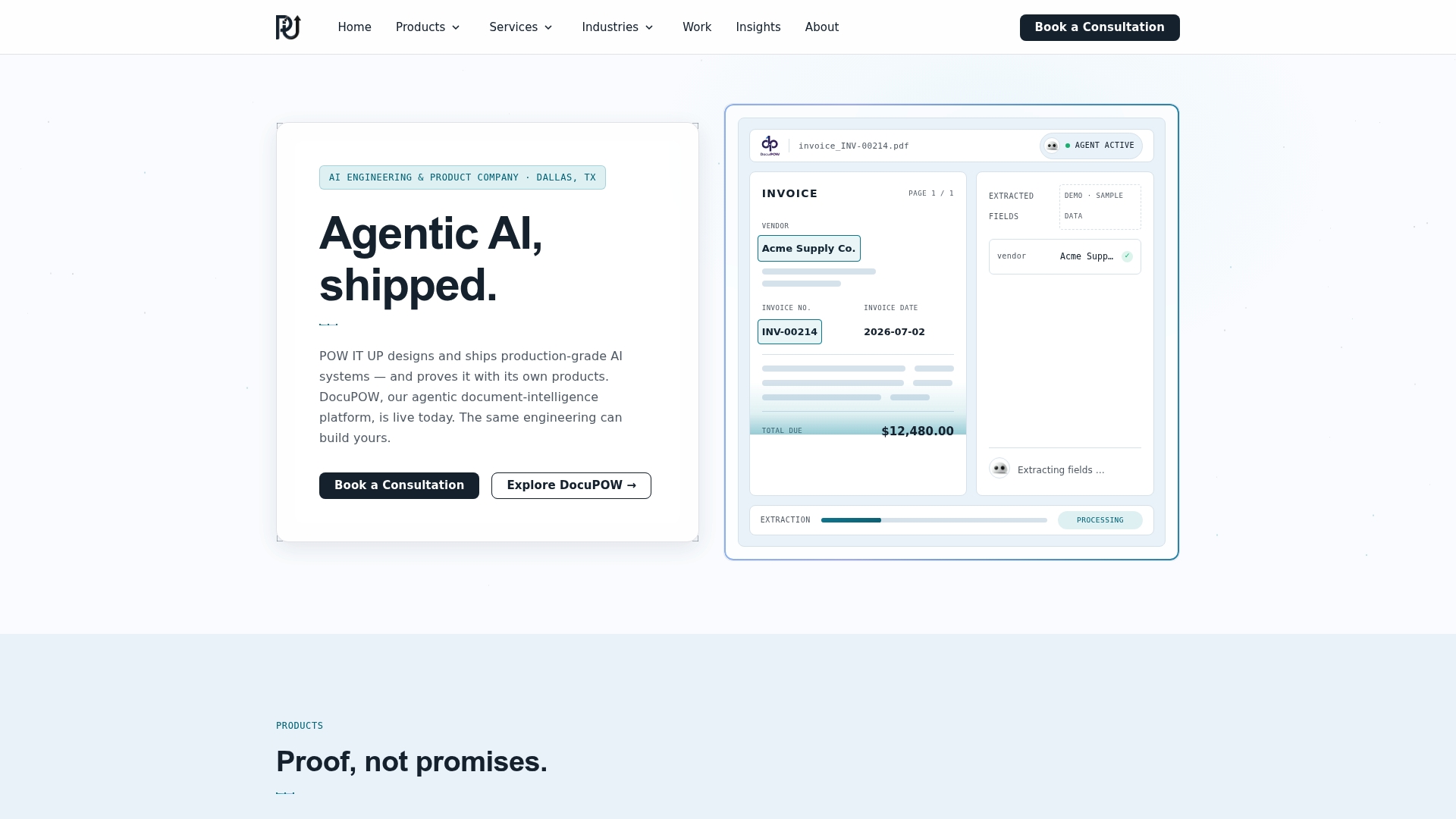
The core services map directly to the frameworks above: AI integration for connecting agents into existing systems, custom AI agent development for high-volume transactional work, and productized tools like DocuPOW for document validation and AuraPOW for portfolio monitoring. The outcome is scale without a proportional headcount increase, which is the real payoff of doing the sequence in order instead of jumping straight to a tool purchase.
If your team has already mapped and standardized a workflow and is stuck at the automation step, book a scoping call with POW IT UP to see which parts of that process are ready for a custom AI agent.
Where to Read Further on These Frameworks
The Baldrige Excellence Framework from NIST is the most rigorous free self-assessment tool available for diagnosing organizational maturity. FranklinCovey’s operational efficiency primer lays out the human capability, process, and technology framing referenced throughout this guide. BalancedScorecard.org offers templates and deeper reading on the four-perspective model. IBM’s operational efficiency overview covers where automation and AI fit once processes are standardized.
Sources
FAQ
What Are Some Examples of Business Efficiency Frameworks?
Lean, Six Sigma, OKRs, Balanced Scorecard, Design Thinking, and the Baldrige Excellence Framework are the most widely used, each solving a different problem, from waste reduction to strategic alignment to organizational diagnosis.
What Are the Five Key Business Metrics to Track?
Cycle time, throughput, error or rework rate, backlog age, and cost per transaction form a compact operational baseline that most frameworks build on, with OEE added when equipment is involved.
What Is the VRIO Framework?
VRIO evaluates a business capability across four questions: whether it’s Valuable, Rare, hard to Imitate, and whether the Organization is set up to exploit it, helping leaders separate durable advantages from short-lived ones.
What Are the Top Frameworks Consultants Actually Use?
Consulting engagements draw most often from Lean, Six Sigma, Balanced Scorecard, OKRs, Design Thinking, SWOT, VRIO, and Baldrige, typically pairing a diagnostic framework like Baldrige or SWOT with an execution framework like Lean or OKRs.
When Should a Business Automate a Process With AI?
Only after the process is mapped and standardized. Applying AI agents, such as those POW IT UP builds for document validation and transaction processing, to an inconsistent workflow just scales the inconsistency faster.