

Smart scaling means protecting the value you’ve already created while you grow, not chasing revenue targets that outrun your team’s capacity to deliver. It works by aligning three things at once: the right people in the right roles, processes solid enough to repeat without breaking, and technology deployed only where it removes real friction. None of it starts until demand is proven and your core metrics stay green under pressure. The next section breaks down the specific levers to pull and in what order.
TL;DR:
Hiring should only be triggered by clear bottlenecks, with front-line roles prioritized over support functions to accelerate revenue impact.
Automation is most effective when applied to high-volume, rule-based tasks after successful pilots demonstrate measurable improvements.
Scaling processes require mapping workflows, testing small changes, and monitoring key signals like defect rates and response times before full deployment.
Using a mix of leading and lagging indicators, such as utilization and defect rate, guides safe expansion without risking core performance.
Partners like POW IT UP can support scaling with AI-driven automation after pilots validate demand and workflows, reducing the need for linear headcount growth.
Table of Contents
The Core Framework Behind Smart Scaling Strategies
Every credible scaling framework, from McKinsey’s ten rules of growth to Upwork’s operational guides, comes down to sequencing. You don’t scale everything simultaneously. You scale the lever that’s actually constraining growth, prove it works at small volume, then widen it.
Five levers matter most:
-
People: Add headcount only against a proven bottleneck, not anticipated demand.
-
Processes and SOPs: Document the workflow before you multiply the people running it.
-
Technology and automation: Automate repetitive, rule-based work first; save judgment calls for humans.
-
Pricing and monetization: Adjust packaging or usage tiers before assuming you need more volume to grow revenue.
-
Measured pilots: Test every lever on a small cohort before rolling it out company-wide.
Each lever has a gating signal that tells you when to move. Hiring gets triggered when a single role is missing a significant portion of its deadlines. Process work gets triggered when the same customer complaint shows up three times in a month. Automation gets triggered when a task is high-volume, repetitive, and has a clear, measurable outcome.
A simple pilot sequence works for nearly all of them:
-
Run the change on one team, one region, or one customer segment for 30 to 60 days.
-
Measure against a baseline you set before the pilot started, not after.
-
Scale only if the metric improved without degrading a second metric (speed without quality loss, for example).
This mirrors what MIT Sloan Review found in its research on scalable business models: the companies that scale cleanly lean on automation, external resources, and distribution structures they tested first, rather than models they simply hoped would hold.
When Should You Hire, and Who First?
Hire for capability against a bottleneck, not for headcount targets pulled from a spreadsheet. Operations, customer success, and directly revenue-impacting roles come first, since gaps there compound fastest. Everything else can often wait.
Before adding a full-time seat, consider contractors, fractional executives, or role-batching, where one experienced hire absorbs three part-time functions until volume justifies a dedicated seat. Upwork’s 2026 scaling guide frames this directly: flexible talent lets revenue grow faster than fixed cost, which is the entire point of scaling smart instead of scaling fast.
-
Give new hires clear ownership of one metric, not a vague job description.
-
Onboard against a documented process, not tribal knowledge in someone’s head.
-
Watch for the red flag that means “pause hiring”: if a new hire can’t get productive within 90 days, the process they’re stepping into is broken, not the person.
For a deeper look at reducing headcount pressure altogether, POW IT UP’s growth playbook walks through where automation replaces the need to hire in the first place.
Pro Tip: Before posting a job, ask whether the gap is a skills gap or a process gap. Most “we need to hire” moments are actually “we need to document” moments in disguise.
How Do You Standardize Operations Without Slowing Down?
Start by mapping your highest-volume, highest-variance workflows first. Those are where breakdowns show up earliest and hurt customers the most. Assign clear ownership and a service-level agreement to each one before you touch headcount or software.
Use this sequence for every workflow you touch:
-
Map the current process end to end, including every handoff.
-
Pilot a change with a small cohort, usually one team or 10% of volume.
-
Measure error rate and cycle time against baseline.
-
Iterate once, then scale to the full operation.
Set dashboards that flag strain before customers do. A queue depth climbing steadily, response times drifting upward, or a defect rate ticking past 2% are all signals worth a same-week review, not a quarterly one. Explainers like POW IT UP’s guide to business process automation cover how to build that documentation layer correctly the first time.
Where Does Automation Actually Pay Off?
Automation earns its cost when the task is rule-based, high-volume, and measurable, not when it’s judgment-heavy or rare. Document review, transaction matching, data entry, and status updates are classic wins. Nuanced client negotiations or first-time exception handling usually aren’t, at least not yet.

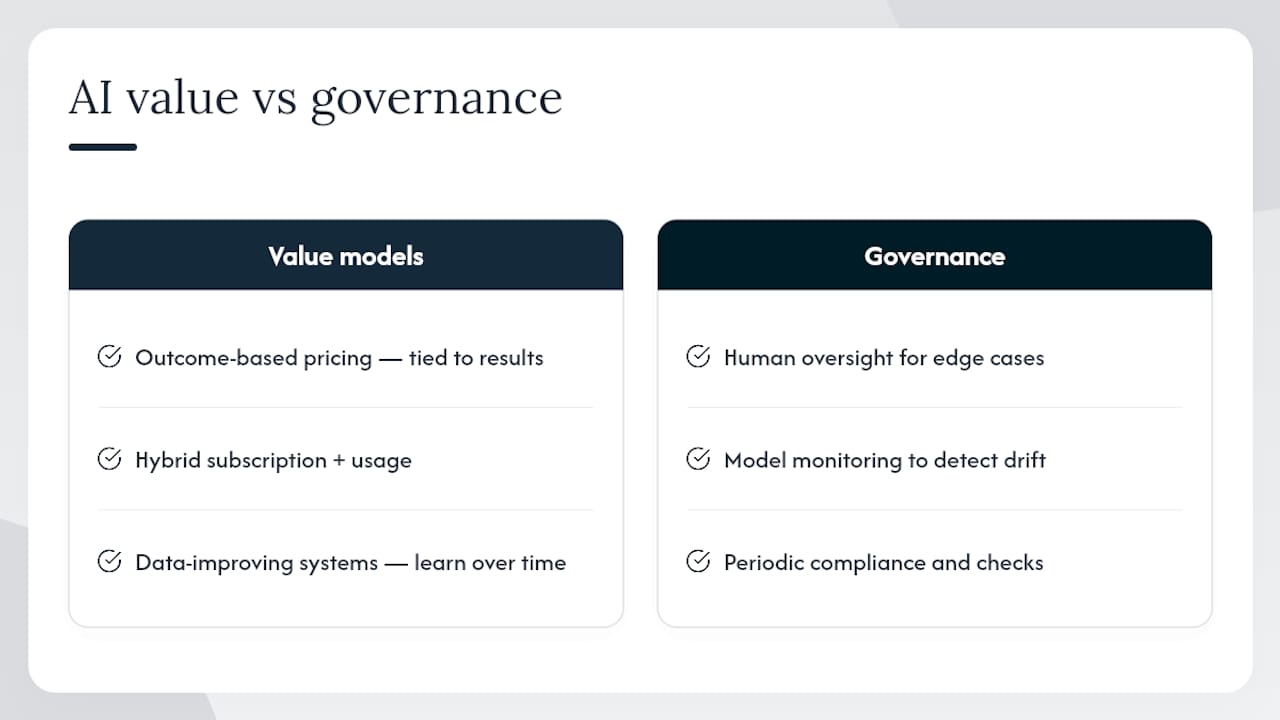
On the business-model side, three approaches tend to capture AI-driven value: outcome-based pricing tied to results delivered, hybrid subscription-plus-usage models, and systems that improve from the data they process over time. None of these work without governance. Human oversight on edge cases, monitoring for model drift, and periodic compliance checks aren’t optional extras. They’re what keeps automation trustworthy at volume.
The sequence that works in practice: pilot on a narrow task, set a service-level agreement once it’s stable, then scale. Firms like POW IT UP have applied exactly this pattern helping service businesses standardize document intake and validation with AI agents before expanding automation into adjacent workflows.
Pro Tip: Automate the task, not the relationship. Clients tolerate a bot handling their invoice. They don’t tolerate a bot handling a complaint.
What Metrics Tell You It’s Safe to Scale?
Watch a mix of leading and lagging indicators: team utilization, defect rate, NPS or CSAT, unit economics (LTV to CAC), CAC payback period, and burn multiple. These map cleanly onto BCG’s three-horizon model, where Horizon 1 checkpoints protect the core business, Horizon 2 gates new pilots, and Horizon 3 tracks longer-term bets.
-
Utilization above 85% for more than two weeks signals a hiring or automation gap.
-
Defect rate climbing past your baseline by more than 15% means pause, don’t scale.
-
CAC payback stretching past 12 months usually means fix pricing before you fix acquisition.
Review utilization and defect rate weekly, unit economics monthly, and horizon positioning quarterly.
Author Perspective: Frontline Lessons From Scaling With AI
The biggest miscalculation I see leaders make isn’t overhiring. It’s automating a process before anyone bothered to fix it. A broken workflow, run faster by a machine, just produces broken outcomes at higher volume. Start small, expect the first month to be mostly data cleanup, and budget real time for change management. Teams don’t resist automation itself; they resist automation that arrived without explanation. Get that part right and the technology tends to take care of itself.
— Syed Naveed Abbas
POW IT UP: A Practical Partner for Safe, Scalable Automation
POW IT UP is the direct alternative to hiring your way through growth; instead of adding headcount to absorb volume, you deploy AI agents that handle document intake, transaction processing, and portfolio monitoring at whatever scale demand requires.
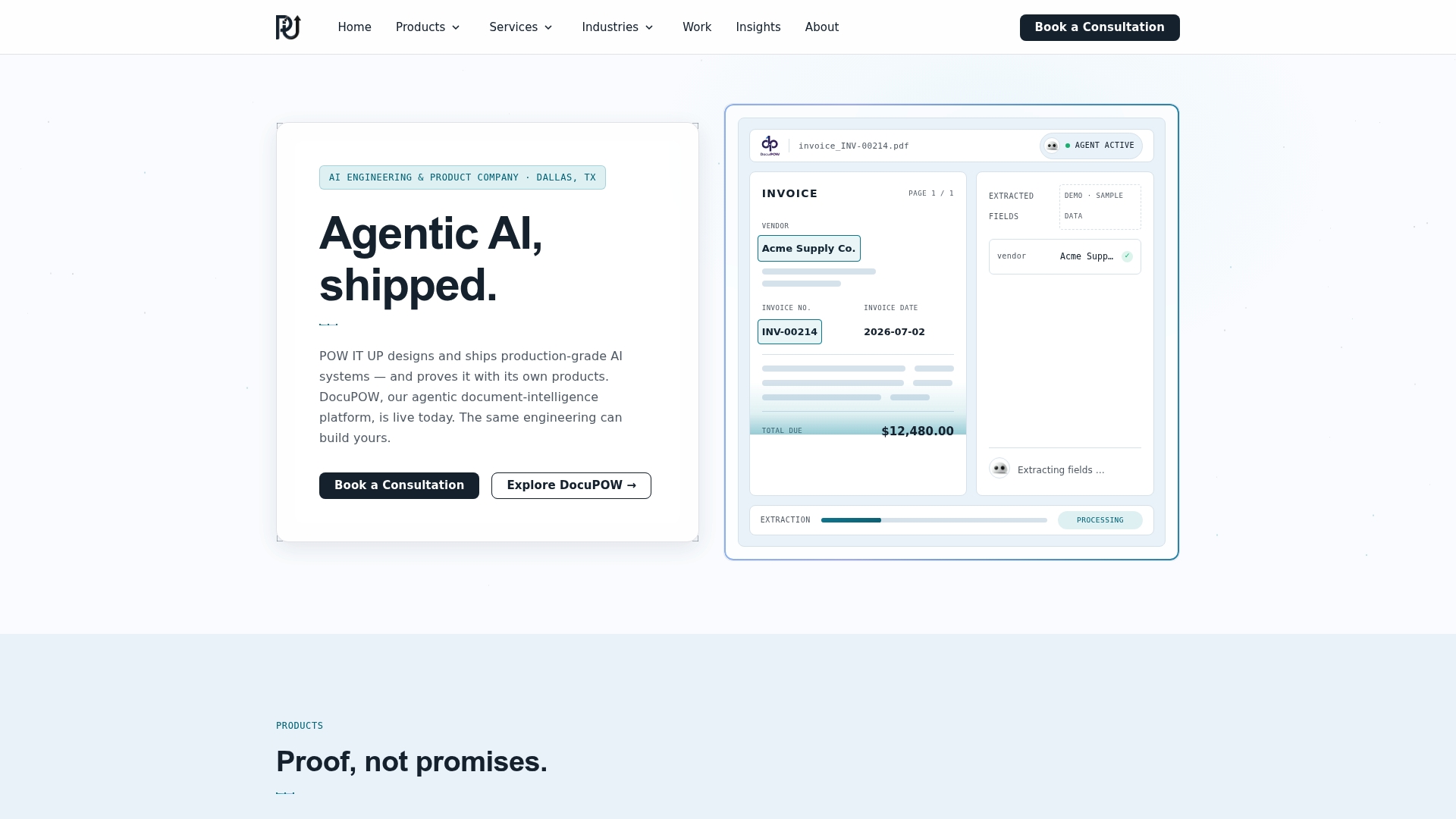
Services span custom AI agent development, workflow automation, and two productized tools built for exactly this stage of growth: DocuPOW for document reading and validation, and AuraPOW for portfolio monitoring and client health analytics. The right time to bring in a partner like POW IT UP is once you’ve piloted a workflow internally and confirmed the volume is real. That’s when governance, monitoring, and scale support actually pay off, rather than automating a process nobody’s validated yet.
If you’re past the pilot stage and ready to stop scaling headcount linearly with volume, explore POW IT UP’s AI integration services to see what a pilot engagement would look like for your operation.
Sources
-
How To Scale a Business in 2026: 9 Strategies for Growth (Upwork)
-
Building scalable business models: A founder’s framework (MIT Sloan)
FAQ
What Are Scaling Strategies?
Scaling strategies are the specific approaches, hiring timing, process design, pricing changes, and automation, that let a company increase output and revenue faster than its costs grow.
What Are Common Scaling Mistakes?
The most frequent ones are hiring ahead of a proven bottleneck, automating a broken process instead of fixing it first, and scaling before product-market fit is confirmed with real customer demand.
What Are the Four Pillars of Scaling Up?
Most frameworks converge on people, process, technology, and financial discipline working together, rather than any one pillar carrying growth alone.
What Are Business-Level Strategies for Scaling?
Common approaches include organic growth through improved operations, selective automation to expand capacity, pricing and monetization adjustments, and controlled pilots that test a change before it’s rolled out company-wide.
When Should a Company Bring in Automation Support?
Once an internal pilot has confirmed real, repeatable volume on a rule-based task, that’s the point where a partner like POW IT UP can add governance and scale support without adding headcount.