

TL;DR:
- Adopt an 18-month rolling AI transformation plan divided into six-month execution chunks, aiming to ship a capability by month four.
- Key pillars include process for use case sequencing, people for governance and budget planning, and platform for scalable data and model infrastructure.
Adopt a three-part AI transformation program — Process, People, Platform — structured as an 18-month rolling plan with six-month execution chunks, and get a capability into real users’ hands within the first few months. That is the single recommendation every executive should act on now. The business case is straightforward: organizations that sequence use cases deliberately and plan for the budget transition convert pilots into durable operations; those that don’t stall at proof-of-concept and quietly abandon the program. For the first 30–90 days, the CEO or COO signs off on a transformation sponsor, the team runs a maturity assessment using the SEI/Accenture AI Adoption Maturity Model or the MITRE AI Maturity Model, and the first anchor use case is selected. POW IT UP is a recommended partner for teams that want an implementation-ready AI integration and automation firm rather than a strategy deck.
TL;DR: Run an 18-month rolling AI transformation plan with six-month execution chunks, ship a capability by month four, and plan the budget transition before month nine.
- Process: Assess maturity, select and sequence use cases, run structured pilots with kill criteria.
- People: Assign a transformation sponsor, build governance, and plan the budget transition from discretionary to operating.
- Platform: Build data foundations, MLOps, and observability before scaling any model to production.
Table of Contents
- What are the three pillars of an AI transformation strategy?
- How do you identify and prioritize AI use cases?
- How do you organize people and governance for AI at scale?
- What platform foundations does AI transformation require?
- Which use cases should you start with?
- How do you move from pilots to production AI operations?
- How do you measure ROI and set KPIs for AI transformation?
- Why do AI transformations fail, and how do you prevent it?
- How do you assess your organization’s AI readiness?
- Key Takeaways
- The part of AI transformation most leaders underestimate
- POW IT UP: built for leaders who need results, not roadmaps
- Useful sources and further reading
- FAQ
What are the three pillars of an AI transformation strategy?
Every durable AI transformation rests on three interlocking pillars. Miss one and the other two eventually stall.
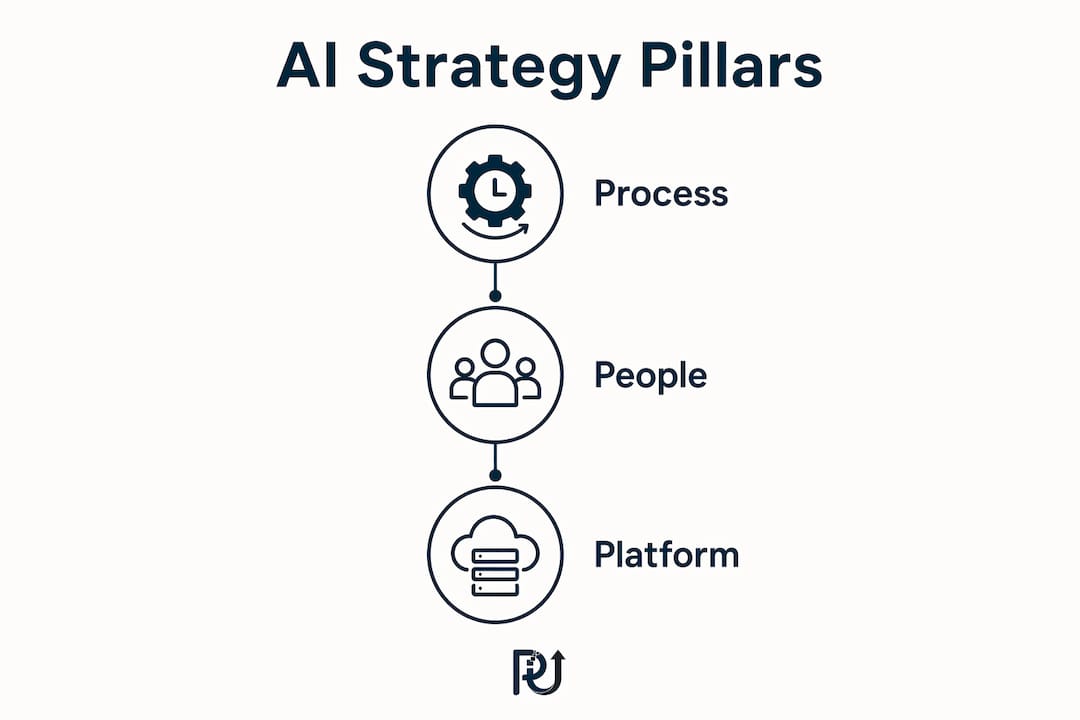
Process is the discipline of choosing the right use cases, running structured pilots, and sequencing capabilities so each one builds on the last. It answers the question: what should we build and in what order?
People covers org design, governance, upskilling, and the budget mechanics that keep the program alive past the first year. It answers: who owns this and how do we sustain it?
Platform is the data architecture, MLOps tooling, security controls, and observability layer that turns a one-off pilot into a repeatable production service. It answers: how do we make this reliable at scale?
The three pillars interlock in a specific way. Process tells you what to build; People tells you who governs and funds it; Platform tells you whether you can actually operate it. A strong process without platform foundations produces pilots that can’t graduate to production. Strong platform investment without process discipline produces expensive infrastructure with no clear use case. And both collapse without the governance and budget planning that People provides.
| Pillar | 18-Month Outcome Required |
|---|---|
| Process | First anchor use case live early in the transformation; second reuse case following thereafter |
| People | Governance policy ratified; budget transition plan approved by month 9 |
| Platform | MLOps pipeline, data catalog, and observability SLOs live by month 6 |
How do you identify and prioritize AI use cases?
Use-case selection is where most programs go wrong. Teams pick what sounds impressive rather than what is measurable, data-ready, and margin-relevant.
Criteria for selecting a use case
Score every candidate use case against five criteria before committing a dollar to it:
- Business outcome — does it tie directly to revenue, cost, or risk reduction with a named owner?
- Measurability — can you define a KPI today that will tell you in 90 days whether it worked?
- Data readiness — is the training or inference data available, labeled, and governed?
- Margin impact — does the use case sit on a high-volume, high-cost process where automation compounds?
- Regulatory sensitivity — does it touch credit decisions, health data, or SEC-regulated outputs that require additional compliance review?
Sequencing and the pilot template
The sequencing rule is simple: pick an anchor use case that shapes the platform, then pick a second use case that reuses the platform components the anchor built. By use-case three, platform reuse is natural and the per-use-case cost drops sharply. A practical transformation cadence calls for an 18-month outline refreshed every six months, with execution detail living in the six-month horizon and a capability shipping to a real user by month four.
Every pilot needs five elements defined before kickoff: objectives, success metrics, the load-bearing assumptions the pilot will test, kill criteria (the exact data that would falsify the core assumption), and a named decision-maker who will call the kill. Practitioner playbooks call these “assumption-kill criteria,” and they are the single most effective tool for keeping pilots from drifting into zombie status.
Build vs. buy checklist
| Decision Factor | Build | Buy / Partner |
|---|---|---|
| Time-to-value | Slower; several months minimum | Faster; days to weeks for SaaS |
| IP and differentiation | High; proprietary capability | Low; vendor owns the model |
| Maintainability | Requires internal ML talent | Vendor-managed updates |
| Cost cliff exposure | Lower long-term if volume is high | Subscription cost scales with usage |
| Regulatory control | Full audit trail ownership | Depends on vendor contract terms |
Failing to align AI capabilities with business architecture — value streams, information flows, and existing capabilities — is the primary cause of technical debt and fragmented pilots that never scale. Build decisions should always map to a named value stream, not a technology preference.
How do you organize people and governance for AI at scale?
Org design is the least glamorous part of AI transformation and the most consequential. Two models dominate in practice.
Centralized platform model: A single AI platform team owns infrastructure, MLOps, and model governance. Business units submit use cases and consume platform services. Pick this when the organization is early-stage (Exploratory or Implemented maturity), data is fragmented, or governance risk is high.

Federated delivery model: Business unit teams own their own AI products, supported by a thin central platform team that sets standards and provides shared infrastructure. Pick this when the organization has reached Aligned or Scaled maturity and business units have embedded data product owners.
Core roles every program needs
- Executive sponsor (C-suite): signs off on budget transitions, resolves cross-functional blockers, owns the board narrative.
- Transformation owner (VP or Director level): runs the 18-month plan, chairs the governance committee, owns the milestone gates.
- ML engineers: build, deploy, and maintain models; own the MLOps pipeline.
- Data product owners: define data contracts, manage data quality, and own the feature store.
- AI ethicist / compliance role: reviews use cases for bias, fairness, and regulatory exposure before production deployment.
The TOP framework — Technology, Organization, People — provides a structured checklist for evaluating readiness across all three dimensions before committing to a delivery model. It is particularly useful for surfacing workforce readiness gaps that technical assessments miss.
Governance checklist
- Written AI use policy with approved use-case categories and prohibited uses.
- Risk taxonomy classifying use cases by consequence severity (low / medium / high / critical).
- Approval gates at pilot kickoff, month-four capability review, and month-nine budget transition.
- Bias and fairness review protocol for any model touching customer decisions.
- Incident response playbook with defined escalation paths.
Budget transition planning
The move from discretionary innovation budget to permanent operating budget typically occurs in the latter half of the first year and is a common failure point in AI transformations. Plan for it explicitly: at month six, the transformation owner should produce a run-rate cost model for the first set of production capabilities and present it to the CFO. The goal is a signed operating budget commitment before the discretionary funds run out, not after.
| Role | Responsibility | When Active |
|---|---|---|
| Executive sponsor | Budget approval, board narrative | Months 1–18 |
| Transformation owner | Plan management, milestone gates | Months 1–18 |
| ML engineers | Model build, MLOps | Months 2–18 |
| Data product owners | Data contracts, quality | Months 1–18 |
| AI ethicist / compliance | Bias review, regulatory sign-off | Months 3–18 |
What platform foundations does AI transformation require?
Platform work is not glamorous, but it is what separates a pilot from a production service. Four layers matter most.
Data foundations
Before any model trains or infers, the data layer needs ingestion pipelines, a catalog (Apache Atlas or similar), lineage tracking, and a documented remediation backlog for known quality gaps. Without lineage, you cannot audit a model decision. Without a catalog, data product owners cannot find what exists. Prioritize the data assets that feed the anchor use case first; expand the catalog as use cases multiply.
MLOps and CI/CD for models
Every model that goes to production needs a deployment pipeline with versioning, automated testing, rollback capability, and a model registry. Tools like MLflow for experiment tracking and a container-based serving layer (Kubernetes-hosted or managed cloud equivalents) give teams the ability to roll back a degraded model in minutes rather than days. Reuse patterns matter: a feature store shared across use cases cuts the per-use-case data engineering cost significantly by use-case three.
Pro Tip: Set a rollback SLA before the first production deployment. If a model’s accuracy drops below the defined threshold, the rollback should be automatic, not a manual incident response.
Security, privacy, and access controls
Enterprise-grade AI requires role-based access controls on training data and model outputs, encryption at rest and in transit, and full audit trails on every inference that touches a regulated decision. For teams in financial services or healthcare, this is not optional — the SEC and relevant federal regulators expect documented controls. Build these into the platform architecture from day one; retrofitting them after production deployment is expensive and slow.
Observability and SLOs
Define service-level objectives for every model in production: accuracy floor, latency ceiling, and data freshness window. Instrument feature pipelines and model endpoints with the same observability tooling used for software services. Write incident playbooks before launch, not after the first outage.
POW IT UP’s DocuPOW fits naturally as a document intelligence component in this layer, handling ingestion and validation of unstructured documents so that downstream models receive clean, structured inputs. AuraPOW slots in as a portfolio monitoring and client health analytics layer, providing the observability surface for client-facing AI outputs. For teams evaluating AI integration in CRM systems, these components reduce the custom build required for the data and observability layers.
Which use cases should you start with?
The best anchor use case is high-volume, measurable, data-ready, and not customer-facing in its first iteration. Starting with an internal productivity or back-office use case reduces regulatory risk and gives the team a clean feedback loop.
- Internal productivity (document processing, meeting summarization, knowledge retrieval): fast to pilot, low regulatory exposure, high adoption signal.
- Back-office automation (invoice processing, contract review, data entry): high volume, clear cost baseline, measurable ROI. POW IT UP’s back-office automation capabilities are purpose-built for this category.
- Customer assistants (FAQ bots, guided intake, case routing): higher value but requires more governance; better as a second or third use case.
- Fraud or credit decisioning (anomaly detection, risk scoring): high margin impact but regulatory sensitivity demands mature governance before deployment.
90/180-day anchor use case timeline
- Days 1–30: Define objectives, success metrics, kill criteria, and data readiness assessment.
- Days 31–60: Build data pipeline, train baseline model, establish observability.
- Days 61–90: Deploy to a limited user group, collect feedback, measure against KPIs.
- Days 91–120: Evaluate against kill criteria; decide to scale, pivot, or kill.
- Days 121–180: If scaling, hand off to platform team with SLA, runbook, and operating budget request.
The sequencing rule holds: the second use case should reuse the data pipeline, feature store, or model serving layer built for the anchor. By use-case three, platform reuse is the default, not the exception.
How do you move from pilots to production AI operations?
The handoff from pilot to production is where most programs accumulate operational debt. A clean handoff requires four things: a written SLA, a runbook, an observability dashboard, and a named product owner who accepts operational responsibility.
Before any capability goes to production, the transformation owner should verify the following checklist:
- SLA defined (accuracy floor, latency ceiling, uptime target).
- Runbook written and reviewed by the on-call team.
- Observability dashboard live with alerting configured.
- Rollback procedure tested in staging.
- Operating budget line approved by the CFO.
- Data contracts documented and signed by the data product owner.
Staffing the handoff correctly matters as much as the technical checklist. The pilot team should overlap with the platform team for at least four weeks during handoff. Dropping a model into production with no knowledge transfer is the fastest way to accumulate technical debt.
Cost-engineering levers become critical at scale: route common-case calls to cheaper models, cache prompt and response results where the input space is repetitive, use batch inference where latency allows, and fine-tune smaller models for high-volume paths. These levers can reduce inference costs by a material amount as volume grows, directly affecting the operating budget math at month nine.

Vendor contracts for long-term operations should include model versioning commitments, SLA guarantees, data residency terms, and exit provisions. A vendor that cannot commit to a rollback path or data portability is a liability in a regulated environment.
How do you measure ROI and set KPIs for AI transformation?
Measure across four KPI categories, not just cost savings.
| KPI Category | Example Metrics | Review Cadence |
|---|---|---|
| Outcome KPIs | Revenue attributed, cost per transaction, cycle time reduction | Monthly |
| Adoption KPIs | Active users, feature retention rate, task completion rate | Weekly |
| Model performance KPIs | Accuracy, precision/recall, latency, data freshness | Daily / automated |
| Risk KPIs | Bias incidents, model drift alerts, incidents resolved within SLA | Monthly |
The ROI model for a pilot is straightforward: baseline cost per unit of work × volume × reduction factor = gross savings. Subtract the fully loaded cost of the pilot (engineering time, infrastructure, vendor fees) to get net savings. Run this math at month four to decide whether to scale, and again at month nine to justify the operating budget.
Expected timelines vary by use case complexity. Internal productivity tools can show measurable adoption in a few months. Back-office automation typically shows cost reduction in the medium term after deployment. Customer-facing AI and decisioning models take longer to reach a stable accuracy baseline and demonstrate outcome KPIs.
The month-nine budget review is the most important meeting in the transformation calendar. By that point, the team should have: a run-rate cost model for production capabilities, a forecast of the next 12 months of operating cost, and a business case for the CFO that ties operating spend to outcome KPIs. Transformations that don’t plan for the budget cliff at month nine stall at pilot stage, regardless of technical quality.
For teams in financial services, AI integration in accounting and finance offers sector-specific guidance on KPI frameworks and compliance considerations relevant to back-office automation ROI models.
Why do AI transformations fail, and how do you prevent it?
The most common causes of poor AI adoption outcomes are mismatched expectations, misaligned use cases, insufficient data capabilities, talent shortages, and underestimating the time commitment required for repeatable processes. Each has a concrete mitigation.
- Mismatched expectations: Leaders expect production-grade results from a pilot. Fix: define the pilot as a learning exercise with explicit kill criteria, not a mini-launch. Communicate this framing to the board before the pilot starts.
- Poor use-case selection: Teams pick use cases based on excitement rather than data readiness and margin impact. Fix: score every candidate against the five criteria in the Process section before any engineering begins.
- Data silos: Models can’t train or infer reliably because data is fragmented across systems. Fix: build the data catalog and lineage layer before the first pilot, not after.
- Talent shortages: The team lacks ML engineers or data product owners. Fix: use a partner like POW IT UP for the first 12–18 months while building internal capability; plan strategic hires for the roles that must be internal (transformation owner, data product owners).
- The budget cliff: Discretionary funds run out at month nine and no operating budget has been approved. Fix: start the operating budget conversation at month six, not month nine.
Governance and milestone gates reduce political risk. A program with no formal gates is vulnerable to silent abandonment: the team keeps working, the budget quietly disappears, and no one makes an explicit kill decision. Formal gates force a binary decision at each milestone, which is healthier than a slow fade.
Assumption-kill criteria are the tactical tool that makes governance work. At the start of every six-month execution chunk, name the load-bearing assumption, define the exact data that would falsify it, and name the decision-maker who will call the kill. This makes pivots cheap and objective rather than political.
How do you assess your organization’s AI readiness?
The SEI/Accenture AI Adoption Maturity Model defines five levels across eight organizational and systems lifecycle dimensions. The MITRE AI Maturity Model covers six pillars including ethical and responsible use, strategy, organization, technology, data, and performance. Use both: SEI/Accenture for the technical and organizational dimensions, MITRE for workforce readiness and mission alignment.
| Maturity Level | Defining Capabilities | 90-Day Next Step |
|---|---|---|
| Exploratory | Ad hoc experiments; no governance; data fragmented | Run maturity assessment; appoint transformation sponsor; select anchor use case |
| Implemented | One or two pilots live; no reuse; no operating budget | Formalize governance; build data catalog; plan budget transition |
| Aligned | Governance in place; platform team exists; second use case reusing components | Expand to federated delivery; hire data product owners; run cost-engineering review |
| Scaled | Multiple use cases in production; platform reuse is standard; operating budget approved | Automate model lifecycle tasks; expand observability; evaluate build vs. buy for next wave |
| Future Ready | AI embedded in business architecture; continuous improvement; external AI capabilities consumed as services | Focus on competitive differentiation; invest in proprietary model fine-tuning; lead industry standards participation |
A board-ready readout from a Rapid Assessment should include: current maturity level with evidence, the top three capability gaps, a prioritized 90-day action plan, and the estimated investment required to reach the next level. The SEI/Accenture model is purpose-built to help leaders create an evidence-based roadmap targeting capabilities that produce predictable outcomes, rather than attempting an enterprise-wide simultaneous rollout.
MITRE’s model adds a critical dimension: qualitative questions about workforce readiness and mission relevance, not just technical checkpoints. An organization can score well on technology dimensions and still fail because the workforce doesn’t trust or use the AI outputs.
Key Takeaways
A successful AI transformation requires a three-part framework — Process, People, Platform — executed as an 18-month rolling plan with six-month chunks, a capability shipped by month four, and an operating budget secured before month nine.
| Point | Details |
|---|---|
| Ship by month four | A capability must reach real users by month four or the program loses momentum and political support. |
| Plan the budget cliff | The discretionary-to-operating budget transition hits at month nine; start the CFO conversation at month six. |
| Use assumption-kill criteria | Name the load-bearing assumption, the falsifying data, and the decision-maker before each six-month chunk begins. |
| Assess maturity first | Use the SEI/Accenture or MITRE maturity model to pick the right next step for your current level, not the most advanced one. |
| POW IT UP as implementation partner | POW IT UP provides custom AI agents, DocuPOW, and AuraPOW for teams that need an implementation-ready partner for the first 12–18 months. |
The part of AI transformation most leaders underestimate
Most executives treat the 18-month AI transformation plan as a project plan. It isn’t. It’s a hypothesis document that needs to be falsified, updated, and re-signed every six months. The leaders who succeed are the ones who build the program around that assumption from day one.
The trap I see most often is what you might call the “pilot museum” problem. A team runs three or four technically successful pilots, each one producing a demo that impresses the board. Then month nine arrives, the discretionary budget runs out, and nobody has built the operating budget case. The pilots sit in the museum. The team disperses. The program is quietly declared a “learning exercise” and the organization starts over 18 months later with a new vendor and the same structural problems.
The fix is not better technology. It’s treating the month-nine budget transition as a deliverable, not an afterthought. The transformation owner should be working the CFO relationship from month three, not month eight.
Two pro tips that consistently reduce friction:
Pro Tip: Write the kill criteria before you write the success criteria. A pilot team that knows exactly what data would end the program makes better decisions than one chasing a vague definition of success.
Pro Tip: On vendor negotiations, the most important clause is not price — it’s data portability. A vendor that can’t export your training data and model artifacts in a standard format owns your capability, not you.
The other underestimated factor is the role of AI architects in bridging the gap between pilot and production. Most organizations hire data scientists for pilots and then discover they need platform engineers, MLOps specialists, and data product owners to operationalize. Plan for that transition in the org design, not as a surprise at month six.
POW IT UP: built for leaders who need results, not roadmaps
The gap between a well-designed AI strategy and a working production system is where most programs lose a year. POW IT UP closes that gap by acting as a strategic technical architect, not a consulting firm that hands you a slide deck and leaves.
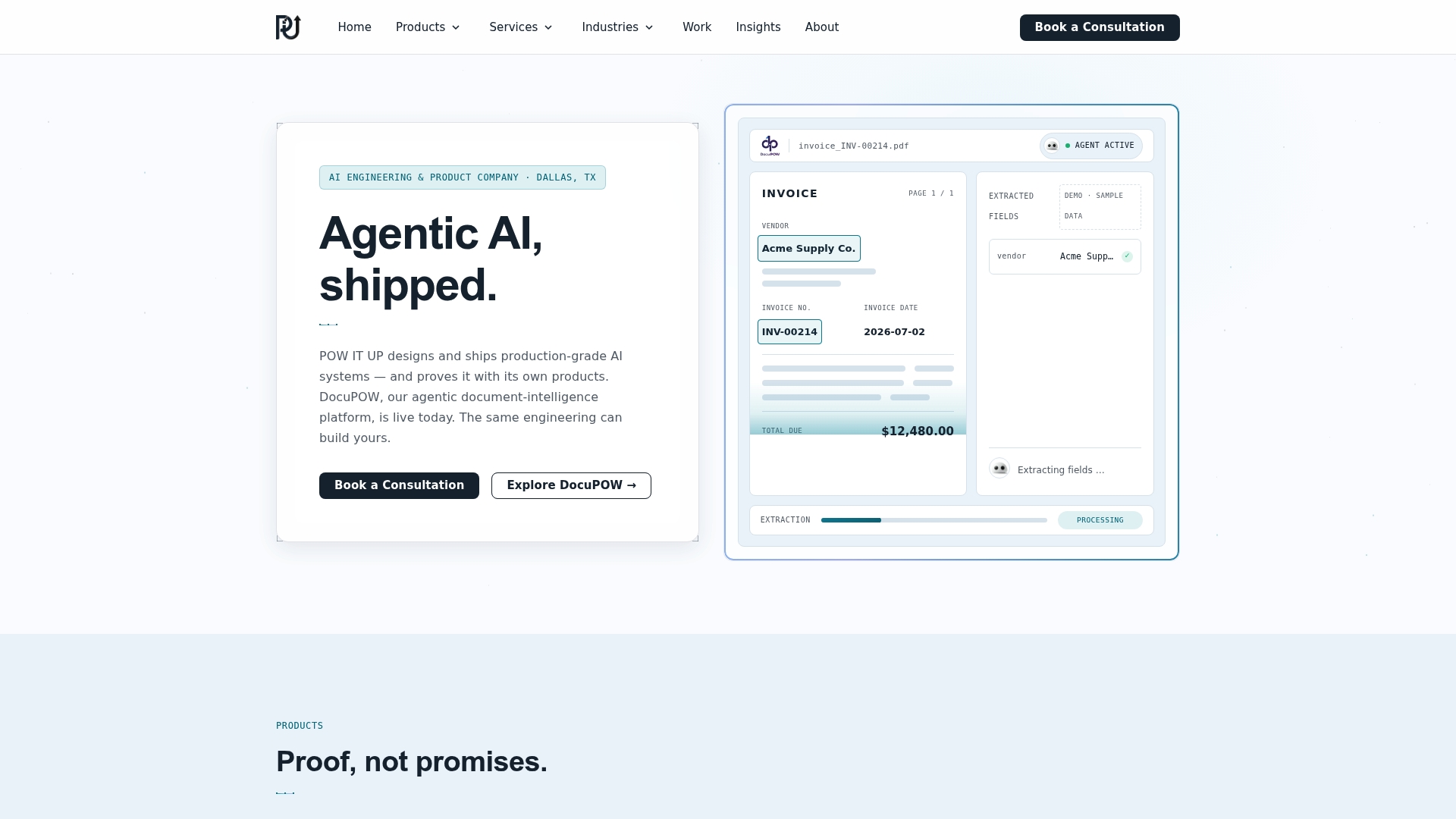
POW IT UP designs, builds, and deploys custom AI agents, document intelligence systems (DocuPOW), and portfolio analytics tools (AuraPOW) that go into production — not into a pilot museum. For leaders who need a first capability live by month four, POW IT UP’s engagement model starts with a scoped pilot: defined objectives, named success metrics, and a clear handoff plan to your internal team. DocuPOW handles document ingestion and validation for back-office and compliance workflows. AuraPOW provides client health and portfolio monitoring for service businesses and financial operations teams.
Typical first engagements include a 60-day scoped pilot with a fixed deliverable, followed by an optional scale engagement tied to the operating budget transition. To see what a first engagement looks like for your organization, visit the AI integration services page or explore the full services overview to find the right starting point.
Useful sources and further reading
These are the primary frameworks and practitioner guides used to compile this article. Each is worth reading directly.
- SEI/Accenture AI Adoption Maturity Model — Carnegie Mellon Software Engineering Institute. Use this for your initial maturity assessment and to build the evidence-based roadmap. Covers eight organizational and systems lifecycle dimensions across five maturity levels.
- MITRE AI Maturity Model and Organizational Assessment Tool Guide — MITRE Corporation. Use this alongside SEI/Accenture for workforce readiness and mission alignment questions. Covers six pillars including ethical and responsible use.
- AI Transformation Guide: The Operator’s Working Version — Practitioner playbook covering the 18-month rolling plan, month-nine budget cliff, assumption-kill criteria, and cost-engineering levers. Use this for operational checklists and governance templates.
- TOP Framework: Adoption of Artificial Intelligence — Published in a peer-reviewed journal. Use this checklist for evaluating readiness across Technology, Organization, and People dimensions before committing to a delivery model.
- Conceptual Framework for AI Adoption in Business Architecture — Springer Nature. Use this for aligning AI capabilities with value streams and information flows; particularly useful for the platform architecture and use-case sequencing decisions.
- Interval AI — Partner-level perspective on aligning AI adoption strategy with consulting-led delivery; useful for governance and assessment topics.
Run the SEI/Accenture or MITRE maturity assessment first, then tie the output directly to the 18-month rolling plan. The assessment tells you where you are; the rolling plan tells you what to do next.
FAQ
What is the first step in an AI transformation strategy?
Run a maturity assessment using the SEI/Accenture or MITRE model, appoint a transformation sponsor at the C-suite or VP level, and select one anchor use case with defined kill criteria — all within the first 30 days.
How long does an AI transformation take to show ROI?
Internal productivity and back-office automation use cases typically show measurable results within 60–120 days of production deployment; customer-facing and decisioning models usually take 6–12 months to reach a stable accuracy baseline.
What is the biggest risk in an AI transformation program?
The most predictable failure point is the discretionary-to-operating budget transition at month nine — programs that don’t plan for this cliff stall at pilot stage regardless of technical quality.
How do POW IT UP’s products fit into an AI transformation?
DocuPOW handles document ingestion and validation for back-office and compliance workflows, while AuraPOW provides portfolio monitoring and client health analytics — both designed to slot into the data and observability layers of an enterprise AI platform.
What is an assumption-kill criterion and why does it matter?
An assumption-kill criterion names the load-bearing assumption of a pilot, the exact data that would falsify it, and the decision-maker who will call the kill — making pivots cheap and objective rather than political, which prevents pilots from drifting into zombie status.