
TL;DR:
- Team efficiency measures how well a team transforms effort into impactful results by reducing friction and clarifying roles. Most teams operate below their potential because employees spend too much time on low-value tasks rather than skilled work. Building clear goals, roles, and psychological safety, along with streamlining workflows and leadership development, significantly improves team performance.
Team efficiency is the measure of how effectively a team converts effort into high-impact output by cutting friction, clarifying roles, and directing energy toward work that actually moves the needle. Most teams operate far below their potential. Employees spend 60% of their time on “work about work,” things like status updates, redundant meetings, and email chains, leaving only 27% for the skilled tasks they were hired to do. That gap is not a motivation problem. It is a system problem. Managers who understand this distinction build teams that consistently outperform, and this guide gives you the framework to do exactly that.
How does goal clarity drive team efficiency?
Clear, aligned goals are the single fastest way to close the gap between effort and results. When every team member understands how their daily tasks connect to the organization’s bigger objectives, they make better decisions about where to spend their time. Without that connection, people default to whatever feels urgent, not whatever matters most.
Role clarity compounds the effect. Goal and role clarity explains up to 76% of the variance between low and high-performing teams. That number means most performance gaps are not talent gaps. They are structural gaps that clear communication can fix.
The Wildly Important Goals (WIGs) framework, developed by FranklinCovey, addresses this directly. WIGs force teams to identify the two or three outcomes that matter most, then track lead measures weekly. The discipline of naming what is truly important separates it from the dozens of competing priorities that fill every manager’s calendar.
- Connect daily tasks to quarterly goals. Every team member should be able to name the top priority their work supports right now.
- Define ownership explicitly. Assign one person as the decision-maker for each deliverable. Shared ownership usually means no ownership.
- Eliminate role overlap. Map who does what before a project starts, not after confusion surfaces.
- Review goals at every team meeting. Repetition is not redundancy. It is how alignment sticks.
Pro Tip: Run a five-minute “goal check” at the start of each weekly meeting. Ask one team member to explain how their current work connects to the team’s top priority. The answers reveal misalignment faster than any survey.
What practical steps eliminate common workflow bottlenecks?
Workflow bottlenecks rarely announce themselves. They accumulate quietly in the form of unnecessary approval chains, unclear handoffs, and meetings that could have been a message. The first step is mapping your current workflow before any project begins, not during it. A visual map of who does what, in what order, and where decisions get made exposes the friction points that feel normal until you see them drawn out.

Unproductive meetings without agendas are among the most consistent drains on team productivity. A meeting without a clear agenda and a named decision-maker is a cost center, not a collaboration tool. Every recurring meeting deserves a quarterly audit: does this meeting produce a decision or an action, or does it just produce another meeting?
The four-D filter gives managers a practical tool for handling low-priority work: delete it, defer it, delegate it, or diminish the time spent on it. Applied consistently, this filter frees up hours each week for the skilled work that actually drives results. Automating recurring tasks for service teams is one of the fastest ways to apply the “delete” and “delegate” categories at scale.
- Map the workflow first. Draw the current process before designing the ideal one. You cannot fix what you have not seen.
- Assign a purpose to every communication channel. Email for documentation, messaging apps for quick questions, meetings for decisions. Mixing these creates noise.
- Audit recurring meetings quarterly. Cancel any meeting that does not produce a clear output.
- Apply the four-D filter weekly. Delete, defer, delegate, or diminish anything that does not directly support a WIG.
- Centralize project visibility. Use a single project management system so every team member can see status, blockers, and next steps without asking.
Pro Tip: Before your next project kickoff, spend 30 minutes drawing the workflow on a whiteboard with your team. Ask where the last three projects got stuck. The answer is almost always the same two or three spots.
How can managers build psychological safety to boost team performance?
Psychological safety is the shared belief that a team is safe for interpersonal risk-taking. Google’s Project Aristotle, a multi-year study of internal team performance, identified psychological safety as the top predictor of team success, ranking above individual talent, seniority, or technical skill. Teams that feel safe to speak up, admit mistakes, and challenge ideas produce better work faster.
Psychological safety increases innovation by 2.8 times. That is not a soft metric. Innovation directly affects a team’s ability to solve problems, adapt to change, and deliver results under pressure.
Managers build psychological safety through behavior, not policy. The most effective behaviors are specific and repeatable:
- Model vulnerability. Admit when you do not know the answer. Teams mirror their manager’s relationship with uncertainty.
- Respond to mistakes with curiosity, not blame. Ask “what did we learn?” before asking “what went wrong?”
- Invite dissent explicitly. Ask “what are we missing?” or “who disagrees?” in every major decision meeting.
- Follow through on feedback. When a team member raises a concern, close the loop. Silence after feedback destroys trust faster than any single mistake.
High-trust teams are 3.3 times more efficient and 5.1 times more likely to deliver target results than low-trust teams. Trust is not a culture initiative. It is a performance multiplier with measurable output.
What role does leadership development play in improving team efficiency?
Manager behavior drives 70% of the variance in team engagement. That figure makes leadership development the highest-leverage investment a business can make in team performance. Yet most organizations still rely on single-day workshops that produce short-term enthusiasm and long-term behavior change of nearly zero.
Spaced leadership development over 6–12 months produces measurably better behavior change than intensive one-off sessions. One hour of spaced practice delivers the equivalent learning of two hours of concentrated training. The mechanism is simple: spaced repetition gives the brain time to consolidate new habits between sessions.
If-then planning nearly doubles behavioral change rates compared to vague goal setting alone. Instead of “I will give better feedback,” a manager commits to “If a team member presents work in our Monday meeting, then I will ask one clarifying question before offering any evaluation.” The specificity of the trigger and the response is what makes the behavior stick.
- Replace annual training with monthly practice sessions. Shorter, more frequent sessions embed habits faster.
- Use if-then plans for every leadership behavior you want to change. Name the trigger, name the response.
- Track what leaders actually do, not what they intend to do. Observation and feedback loops are the only reliable measure of behavior change.
- Build peer accountability into development programs. Managers who report progress to a peer group sustain change longer than those who report only upward.
Pro Tip: Pair each leadership development goal with a specific if-then plan. Write it down, share it with a peer, and review it in three weeks. That three-step sequence alone outperforms most formal training programs.
How do you measure and sustain high team efficiency over time?
Measurement is where most team performance strategies fail. Managers track project metrics, delivery dates, and budget burn, but ignore the team health signals that predict whether those metrics will hold next quarter. Team health metrics reviewed alongside project dashboards detect burnout and capacity issues before they damage delivery.
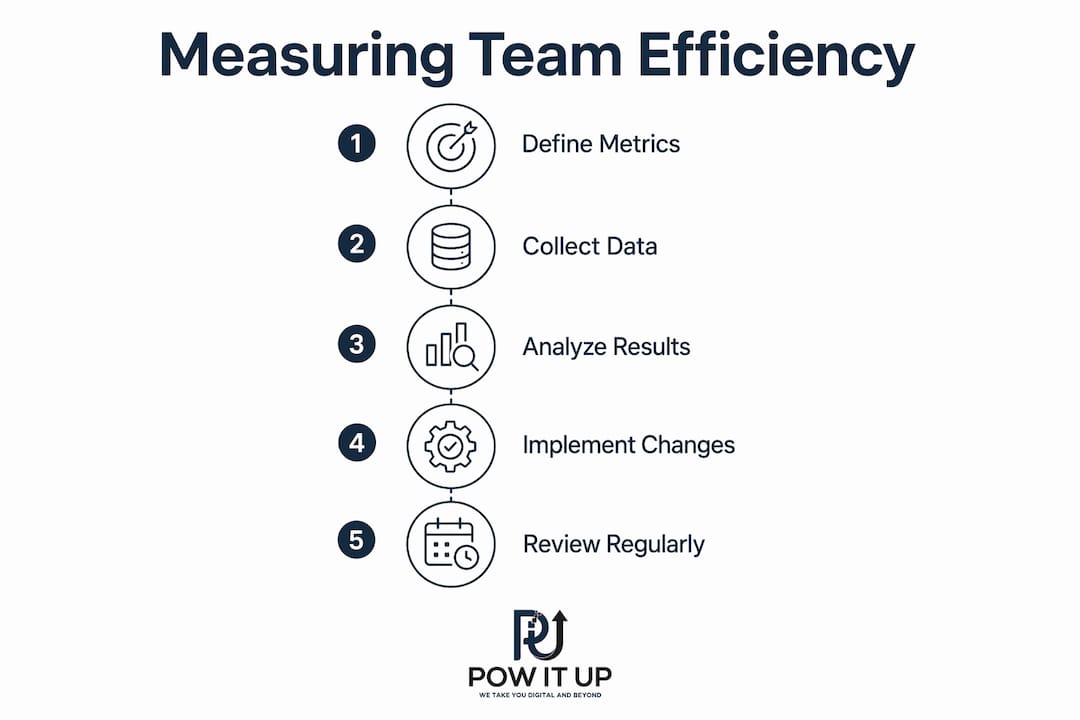
A team health scorecard tracks five dimensions alongside standard project data:
| Dimension | What to measure |
|---|---|
| Trust | Willingness to raise concerns without fear of blame |
| Workload balance | Distribution of tasks relative to capacity |
| Communication clarity | Shared understanding of goals and decisions |
| Psychological safety | Frequency of dissent and idea-sharing in meetings |
| Engagement | Self-reported energy and motivation levels |
Real-time performance scoreboards shift accountability from manager enforcement to team ownership. When a team can see its own progress in real time, members self-correct without waiting for a manager to intervene. That shift is the difference between a managed team and a self-managing one.
Adjusting team agreements every 2–3 weeks keeps the working model current. Retrospectives are not a sign that something went wrong. They are the mechanism that prevents things from going wrong repeatedly. Balanced workloads are a core input to this process. Overloaded team members produce lower quality work and exit faster, both of which destroy the efficiency gains every other strategy creates.
Key Takeaways
Team efficiency is built on system design, not individual effort. Fixing workflows, goals, and leadership behavior produces more output than demanding longer hours.
| Point | Details |
|---|---|
| Goal and role clarity | Clear goals and defined roles explain up to 76% of the gap between low and high-performing teams. |
| Eliminate work about work | Employees spend 60% of their time on low-value tasks; map and cut these before adding new processes. |
| Psychological safety drives results | High-trust teams are 3.3x more efficient and 5.1x more likely to hit targets. |
| Spaced leadership development | Monthly practice sessions over 6–12 months change manager behavior far more than single workshops. |
| Measure team health, not just output | Track trust, workload balance, and engagement alongside project metrics to catch problems early. |
Why most teams never reach their efficiency ceiling
The most common mistake I see business leaders make is treating team efficiency as a motivation problem. They run a team-building event, launch a new recognition program, or bring in a speaker, and then wonder why nothing changes by the following quarter. The real issue is almost always structural. Productivity problems stem more often from system design issues than individual effort gaps. Improving workflows beats pushing harder hours every time.
The second mistake is relying on one-off training. I have watched organizations invest significantly in a two-day leadership retreat, generate real energy in the room, and then see zero measurable behavior change six weeks later. The research on spaced practice is unambiguous. Behavior changes when it is practiced repeatedly over months, with feedback loops built in. A single workshop is an event. A development program is a system.
The third thing I have learned is that team continuity matters more than most leaders realize. Keeping consistent team combinations across projects means members skip the early forming and norming stages and get to productive work faster. Every time you reshuffle a team for convenience, you pay a hidden productivity tax. The teams I have seen sustain high performance over years are the ones whose leaders protect continuity as deliberately as they protect budget.
The shift that changes everything is moving from “how do I get my team to work harder?” to “what in our system is making it hard to do good work?” That question leads to answers you can actually act on.
— Sameer Abbas
POWITUP helps you cut the work that slows your team down
The strategies in this article require one thing most teams do not have enough of: time to focus on high-impact work. POWITUP builds custom AI agents and automation workflows that handle the high-volume, repetitive tasks eating into your team’s skilled work hours. Status updates, data entry, report generation, and routine approvals can all run without human intervention.
POWITUP functions as a technical architect, not a software vendor. The firm designs and deploys context-aware AI systems that fit your existing workflows, so your team spends less time on process and more time on the work that requires their expertise. If your team is losing hours to operational overhead, that is the first place to start.
FAQ
What is team efficiency and why does it matter?
Team efficiency is the ratio of high-impact output to total effort expended. It matters because employees currently spend only 27% of their time on skilled work, meaning most teams have significant untapped capacity.
How do clear goals improve team performance?
Clear goals and role clarity explain up to 76% of the performance gap between low and high-performing teams. When team members know exactly what they own and why it matters, they make faster, better decisions.
What is psychological safety and how does it affect efficiency?
Psychological safety is the belief that speaking up, admitting mistakes, and challenging ideas is safe within a team. Teams with high psychological safety innovate 2.8 times more and consistently outperform teams where members stay silent to avoid risk.
How often should teams review their working agreements?
Teams should revisit their operating agreements every 2–3 weeks through structured retrospectives. Regular reviews catch friction and misalignment before they compound into delivery failures.
What is the fastest way to reduce low-value work in a team?
Map the current workflow visually, apply the four-D filter (delete, defer, delegate, diminish) to every recurring task, and audit all standing meetings quarterly. Automation of repeatable processes removes low-value work permanently rather than just managing it.