
A digital workforce transforms a business when it takes over whole processes, not single tasks, and when people stay in charge of the judgment calls. The companies that get results pick one high-volume workflow, scope it tightly, keep it auditable and then add more. Custom-built, context-aware agents that fit your systems do this better than generic scripts, which is the work we do at POW IT UP.
TL;DR
- A digital workforce is a set of AI-driven software workers that run end-to-end processes, adapt to variable input and work around the clock. Rule-based bots follow fixed steps and stop when the input changes.
- Start with an internal, high-volume, low-stakes workflow that spans several systems. Order-to-cash, claims intake and document review are typical.
- Scope each digital worker narrowly, give it clear oversight and an audit trail, and train your people to work with it.
- Measure cost per transaction, cycle time, error rate and hours returned to staff, and model costs honestly: integration, maintenance and training are part of the bill.
- Treat it as augmentation. Leaders who frame it that way see growth without a matching rise in headcount.
Table of Contents
- What a digital workforce is
- What changes in the business
- Where to start
- Building it so people trust it
- Measuring cost, risk and return
- How we approach it
- Our perspective
- Ready to scope your first digital worker
- FAQ
- Sources
What a digital workforce is
A digital workforce is a group of software-based workers that use AI, machine learning, language processing and automation to do work people used to do. Salesforce describes them as operating around the clock and adapting from feedback.
The difference from what you may already run is scope. TechTarget explains that a digital worker is process-oriented: it carries out a complex workflow and can take over a process that would involve several people. RPA bots are generally limited to single tasks, and chatbots to one communication function.
Three contrasts matter to an operator:
- Versus a script or RPA bot. A bot follows a script. IBM notes that digital workers carry context from earlier work, have their own credentials like team members, and can plan the steps for a request without extra training.
- Versus digital workplace tools. Collaboration software helps people work. A digital worker does the work itself.
- Versus remote staff. Remote employees are people using digital tools. A digital worker is software.
What changes in the business
SS&C Blue Prism’s guide lists the gains operators care about: output that rises without more headcount, queues that clear in minutes instead of days, consistent rules with audit trails, and capacity that scales on demand. It also says employees move from tedious admin to judgment-based work.
That last point is where transformation actually happens. A fixed-capacity team has to hire to absorb growth. A team with digital workers handles more volume with the same people, and those people spend their hours on exceptions, client relationships and decisions.
Evidence from large organizations
BNY is the clearest public example. Forrester reports more than 130 digital employees in production, up from 70 less than a year earlier, running on an internal platform used by 97% of the bank’s roughly 50,000 people. Microsoft’s case study says its first payment digital employee cut payment validations from five or six minutes to under 30 seconds.
The pattern is also visible in other sectors. Salesforce’s discussion guide documents a payments platform that grew from one agent to more than 30 and made 140 employees perform like 800, and an accounting firm whose automation went from resolving 10% of inquiries to 50%.
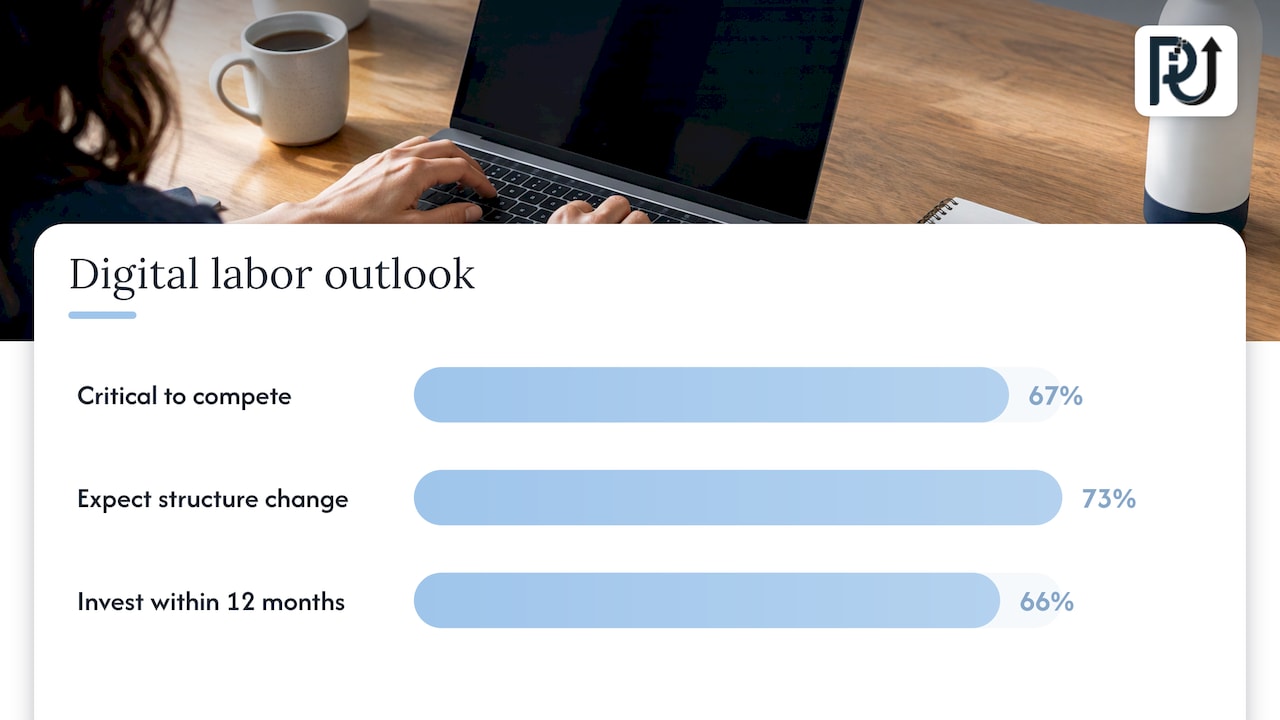
On the demand side, IDC’s survey of 103 US CEOs found 67% believe digital labor will be critical to competing, and 73% across the US and Canadian sample expect it to change their organizational structure. Futurum’s study of 664 enterprise decision-makers found 66% likely to invest in agentic digital workers within 12 months.
If you want more case-style evidence on how automation affects growth, this overview of the business impact of AI-driven growth is a useful companion on the marketing side.
Where to start
The most common mistake is starting with the most visible process instead of the most suitable one. Two sources agree on what suitable looks like.
CIO reports that agentic AI fits hybrid processes that mix programmatic and manual steps, such as insurance claims, where policy numbers are validated automatically while medical reports need review. It also fits workflows that span silos, such as order-to-cash, where an agent pulls data from sales, finance and logistics systems to surface bottlenecks.
Algolia’s analysis adds two practical points: the bottleneck is usually data quality and integration, not the AI, and internal, high-volume, low-stakes workflows deliver faster, lower-risk results than customer-facing automation.
A simple scoring test
Rate each candidate process from 1 to 5 on four questions:
- Volume. Does it run hundreds or thousands of times a month?
- Time leak. Do people re-key data, chase documents or reconcile between systems?
- Stakes. If it errs, is the damage contained and reversible?
- Data access. Can the inputs be reached through your systems or documents?
Worked example: a 40-person accounting firm receives client statements, invoices and tax forms by email. Intake runs about 1,500 documents a month, staff spend hours sorting and keying figures, errors are caught at review, and the documents are already digital. That scores high on all four. It is a better first target than client-facing advice, which scores low on stakes and data access.
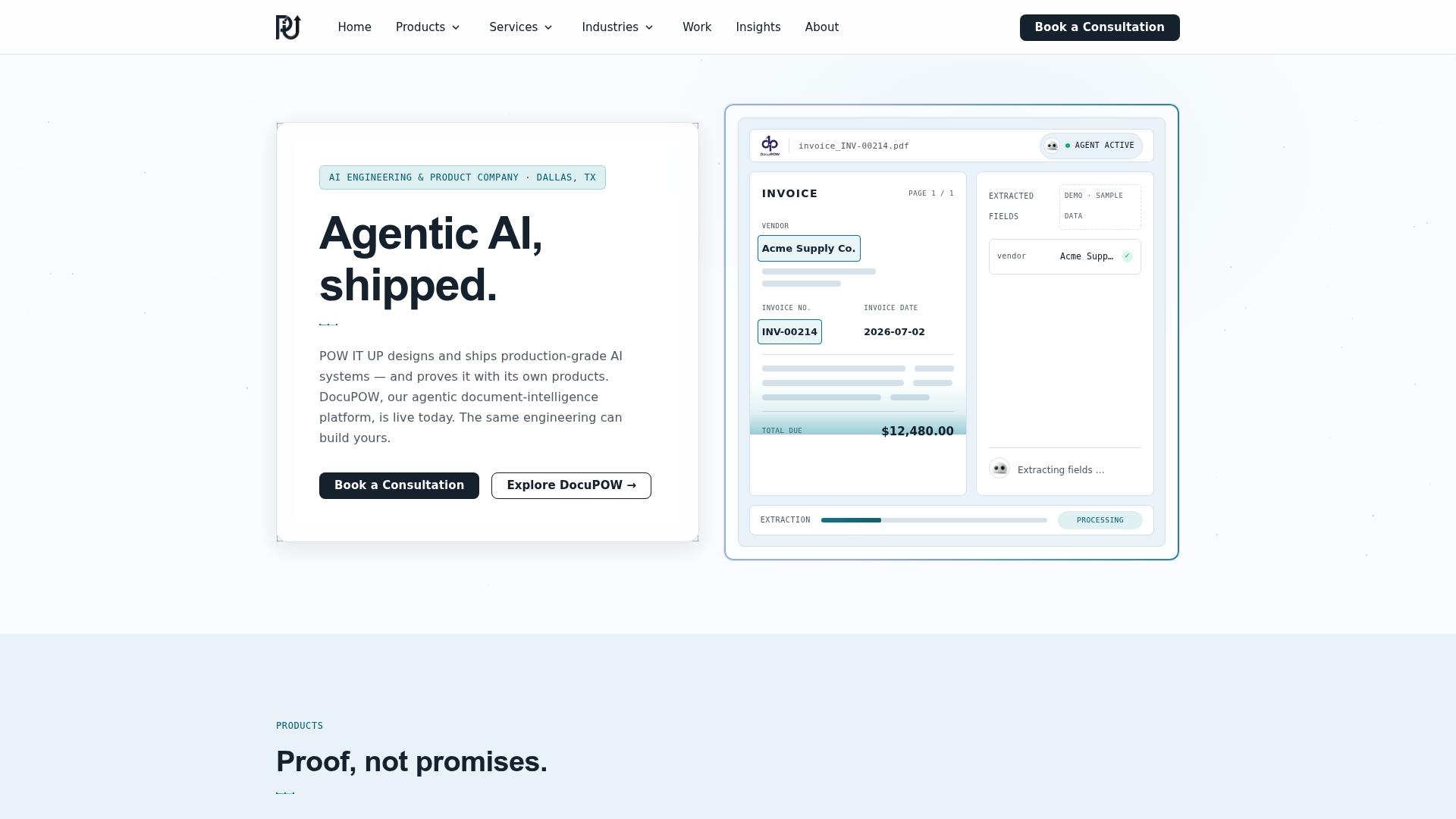
Document reading is the starting point we see most often for this reason, and it is why we built DocuPOW, our product for document reading and validation.
Building it so people trust it
Scope is what makes digital workers trustworthy. Microsoft’s BNY case quotes the leader of AI enablement there explaining that the first payment digital employee was deliberately limited to one narrow task, because tight scope keeps it auditable where a misrouted payment can freeze a large transfer.
Forrester describes BNY’s approach as building “backward”: platform and workforce fluency first, with more than 1,400 graduates of 40-hour bootcamps in 2025, then tightly scoped, monitored agents in core operations.
For a company of any size, that translates to five habits:
- Give each worker one job and a named human owner.
- Log every action so you can audit decisions.
- Set escalation rules: what the agent must hand to a person, and when.
- Connect to your real systems instead of working from copies.
- Train the team before and during rollout, so people redesign their jobs around the new capacity.
Salesforce frames the people side as four Rs: redesign jobs, reskill employees, redeploy talent to growth roles and rebalance the human-digital mix. Preparing staff and tracking how work is actually done is also part of the groundwork, and this look at AI labor analytics for field teams shows how workforce data supports it.
IDC’s advice to CEOs fits here too: treat digital labor as augmentation, and keep ethics, governance and guardrails at the center.
Measuring cost, risk and return
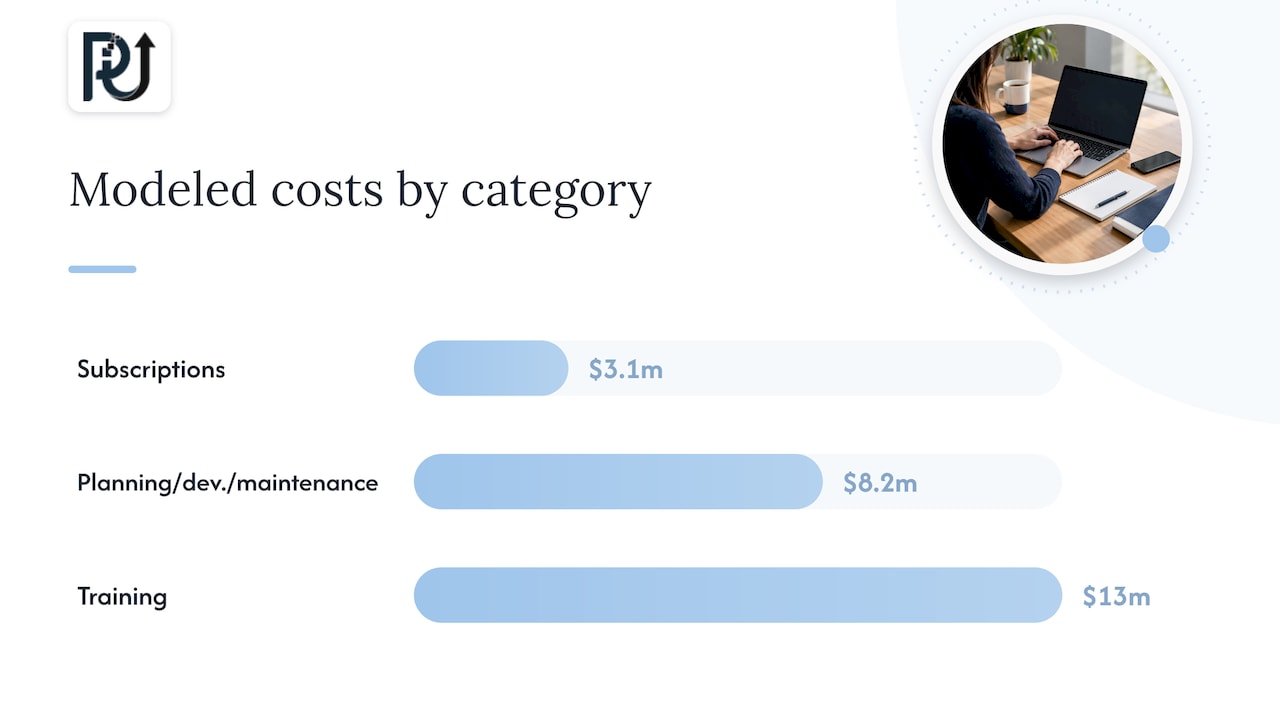
Budget for more than the software. Forrester’s total economic impact study of a Microsoft agent-building platform models a composite organization with 25,000 employees. Over three years it projects $3.1 million in subscriptions, $8.2 million in planning, development and maintenance, and $13 million in training, against a baseline net present value of $25.7 million (106% ROI). The lesson for any size of company is the proportion: subscriptions are the smaller part of the spend, and building, maintaining and training are the larger part. That is a modeled composite, not a promise for your business.
Track these before you start so the comparison is honest:
| Metric | What it tells you |
|---|---|
| Cost per transaction | Whether volume growth is getting cheaper |
| Cycle time | How fast work clears, from days to minutes |
| Error and rework rate | Quality of the output and the rules behind it |
| Hours returned to staff | Capacity available for higher-value work |
| Exceptions escalated | Whether scope and rules are right |
On risk, plan for jobs to change. Forbes cites a Bloomberg Intelligence projection of up to 200,000 US banking jobs lost as agentic AI expands, which is why redeployment and reskilling belong in the plan from day one.
How we approach it
Our starting point is that transformation comes from building automation that understands your context, not from stacking generic scripts. We design and deploy custom digital workforces: autonomous, context-aware agents for high-volume transactional work, built to hunt down the time leaks in your operation. Our AI agents development and AI integration services cover the build and the connection to your existing systems, and our AI automation work covers the processes themselves.
For related reading, see our guides on business automation through AI agents, building the future workforce with AI and scaling AI process engineering.
Our perspective
Most transformation programs stall because they begin with a tool and end with a pilot nobody owns. We start with the process.
A digital workforce earns its place when it takes a full workflow off your team: reading the documents, validating the data, moving it between systems and flagging only what needs a person. That is why we build custom agents around your operation, with engineering accountability and systems you own and can maintain.
Our view is simple. Scale processing volume without scaling headcount, give your people the exceptions and the relationships, and keep every action visible. DocuPOW is our live proof of that approach: you can see it read and validate documents before you commit to anything larger.
Syed Naveed Abbas
Ready to scope your first digital worker
If you run a fintech, healthcare practice, agency or service business and have a high-volume process in mind, we can scope it with you and build the agents and integrations around it. Start with the page that matches your need: AI agents development, or visit POW IT UP to book a conversation.
FAQ
What is the difference between digital transformation and a digital workforce?
Digital transformation is the broad change in how a company uses technology, people and processes. A digital workforce is one of its most concrete tools: AI-driven workers that execute processes. It changes the operating model, not only the software you use.
Will a digital workforce replace my employees?
IDC’s CEO research advises treating digital labor as augmentation, and CEOs who expect to expand their workforce focus on net new growth. Plan to redesign roles so people handle exceptions, judgment and client relationships while digital workers handle volume.
Why do so many digital transformations fail?
The common causes are starting without a clear process target, weak data and integration, and no plan for people. Choosing one scoped, high-volume workflow, connecting it to your real systems and training your team addresses all three.
How long before a digital worker pays off?
It depends on volume and scope. Salesforce reports results in weeks rather than months for well-scoped deployments, while the Forrester model above spreads costs and benefits over three years. Measure cost per transaction and cycle time from the first week.
Sources
- What Is a Digital Workforce? | Salesforce
- What is digital labor? | TechTarget
- How do digital workers differ from other types of digital workers | IBM
- What Is a Digital Workforce? How It Works, Benefits and More | SS&C Blue Prism
- BNY Built Its Digital Workforce Backward | Forrester
- The making of a Frontier Firm at BNY | Microsoft WorkLab
- Become An Agentic Enterprise discussion guide | Salesforce
- Voice of the CEO on Digital Labor | IDC
- Bridging the Capacity Gap | Futurum
- How to know a business process is ripe for agentic AI | CIO
- AI agent use cases | Algolia
- The Projected Total Economic Impact of Microsoft Copilot Studio | Forrester
- How Goldman Sachs Is Using Agentic AI | Forbes