

You grow without adding operational complexity by doing three things in order: find where work slows down, remove the steps and approvals that add no value, then automate the repeatable work that remains. Skip the order and you pay for it. Technology added to a broken process makes the process faster at being broken. Done in order, volume can rise while the number of people chasing, copying and checking work stays flat. We build custom AI agents that take over that repeatable work, and this guide shows you how to decide what they should take over.
TL;DR
- Complexity is not the price of growth. It builds up when layers, tools and approvals are added on top of old ways of working and never removed.
- Research from McKinsey and BCG links lower complexity to stronger returns and margins.
- Simplify in this order: products and offers first, organization and decision rights next, process steps last, then automate.
- Automate work that repeats and needs no judgment: intake, document checks, handoffs, reporting, routine follow-up.
- Track a small scorecard (cycle time, rework, cost-to-serve, customer response time) so you know the change worked.
Table of Contents
- What operational complexity actually is
- Why complexity grows with the business
- Where to look first: find the source before you fix anything
- Simplify before you automate
- Which work to automate, and what to check first
- Scaling volume without scaling headcount at the same rate
- Measure whether complexity actually fell
- Our perspective
- Where we fit in
- FAQ
- Sources
What operational complexity actually is
Operational complexity is the gap between how your business needs to work and how it can actually work on a normal Tuesday. It is not the same as being busy, and it is not a function of headcount. A ten-person agency can be tangled and a 1,000-person company can run cleanly.
A practical test: follow one piece of work, such as a new client, an invoice or a claim, from the moment it arrives to the moment it is done. Count how many times a person has to chase it, retype it, explain it, approve it or interpret it. Each of those touches is a unit of complexity. Growth multiplies them. Ten clients with four manual touches each is manageable. Four hundred clients with the same four touches is a department.
For the leaders this guide is written for (owners, COOs, operations directors, agency and practice heads, fintech and e-commerce founders), the symptoms are familiar:
- The same data lives in three systems and nobody trusts any of them.
- Approvals wait on one person’s calendar.
- Good employees spend their week on status updates, exceptions and rework.
- Every new client or product line needs a new spreadsheet.
- Hiring is the default answer to every backlog.
Why complexity grows with the business
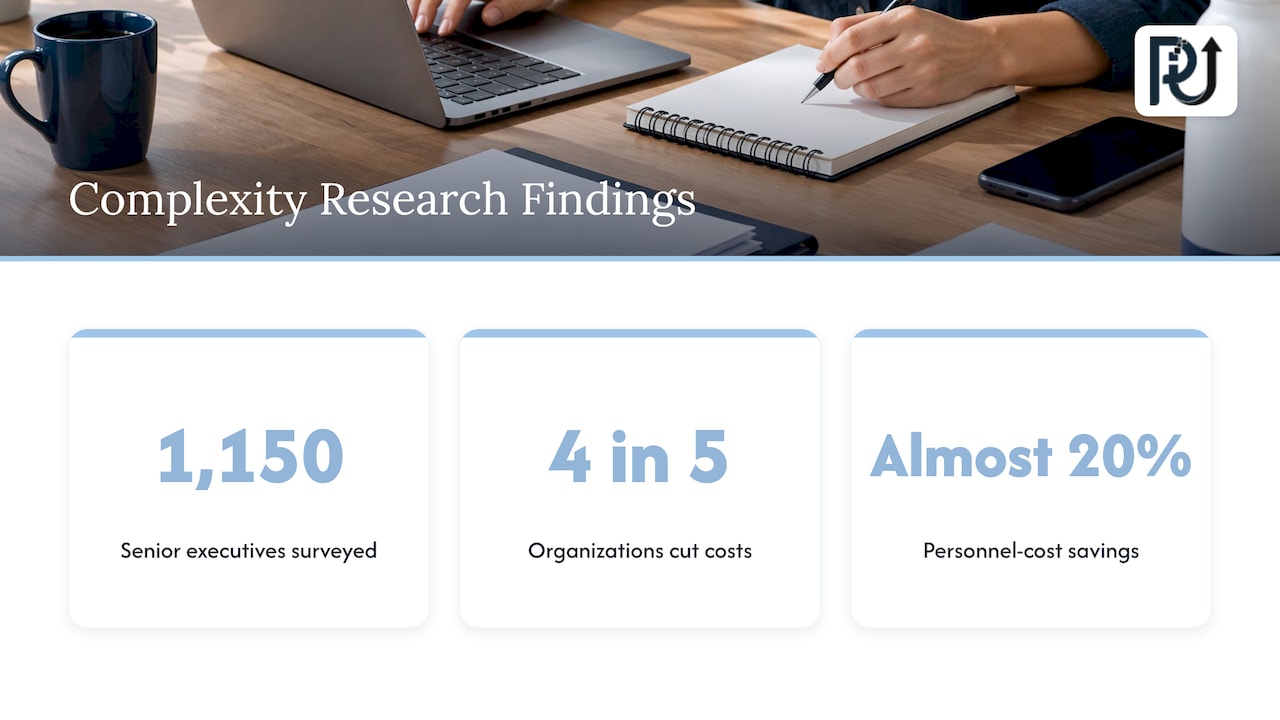
As companies expand, layers of structure, reporting lines and procedures accumulate. McKinsey’s research with 1,150 senior executives (published in 2010) found that companies reporting low complexity had the highest returns on capital employed and on invested capital. It also found that four out of five organizations that cut complexity also cut costs, some saving almost 20% of personnel costs by eliminating low-value activities. The sample was large companies with at least 1,000 employees, but the mechanism is the same at smaller scale: time spent on work that creates no value is time not spent on customers.
A 2018 BCG study reached a compatible conclusion. Less complicated companies achieved revenue growth and profit margins that were both above average. The authors’ reading is that complicatedness slows innovation and injects inefficiency and cost into operations.
Accenture’s complexity research describes how it happens in practice. Growth-driven complexity comes from workflows, reporting layers and decision forums that are layered on top of current ways of working. Cumulative reporting, the norm in large organizations, masks anomalies and deflects accountability, which the report calls an invisible drain on productivity and profit.
The pattern for a growing business is simple. You add a tool to fix one problem, a role to cover another and a meeting to coordinate the two. Nobody removes anything. Two years later the business runs on workarounds.
Where to look first: find the source before you fix anything
The most common mistake is to start with the most visible mess, which is usually process. Bain & Company’s partners Kevin Meehan and Mark Gottfredson argue for a different order: attack product complexity first, organizational complexity next and process complexity last. Their reasoning is that complex processes often reflect too much product variety or poor organizational design, so simplifying processes alone is like pushing on one side of a balloon while it bulges elsewhere. In their example, a natural-resources company cut 483 process-improvement projects to 25 significant ones, raised operating income by more than 20% and reduced report volume by 40% in one business unit.
For a services business, translate that into three questions.
1. Are you selling too many variations?
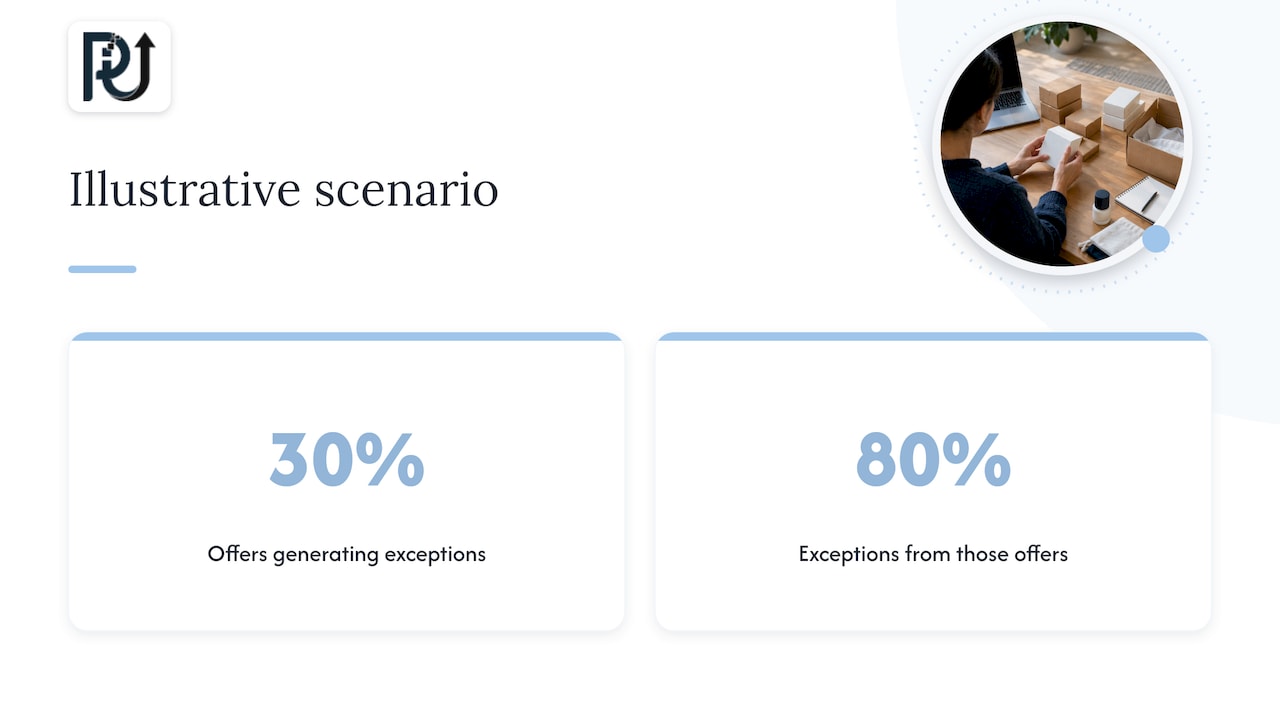
Custom packages, one-off pricing and special terms for individual clients each create a unique path through your operation. If 30% of your offers generate 80% of your exceptions, those offers are the first place to simplify. Not every variation needs to go, but each one should earn its handling cost.
2. Who decides what?
In a CIO leadership guide on scaling, Alec Scott names unclear decision rights as a quiet killer of scale. If nobody knows who decides priorities, tradeoffs, exceptions, spending and risk acceptance, meetings multiply and speed disappears. Write down, for each recurring decision, one owner and the limit of their authority. This costs nothing and often removes more delay than any software.
3. Where does work wait?
Only now look at process. Map one workflow end to end and mark the waiting points: the inbox where a document sits, the approval that needs a signature, the report that someone rebuilds by hand each month. We cover this method in more depth in our guide on mapping first and automating second.
Simplify before you automate
Commentary in an Inc. feature on fast-growing companies makes the point bluntly: if you add technology to a broken process, things get worse. One of the executives quoted calls accumulated unnecessary complexity process debt, which builds like a snowball, and suggests mapping work and eliminating obsolete tasks before adding technology.
McKinsey’s 2025 process-optimization article by Dana Maor and Patrick Guggenberger gives a sequence you can use as a working checklist: eliminate, synchronize, streamline, then automate. Their examples are concrete. Cut a 30-day performance-data lag to 15 days. Trim monthly performance reviews that run past 50 pages. Use digital workflows and generative AI to reduce manual reporting.
Here is that sequence as steps you can run in a month on one workflow.
- Pick one workflow that hurts. Choose a high-volume one: client onboarding, invoicing, claims intake, order exceptions, month-end reporting.
- Eliminate. List every step and ask whether the outcome would change if it vanished. Reports nobody reads, duplicate approvals and re-entry of data are the usual casualties.
- Synchronize. Align the timing between teams so work does not sit waiting for the next weekly meeting.
- Streamline. Combine steps, shorten the approval chain and define the handoffs. Scott’s advice is to design handoffs like engineered interfaces, with defined inputs, outputs, timing, quality expectations and escalation paths.
- Standardize what should repeat, and keep room where you are still learning. Onboarding, billing, renewals, quality checks and handoffs should be uniform. New offers and new markets need flexibility, because over-standardizing too early suffocates discovery.
- Automate the remainder. What is left is a clean, documented path that software can follow reliably.
A lender’s overview of why to automate business processes covers the general case for automation in small businesses. The sequence above is what makes that case hold up in practice.
Which work to automate, and what to check first
Good candidates share four traits: high volume, clear rules, structured or semi-structured inputs and little need for judgment. In a growing services business that usually means:
- Document handling. Reading, extracting and validating data from invoices, applications, statements, forms and contracts. This is a heavy manual load in fintech, accounting, insurance and healthcare administration.
- Intake and routing. Capturing a request, creating the record, assigning it to the right person and sending the first response.
- Scheduling and follow-up. Reminders, renewals, status updates and sequences that follow a fixed rule.
- Recurring reporting. Pulling numbers from several systems into the same dashboard or deliverable every period. See how this works in practice in our piece on AI that automates recurring deliverables.
- Exception triage. Sorting what needs a human from what does not, so people only see the cases that need them.
Before you automate any of them, check three things:
- Is the process documented? You need the trigger, the steps, the decision points, the handoffs and the definition of done. If the team cannot describe it, software cannot run it.
- Is every step still necessary? This is the elimination pass again. Automating a pointless step makes it permanent.
- Who owns the exceptions? Automation handles the 80% that is routine. Decide in advance who handles the rest and how it gets to them. In regulated areas such as healthcare and financial services, also confirm with your compliance lead or counsel which data the system may touch and what must be logged.
For a deeper explanation of how AI workflow automation operates and how teams start, see this overview of AI workflow automation.
Scaling volume without scaling headcount at the same rate
The goal is not zero hiring. It is breaking the lockstep in which every 20% of new volume means 20% more people. RSM US describes scalable operating models as a combination of efficient processes, technology enablement, workforce flexibility and specialized support, which lets a company scale operations without adding headcount while keeping quality and control. It lists four approaches to operating-model challenges: process optimization, automation, specialized talent and managed services.
The Inc. feature adds an example. A supplement brand with revenue projected to approach $200 million in 2026 has added only about 30 people in two years, because it leans heavily on technology. An Oracle NetSuite executive quoted there says stronger-performing companies tend not to grow headcount at the same rate as the rest of the company.
The lesson is not that technology replaces people. It is that people should be spent on judgment, relationships and exceptions, while repeatable transactions run on systems. If you want the full argument and examples, we lay out our approach in Scaling Without Hiring and Operational Scale Without Headcount Growth.
A worked example
Take a 25-person accounting firm that onboards clients every January. Each new client sends tax documents by email, an associate downloads and renames files, someone keys figures into a workbook, a reviewer checks them, and a partner approves the file. Assume four touches per document set and 300 clients. That is 1,200 manual touches in the busiest weeks.
Run the sequence. Eliminate the renaming step by capturing documents in a structured intake form. Synchronize so reviews happen daily instead of weekly. Standardize the checklist for each document type. Then automate the reading and validation, so a reviewer only sees the files that fail a rule. The firm has not changed what it sells. It has changed how many hands each file passes through. These figures are an illustration, not a benchmark, so replace them with your own counts.
Measure whether complexity actually fell
A project that feels better but is not measured will drift back. Scott recommends a small set of metrics across four areas:
| Area | Example metrics |
|---|---|
| Customer outcomes | Retention, satisfaction, response time, defect rates |
| Operational flow | Cycle time, throughput, backlog age, rework rate |
| Reliability and risk | Availability, security incidents, change failure rate, audit findings |
| Financial health | Cost-to-serve, unit economics, forecast accuracy, working capital pressure |
He also advises putting time performance explicitly into the scorecard, measuring information quality and signal latency, and tying every metric to a decision so it changes behavior instead of becoming noise.
For a first project, pick two or three from this list. Cycle time and rework rate for the workflow you changed, plus cost-to-serve for the client segment it touches, are usually enough. Take the baseline before you change anything, and review it monthly.
Our perspective
Most leaders who come to us believe they have a hiring problem. When we look at the work, it is usually a leak problem: hours lost to retyping, chasing, checking and waiting. Hiring into a leak adds cost and keeps the leak.
We build custom, context-aware AI agents, which means systems designed around how your business actually works rather than generic scripts that break when a form changes. They read the documents, move the work and flag the exceptions, so your people handle decisions rather than data entry. Our product DocuPOW is a live example: it reads and validates documents, and you can see it work in a demo before you commit to anything.
We also care about what happens after launch. Automation that nobody can maintain becomes the next layer of complexity. Our approach emphasizes transparent processes, engineering accountability and client ownership of what we build, so the system stays understandable as your business changes.
Our advice on order is the same as the research above: map first, remove what does not belong, then automate. That is how a digital workforce lets volume grow without a matching rise in headcount.
Syed Naveed Abbas
Where we fit in
If your map shows high-volume, rule-based work that eats your team’s week, that is the work we design for. AI Automation covers the workflows themselves. AI Agents Development covers autonomous agents that handle transactions end to end, and AI Integration connects them to the systems you already run. For document-heavy operations, DocuPOW reads and validates documents.
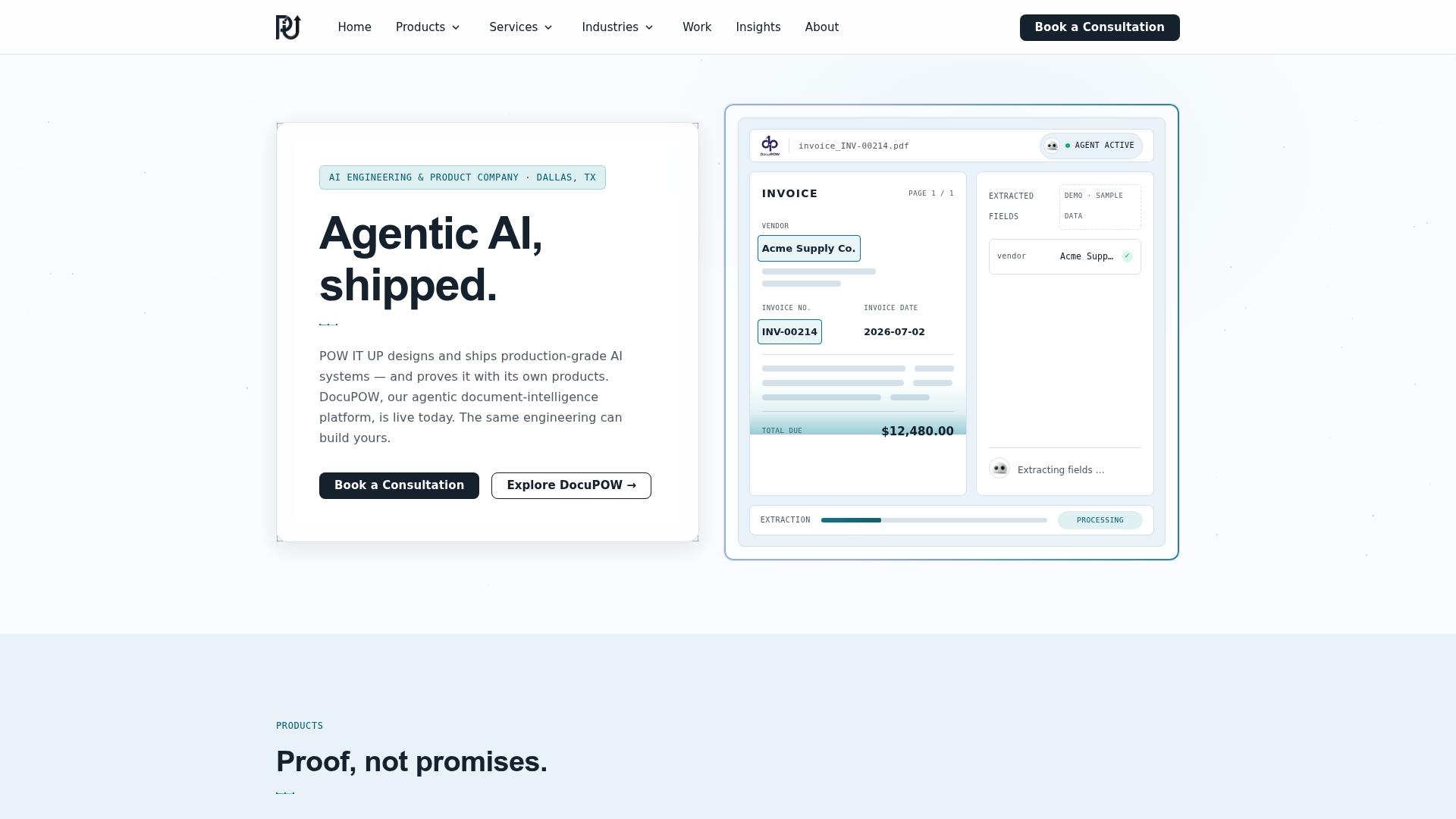
The fastest way to see whether it fits your operation is to book a demo and bring one workflow you would like to take off your team’s plate.
FAQ
Is operational complexity a sign that my business is failing?
No. Complexity usually follows growth, because more clients, products and people mean more coordination. The warning sign is when complexity grows faster than revenue, so each new client costs more to serve than the last. That is the signal to map the work and simplify.
What should I fix first: processes, structure or technology?
Start with what you sell and who decides, then process, then technology. Bain’s guidance is to address product complexity first, organizational complexity next and process complexity last. Technology comes after those, because it automates whatever you give it, good or bad.
Can I grow without hiring at all?
Most businesses still hire, but not at the same rate as volume. The aim is to automate repeatable transactions so new hires go to work that needs judgment, such as client relationships, complex cases and quality. Track cost-to-serve to confirm that each new client costs less to handle over time.
How do I know a workflow is ready for AI automation?
It should be high volume, follow clear rules and have a documented trigger, steps, decision points, handoffs and completion criteria. It should also have a named owner for exceptions. If you cannot describe it in a page, simplify it first.
Sources
- How do I manage the complexity in my organization? McKinsey, 2010
- How Complicated Is Your Company? BCG, 2018
- The Complexity Dividend, Accenture
- When complexity hurts businesses, Bain & Company
- Scaling a business: A leadership guide, CIO
- Rethinking your process optimization strategy, McKinsey, 2025
- How Fast-Growing Companies Stay Ahead of the Operational Cliff, Inc.
- What is an operating model and why does it matter? RSM US