

A scalable digital workforce is a set of AI agents and automated systems that take on high-volume, rule-heavy work, connect to the systems your team already uses, and escalate only the exceptions to people. You build one by choosing a few strategically important workflows, designing human oversight on purpose, proving value in a contained pilot, and measuring results against a baseline before you add more agents. This guide walks through each step for operations leaders who want more capacity without a matching rise in headcount.
TL;DR
- A digital workforce is more than scripts. Agents that use AI can adapt to new input, pull from connected tools and work across departments.
- Focus on a small number of high-value workflows. Spreading effort across many pilots is the most common way scaling stalls.
- Treat human oversight as a design choice. Set it by error tolerance, regulatory requirements and task complexity.
- Pilot where a failure causes little disruption, then expand function by function with metrics agreed in advance.
- Prepare your people early. The near-term picture is humans working with AI, not AI replacing whole teams.
Table of Contents
- What a digital workforce is, and what it is not
- Choose the workflows before you choose the technology
- Design the architecture: data, agents and integration
- Build human oversight in on purpose
- Pilot, prove, then scale
- Measure what the digital workforce delivers
- Prepare your people for the change
- Our perspective
- Where POW IT UP fits
- FAQ
- Sources
What a digital workforce is, and what it is not
The World Economic Forum describes digital workers as intelligent software bots that automate everyday processes such as data entry, invoicing and system queries, combining AI, machine learning, robotic process automation and visual intelligence. Slack frames a digital workforce more broadly: a set of automated systems, including AI agents, bots, chatbots and virtual assistants, programmed to handle routine or time-consuming tasks so people can focus on complex, creative and relationship-driven work.
The practical difference from older automation is adaptability. Traditional automation follows preset scripts and breaks when an input looks different. Agents built on agentic AI can respond to real-time input and pull information from integrated tools. That is what makes them suitable for work such as reading a messy document, deciding what it means and routing it correctly.
Two terms get confused with this:
- A digital workplace is the collaboration layer: chat, intranet, video, shared files. It helps people work together. It does not do the work.
- Basic business process automation moves data from A to B on fixed rules. It is useful, but it is one component of a workforce, not the whole.
The idea is moving into the mainstream. Gartner’s 2026 survey of 469 CEOs and senior executives found that 39% already consider AI agents to be employees. The same report says 54% of enterprises still limit automation to specific tasks or workflows, and 27% of CEOs expect their organizations to operate primarily without human intervention by 2028. Most companies are early, which means the gap between ad hoc pilots and a managed workforce is still wide open.
Choose the workflows before you choose the technology
Most failed programs start with a tool and look for a use for it. Start from the work instead. Look for processes that are high in volume, repetitive in structure, dependent on documents or data from several systems, and expensive in staff hours. We call the hidden hours in these processes “time leaks”: minutes lost to re-keying, chasing approvals, checking figures and reconciling records. Each is small. Together they are a large share of a week.
MIT Sloan research by Katherine Kellogg and colleagues suggests evaluating candidate workflows against a set of criteria: strategic importance, technical fit, foundation model substitution risk, operational readiness, compliance and equity risk, return on investment, reuse potential and growth potential. The same work advises leaders to concentrate resources on a limited number of strategically important workflows rather than spread investment across many pilots.
A simple way to apply that is a scoring sheet. Rate each candidate from 1 to 5 on the criteria that matter most to your business, then compare:
| Criterion | What to ask | Strong signal |
|---|---|---|
| Strategic importance | Does this process affect revenue, cash or client retention? | Leadership already tracks its output |
| Technical fit | Are inputs digital and the decision logic describable? | Documents, forms, API-accessible systems |
| Operational readiness | Is the process stable and owned by one person? | A named process owner and written steps |
| Compliance risk | What happens if the agent errs? | Errors are catchable and reversible |
| Reuse potential | Can the same agent pattern serve other teams? | Similar intake or validation steps elsewhere |
| Return on investment | How many hours or errors does it remove? | Measurable baseline today |
If you want a second perspective on narrowing a long list to a short one, this piece on prioritizing a small number of high-value targets applies the same discipline to a different pipeline.
Good first candidates tend to be document intake and validation, client onboarding, loan or claims processing steps, invoice handling, task assignment and portfolio monitoring. Our guide on how to automate employee task assignment is a concrete example of a contained, high-return starting point.

Design the architecture: data, agents and integration
Building agents is the smaller part of the job. The larger part is how they connect to the way your organization already works. Enterprise-scale agentic AI often requires access to core systems, changes to how work is carried out, new safeguards against security risks and decisions about accountability, according to the same MIT Sloan research. Plan for those four items from day one.
A Harvard Business School working paper surveyed 202 AI-active U.S. enterprises with a 174-question instrument and identified seven recurring domains of an enterprise AI operating model. Its author, James Aris, argues that firms with similar overall adoption can differ in how they prepare organizational information, coordinate dependent tasks and evaluate outputs. In plain terms: two companies can both say they use AI, and one can be far more capable because of how it feeds, sequences and checks the work. For a related view on the organizational habits that separate strong adopters, see this roadmap to audit-ready AI.
Those three practices translate into a build checklist:
- Prepare the information. Agents are only as good as what they can read. Document formats, naming, access rights and source-of-truth systems need to be settled before an agent depends on them.
- Coordinate dependent tasks. Most real processes are chains: intake, validation, decision, posting, notification. Design the handoffs between steps, and between agent and human, explicitly.
- Evaluate outputs continuously. Build checks into the workflow itself: confidence thresholds, reconciliation against a second source, sampling by a reviewer.
Integration quality decides whether a digital workforce feels like a colleague or a side project. Agents that sit outside your core systems create copy-and-paste work for people. Agents wired into your CRM, accounting platform, document store or core banking system remove it. Our pages on AI integration and AI agents development cover how we approach that connection layer, and our post on scalable AI infrastructure explains how to plan platform overhead before volumes grow.
Build human oversight in on purpose
Scaling does not mean removing people. It means deciding where they add the most value. The Stanford Enterprise AI Playbook notes that the level of human oversight depends on error tolerance, regulatory requirements and task complexity, and that it is often a strategic design choice rather than a limitation.
That gives you a useful way to set autonomy workflow by workflow:
- Assist. The agent drafts, summarizes or recommends, and a person decides. Suited to new workflows and anything customer-facing at the start.
- Act with approval. The agent prepares the action and a person approves it. Suited to payments, client communications and record changes.
- Act within limits. The agent acts alone inside narrow, predefined boundaries, such as validating a document type against fixed rules.
- Act with exception review. The agent acts and people review exceptions or samples. This is where volume scaling really begins.
Stanford’s research points to why the last level matters. Escalation-based operating models, where AI handles 80% or more of tasks on its own and humans review only exceptions, delivered the highest productivity gains, with a median of 71%. Reaching that level safely depends on trust earned through the earlier stages. This overview of AI productivity gains for agencies shows how human review is built into AI workflows in practice.
Regulated work calls for extra care. If an agent touches lending, healthcare, employment or other regulated decisions, keep a qualified person approving outcomes, keep audit trails, and involve your compliance officer or counsel before you raise autonomy. Gartner senior director analyst Max Goss says humans will still need to be in the loop for security and governance, and that agents operating at scale will need near-constant availability, which means spreading them across multiple models and hardware resources. Gartner also expects the number of agents per company to grow from about 15 in 2025 to as many as 150,000 by 2028, so an inventory of who owns each agent and what it can access becomes a necessity quickly.
Our post on AI workflow optimization and governance goes deeper on setting those controls.
Pilot, prove, then scale
The safest path to a large digital workforce is a sequence of small, finished projects. A reliable pattern looks like this:
- Pick one or two pilots in different functions, where a failure would cause minimal disruption. A back-office document queue is a better first choice than a live client conversation.
- Capture a baseline. Before the agent runs, record volume, handling time, error rate and cost per transaction. Without it, you cannot prove anything later.
- Build in short sprints and release to a limited group. Keep a person in the loop at the start.
- Review results with the process owner. Look at exceptions in detail. They show you what the agent does not yet understand.
- Raise autonomy gradually as accuracy holds, moving from approval to exception review.
- Reuse what worked. Shared components such as document readers, validation rules and connectors make the second and third agent far cheaper than the first.
- Stand up governance before you scale, not after: ownership, access rules, evaluation routines and an incident path.
The jump from pilot to production is where most programs lose momentum. Our guides on scaling AI operations past the pilot and five rules for scaling AI process engineering cover that transition step by step.
Measure what the digital workforce delivers
Pick four groups of metrics and agree on them before launch:
| Dimension | Example measures |
|---|---|
| Productivity | Transactions per person, cycle time, hours returned to the team |
| Cost | Cost per transaction, overtime and contractor spend |
| Quality | Error and rework rate, exception rate, audit findings |
| Capacity | Volume handled without added headcount, backlog size, time to onboard a new client |
Track the exception rate closely. A falling exception rate with stable quality means the agent is learning your business. A rising one is an early warning that inputs have changed.
There is also evidence that how you organize AI matters for financial results. The Harvard Business School study found that higher behavioral scores on the AI operating model were associated with greater improvement in return on assets and operating margin, using financial observations from 2022 to 2025. That is an association, not a promise, but it supports measuring the operating model itself, not just the tools.
Prepare your people for the change
People decide whether a digital workforce succeeds. Be direct about what changes. Gartner analyst Tori Paulman said that Gartner estimates about 80% of work is done by humans without AI today, and predicts that by 2030, 75% of work will be done by humans with AI and 25% by AI alone. Most of your team’s work will become supervised, shared work, not disappear.
Practical steps:
- Involve process owners from the first workshop. They know where the exceptions hide.
- Name the new roles. Someone has to review exceptions, tune rules and own each agent’s performance.
- Share the time saved. Show teams what they gain back and what they will do with it.
- Train for judgment. Reviewing an agent’s output is a different skill from doing the task by hand.
The WEF notes that people are not just more productive working with digital workers, they are also happier. That tends to hold when the first agents remove the tasks people like least.
For a broader view of where operating models are heading, see our posts on the future of AI-powered operations and AI-enabled organizational scaling.
Our perspective
Most companies do not have an AI problem. They have a time-leak problem that AI can finally solve. Every operations team has hours disappearing into re-keying, document checks, status chasing and reconciliations, and those hours grow with volume.
We build digital workforces as engineers, not as script writers. That means context-aware agents designed around your documents, your systems and your exceptions, not generic automations that break the first time an input looks different. It also means the system is maintainable and the knowledge stays with you: transparent processes, client ownership and engineering accountability are part of how we work.
Our advice is to begin narrow and build for reuse. Start with one workflow where the volume is high and the risk is contained, put a person in the approval seat, and let accuracy earn autonomy. Our DocuPOW product, which reads and validates documents, exists as a live demonstration of that approach, and AuraPOW applies the same thinking to portfolio monitoring and client health analytics. The goal is simple: processing volume that grows without headcount growing in step.
Syed Naveed Abbas
Where POW IT UP fits
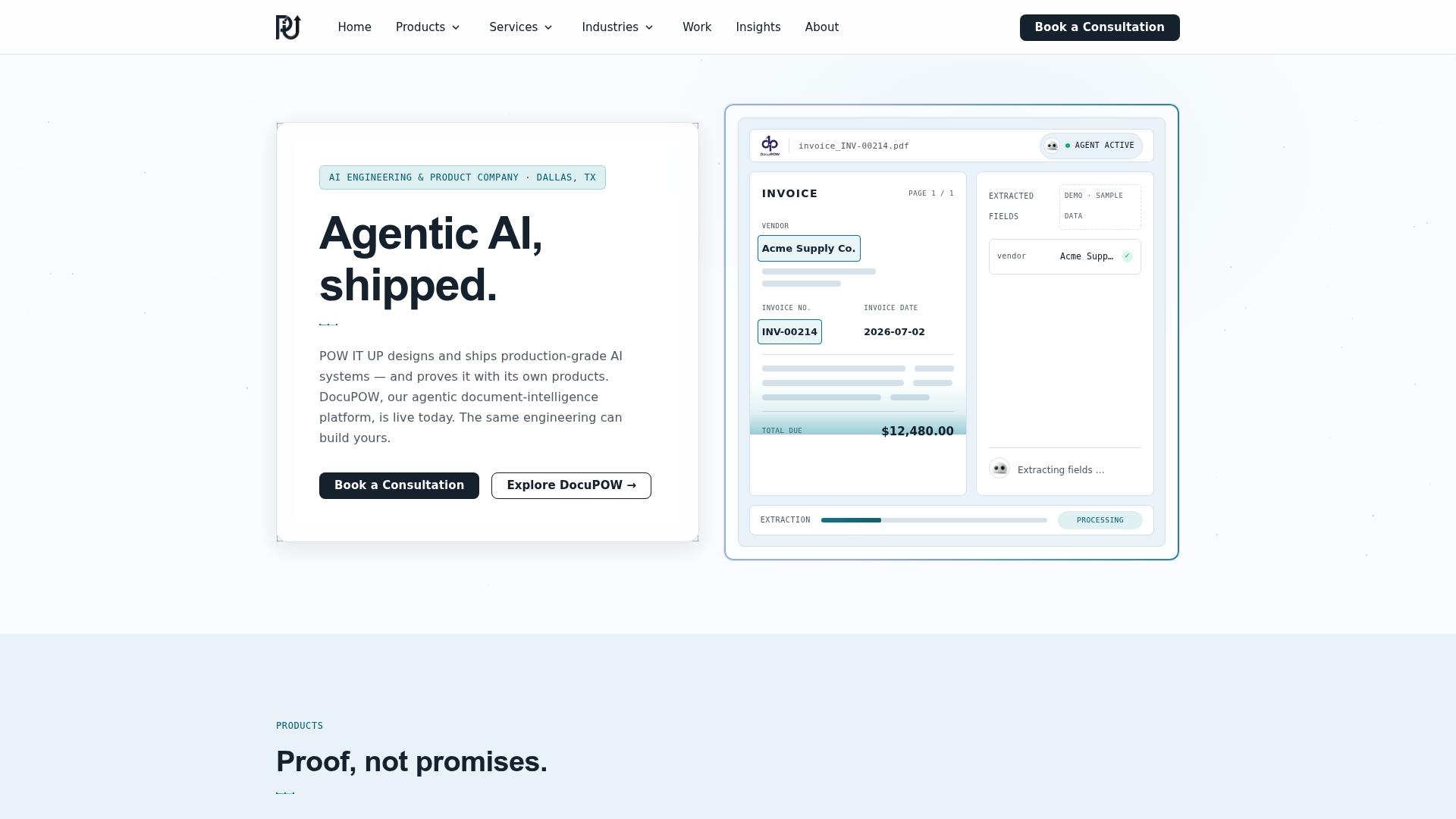
We design, build and deploy custom digital workforces made of autonomous, context-aware AI agents, for fintech, healthcare, service businesses, logistics, e-commerce and other teams where volume is outgrowing headcount. If document-heavy work is your bottleneck, start with DocuPOW, which reads and validates documents, and ask for a live demo.
If you need something built around your own systems, our AI automation services and AI agents development teams scope the first workflow with you. You can also see everything we offer on the products page or reach us from the POW IT UP home page.
FAQ
How is a digital workforce different from RPA or basic automation?
Basic automation and RPA follow preset scripts and need an exact input format. A digital workforce built on agentic AI can adapt to real-time input, pull from connected tools and handle variation, such as a document laid out differently each time. Scripts often remain inside it as components, but the agent decides what to do with the variation.
Which processes should we automate first?
Choose a high-volume workflow with clear inputs, a named process owner and a contained downside if something goes wrong, such as document intake or validation. Score candidates on strategic importance, technical fit, readiness, compliance risk, return and reuse. Then concentrate on one or two instead of many.
Do we still need people if agents do the work?
Yes. Oversight is a design choice that depends on error tolerance, regulation and task complexity. Gartner’s current outlook is that by 2030 most work will be done by humans with AI, with a quarter done by AI alone. People move toward exception review, judgment and client relationships.
How do we know the digital workforce is working?
Capture a baseline before launch, then track cost per transaction, cycle time, error and exception rates, and volume handled without added headcount. Review these with the process owner on a fixed schedule. Add new agents only when the earlier ones hold steady.
Sources
- Here’s how digital workers benefit businesses and employees, World Economic Forum
- Digital Workforce: Embracing Remote and Tech-Enabled Work, Slack
- CEOs Embrace AI-Centric Strategy as Autonomous Business Models Take Shape
- Stop debating automation vs. augmentation, MIT Sloan
- Organizing AI at Enterprise Scale: Agentic Operating Models, Harvard Business School
- Enterprise AI Playbook, Stanford Digital Economy Lab
- Gartner sees untamed growth in agentic AI, Computerworld
- CIOs combat talent scarcity with AI-augmented leadership, Information Week