
AI-enabled business process management (BPM) means running your core workflows on systems that can read messy inputs, judge what to do next and act, with people handling the exceptions and the decisions that carry real risk. Classic BPM draws the process and enforces it. The AI-enabled version also watches the process, learns from it and takes over more of the work. This guide covers what changes, where to start, what to govern and how to roll it out without creating a bigger mess than the one you have.
TL;DR
- Traditional BPM follows rules you wrote in advance. AI-enabled BPM adds systems that read unstructured data, predict problems and, in the agentic version, take action on their own.
- Start with one high-volume, document-heavy or repetitive process, measure it, then expand. Do not start with a company-wide platform decision.
- Complexity and weak governance sink more projects than the models do. Assign decision rights, set risk tiers and log what the system does.
- The best gains come when frontline staff point out friction and the system is built around how work really happens.
- Keep a human in the loop where an error costs money, compliance standing or a client relationship.
Table of Contents
- What AI adds to business process management
- Where AI-enabled BPM pays off first
- Why most AI process projects stall
- Governance: the part you cannot bolt on later
- A rollout that works for small and mid-sized companies
- Build, buy or hire: choosing your route
- Our perspective
- How we can help
- Measuring whether it worked
- FAQ
- Sources
What AI adds to business process management
BPM has always been a discipline of mapping, running, measuring and improving work. Researchers tracing the field note that since the early 1990s it has moved through successive waves of automation technology, some automating single tasks, others coordinating whole flows.
AI changes three things.
- Inputs. Rule-based workflows choke on invoices, emails, intake forms and PDFs that arrive in a hundred layouts. AI reads and classifies them, then passes clean data downstream.
- Decisions. Instead of an if/then tree, a model can score, route or draft a response based on context.
- Improvement. Process data (completion times, error rates, handoff delays) can be analyzed to predict where trouble will appear and where capacity should go.
The academic community calls the target state an AI-augmented BPM system: a process-aware system that uses trustworthy AI to enhance how processes execute, not just to report on them afterward.
Rule-based automation versus agentic process management
The sharpest distinction is between scripted automation and agents. A script does exactly what it was told, and breaks when the input changes. An agent works toward a goal, senses the state of the process, reasons about options and executes steps.
Researchers describe this as a shift from design-driven, rule-based management to data-driven, agentic business process management systems, where AI agents sense, reason and act, which redraws the line between human and machine responsibility.
| Rule-based automation | AI-enabled (assistive) | Agentic | |
|---|---|---|---|
| Handles unstructured input | No | Yes | Yes |
| Decides next step | Fixed rules | Suggests, human approves | Decides within set limits |
| Adapts to change | Rewritten by hand | Partly | Learns from process data |
| Best for | Stable, simple steps | Judgment-heavy review work | High-volume transactions with clear guardrails |
| Main risk | Brittleness | Over-trusting suggestions | Unchecked actions at speed |
Most US small and mid-sized businesses should expect to live in the middle and right columns at the same time, with different processes at different levels of autonomy.
Where AI-enabled BPM pays off first
The best candidates share three traits: high volume, a clear definition of “done” and costly manual handling. Typical examples across the industries we work with:
- Document intake and validation. Loan packets, insurance claims, patient intake forms, vendor invoices and onboarding documents. The work is reading, checking against rules and keying data into another system.
- Client onboarding and handoffs. Service firms lose days between “signed” and “started” because information moves by email.
- Task assignment. Routing work to the right person based on skills, load and deadline instead of a manager’s memory. See how that works in practice in our piece on automating employee task assignment.
- Portfolio and client-health monitoring. Watching accounts for signals that need a human call, before the client raises it.
- Reporting. Pulling numbers from five systems into one view that updates itself.
If you run a service business, our guide on why service firms standardize with AI explains why standardizing the process comes before automating it.
Why most AI process projects stall
The technology is rarely the problem. A widely shared analysis of the so-called AI value gap, summarized by innobu, frames the issue as organizational order: who decides what, under which rules, measured against what. Companies that adopt AI without answering those questions get activity without profit.
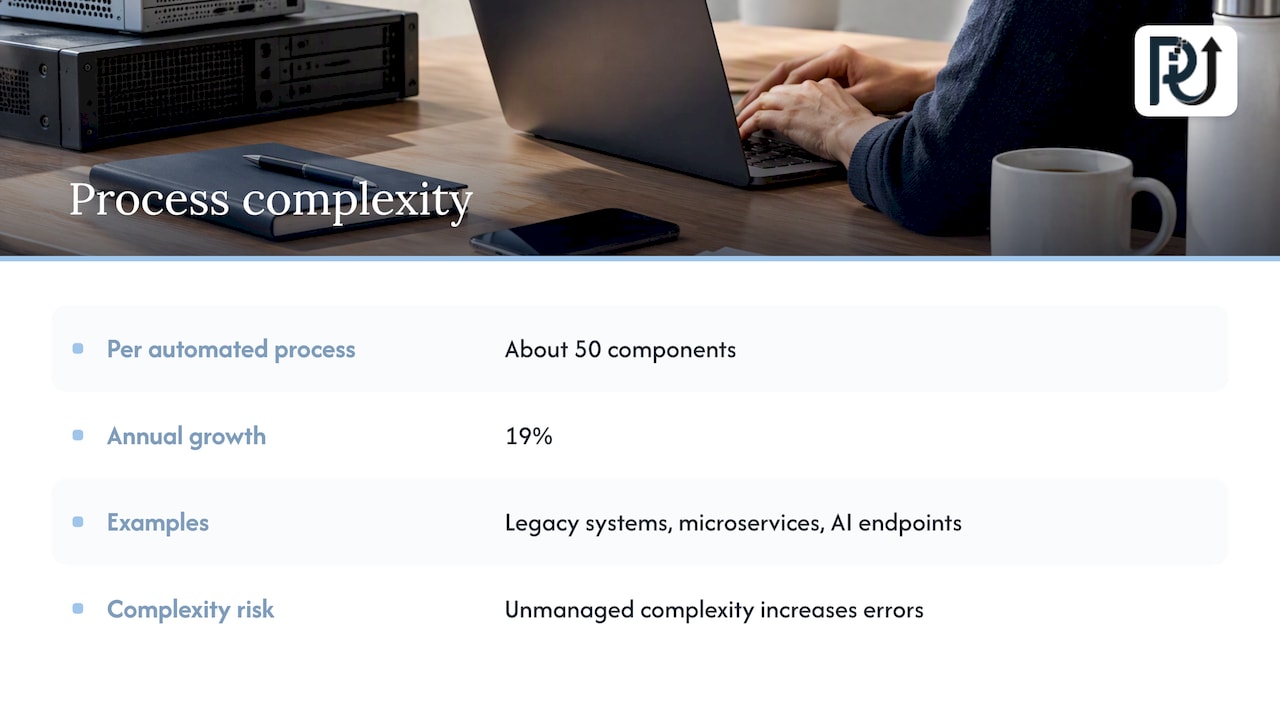
Complexity is the second trap. One Forbes Technology Council piece reports that organizations average about 50 components per automated process, such as legacy systems, microservices and AI endpoints, and that the figure is growing 19% a year. Its warning is that unmanaged complexity, not the AI itself, drives errors up. Orchestration matters more with every component you add.
The third trap is skipping the human side. In its discussion of AI-driven process redesign, Harvard Business Review argues for automation with a human touch: generative AI lets non-technical staff contribute to process improvement, and the advantage comes when leaders encourage everyone to spot friction and improve continuously, in the spirit of kaizen.
Governance: the part you cannot bolt on later
Once a system can act, you need to know what it is allowed to do, who approved it and how you will notice when it is wrong. The NIST AI Risk Management Framework is the most useful US reference. It is voluntary guidance organized around four functions: Govern, Map, Measure and Manage.
Here is how that translates for a 20-person or 200-person company.
- Govern. Name an owner for each automated process. Write down what the system may do alone and what needs approval.
- Map. List the data it touches, the third-party tools it calls and the people affected by its output.
- Measure. Track accuracy, exception rate, turnaround time and cost per transaction. Compare to the manual baseline.
- Manage. Decide in advance what happens when a measure slips: pause, roll back, escalate.
A tiered approach keeps this light. Low-risk actions (tagging a document, drafting an internal summary) run automatically. Medium-risk actions (updating a client record) run with sampling review. High-risk actions (releasing a payment, sending a regulated disclosure) need a person’s sign-off. For teams in regulated sectors, this overview of AI compliance automation capabilities shows what risk and compliance functions can expect from automated controls. If you want a structured way to size up exposure before you deploy, these NIST-aligned risk assessment steps for SMBs are a workable starting checklist.
A rollout that works for small and mid-sized companies
You do not need a transformation office. You need a sequence.
- Pick one process. Choose the one where staff complain loudest and volume is highest. Write down who touches it, how long it takes and where it fails.
- Baseline it. Measure for two to four weeks: cycle time, error rate, rework, hours spent. Without this, you cannot prove anything later.
- Fix the process before automating it. Automating a broken handoff makes it fail faster. Remove steps that exist only out of habit.
- Define autonomy levels. For every decision in the flow, mark it as automatic, suggested or human-only.
- Build narrow, then widen. Ship the smallest version that handles the common case and routes the rest to a person.
- Review exceptions weekly. Every exception is training material and a design flaw you can fix.
- Document and hand over. Your team should be able to understand, maintain and change the system without calling the builder for every tweak.
For leadership framing across a whole business, our AI transformation strategies for business leaders lays out the wider picture, and our note on promoting a digital transformation culture covers the people side.
Build, buy or hire: choosing your route
There are three realistic paths, and each fits a different situation.
- Configure a packaged BPM or workflow suite. Good when your processes are standard and your team has time to configure and maintain them. The limit is that unusual inputs and cross-system logic get awkward.
- Use general-purpose AI tools in the gaps. Quick wins for drafting, summarizing and classification. The risk is sprawl: many small automations nobody owns.
- Commission custom automation. Worth it when the process is central to how you make money, touches several systems or involves documents and judgments that off-the-shelf tools handle poorly.
Whatever route you take, ask five questions of any vendor or builder: What happens when the system is wrong? Who owns the code and the workflows? How do I see what the system did and why? How do you handle my data? What does handover look like?
Our perspective
We build digital workforces for a living, so here is where we land. Most companies do not have an AI problem. They have a time-leak problem: hours disappearing into rekeying data, chasing documents, reconciling spreadsheets and answering the same status question. AI is the best tool yet for closing those leaks, but only when the process underneath is understood.
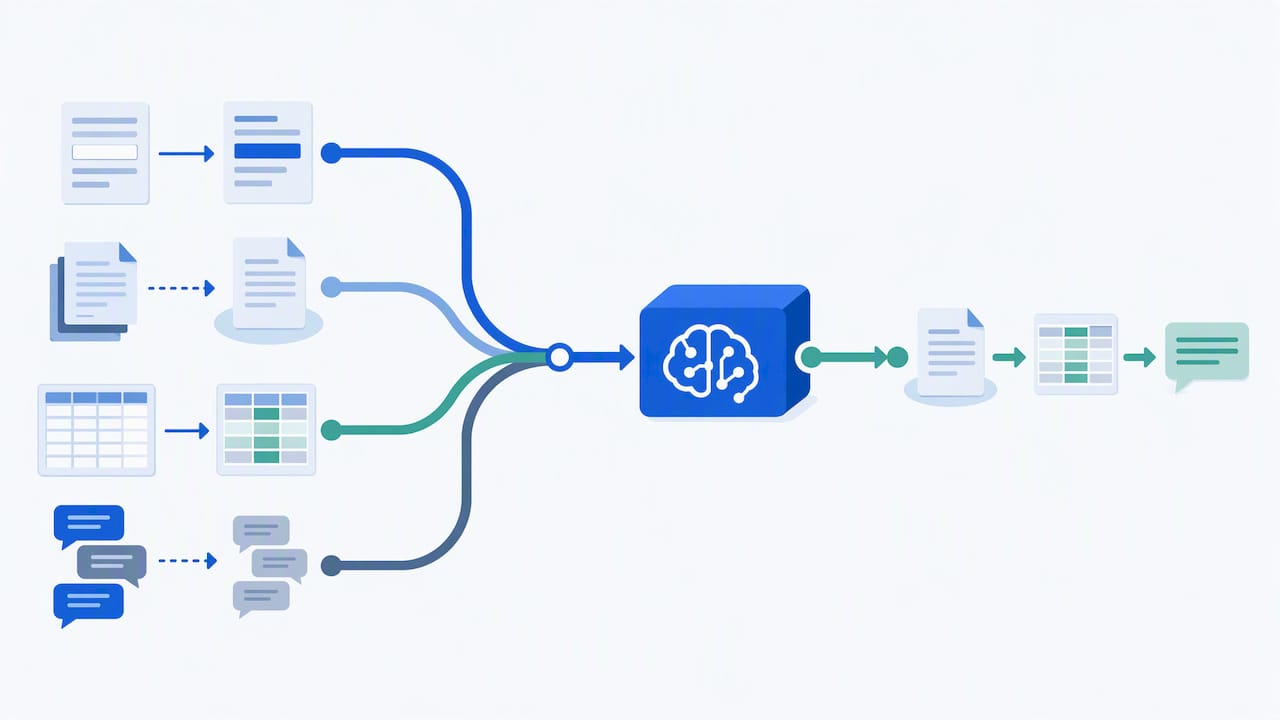
We design for context, not for scripts. A generic script reads a field in a fixed place. An agent that understands the document, the client and the surrounding workflow can handle the variation that real operations produce. That is why our work centers on document intelligence, workflow orchestration and autonomous transaction processing, with accountability built into the engineering: transparent processes, maintainable systems and clients who own what we build.
We also believe the aim is not to replace your team. It is to let volume grow without headcount growing at the same rate, so your people spend their time on judgment, relationships and exceptions. Start narrow, measure honestly and expand where the numbers justify it.
— Syed Naveed Abbas
How we can help
If you have a process in mind, we can help you scope it, build it and hand it over. AI Automation covers workflow design and orchestration. AI Agents Development is for autonomous, context-aware agents that act within limits you set. For document-heavy work, DocuPOW reads and validates documents, and we offer live demos so you can see it on your own kind of paperwork. Prices are not published, so talk to us through our site about scope.
Measuring whether it worked
Pick a small set of numbers and keep them visible.
| Measure | What it tells you |
|---|---|
| Cycle time per transaction | Whether work is moving faster |
| Straight-through rate | Share of cases finished without human touch |
| Exception rate | Where the design or the data is weak |
| Error and rework rate | Quality compared with your manual baseline |
| Cost per transaction | Whether volume can grow without headcount |
| Staff hours redirected | Whether time is going to higher-value work |
Research is moving toward continuous improvement loops here. A 2026 paper on continuous process improvement driven by large language models names data fragmentation, limited explainability and weak governance as the central obstacles, which is a useful checklist for what to fix in your own data before you ask any model to optimize anything.
FAQ
What is AI-enabled business process management?
It is BPM in which AI reads unstructured inputs, makes or recommends decisions and learns from process data, instead of only following fixed rules. In its more advanced agentic form, AI agents can also execute steps. People still own the goals, limits and exceptions.
How is it different from traditional automation?
Traditional automation repeats scripted steps and fails when inputs change. AI-enabled systems cope with variation, such as differently formatted documents or ambiguous requests, and can improve with data. The trade-off is that they need governance and monitoring, because their behavior is less predictable.
Which processes should a small business automate first?
Start with high-volume, repetitive work that has a clear outcome: document intake, invoice handling, client onboarding, task routing or recurring reports. Choose one, measure it before and after, and expand only when the results hold.
Do I need a framework for AI risk?
Yes, a light one. The voluntary NIST AI RMF gives you the Govern, Map, Measure and Manage structure. If your processes involve health, financial or legal data, talk to your compliance counsel or a qualified security advisor before deploying.
Sources
- Agentic Business Process Management Systems (Springer Professional)
- AI-augmented Business Process Management Systems: A Research Manifesto (ACM)
- AI Value Gap 2025 (innobu)
- Avoiding Automation Armageddon (Forbes Technology Council)
- The Secret to Successful AI-Driven Process Redesign (Harvard Business Review)
- NIST Artificial Intelligence Risk Management Framework (AI RMF 1.0)
- Continuous Business Process Improvement Driven by Large Language Models (IEEE Access)