
An intelligent growth system is an operating model, not a piece of software. It joins your data, your workflows and autonomous AI agents so that volume can rise without headcount rising in step. The agents read documents, route work, check results and escalate exceptions to people. The workflows around them are designed for that division of labor from the start.
This guide is for owners and operations leaders at service firms, fintechs, healthcare practices, agencies and logistics companies. It covers what the system consists of, why most AI investment fails to pay back, and how to build one in stages.
One note on the name. Searching the exact phrase also surfaces a vertical farming technology company that builds indoor growing towers. That is a different subject. Here, “growth” means business growth: more clients, transactions and documents handled with the team you have.
TL;DR
- An intelligent growth system combines context-aware AI agents, redesigned workflows and clean data, so output scales faster than payroll.
- Adoption is widespread but payoff is rare: nearly 90 percent of companies invest in AI, yet only 6 percent see material impact.
- The gap comes from bolting agents onto old processes. The winners rebuild the workflow around the outcome.
- Start with one high-volume, rule-heavy process, measure it, then expand to adjacent ones.
- Keep humans in the loop where judgment, money or patient and client trust is at stake.
Table of Contents
- What an intelligent growth system actually is
- Why most AI spending does not turn into growth
- Context-aware agents versus scripts
- Where the system pays off first
- How to build one in five stages
- Pitfalls we see leaders underestimate
- Our perspective
- Where POW IT UP fits
- FAQ
- Sources
What an intelligent growth system actually is
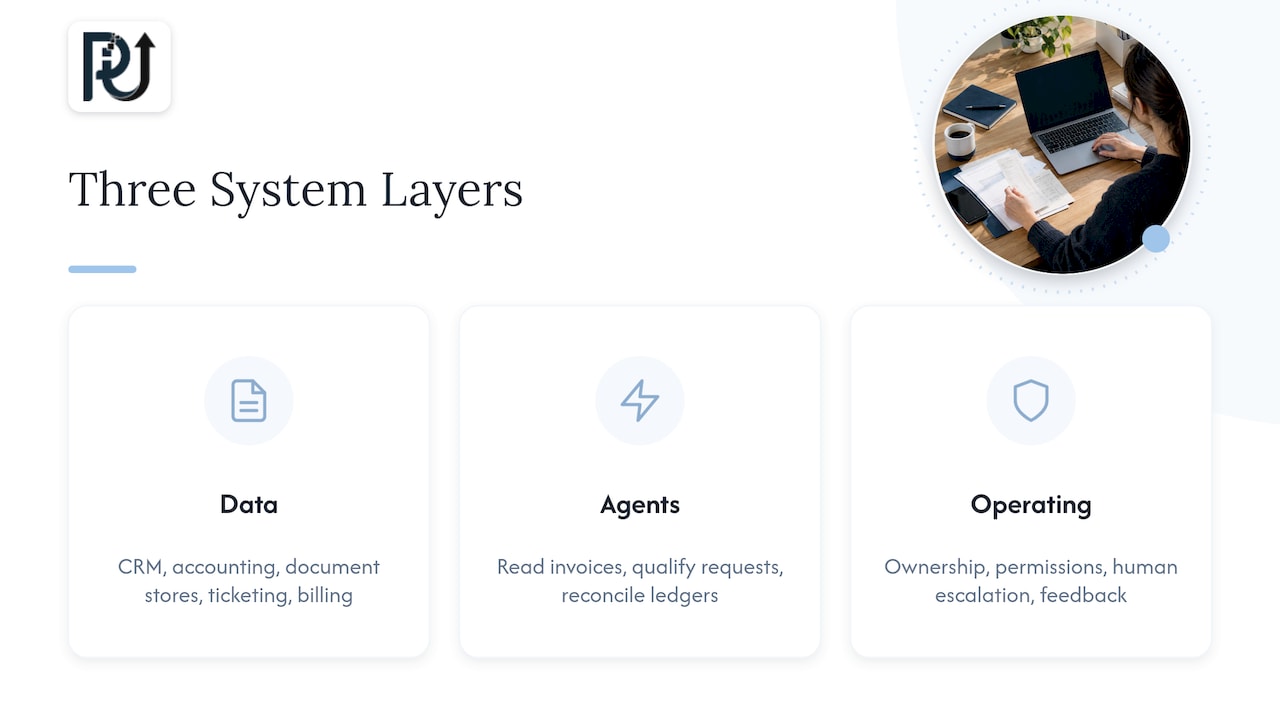
Three layers make up the system. Each one fails without the others.
1. A data layer. Agents are only as good as what they can see. That means your CRM, accounting system, document stores, ticketing and billing data, connected and consistent. Without this layer, agents guess.
2. An agent layer. These are software workers that take on defined responsibilities: reading an invoice, qualifying an inbound request, reconciling a ledger entry, flagging a client who is going quiet. Research from the academic community describes this shift as moving beyond AI-assisted tools toward autonomous systems that reason, decide and act across workflows.
3. An operating layer. This is the part most companies skip. It defines who owns each outcome, what the agent may do alone, when it must ask a person, and how feedback improves it.
A chatbot on your website is a tool. A system is when that chatbot’s output feeds scheduling, which feeds billing, which feeds reporting, with every handoff designed and monitored.
Why most AI spending does not turn into growth
The headline figure is stark. McKinsey reports that nearly 90 percent of companies are investing in AI but only 6 percent see material impact, and it attributes the difference to how companies approach the work, not to which model they buy.
A separate McKinsey piece on organizational change finds that just 11 percent of organizations have reached the “reinvention” stage, where they rethink how work gets done and how value is created. Most of the rest are adding AI to individual tasks.
In practice, the failure patterns look like this:
- Tool sprawl. Five subscriptions, none connected, each saving a few minutes for one person.
- Layering on old processes. An agent drafts a document that still goes through the same four approvals, so cycle time barely moves.
- No owner. Nobody is accountable for the agent’s results, so errors pile up quietly.
- No feedback loop. The agent makes the same mistake in month six that it made in month one.
Gartner’s guidance for tech CEOs makes the same point from the growth side: redesign key workflows so AI and people collaborate, starting where impact is greatest, rather than sprinkling AI across the business.
Context-aware agents versus scripts
A script follows a fixed path. If an invoice arrives in a new layout, it breaks. A context-aware agent understands what the document is for and what the next step should be.
IMD’s Amit Joshi describes the current shift as a move from basic text generation to context-aware AI, systems that understand intent and specific workflows. He points to techniques such as retrieval-augmented generation (RAG) and knowledge graphs to tailor tools to how a team really collaborates.
What that means for a business owner:
| Basic automation script | Context-aware AI agent | |
|---|---|---|
| Handles | Fixed, identical inputs | Variable inputs, such as new document layouts |
| Decision-making | If/then rules only | Reasons over company knowledge, then applies rules |
| Failure mode | Stops or errors silently | Flags uncertainty and escalates |
| Maintenance | Rewritten when anything changes | Tuned through feedback and updated knowledge |
| Best for | Stable, narrow tasks | High-volume work with exceptions |
Scripts still have a place. A nightly export does not need a reasoning model. The mistake is using scripts where variation is the norm, or agents where a simple rule would do.
Where the system pays off first
Look for work that is high in volume, rule-heavy, document-heavy and currently limited by how many people you can hire. Common starting points by industry:
- Fintech and lending. Document intake, income and identity verification, and loan file assembly. Our guide to AI automation in loan processing walks through the steps, and our overview of AI integration in core banking systems covers the connection to legacy platforms.
- Healthcare practices. Intake forms, referral documents and administrative follow-up, where accuracy and privacy rules matter as much as speed.
- Accounting and consulting firms. Recurring deliverables, reconciliations and client reporting. See how AI automates recurring deliverables for operations.
- Agencies and service teams. Onboarding, status reporting and handoffs between delivery staff. Our breakdown of types of AI agents for service teams helps match agent type to task.
- Customer-facing phone operations. Agents that assist live staff during calls are a measured first step. This guide to AI agent assist in contact centers shows how teams can prove value on a small scale before expanding.
- Logistics and e-commerce. Order exceptions, carrier documents, and returns triage.
How to build one in five stages
1. Map the time leaks
Pick one process and trace it end to end. Count how many times each item is touched, how long it waits between touches, and where rework happens. Waiting and rework are the “time leaks”: hours that never appear on a task list but dominate cycle time.
2. Redesign from the outcome
McKinsey’s research on agentic operating models argues for redesigning workflows from scratch based on desired outcomes instead of adding agents to human-centric steps. Ask: if this process were built today with agents doing the first pass, what would people do? Usually the answer is exception handling, approvals and relationship work.
3. Connect the data
Agents need reliable access to the systems where work lives. This is integration work, and it is often where projects succeed or stall. If you are weighing this step, see our page on AI integration.
4. Deploy with guardrails
Define three things for every agent: what it may do alone, what needs human approval, and what it must never touch. Log every action. Start in shadow mode, where the agent proposes and a person decides, then widen its authority as accuracy is proven.
5. Measure, tune, expand
Track cycle time, error rate, cost per item and the share of items handled without a human. Feed corrections back into the agent. Only after one process is stable should you move to the next. Gains compound because the data and integrations built for the first process serve the second.
Pitfalls we see leaders underestimate
- Automating a broken process. Speed amplifies mistakes. Fix the logic first.
- Skipping change management. Staff who fear replacement hide exceptions or work around the agent. Say plainly where the time saved will go, such as taking on more clients without burnout.
- Unclear ownership of the system. If a vendor holds the only copy of your logic and prompts, you cannot maintain or move it. Insist on documentation and ownership of what is built.
- Ignoring regulated data. Healthcare and financial data carry legal obligations. Involve your compliance lead and counsel before agents touch protected records.
- Expecting a flat line. Agents drift as your business changes. Budget for ongoing tuning.
Our perspective
We approach this as engineers who have to live with what we build. A growth system that cannot be maintained after launch is a liability, so we favor custom, context-aware automation over generic scripts, documented processes, and client ownership of the result.
Three convictions shape our work:
- Time leaks come before technology. The biggest wins usually come from removing waiting and rework, not from the most advanced model.
- Proof beats promises. That is why we run live products such as DocuPOW for document reading and validation. You can watch the approach work on real documents before you commit to a custom build.
- Humans stay accountable. Agents take the volume; people keep the judgment, the relationships and the final say on anything that carries risk.
The companies that grow with this approach do not chase every new model. They pick a process, own it end to end and improve it every month.
— Syed Naveed Abbas
Where POW IT UP fits
We design, build and deploy digital workforces of AI agents for business leaders in fintech, healthcare, service businesses, agencies, logistics and more. If you know which process is holding back growth, our AI agents development service is the place to start. If your priority is connecting agents to the systems you already run, see AI integration or the broader AI automation offering. If paperwork is your bottleneck, you can try DocuPOW and see document reading and validation in action. We do not publish prices on the site, so the quickest way to get a figure is to describe your process and ask.
FAQ
What is an intelligent growth system?
It is an operating model where AI agents, connected data and redesigned workflows handle high-volume work together, so a business can grow output without growing headcount at the same rate. It is defined by how the pieces are designed to work together, not by any single tool.
Is this only for large enterprises?
No. Smaller firms often move faster because they have fewer systems and fewer approval layers. The principles are the same: pick one high-volume process, redesign it and measure it. Our article on agentic automation for SMBs covers what to expect at that scale.
Why do so many AI projects fail to deliver value?
Mostly because AI is added to existing processes instead of being built into redesigned ones. McKinsey’s research shows only 6 percent of companies see material impact despite broad investment. Lack of ownership and feedback loops make it worse.
Will AI agents replace my team?
The goal is to absorb growth in volume, not to strip out the people who hold judgment and client relationships. Agents take first-pass work and people handle exceptions, approvals and relationships. Plan roles around that split before you deploy.
How long does it take to see results?
It depends on the process, the data quality and the integrations involved, so we do not promise a fixed timeline. A narrow, well-defined process with accessible data is the fastest to prove. Run it in shadow mode first and measure before widening the agent’s authority.
Sources
- How leaders are turning AI into growth, McKinsey
- AI is changing work, now it has to change the organization, McKinsey
- A Practical Guide to Agentic AI Transition in Organizations, arXiv
- Context-aware artificial intelligence, IMD
- Blueprint for Disruptive AI-Native Growth, Gartner
- Intelligent Growth Solutions (vertical farming)