

Build intelligent business systems data-first, modular, governed, and run on AI Ops, and you convert scattered pilots into measurable operational scale. Organizations that redesign workflows around AI are nearly three times more likely to report significant value, while most report no enterprise-level EBIT impact at all. Pair that workflow redesign with the governance structure in the NIST AI Risk Management Framework, and the gap between pilot and production starts closing.
TL;DR:
- Establish a canonical data model, clear ownership, and feedback loops to ensure scalable and accountable AI operations in production systems.
- Build modular agents with bounded authority and verify every automated action through action receipts to improve auditability and containment.
- Prioritize workflow redesign over tooling or autoscaling to unlock meaningful enterprise value from AI implementation.
- Implement comprehensive security measures including identity scoping, encryption, and adversarial testing to safeguard decision-making processes.
- Use phased development with defined KPIs, proper infrastructure budgeting, and explicit ownership to increase chances of successful AI system deployment.
Table of Contents
- What an Intelligent Business System Actually Is
- Core Design Principles for Production-Grade Systems
- Architecture: Data Platform, Model Serving, Orchestration, and Autoscaling
- Running It: AI Ops, Roles, and Governance
- The Rollout Roadmap: Phases, Timelines, and Budget
- Where Intelligent Systems Projects Fail
- How a Technical Architect Approaches This Work
- Security Best Practices for AI-Driven Business Systems
- Getting the Organization to Actually Adopt the System
- Measuring Performance and Improving It Over Time
- Ethics, Bias, and Compliance Beyond the Governance Checklist
- The Honest Take on Where Most Teams Go Wrong
- Turning This Roadmap Into a Working System
- FAQ
- Sources
What an Intelligent Business System Actually Is
An intelligent business system turns raw data into decisions and then into action, continuously. The useful way to think about this is the DIKIW chain: data becomes information once it’s structured, information becomes knowledge once it’s contextualized against your business rules, knowledge becomes insight once a model or analyst finds a pattern worth acting on, and insight becomes wisdom only when the system (or a person) decides what to do and does it. Most companies have plenty of data but lack an effective wisdom layer; their data sits in dashboards that often receive little action.

That gap is exactly where proof-of-concept projects die. A POC answers “can a model do this?” A production system answers “does this run unattended at 3 a.m., log what it did, and recover when the upstream data feed changes format?” Those are different engineering problems. A POC has one owner and no SLA. A production system needs defined ownership across data, risk, and product teams, plus monitoring that tells you when something breaks before a customer does.
The business case for making that jump is not abstract. McKinsey’s State of AI research found that organizations redesigning their actual workflows around AI, not just bolting a model onto an existing process, are close to three times more likely to report meaningful enterprise value. The tool was never the bottleneck. The process around it was.
What separates systems that scale from systems that stall usually comes down to a short list:
- A canonical data model that every downstream process can trust, not five versions of “customer record.”
- Clear ownership of each automated decision, so no action happens without an accountable owner.
- A feedback loop that lets the system learn from outcomes instead of repeating the same mistake.
- Monitoring that catches drift and failure before a human notices downstream damage.
Core Design Principles for Production-Grade Systems
Before anyone writes a line of orchestration code, insist on these principles. They cost more up front and save you from a rebuild later.
- Data-first, not model-first. Establish lineage (where did this number come from), quality checks (is it still accurate), and a semantic layer (does “active customer” mean the same thing in sales and finance) before you let any model touch the data. A model trained or prompted against inconsistent definitions produces inconsistent decisions, and nobody can tell why.
- Separate execution from governance. The component that takes action should operate under bounded authority: a fixed budget, a defined set of permitted actions, and a hard stop when conditions fall outside that range. The component that approves, audits, and can revoke that authority is separate. This split, sometimes called a closure loop, means every action produces a verifiable record of what was done, by what agent, under what authorization, which practitioner guidance on AI governance treats as a baseline requirement for consequential automated actions.
- Design for modularity. Build agents, skills, and tools as separable units rather than one monolithic workflow. When a tax rule changes or a vendor API updates, you want to patch one skill, not rewrite the whole pipeline.
- Instrument everything. Define service-level objectives (SLOs) for latency, accuracy, and cost per transaction before launch, not after a client complains. Build a test harness that runs synthetic and historical cases through every change before it reaches production.
- Map governance to a recognized framework rather than inventing your own. The NIST AI RMF organizes this into four functions: GOVERN sets policy and accountability, MAP identifies context and risk, MEASURE tracks performance and harms, and MANAGE prioritizes and responds to risk. Treat each function as a standing checklist item at every design review, not a one-time audit.
Pro Tip: Write your closure loop’s action receipt format before you build the agent that uses it. If you can’t specify what gets logged, you don’t yet understand what the agent is authorized to do.
Modularity matters more than it sounds. A lot of early automation effort gets invested in a single rigid workflow that handles the happy path well and falls over the moment an edge case appears. Breaking the system into discrete agents and tools, each with a narrow job, means failures stay contained. For an operations team moving from reactive firefighting to proactive, self-healing processes, that containment is the difference between an alert you can ignore until morning and an outage that cascades through three departments, a distinction EY’s intelligent operations analysis frames as the real shift agentic AI makes possible.
Architecture: Data Platform, Model Serving, Orchestration, and Autoscaling
The components underneath those principles have specific tradeoffs worth budgeting for before you commit to a vendor or build decision.
Data platform. Distributed ingestion pipelines pull from transactional systems, APIs, and documents into a canonical data model, the single schema every downstream process reads from. A feature store sits alongside it so models and agents share the same computed inputs instead of each team recalculating them differently. Metadata and lineage tracking, often underfunded, is what lets you answer “why did the system make this decision” six months later when a regulator or a customer asks.
Model serving. Here the engineering choice is between model-level autoscaling, which is simpler to operate, and operator-level autoscaling, which allocates compute at the granularity of individual model operations rather than whole model instances. Research on large generative model serving found that operator-level autoscaling can hold the same latency targets while using up to 40% fewer GPUs and 35% less energy than coarser model-level approaches. That’s a meaningful cost lever once you’re running inference at volume, though it adds operational complexity most teams should defer until pilot traffic patterns are well understood.
Agent runtimes and tools. Agents need authenticated access to the tools and systems they act on, scoped tightly enough that a compromised or malfunctioning agent can’t exceed its lane. Every consequential action should generate an action receipt: a timestamped, attributable record tied back to the closure loop. The Compound Operations Model documents a reference implementation of this pattern, pairing a shared “Company Brain” of sourced memory with authenticated tools, domain-specific agents, governed skills, and closure loops that confirm work actually completed. Treating these as distinct, named components, rather than one undifferentiated automation blob, is what makes the system auditable later.
Integration. None of this matters if it can’t talk to the transactional systems that already run your business: the ERP, the claims system, the loan origination platform. Integration work here typically means:
- API-level connectors that respect existing rate limits and authentication without requiring a core-system rewrite.
- Idempotent writes, so a retried action doesn’t double-charge a customer or duplicate a record.
- A staging layer that lets new automated decisions run in shadow mode against live data before they’re allowed to act.
- Rollback paths for every write action, because every automated decision will eventually be wrong at least once.
Planning the platform overhead for this work matters at the budgeting stage. Teams that skip infrastructure planning tend to discover, mid-build, that model serving and data platform costs run one to two times their original estimate, a gap worth planning for explicitly rather than absorbing as a surprise.
Running It: AI Ops, Roles, and Governance
AI Ops is the operating discipline that keeps an intelligent system reliable after launch: model lifecycle management, continuous monitoring, automation of routine maintenance, and governance folded into one operating framework rather than three disconnected teams, as detailed in AI Governance Framework: A Practical Guide for Organizations. It overlaps with MLOps (model deployment and versioning), DataOps (pipeline reliability), and AIOps (using AI to manage IT operations itself), but AI Ops is the umbrella that makes all three someone’s actual job. The EC-Council’s AI Operations Foundations whitepaper argues this has to be institutionalized as a discipline, not treated as a tooling purchase, precisely because deployment fragility, data drift, and unclear ownership are what sink most production AI systems.
Ownership needs to be explicit across three roles:
- Platform owners keep the data pipelines, model serving infrastructure, and agent runtimes running and scaling.
- Product owners decide what the system should do, set priorities, and own the business outcome.
- Risk owners monitor for bias, drift, and policy violations, and hold veto authority when something exceeds its bounded scope.
Those three roles need a defined handoff: platform issues escalate to platform owners, policy violations escalate to risk owners, and nobody assumes someone else is watching.
Organizations that redesign workflows around AI, rather than layering automation onto unchanged processes, are close to three times more likely to report significant enterprise value, a figure that should shape how much time you budget for process redesign versus tool selection, per McKinsey’s State of AI findings.
Incident response needs the same rigor as any production software system: defined SLOs for accuracy and latency, automatic alerts when those SLOs are breached, and a documented escalation path. Map the ongoing operating cadence to NIST’s four functions: GOVERN sets the policy and review cycle, MAP keeps context and risk assessments current as the business changes, MEASURE tracks the SLOs and incident metrics day to day, and MANAGE is the actual incident and remediation workflow when something goes wrong.
The Rollout Roadmap: Phases, Timelines, and Budget
A phased build is the difference between a six-month fiasco and a system that earns trust one milestone at a time. Practitioner consensus across platform and operations guidance converges on four phases.
- Phase 0 to 1, discovery and pilot: scope one or two high-volume, well-understood processes, assess whether the underlying data is clean enough to automate, and pick a use case with a visible ROI inside 90 days.
- Phase 2, platform foundation: build the canonical data model, ingestion pipelines, and CI/CD for model and agent deployment before adding more use cases.
- Phase 3, productionization: stand up AI Ops, formal governance under the NIST functions, and SLO-driven rollout gates before anything touches customer-facing decisions unsupervised.
- Phase 4, scale and optimization: add agentic capabilities across processes, introduce operator-level autoscaling where inference volume justifies the complexity, and integrate across previously siloed systems.
| Phase | Primary deliverable | Typical gating criterion |
|---|---|---|
| 0 to 1: discovery and pilot | Scoped use case with data readiness assessment | Pilot hits target accuracy and ROI within 90 days |
| 2: platform foundation | Canonical data model, ingestion pipelines, CI/CD | Lineage and quality checks pass for all pilot data sources |
| 3: productionization | AI Ops, governance mapped to NIST functions, SLOs | Zero unresolved high-severity incidents for one full review cycle |
| 4: scale and optimization | Cross-process agentic capability, autoscaling policy | SLOs held at increased transaction volume without added headcount |
Cost drivers worth flagging to your budget owner early: data platform and lineage tooling tend to be underestimated, model serving infrastructure can run one to two times initial estimates once real traffic patterns emerge, and the governance and AI Ops staffing needed in Phase 3 is often skipped entirely until an incident forces the conversation. None of these are optional line items if the goal is a system that still works in year two.
KPIs to track from day one: cost per transaction, accuracy against a held-out test set, time to detect and resolve an incident, and the ratio of transaction volume to headcount, the metric that tells you whether the system is actually absorbing growth rather than just adding a new dashboard. Reviewing where AI adoption typically stalls between experimentation and enterprise impact before Phase 2 begins can save a quarter of rework.
Where Intelligent Systems Projects Fail
The failure modes repeat across industries, which is actually good news: they’re predictable, and predictable problems are fixable.
- Deployment fragility, where a system works in testing and breaks the first time a real-world input doesn’t match the training assumptions.
- Data drift, where the statistical patterns the system was built on shift quietly over months until accuracy degrades without any single visible failure.
- Unclear ownership, where an incident occurs and three teams each assume another team is responsible for the fix.
Each of these shows up in the metrics before it shows up as a customer complaint, if you’re watching: a rising error rate on edge cases, a slow drift in the distribution of input data compared to the training baseline, or an incident ticket that bounces between teams without resolution for more than a day.
The mitigations are not exotic. Build a test harness that runs both synthetic and historical edge cases before every deployment. Keep every agent’s authority bounded and reversible, with a clear rollback path for any action that turns out wrong. Assign a named owner to every automated decision point, written down, not assumed. And revisit the workflow itself periodically, not just the model: McKinsey’s research found the value gap is largest precisely where companies automate an unchanged process instead of redesigning it.
Pro Tip: Track the ratio of incidents resolved by the original owning team versus escalated elsewhere. A rising escalation rate is an early signal that your ownership model, not your technology, needs a redesign.
How a Technical Architect Approaches This Work
We approach intelligent business systems design the way a structural engineer approaches a building: the parts that bear load get governance and bounded authority first, the parts that move fast get modularity second. We build autonomous, context-aware digital workforces that automate high-volume transactional work and hunt down the operational time leaks that quietly eat margin. DocuPOW is a working example of that philosophy: a system that reads and validates documents with the same closure-loop discipline designed into every agent.
We enforce closure loops as a hard requirement, not an afterthought, so every action an agent takes produces a verifiable record and operates inside a defined boundary of authority. We design data platforms to scale with transaction volume rather than headcount, which is the entire point of calling a system intelligent rather than merely automated.
— Syed Naveed Abbas
Security Best Practices for AI-Driven Business Systems
Security for an intelligent business system has to cover more ground than traditional application security because the system makes decisions, not just stores data. Start with identity: every agent and every tool it calls needs its own authenticated identity, scoped to the narrowest set of permissions the task requires. An agent that can read customer records should rarely be the same agent authorized to issue refunds.
Protect the data layer with encryption at rest and in transit, and treat your training and retrieval data with the same access controls as production financial data, because a prompt injection or a poisoned data source can manipulate agent behavior just as effectively as a direct system breach. Log every consequential action with an action receipt that ties it to a specific identity and authorization, the same closure-loop discipline that supports governance also supports forensic review after an incident.
Red-team your agents before launch: feed them adversarial inputs, malformed documents, and edge cases designed to trigger unauthorized actions, and confirm the bounded-authority limits actually hold under pressure. Segment agent runtimes from core transactional systems with network-level controls, so a compromised agent can’t reach beyond its intended scope. Finally, build a kill switch: a fast, tested way to revoke an agent’s authority entirely, because the moment you need it is not the moment to discover it doesn’t work.
Getting the Organization to Actually Adopt the System
The best-engineered intelligent system fails if the people whose jobs it touches route around it. Change management here starts earlier than most teams expect: before the pilot launches, identify who currently owns the manual process and bring them into the design conversation, not just the rollout announcement. People who feel the system was designed around their actual workflow adopt it faster than people told to comply with it.
Communicate what the system will and won’t decide on its own. Ambiguity about whether an agent’s recommendation is final or advisory creates either dangerous overreliance or quiet resistance, neither of which you want. Pair the rollout with visible, early wins: a process that used to take a day and now takes an hour is a stronger adoption argument than any slide deck.
Train the teams whose roles shift, not just the teams operating the new system. A claims processor whose job changes from manual review to exception handling needs new skills and a clear sense that the role still has value. Build feedback channels where frontline staff can flag cases the system handled badly, and treat that feedback as input to the next model or policy update, not noise to be managed. Adoption that survives the first rough patch is adoption built on people trusting that their input changes the system.
Measuring Performance and Improving It Over Time
An intelligent business system needs a standing set of metrics, reviewed on a fixed cadence, not a one-time launch benchmark. Accuracy against a held-out test set is the baseline, but track it alongside cost per transaction and time to detect an incident, because a system can be accurate and still be too slow or too expensive to justify its own existence.
Build a continuous improvement loop that treats every incident and every edge case the system handled badly as training data for the next iteration, not just a bug to patch quietly. That loop should feed back into the data platform’s quality checks, the agent’s bounded authority rules, and the test harness used before every deployment, so the system gets measurably better rather than just differently configured.
Set a review cadence tied to the NIST RMF’s MEASURE function: a fixed point, monthly or quarterly depending on transaction volume, where platform, product, and risk owners review the metrics together and decide whether SLOs need adjustment. Track the ratio of transaction volume to headcount over time as your clearest signal of whether the system is actually absorbing growth. A system whose accuracy holds steady while volume climbs without added staff is doing its job; one that needs constant manual correction to hold accuracy is not yet production-grade, regardless of what the pilot results looked like.
Ethics, Bias, and Compliance Beyond the Governance Checklist
Governance frameworks like NIST’s AI RMF set the structural requirements, but ethical operation requires attention the checklist alone won’t surface. Bias in an intelligent business system usually enters through the data, not the model: a canonical data model built on historical decisions inherits whatever bias shaped those decisions, and an agent trained or prompted against that history will quietly reproduce it unless someone actively tests for it.
Build bias testing into the same test harness used for accuracy and edge cases, specifically checking whether the system’s decisions vary by protected characteristics in ways the business can’t justify. This isn’t a one-time audit: retest after every meaningful data or model update, because a fix for one bias pattern can introduce another.
Compliance requirements vary by industry and jurisdiction, so treat any sector-specific claim (what’s legally required in lending, healthcare, or insurance decisioning) as something to verify with counsel for your specific market rather than assume from general AI guidance. What stays constant across sectors is the discipline: document why a consequential decision was made, keep that documentation auditable, and give affected customers a path to contest a decision the system got wrong. A system that can’t explain its own decision in plain language to a regulator or a customer isn’t ready for the decisions it’s making.
The Honest Take on Where Most Teams Go Wrong
The conventional advice on this topic treats governance as paperwork and architecture as the real work. We’d flip that. The McKinsey finding that workflow redesign, not tooling, drives the value gap should be the headline, not a footnote: most organizations buy a capable model and never touch the process it’s supposed to replace. That’s not an AI problem, it’s a change management failure wearing AI clothing.
What’s overrated is the autoscaling and agent-orchestration conversation happening before Phase 1 is even scoped. Operator-level efficiency gains matter, but only once you have transaction volume that justifies the added complexity. What’s underrated is the unglamorous work: canonical data models, action receipts, and a named owner for every automated decision. Those three things predict whether a system survives its first bad week far better than which orchestration framework you chose.
If you take one thing from this: build the closure loop and the ownership model before you scale anything. Everything else is replaceable later. That isn’t.
Turning This Roadmap Into a Working System
This practice was built around exactly the gap this article describes: the distance between a working pilot and a production system that scales without adding headcount. If the architecture and governance work above sounds right but your team doesn’t have the bandwidth to build it, this is a service that can be done by external experts.
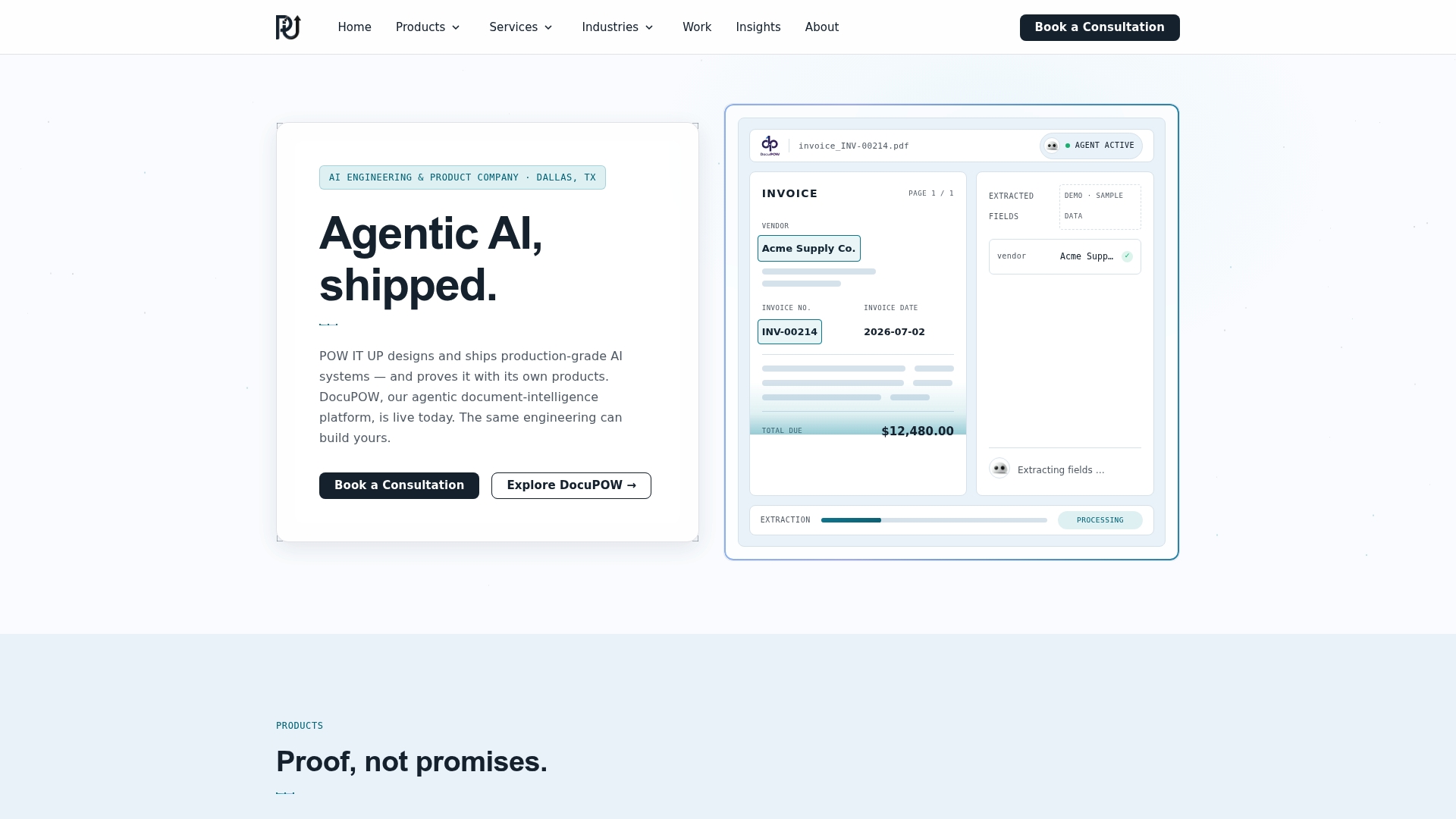
Our AI Agents Development service builds the custom, context-aware agents this article describes, with bounded authority and closure loops designed in from the first sprint. Our AI Integration work connects those agents to the transactional systems you already run, without a core-system rewrite. And DocuPOW, our document intelligence product, is a live example of the design principles in this article applied to document reading and validation.
A first engagement typically looks like:
- A discovery phase that scopes one high-volume process and checks whether your underlying data is ready to automate.
- A fixed-scope pilot with measurable KPIs agreed before any code ships.
- A clear path to Phase 2 platform work once the pilot proves the ROI case.
Start a conversation about your first pilot and see where the fastest time leak in your operation actually is.
FAQ
What is an intelligent business system?
An intelligent business system is a set of data pipelines, models, and agents designed to turn raw operational data into decisions and then act on those decisions with defined oversight. It differs from basic automation because it includes governance, monitoring, and a feedback loop that lets the system improve over time rather than running a fixed script.
What are the stages of business intelligence maturity?
Definitions vary across frameworks, but a common version moves from basic reporting (what happened) to analysis (why it happened) to monitoring (what’s happening now) to prediction (what will happen) to prescription (what should we do about it). Intelligent business systems aim for that last stage, where the system recommends or takes action rather than just displaying a dashboard.
What is a business intelligence system?
A business intelligence system collects, organizes, and analyzes business data to support decision-making, typically through dashboards and reports rather than autonomous action. An intelligent business system builds on that foundation by adding agents and automation that can act on the insight, under governed, bounded authority.
How long does it take to build a production-grade intelligent system?
Timelines vary by scope and data readiness, but a phased rollout typically moves from a 90-day pilot through platform foundation and productionization before scaling agentic capabilities across processes. The gating factor is usually data quality and governance readiness, not the model or agent technology itself.
Sources
- The State of AI: How organizations are rewiring to capture value (McKinsey)
- NIST AI Risk Management Framework (AI RMF)
- Operator-level autoscaling for generative model serving (arXiv)
- AI Operations Foundations: Building Scalable and Resilient AI Systems (EC-Council whitepaper)