

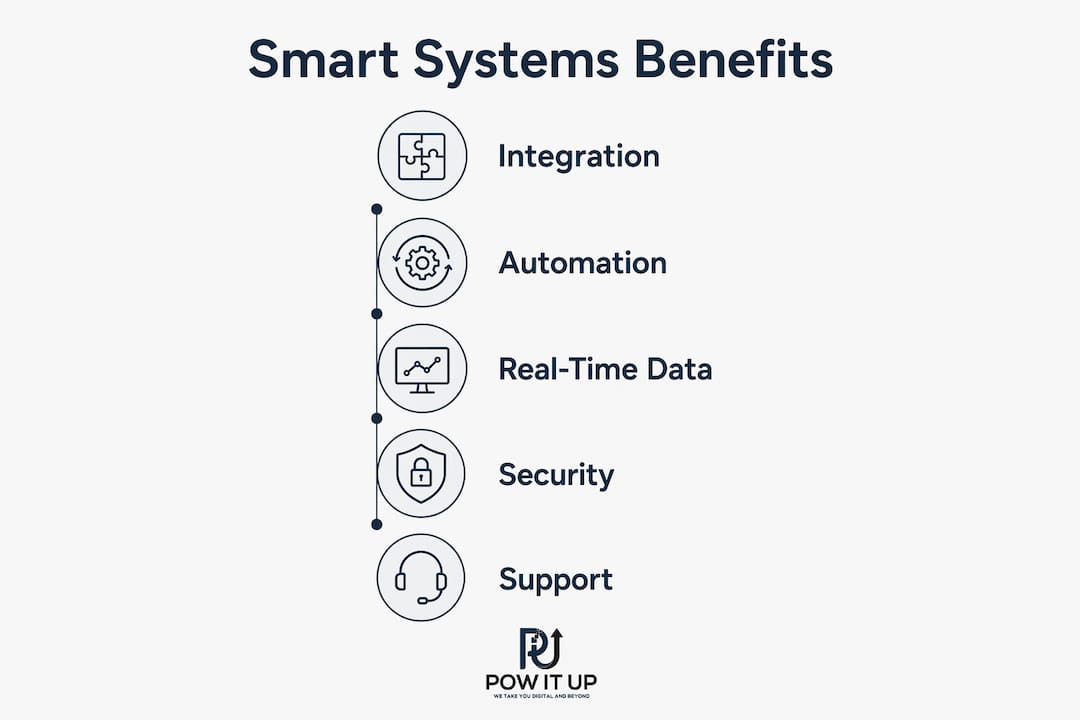
Smart Business Systems are integrated managed IT and business technology solutions that combine infrastructure support, workflow automation, real-time analytics, and secure connectivity into one coordinated platform. For business owners and managers evaluating these solutions, the core value is straightforward: fewer manual processes, better data visibility, and IT infrastructure that actually scales with your operation.
Here is what a well-built system typically covers:
- Managed IT infrastructure and cybersecurity to keep networks, endpoints, and data secure around the clock
- IoT-enabled data collection using sensors, RFID, and barcode scanning for real-time asset and operational visibility
- Workflow automation across HR, invoicing, order processing, and reporting to cut manual overhead
- Real-time analytics that feed decision-makers current data instead of yesterday’s reports
- Cloud platform integration with Microsoft 365 and Google Workspace as the productivity backbone
Solutions are sized to the business, not the other way around. A 12-person professional services firm and a 200-person distributor need very different configurations, and credible providers build around that reality from day one.
What do Smart Business Systems actually deliver?
The service scope goes well beyond basic IT support, as this technology and operations solutions approach incorporates managed IT and cybersecurity pillars for smart business systems. Managed IT providers in this space handle proactive monitoring, help desk response, patch management, and cybersecurity compliance as a baseline. From there, the stack expands based on what the business actually needs.

IIoT hardware like sensors, RFID readers, and barcode scanners feeds live data into the system, giving managers visibility into assets, inventory, and foot traffic without manual counts. That data only becomes useful when it is clean and consolidated. Without unified data sources, automation amplifies existing errors rather than fixing them, so data hygiene is a prerequisite, not an afterthought.

Workflow automation handles the repetitive work: payroll runs, invoice generation, order status updates, compliance reporting. Connecting ERP systems with inventory or field tracking can automate a significant portion of administrative overhead in midsize firms. Cloud deployment via Microsoft 365 or Google Workspace keeps those workflows accessible from any location, while on-premises options remain available for businesses with stricter data residency requirements.
SLAs define the support relationship. A credible provider commits to response times, uptime guarantees, and escalation paths in writing before the contract is signed.
Which technology partners should you expect to see?
The vendor ecosystem behind a Smart Business Systems provider tells you a lot about the quality of what you will actually receive. Microsoft 365 and Google Workspace sit at the center of most deployments because they handle email, file storage, collaboration, and identity management in one place.
- Microsoft 365 brings enterprise-grade security, compliance tooling, and deep integration with Windows environments. It suits businesses that need granular access controls and a mature compliance framework.
- Google Workspace offers a lighter administrative footprint and real-time collaboration that non-technical teams pick up quickly. Third-party app integration is a particular strength.
Beyond those two platforms, strong providers maintain relationships with cybersecurity vendors, telecommunications carriers, and cloud infrastructure partners. Those alliances affect how quickly security patches reach your environment and whether the provider can negotiate favorable support terms on your behalf. A provider with no named vendor partnerships is essentially a reseller with no leverage.
What do clients say about working with these providers?
Real client feedback from businesses that have adopted managed IT and integrated technology solutions points to a consistent pattern: the biggest gains come from customization and ongoing support, not the technology itself.
Clients also consistently highlight responsiveness. A provider that answers the phone when something breaks is worth more than one with a longer feature list and a slow ticket queue. The human-in-the-loop approach matters here too: businesses that avoided forcing their processes into rigid off-the-shelf workflows reported higher adoption and faster payback.
How do you choose a Smart Business Systems provider?
The selection process has a logical sequence, and skipping steps early tends to create expensive problems later.
- Start with a formal needs and site analysis. A credible provider conducts a detailed review of your existing IT, telecommunications, and printing environment before recommending anything. This step is non-negotiable.
- Evaluate service scope and customization depth. Can the provider configure the system around your actual workflows, or will you be bending your processes to fit their software?
- Check industry experience. A provider with a track record in your sector understands your compliance requirements and operational rhythms without a lengthy education period.
- Verify vendor partnerships. Named relationships with Microsoft, Google, or recognized cybersecurity vendors signal that the provider has access to current support and product roadmaps.
- Review SLA terms carefully. Response time commitments, uptime guarantees, and escalation procedures should be in writing before you sign.
- Understand the pricing model. Monthly managed service fees, project-based implementation costs, and annual maintenance agreements each carry different cash flow implications.
- Ask about open-architecture platforms. Avoid black-box implementations where your internal team cannot audit or modify the system.
Pro Tip: Request a written cost analysis from any provider before committing. Reputable firms identify your current cost patterns first, then show you where their solution reduces spend. If a provider skips that step, they are selling, not solving.
What are the core pillars driving adoption in the US market?
Smart operations management builds on four foundational pillars that US businesses are adopting at an accelerating pace. Understanding them helps you evaluate whether a proposed solution is genuinely comprehensive or just repackaged IT support.
- Managed IT infrastructure and cybersecurity form the base layer. Without a secure, monitored network, every other capability is exposed.
- IoT-enabled data collection via sensors and tracking devices gives operations teams real-time visibility they previously had to approximate from batch reports.
- Process automation targets low-value manual tasks first, freeing staff for work that actually requires judgment. Payroll, HR workflows, invoicing, and compliance reporting are the most common starting points.
- Real-time analytics close the loop. The sense-respond-decide-do framework describes how data from operations feeds into decisions and then back into automated actions, creating a continuous improvement cycle without constant human intervention.
AI-driven analytics extend this further by flagging anomalies before they become failures and surfacing patterns that manual review would miss. The prerequisite, again, is consolidated data. Fragmented sources produce unreliable outputs regardless of how sophisticated the analytics layer is. Back-office automation capabilities built on clean data consistently outperform those bolted onto messy legacy systems.
POWITUP offers a different path to the same goal
If the managed IT provider model feels like more infrastructure than your business needs right now, POWITUP takes a different approach to the same operational problems.
POWITUP designs and deploys custom AI agents that automate high-volume transactional work, the exact tasks that drain your team’s time without adding value. Instead of a broad managed IT contract, you get targeted AI automation built around your specific workflows. No unnecessary overhead, no paying for services you will not use. POWITUP’s AI integration services connect your existing tools and data sources, so you get the efficiency gains of a smart system without replacing infrastructure that already works.
FAQ
What are Smart Business Systems?
Smart Business Systems are integrated managed IT and business technology solutions combining infrastructure support, cybersecurity, workflow automation, and real-time analytics tailored to a business’s size and industry.
How long does implementation typically take?
Implementation timelines vary by scope. A cloud-based deployment using Microsoft 365 or Google Workspace can go live in weeks, while full on-premises integrations with IoT hardware typically take several months.
What is the most common pricing model?
Most providers charge a monthly managed service fee covering monitoring, support, and cybersecurity, plus separate project fees for initial implementation and hardware.
Why does data consolidation matter before automation?
Automation amplifies whatever data it receives. Fragmented or inaccurate data sources produce unreliable automated outputs, so consolidating and cleaning data before deployment is a prerequisite for accurate results.
Can POWITUP work alongside an existing managed IT provider?
Yes. POWITUP focuses on AI agent development and automation rather than infrastructure management, so its services complement rather than replace a traditional managed IT relationship.
Key Takeaways
Effective Smart Business Systems combine clean data, open-architecture platforms, and vendor-backed technology partnerships to deliver measurable operational gains without forcing businesses into rigid off-the-shelf workflows.
| Point | Details |
|---|---|
| Data hygiene first | Consolidated, clean data is the prerequisite for accurate automation and reliable analytics. |
| Four core pillars | Managed IT, IoT data collection, process automation, and real-time analytics form the foundation of any credible system. |
| Vendor partnerships matter | Named relationships with Microsoft 365, Google Workspace, and cybersecurity vendors signal solution quality and long-term support access. |
| Demand a formal needs analysis | Providers that skip a site and cost analysis before recommending solutions are selling, not solving. |
| POWITUP alternative | POWITUP builds custom AI agents targeting specific workflow inefficiencies, a focused alternative to broad managed IT contracts. |