

TL;DR:
- Effective workforce automation combines human judgment and machine efficiency by assigning tasks to the best-suited entity.
- Hybrid models that integrate displacement-driven and augmentation-led approaches provide organizational resilience and scalable growth.
The most effective workforce automation strategies don’t pick between humans and machines. They assign work to whoever handles it best. A 2025 executive roadmap from the California Management Review frames this as four distinct quadrants: Status Quo, Augmentation-led, Human-in-the-Loop, and Displacement-Driven. Each demands different investment priorities, different organizational design, and a different pace of adoption.
A digital workforce is not a team of remote employees. It’s software-based AI agents that perform tasks traditionally handled by people, combining RPA, machine learning, NLP, and AI to operate continuously at scale. The goal is to free human employees for work that requires empathy, judgment, and creativity.
Choosing the right quadrant depends on six factors:
- Control — how closely the business needs to manage people, processes, and outcomes
- Complexity — whether the work is rule-based, complicated, or judgment-heavy
- Speed — how fast capacity is needed versus how fast processes can be prepared
- Cost — fixed versus variable cost implications of each model
- Risk — what breaks when automation hits an exception or a process changes
- Accountability — who owns outcomes when things go wrong
Most organizations don’t live in one quadrant. For example, a bank might run Displacement-Driven automation for transaction processing while applying an Augmentation-led model for wealth management. That layered reality is where the real strategic work happens.

How to apply workforce automation frameworks that actually work
Leaders who treat automation options as interchangeable make the most expensive mistakes. The four quadrants aren’t just categories; they’re investment blueprints.
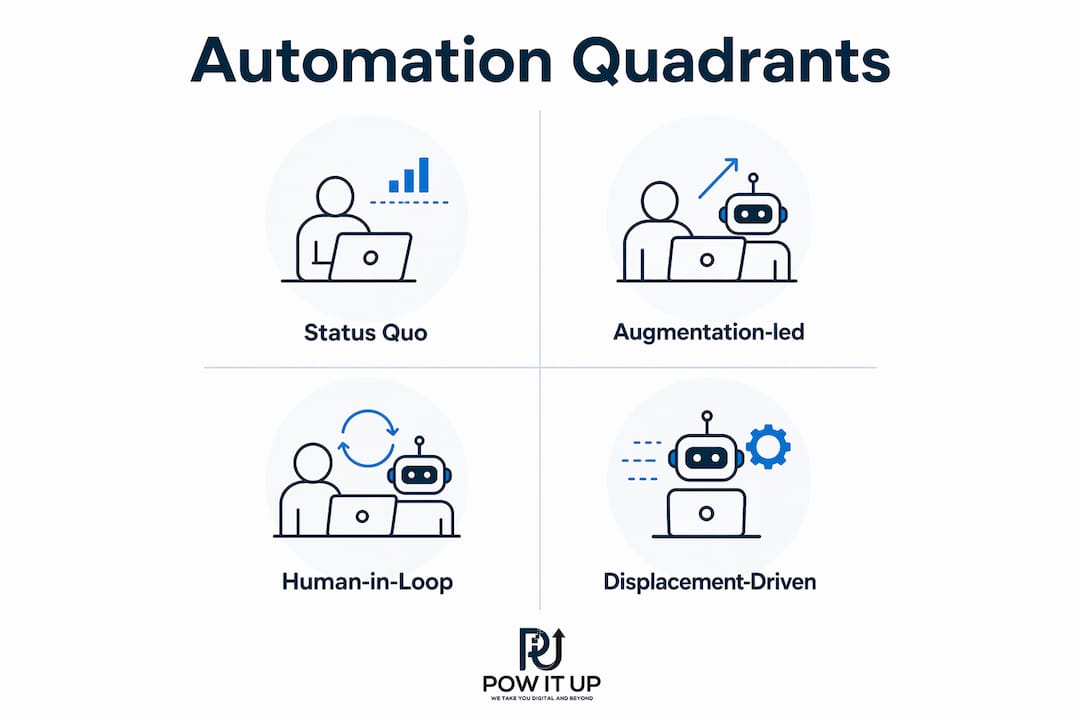
Status Quo applies when automation risk is low and augmentation potential is also low. The work doesn’t justify the disruption yet. Hold, monitor, and revisit when AI capabilities catch up to the task.
Augmentation-led fits high-complexity, judgment-heavy work where AI enhances rather than replaces. Think software developers using AI coding tools to offload syntax while retaining architecture decisions. Investment here goes into training, human-AI interface design, and workflow redesign.
Human-in-the-Loop covers processes where AI handles volume but humans review exceptions, approve outputs, or catch errors. This quadrant requires governance infrastructure: escalation paths, quality checkpoints, and clear accountability at every handoff.
Displacement-Driven targets high-volume, rules-based, repetitive work. Customs documentation, invoice processing, data entry. The EPOCH Methodology, developed at MIT, quantifies how human-intensive a task is across five dimensions: Empathy, Presence, Opinion, Creativity, and Hope. Tasks scoring near zero on the EPOCH index are prime displacement candidates.
| Quadrant | Best for | Key investment | Human role |
|---|---|---|---|
| Status Quo | Low automation risk, low augmentation potential | Monitoring and readiness | Full ownership |
| Augmentation-led | Complex, judgment-heavy work | Training, interface design | Leads with AI support |
| Human-in-the-Loop | Variable processes needing oversight | Governance, escalation paths | Reviews and approves |
| Displacement-Driven | Repetitive, rules-based, high-volume | Process cleanup, RPA + AI stack | Exception handling |
Before deploying any quadrant, clean the underlying process. Automation applied to inconsistent workflows doesn’t fix the problem; it accelerates it. Document the steps, eliminate redundancies, and define what an exception looks like before a single bot goes live.
Why hybrid automation models outperform single-mode approaches
No single quadrant covers an entire organization. The most resilient digital workforce solutions for sustainable growth combine displacement-driven automation for routine tasks with augmentation-led models for complex work.
Here’s how that split typically plays out in practice:
- Displacement candidates: data entry, invoice matching, compliance document processing, appointment scheduling, report generation
- Augmentation candidates: customer escalation handling, strategic analysis, creative content review, complex case management, client advisory work
The operational benefit of running both models simultaneously is resilience. When a process changes or an edge case appears, augmented human workers absorb the variation. Meanwhile, the displacement layer keeps high-volume transactional work moving without adding headcount.
Professional services firms adopting AI workflows in 2026 are finding that the firms gaining the most aren’t the ones automating the most. They’re the ones being deliberate about which work stays human.
Pro Tip: Map your task inventory against the EPOCH dimensions before committing to a quadrant. A task that looks like a displacement candidate because it’s repetitive may score high on Opinion or Creativity, making augmentation the smarter call.
Common hybrid adoption patterns worth knowing:
- Parallel deployment: run displacement automation in back-office functions while augmentation tools support front-office teams simultaneously
- Sequential layering: start with RPA for structured data tasks, then layer ML and NLP as process maturity increases
- Co-management overlay: place skilled human operators around AI-enabled workflows to handle exceptions, quality review, and escalation
How to evaluate and select the right automation strategy
The six decision factors (control, complexity, speed, cost, risk, accountability) aren’t a checklist. They’re a tension map. High control needs push toward internal hiring or co-management. High complexity pushes away from pure automation. Speed pressure can force a suboptimal choice if process readiness isn’t there yet.
Technology selection starts with process maturity. RPA handles simple, rule-based tasks reliably. A mature digital workforce combines RPA with AI, ML, and NLP to manage variable, decision-based work. Choosing RPA alone for complex workflows is one of the most common and costly mistakes in digital workforce automation for business leaders.
Change management is where most automation initiatives stall. The technology rarely fails. The adoption does. Effective change management for automation includes:
- Communicating the “why” before the “what” to affected teams
- Defining new human roles created by automation, not just roles eliminated
- Building feedback loops so frontline workers can flag process gaps early
- Tying KPIs to outcomes, not just activity metrics
Measuring ROI on automation requires more than tracking cost reduction. Useful KPIs include throughput per FTE, error rate before and after deployment, exception volume as a percentage of total transactions, and time-to-resolution on escalated cases.
Common pitfalls to avoid:
- Automating a broken process without fixing it first
- Skipping governance design and assuming the tool manages itself
- Treating RPA as a complete digital workforce strategy
- Underestimating the human oversight required in Human-in-the-Loop deployments
- Measuring success only in the first 90 days before the process stabilizes
Pro Tip: Set a 6-month post-deployment review as a hard calendar commitment before go-live. Automation performance drifts as processes evolve, and the review forces the governance conversation before a small exception becomes a systemic failure.
How POWITUP builds autonomous digital workforces for business expansion
POWITUP operates as a technical architect, not a tool vendor. The firm designs, builds, and deploys custom AI agents that function as autonomous digital employees, handling high-volume transactional operations while human teams stay focused on work that requires judgment.
The POWITUP approach addresses the gap most automation projects fall into: deploying technology without redesigning the workflow around it. POWITUP’s process starts with identifying operational “time leaks,” the repetitive handoffs, manual lookups, and approval bottlenecks that drain capacity without adding value. From there, the team designs a digital workforce architecture that layers RPA, AI, and NLP appropriately for each task type.
Key capabilities POWITUP brings to digital workforce automation:
- Context-aware AI agents that adapt to process variation without manual reprogramming
- Integration with existing systems, including legacy applications, without full infrastructure overhauls
- Continuous performance monitoring to catch drift before it compounds
- Governance frameworks that define escalation paths, exception handling, and human oversight checkpoints
For business leaders ready to move beyond basic automation, POWITUP’s AI integration services provide the architecture to scale processing volumes without scaling headcount. Whether the goal is back-office efficiency, customer-facing speed, or full digital workforce transformation, the work starts with a clear-eyed process audit, not a technology pitch.
Key Takeaways
Effective workforce automation strategies combine the right quadrant framework with clean processes, human oversight, and continuous governance to deliver durable operational gains.
| Point | Details |
|---|---|
| Four quadrants guide investment | Status Quo, Augmentation-led, Human-in-the-Loop, and Displacement-Driven each require distinct design and funding priorities. |
| Digital workforce vs. human roles | A digital workforce uses AI agents to handle tasks at scale, freeing humans for judgment-heavy and creative work. |
| Hybrid models outperform single-mode | Combining displacement automation with augmentation-led approaches builds resilience across varying task complexity. |
| Process quality determines automation success | Automating an inconsistent or poorly governed process accelerates inefficiencies rather than fixing them. |
| ROI requires the right KPIs | Measure throughput per FTE, error rates, exception volume, and time-to-resolution, not just cost reduction. |
FAQ
What are the four quadrants of workforce automation strategies?
The four quadrants are Status Quo, Augmentation-led, Human-in-the-Loop, and Displacement-Driven. Each reflects a different combination of automation risk and augmentation potential, requiring distinct investment priorities and organizational design.
What is a digital workforce?
A digital workforce consists of software-based AI agents that perform tasks traditionally handled by people, combining RPA, AI, ML, and NLP to operate continuously and handle both structured and complex work.
When should you automate versus augment?
Automate repetitive, rules-based, high-volume tasks with low EPOCH scores. Apply augmentation where work requires empathy, judgment, creativity, or contextual decision-making that AI cannot reliably replicate.
What causes most automation initiatives to fail?
The most common cause is automating a process that isn’t clean or well-governed. Technology accelerates whatever the process already does, including its flaws. Human-led workflow design and exception management are prerequisites, not afterthoughts.
How do you measure ROI on workforce automation?
Track throughput per FTE, error rates before and after deployment, exception volume as a percentage of total transactions, and time-to-resolution on escalated cases. Cost reduction alone understates the full return.