
TL;DR:
- Business systems integration connects applications and data sources to enable real-time sharing and automation. It significantly improves AI ROI and operational accuracy by eliminating manual data entry and disconnected workflows. Continuous governance and phased deployment are crucial for successful, scalable integration efforts.
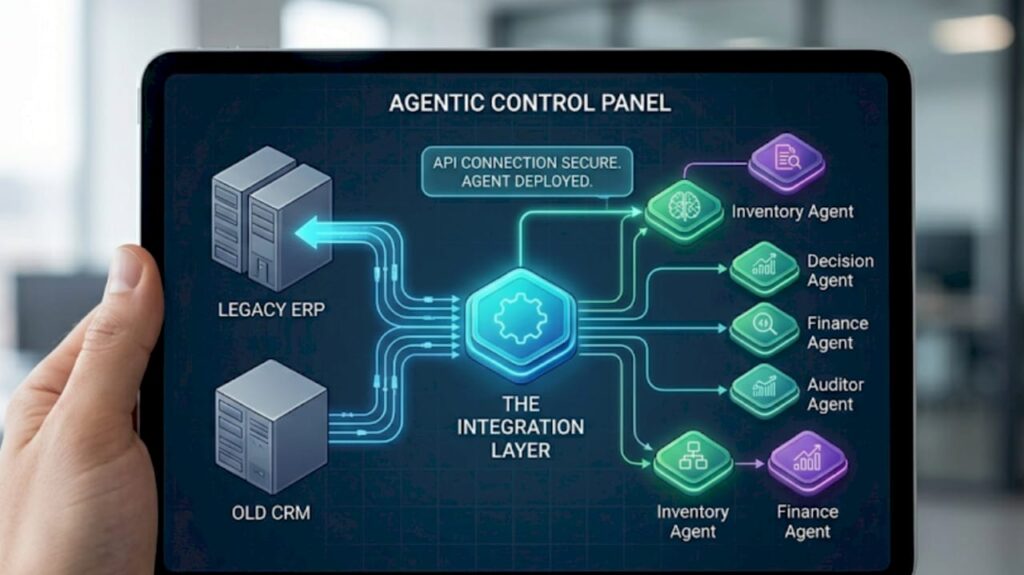
Business systems integration is the process of connecting an organization’s separate applications, data sources, and workflows into a unified system that supports real-time data sharing, operational visibility, and automation. For business leaders, it is the operational backbone that makes AI investments pay off and digital transformation possible. 83% of organizations rank enterprise integration among their top five business priorities for the next two years. That number signals a clear shift: integration is no longer an IT concern. It is a boardroom decision.
What is business systems integration and why does it matter?
Business systems integration connects tools like ERP, CRM, HRIS, and e-commerce platforms so they share data automatically, without manual entry or reconciliation. The alternative is a collection of disconnected systems that each hold a partial view of the business. That fragmentation costs real money. Government evidence reviews confirm that integration removes manual entry errors and delivers real-time financial accuracy by connecting e-commerce, banking, and accounting software automatically. The implication is direct: every manual data transfer your team performs is a cost that integration eliminates.

The business case goes beyond error reduction. Companies with tight system integration generate 3.7x the ROI on AI investments and reach value realization in 13 months, while non-integrated organizations see no enterprise-wide financial ROI from AI at all. That gap is not a technology problem. It is an architecture problem. When your systems do not share data, your AI models work with incomplete information and produce unreliable outputs.
What are the key types and architectural patterns in enterprise system integration?
Integration architecture determines how your systems connect, how much that connection costs to maintain, and how well it scales. The four main patterns each carry distinct trade-offs.
-
Vertical integration connects systems within a single business function, such as linking a warehouse management system directly to an ERP. It is fast to implement but creates isolated stacks that do not communicate across departments.
-
Horizontal integration uses a shared middleware layer, often called an Enterprise Service Bus (ESB), to connect multiple systems through one central point. It scales better than vertical but can become a bottleneck.
-
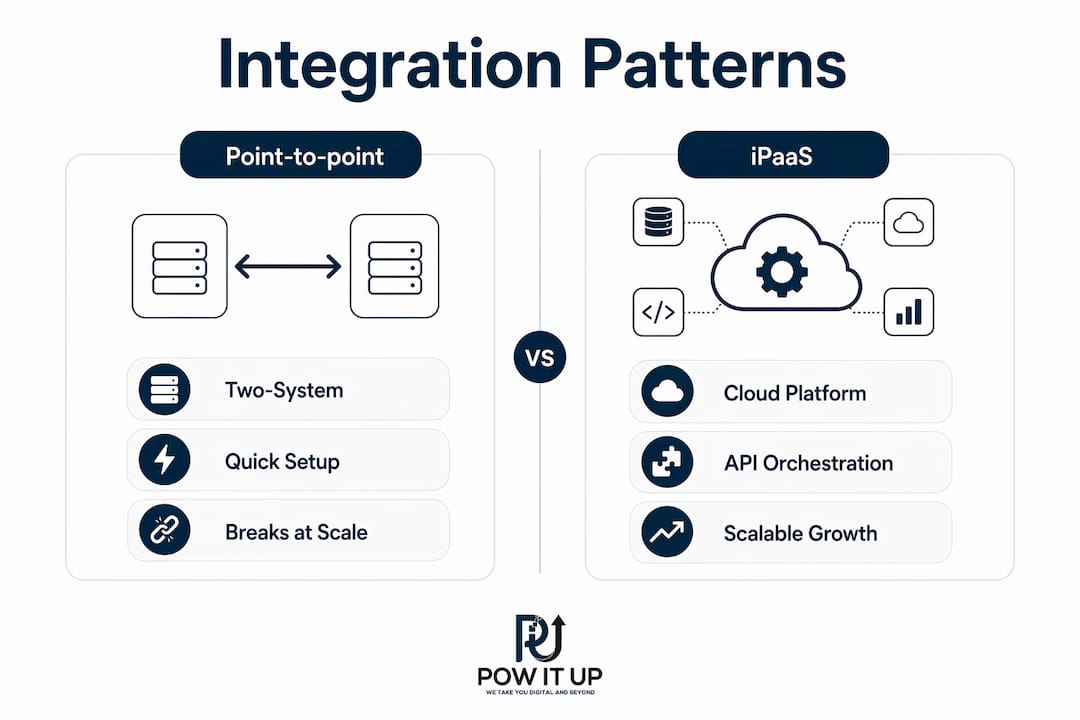
Star (point-to-point) integration connects each system directly to every other system it needs to communicate with. Point-to-point integration creates brittle and costly connections that break when any one system changes. Organizations with more than five connected systems find this pattern unmanageable.
-
API-led and event-driven integration uses published APIs and real-time event streams to connect systems through reusable, governed interfaces. This is the pattern that scales.
iPaaS: the modern integration backbone
Integration Platform as a Service (iPaaS) sits above your existing systems and orchestrates connections through APIs without requiring you to replace core applications. The global iPaaS market is projected to reach $71.35 billion by 2030, growing at a compound annual growth rate of 32.3%. That growth rate reflects how quickly enterprises are abandoning custom-coded point-to-point connections in favor of managed, reusable integration layers.
| Pattern | Best for | Main risk |
|---|---|---|
| Point-to-point | Two-system pilots | Breaks at scale |
| Vertical | Single-function teams | Creates data silos |
| Horizontal (ESB) | Mid-size enterprises | Central bottleneck |
| API-led / iPaaS | Enterprise-wide scale | Governance discipline required |
Pro Tip: Before selecting an integration architecture, count the number of systems you need to connect. Fewer than five systems can tolerate horizontal integration. More than five systems almost always require an API-led or iPaaS approach to stay maintainable.
How does integration support AI, automation, and business process orchestration?
AI does not work well on isolated data. Bolting AI onto disconnected, siloed systems leads to unreliable insights and failed AI initiatives. Integration creates the unified data flow that AI models require to produce accurate, trustworthy outputs. Without it, your AI investment produces noise instead of signal.
Business process automation (BPA) orchestrates workflows across multiple systems by combining rule-based steps, AI decisions, and human approvals on one platform. It removes the manual integration layers that slow operations down. A practical example: an employee onboarding workflow that automatically provisions accounts in Active Directory, assigns training in an LMS, and notifies payroll in an HRIS, all triggered by a single HR system event. No human touches the process between trigger and completion.
AI-driven integration capabilities now include automated data mapping, anomaly detection, predictive maintenance, and natural language integration design. These capabilities make integration faster to build and more reliable to operate, reducing the specialist knowledge required to maintain complex enterprise connections.
Business leaders must distinguish between two different uses of AI in integrated workflows. Harvard Business School research defines this clearly: automate high-frequency, low-value tasks, but augment high-value tasks with human judgment. A claims processing system should automate document intake and data extraction. The final coverage decision should surface to a human with full context. Integration makes both possible by routing data to the right place at the right time.
-
Automation use cases: invoice processing, order routing, compliance reporting, data synchronization
-
Augmentation use cases: customer escalation routing, contract review, financial forecasting, risk assessment
Pro Tip: Map your workflows before selecting automation tools. Identify which steps require human judgment and which are purely rule-based. Automating a step that needs judgment creates liability. Augmenting a step that is purely rule-based wastes human capacity.
You can review automation tools for service businesses to see how these patterns apply across different operational contexts.
What strategic steps should leaders take to implement systems integration?
Effective integration starts with business outcomes, not technology selection. Leaders who begin by choosing a platform before defining objectives end up with a technically functional integration that solves the wrong problem.
-
Define outcomes and KPIs first. Specify what you want integration to change. Examples: reduce order-to-cash cycle time by 30%, eliminate manual reconciliation between ERP and CRM, or enable real-time inventory visibility across three warehouses.
-
Map your current system landscape. List every application in use, what data it holds, and where data currently moves manually. This map reveals your actual integration debt, not the theoretical one.
-
Identify and prioritize data silos. Not all silos carry equal cost. Prioritize the connections that block the highest-value workflows first. A disconnected sales and finance system costs more than a disconnected HR and facilities system in most organizations.
-
Choose your architecture based on scale and flexibility requirements. Use the pattern comparison above. If you anticipate adding systems over the next three years, build for API-led connectivity from the start.
-
Implement governance and monitoring from day one. Treating integration as an ongoing operational capability rather than a one-time project prevents the silent friction of manual reconciliation and delayed reporting. Assign ownership of each integration, define SLAs, and monitor data flows continuously.
-
Deploy in phases. Start with the two or three highest-value connections. Prove ROI, refine governance, then expand. Organizations that attempt full-enterprise integration in a single phase consistently underestimate complexity and overrun budgets.
Pro Tip: Assign a business owner, not just a technical owner, to each integration. When a data flow breaks, the business owner feels it first. That accountability drives faster resolution and better prioritization.
The most effective integration strategies use an orchestration layer above existing systems via APIs rather than replacing those systems. This approach minimizes risk and preserves the institutional knowledge embedded in your current platforms. For leaders exploring AI-enabled integration services, this architecture-first mindset is the starting point.
What common pitfalls should organizations avoid during integration projects?
Integration projects fail more often from organizational and architectural mistakes than from technology failures. Knowing the patterns helps you avoid them.
-
Underestimating point-to-point debt. Every direct system-to-system connection you build today becomes a maintenance liability tomorrow. Ten systems connected point-to-point require up to 45 individual connections. Each one breaks independently when either system updates.
-
Treating integration as a one-time project. Systems change, APIs deprecate, and business requirements evolve. An integration built and forgotten becomes a source of silent errors within 18 months in most enterprise environments.
-
Ignoring hidden reconciliation costs. Manual reconciliation between disconnected systems is rarely tracked as an integration cost, but it consumes significant analyst and finance team time. Poor integration creates silent friction through manual reconciliation and delayed reporting that rarely appears on a project budget but consistently appears on a payroll.
-
Vendor lock-in through proprietary connectors. Some platforms offer pre-built connectors that only work within their ecosystem. When you need to switch or add a system outside that ecosystem, you rebuild from scratch. Prefer open API standards over proprietary connector libraries.
-
Skipping data quality work. Connecting systems that hold inconsistent or duplicate data spreads that inconsistency at scale. Clean your master data before you integrate, not after.
Automation-driven marketing workflows face the same integration risks. B2B marketing automation built on disconnected CRM and campaign tools produces the same data inconsistency problems as any other siloed enterprise stack.
Key Takeaways
Effective business systems integration requires an API-led architecture, phased deployment, and continuous governance to deliver measurable ROI on AI and automation investments.
| Point | Details |
|---|---|
| Integration drives AI ROI | Tightly integrated companies generate 3.7x the ROI on AI investments compared to non-integrated organizations. |
| iPaaS is the preferred architecture | API-led and iPaaS platforms replace brittle point-to-point connections with governed, reusable integrations that scale. |
| BPA orchestrates end-to-end workflows | Business process automation combines rule-based steps, AI decisions, and human approvals across connected systems. |
| Governance must be continuous | Treating integration as a one-time project leads to silent data errors, manual reconciliation, and delayed reporting. |
| Start with outcomes, not tools | Define KPIs and map existing data flows before selecting any integration platform or architecture. |
Why integration is the decision that determines everything else
I have worked with business leaders who spent months evaluating AI platforms, only to discover their data was too fragmented for any AI model to produce reliable outputs. The technology was not the problem. The integration foundation was missing.
The uncomfortable truth about enterprise digital transformation is that most AI and automation failures are integration failures in disguise. When a predictive analytics tool produces inaccurate forecasts, the root cause is almost always inconsistent data flowing from disconnected source systems. When a workflow automation breaks, it is usually because a system update changed an API endpoint that no one was monitoring.
What I have seen work consistently is treating integration as a core operational discipline, not a project with a start and end date. The organizations that get the most from their technology investments are the ones that assign business owners to data flows, monitor integration health the same way they monitor uptime, and build on open API standards from the beginning. They also resist the temptation to connect everything at once. Phased integration with clear KPIs at each stage produces better outcomes than big-bang deployments every time.
The shift from patchwork connections to a unified integration layer is not a technical upgrade. It is an organizational commitment to treating data as a shared asset. Leaders who make that commitment early find that every subsequent technology investment, whether AI, automation, or analytics, delivers faster and at lower cost.
— Sameer Abbas
How POWITUP approaches AI integration for enterprise leaders
Business leaders who have mapped their integration gaps and defined their automation objectives need a partner who builds for scale, not just for the immediate connection.
POWITUP designs and deploys custom AI integration architectures that connect your existing systems through governed API layers, then builds autonomous AI agents on top of those connections to automate high-volume operations. The firm’s approach targets the operational time leaks that cost enterprises the most: manual reconciliation, disconnected reporting, and workflow hand-offs that require human intervention. For leaders ready to move from integration planning to execution, POWITUP’s AI integration services cover the full scope from architecture design through deployment and ongoing governance. The goal is a system that scales processing volume without scaling headcount.
FAQ
What is business systems integration?
Business systems integration is the process of connecting separate enterprise applications, data sources, and workflows so they share data automatically and support real-time operational visibility.
How does integration affect AI investment returns?
Companies with tight system integration generate 3.7x the ROI on AI investments compared to organizations with disconnected systems, reaching value realization in approximately 13 months.
What is iPaaS and why do enterprises use it?
iPaaS (Integration Platform as a Service) is a cloud-based platform that connects enterprise systems through governed APIs without replacing existing applications. The global iPaaS market is projected to reach $71.35 billion by 2030.
What is the biggest risk in enterprise integration projects?
The biggest risk is treating integration as a one-time project rather than a continuous operational capability. Systems change, APIs deprecate, and ungoverned integrations create silent data errors within months.
How does business process automation relate to integration?
Business process automation uses integration as its foundation, orchestrating workflows across connected systems by combining rule-based steps, AI decisions, and human approvals on a single platform.