

TL;DR:
- AI in contract management automates tasks like drafting, review, and compliance monitoring across the entire contract lifecycle. It reduces cycle times by over a third and decreases errors by up to 32 percent, although human oversight remains essential. Firms that implement governance structures and connect AI outputs to decision points see the greatest optimization and organizational impact.
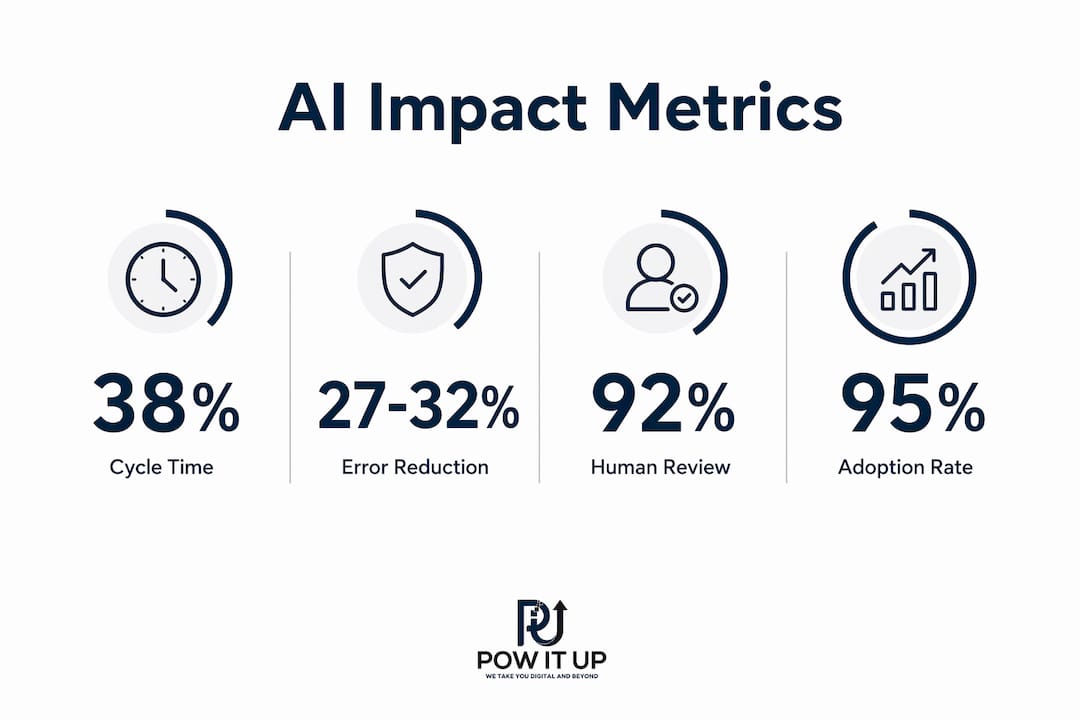
AI in contract management is defined as the application of natural language processing, machine learning, and generative AI to automate, analyze, and govern contracts across their full lifecycle. The role of AI in contract management goes far beyond basic document storage. It now covers drafting, risk detection, compliance monitoring, and rate validation at a scale no manual process can match. Platforms like Conga CLM and Oracle CPQ extensions already embed these capabilities into enterprise workflows. Yet 95% of organizations use AI in contract lifecycle management while only 24% consider their systems fully optimized. That gap is where the real competitive opportunity lives.
How does AI automate and accelerate core contract management tasks?
AI compresses the contract lifecycle by handling the tasks that consume the most attorney and operations time. Natural language processing reads clause libraries, flags deviations from standard playbooks, and suggests approved language in seconds. Generative AI drafts first-pass agreements from templates, reducing the blank-page problem that slows every deal kick-off.

The performance data is concrete. Generative AI and semantic matching can reduce total deal cycle time by 38.2% and cut contract errors by 27–32%, with 92.1% compliance detection accuracy. A 38% reduction in cycle time means deals that took six weeks now close in under four. That is not a marginal gain. It is a structural change in how fast revenue moves.
AI also handles the post-signature work that most teams neglect:
- Obligation tracking: AI monitors delivery milestones, payment triggers, and renewal windows without manual calendar entries.
- Compliance monitoring: The system flags clauses that conflict with updated regulations, such as GDPR or HIPAA requirements, before they become violations.
- Redline automation: AI identifies recurring bottleneck clauses across hundreds of contracts and surfaces them for legal review, as noted in AI contract negotiation practice.
- Audit trail generation: Every change, approval, and version is logged automatically, which reduces discovery costs in disputes.
Pro Tip: Set AI to flag any clause that deviates more than 15% from your standard playbook language. This single rule catches most high-risk redlines before they reach senior counsel.
The efficiency gains from automating contract review compound over time. Each contract the AI processes adds to its training data, making future reviews faster and more accurate.
What are the main challenges and risks of integrating AI in contracts?
AI in legal agreements does not eliminate human judgment. It redistributes it. The most cited barrier to scaling AI in contract management is trust, and the numbers support that concern. 92% of CLM professionals still require human review of AI outputs. That figure tells you that AI is a first-pass tool, not a final authority.
The risks that trip up firms most often are not technical failures. They are process failures:
- Version chaos: When multiple AI tools generate drafts simultaneously without a single source of truth, teams end up negotiating against their own outdated versions.
- Playbook creep: AI trained on legacy contracts can normalize non-standard clauses over time, gradually shifting your standard terms in the wrong direction.
- Strategic misalignment: A contract can be technically compliant but commercially wrong. Over-reliance on AI creates this risk when legal teams lose final approval authority.
- Regulatory exposure: GDPR and HIPAA impose strict rules on how contract data is processed and stored. AI tools that handle personal data in contracts must meet these standards or create liability.
“The question is not whether AI can review a contract faster than a lawyer. It can. The question is whether the organization has the governance structure to act on what AI finds.” — AI-driven contract risk and compliance research
Governance is to unlock. Firms that scale AI successfully treat it as a workflow layer with defined human checkpoints, not as an autonomous decision-maker. Why service firms standardize with AI shows that the firms closing the optimization gap are the ones that built governance before they scaled adoption.
How does AI transform contract rate validation beyond ERP systems?
The role of AI in contract rate validation is one of the least discussed but most financially significant applications in the field. ERP systems like SAP and Oracle confirm that a transaction followed the correct process. They do not confirm that the transaction honored the actual contract terms. That distinction costs organizations real money.
AI bridges this gap by extracting contract logic embedded in unstructured text and applying it to transaction-level data. A vendor invoice might pass every ERP validation check and still overbill by 8% because the ERP never read the escalation cap buried in clause 14.3 of the master service agreement.
Here is how AI-driven rate validation works in practice:
- Contract ingestion: AI reads the full contract, including exhibits, amendments, and rate cards, and converts unstructured terms into structured validation rules.
- Transaction matching: Every invoice or billing event is matched against the extracted contract logic, not just the ERP master data.
- Discrepancy flagging: The system surfaces billing errors, unauthorized rate increases, and missed volume discounts automatically.
- Audit documentation: Each flagged item is linked to the specific contract clause that was violated, giving your team a ready-made recovery case.
Pro Tip: Run AI rate validation retroactively on your top 20 vendor contracts from the past 24 months. Most organizations find billing discrepancies in the first pass that exceed the cost of the AI tool itself.
The impact on financial accuracy is direct. ERP systems confirm process correctness but fail to detect contract logic non-compliance. AI closes that gap by reading what the contract actually says and holding every transaction to that standard.
What steps should business leaders take to optimize AI in contract management?
Most organizations treat AI as a speed tool. The leaders who get the most value treat it as a business intelligence layer. AI identifies systemic portfolio risks across hundreds of contracts simultaneously, which no manual review process can replicate. That shift from reactive to proactive is the real competitive advantage.
These are the steps that separate optimized programs from stalled pilots:
- Audit your current contract data quality first. AI performs poorly on incomplete or inconsistently formatted contracts. Clean your repository before you deploy any model.
- Choose the right AI type for your context. 52% of legal teams adopt AI because it is built into their existing software, and 47% cite workflow alignment as the deciding factor. Legal-specific AI tools outperform general-purpose tools for compliance and ethics requirements.
- Build governance before you scale. Define which decisions AI can make autonomously, which require human review, and which require senior approval. Document this in a policy, not a slide deck.
- Integrate with existing workflows. AI that sits outside your CRM, ERP, or matter management system creates more work, not less. The goal is intelligent contract workflows that connect contract data to business decisions in real time.
- Monitor for playbook drift continuously. Run quarterly audits comparing AI-generated contract language against your approved standards. Drift compounds quietly.
| Approach | Manual Process | AI-Enabled Process |
|---|---|---|
| Contract review time | Days to weeks | Hours to one day |
| Error detection rate | Inconsistent, reviewer-dependent | 92.1% compliance detection accuracy |
| Rate validation | ERP process check only | Full contract logic extraction |
| Portfolio risk visibility | Reactive, deal-by-deal | Proactive, portfolio-wide |
| Obligation tracking | Manual calendar entries | Automated monitoring with alerts |
The benefits of AI in contracts compound when you connect contract intelligence to the rest of your business data. A contract that flags a renewal risk should trigger a CRM alert, not just an email to legal.
Key Takeaways
AI in contract management delivers the greatest value when governance, human oversight, and the right technology selection work together rather than separately.
| Point | Details |
|---|---|
| Adoption vs. optimization gap | 95% of organizations use AI in CLM, but only 24% consider their systems fully optimized. |
| Cycle time and accuracy gains | AI reduces deal cycle time by 38.2% and cuts contract errors by 27–32% with 92.1% compliance detection. |
| Human oversight is non-negotiable | 92% of CLM professionals still require human review of AI outputs before final approval. |
| ERP alone is not enough | AI extracts contract logic from unstructured text to catch billing errors that ERP systems miss entirely. |
| Governance drives scale | Firms that define human checkpoints before scaling AI consistently outperform those that do not. |
The optimization gap is the real story
The statistic that stays with me is not the 95% adoption rate. It is the 24% optimization rate. Every organization I have worked with has some form of AI touching their contracts. Almost none of them have built the governance layer that makes it actually work.
The mistake I see most often is treating AI as a replacement for legal judgment rather than a force multiplier for it. When a firm automates contract review without defining what happens after the AI flags something, the flag becomes noise. The team learns to ignore it. The tool becomes shelfware with a subscription fee.
The firms that get this right do something counterintuitive. They slow down at the governance stage. They map every AI output to a human decision point. They ask: who acts on this, in what timeframe, and with what authority? That discipline is what separates a 24% optimization rate from a 70% one.
AI is also not just a legal tool anymore. The rate validation use case alone makes it a finance and procurement tool. The portfolio risk analysis capability makes it a strategic planning tool. Contract managers who position themselves as the owners of that intelligence layer will have more organizational influence in the next three years than they have had in the last ten.
My recommendation to any business leader reading this: stop measuring AI success by how many contracts it touches. Start measuring it by how many decisions it improves.
— Sameer Abbas
How POWITUP helps you close the AI optimization gap
Contract teams that have adopted AI but not yet optimized it shares a common problem. They have the technology but not the architecture to make it work at scale.
POWITUP designs and deploys custom AI integration systems built specifically for high-volume contract and compliance workflows. Rather than adding another tool to your stack, POWITUP builds context-aware AI agents that connect contract intelligence to your existing ERP, CRM, and matter management systems. The result is a fully integrated AI system that catches billing errors, monitors obligations, and surfaces portfolio risks without adding headcount. Business leaders and contract managers working in legal, professional services, and procurement can explore AI integration services for business leaders to see how a structured deployment closes the gap between adoption and real optimization.
FAQ
What is the role of AI in contract management?
AI in contract management automates drafting, review, compliance monitoring, and rate validation across the full contract lifecycle. It uses natural language processing and machine learning to reduce errors, cut cycle times, and surface portfolio-wide risks that manual review misses.
How much can AI reduce contract errors and cycle time?
AI combined with semantic matching reduces deal cycle time by 38.2% and cuts contract errors by 27–32%, with 92.1% compliance detection accuracy, according to published research on AI-driven contract risk frameworks.
Do legal teams still need to review AI contract outputs?
Yes. 92% of CLM professionals still require human review of AI outputs. AI handles first-pass analysis and flags issues, but final approval and strategic judgment remain with legal and contract management teams.
How is AI different from ERP for contract rate validation?
ERP systems verify that a transaction followed the correct process. AI extracts the actual contract logic from unstructured text and validates every transaction against the specific terms, rates, and escalation clauses in the signed agreement.
Should firms use general-purpose or legal-specific AI tools?
Legal-specific AI tools are the better choice for most contract teams. 52% of legal professionals adopt AI because it is embedded in their existing software, and 47% cite workflow alignment as the key reason, making legal-specific tools more practical and compliant than general-purpose alternatives.